
















|
Listen to article
|
Former Vice President Atiku Abubakar has described the ruling All Progressives Congress, APC, as “a party of forgers and riggers,” accusing the party of undermining democratic processes in Nigeria.
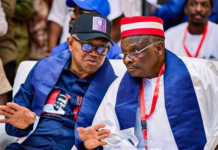
Atiku spoke in Minna after a closed-door meeting with former Military President, Gen. Ibrahim Badamasi Babangida (rtd.), at the IBB residence.
The meeting lasted nearly two hours, during which journalists and supporters waited outside the compound.
Reacting to the tax reforms proposed and gazetted by the administration of President Bola Ahmed Tinubu, Atiku said Nigerians should not be surprised by the actions of the ruling party.
“What do you expect? APC generally is a party of forgers and riggers. They forge everything, certificates, age limits, they forge everything. That is the hallmark of APC,” he insisted.
The former Vice President also criticised the outcome of the Senate’s emergency plenary on electoral reforms, describing the decision on result transmission as disappointing.
“First and foremost, it is below the expectation of Nigerians, because Nigerians were expecting real-time transmission of election results at the various levels.
“What we got instead is a mixture of electronic and manual transmission, which is going to cause more confusion and chaos than if we had a single-tier electronic transmission of results,” he said.
Atiku urged political parties to unite in pushing for credible reforms.
“We must come together to pursue this issue. We shouldn’t allow it to rest where they want it to rest. Absolutely not. I don’t support that,” he added.
On whether he would contest the 2027 presidential election, Atiku said the issue is not under consideration at the moment, noting that he is now a member of the African Democratic Congress (ADC).
“The question of contesting the 2027 election does not even arise. I am a member of ADC and we are busy ensuring our structures are firmly rooted at ward, local, state, and national levels,” he said.
The former Vice President also stated that the party is focused on mobilisation and registration of members nationwide.
Atiku further said the ADC does not operate zoning in its constitution, noting that zoning is formally entrenched only in the Peoples Democratic Party (PDP).
Read Also: Senate President Explains Stance On Digital Vote Transmission
Meanwhile, Oyo State Governor, Seyi Makinde, also held a separate closed-door meeting with Babangida at the residence but declined to speak with journalists afterward.
Nigeria’s Senate reversed itself Tuesday on a controversial decision that had sparked nationwide protests, voting to permit electronic transmission of election results after initially rejecting the provision last week, though the revised amendment stops short of making the technology mandatory and includes fallback provisions that critics say preserve loopholes for manipulation.
The upper chamber rescinded its February 4 decision during a rowdy emergency session marked by procedural confusion, shouting matches between lawmakers, and brief threats of an individual vote that could have derailed the reversal. Senate Chief Whip Tahir Monguno moved the motion citing “fresh issues” that emerged from closer scrutiny of the bill and overwhelming public backlash against the chamber’s original position, which had retained discretionary “transfer” language instead of requiring real-time electronic “transmission” of polling unit results to the Independent National Electoral Commission’s Result Viewing portal.
“This amendment is to bring our laws to make it a replica of the wishes and aspirations of the people,” Monguno said.
Minority Leader Abba Moro seconded the motion, describing the development as “the beauty of democracy” and noting that lawmakers must retain courage to correct themselves when necessary. Senate President Godswill Akpabio put the motion to a voice vote, which passed with majority support despite audible dissent from some corners of the chamber. The reversal came exactly one week after the Senate had passed the Electoral Act Amendment Bill rejecting mandatory real-time electronic transmission—a decision that triggered protests at the National Assembly gates Monday, condemnation from the Nigeria Labour Congress threatening election boycotts, and accusations from opposition parties and civil society that lawmakers were deliberately creating conditions for electoral fraud ahead of 2027 voting.
Under the revised provision approved Tuesday, presiding officers at polling units shall electronically transmit results to INEC’s portal after completing and signing Form EC8A, the official tally sheet countersigned by party agents. However, the amendment includes a critical caveat: where electronic transmission fails due to network or communication challenges, the manually completed and signed EC8A form will serve as the primary source for result collation and declaration. Critics immediately seized on this language, arguing it provides INEC with the same discretion to avoid electronic transmission that plagued the disputed 2023 presidential election, when the commission failed to upload results as anticipated despite spending billions of naira on the technology and promising voters it would function seamlessly. The provision does not make electronic transmission mandatory in the sense of requiring it under all circumstances or imposing penalties for non-compliance. Instead, it establishes electronic transmission as the default method while explicitly authorizing manual processes when technical problems occur, a framework opposition figures and electoral reform advocates say leaves room for the same failures and manipulation that have undermined confidence in Nigerian elections for decades.