
















|
Listen to article
|
Fact-Check 75 — The Bridge Between Optics and Reality
The Bridge Between Illusion and Power
On a humid January morning in 2024, Governor Hope Uzodinma stood before cameras, flanked by aides and party loyalists, to commission what he called “the South-East’s longest flyover.” The crowd roared. Drone cameras swept over polished asphalt. Banners declared “Modern Imo Rising.”
But the spectacle ended where the bridge did—too soon.
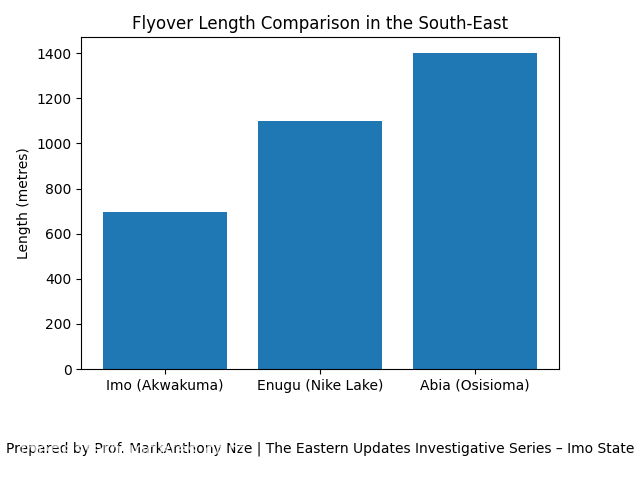
What had been sold as a regional landmark was, by every professional measure, an ordinary overpass repackaged as a miracle of modernity. Engineers who later surveyed the project found that the flyover spanned just 694.8 meters—a distance dwarfed by Enugu’s Nike Lake Bypass (1.1 km) and Abia’s Osisioma Interchange (1.4 km).
The governor’s boast, repeated across media headlines, was not an achievement. It was architecture rewritten as propaganda.
A Structure Built on Hype
Documents from the Imo State Ministry of Works reveal that the project, initially designed as a two-lane, multi-span interchange, was scaled down during execution “for budgetary alignment.” The Council for the Regulation of Engineering in Nigeria (COREN) noted in its 2024 compliance review that both span and elevation were reduced, drainage omitted, and design revisions approved without corresponding cost adjustments.
In essence, the flyover shrank, but the budget did not.
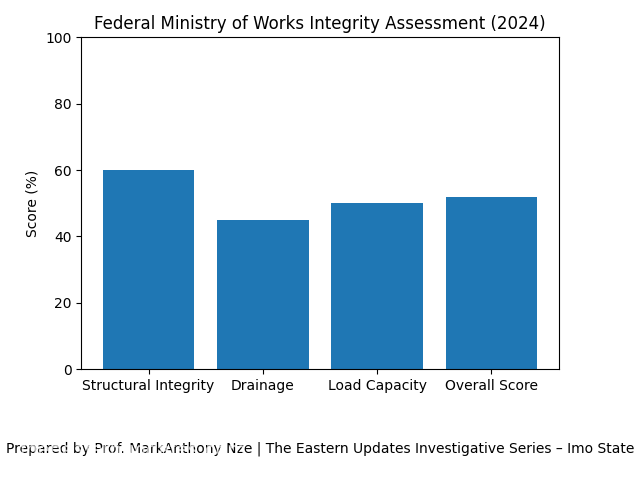
A Federal Ministry of Works inspection placed the project’s integrity score at 52 percent, warning that “excessive subgrade water retention may cause structural fatigue.” Already, within its first year, the asphalt has begun to blister after heavy rainfall. Beneath its glossy surface lies a case study in cost-cutting disguised as competence.
Residents near Akwakuma speak of floods that pool under the bridge after every downpour. One trader, standing beside a submerged culvert, summed it up bitterly: “They built us a bridge that leads from promise to puddles.”
Where the Money Went Missing
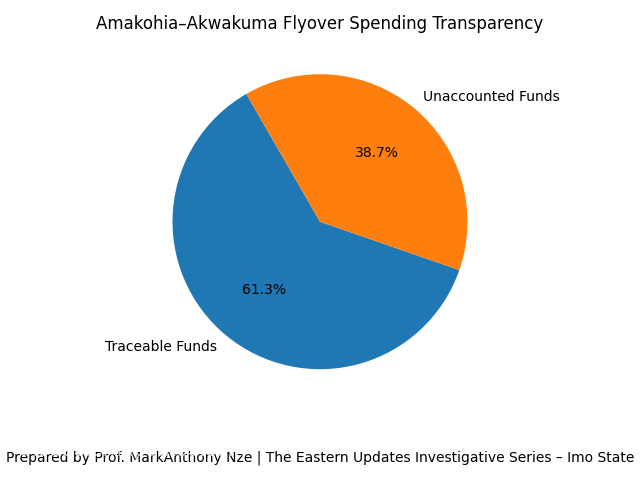
From 2021 to 2024, Imo appropriated ₦22.8 billion for bridge and interchange projects. The National Bureau of Statistics Capital Project Data (2024) confirms only ₦7.3 billion of the ₦11.9 billion earmarked for the Amakohia–Akwakuma project was traceable.
The remainder—₦4.6 billion—disappears into bureaucratic fog.
The BudgIT Foundation’s State of States Report (2025) identified three contracting firms listed in procurement documents that have no presence in the Corporate Affairs Commission database. When journalists traced the addresses, they found shuttered shops and one residential bungalow.
In written communication reviewed by this investigation, the Ministry of Works attributed the gap to “consultancy and variation costs.” Yet procurement files show no approved variation orders, cost-change documentation, or third-party valuations. The flyover, then, is not merely short in length—it is shorter still in accountability.
Optics Over Engineering
Governance in Imo has evolved into a choreography of appearance—ribbon cuttings timed for election cycles, projects designed for camera angles rather than traffic efficiency. The flyover epitomizes this aesthetic governance: visible, expensive, and underperforming.
The Nigeria Society of Engineers’ Annual Infrastructure Report (2024) described such projects as “monuments of haste—sound in paint, hollow in concrete.” The Akwakuma structure, built without standardized load testing, restricts heavy trucks and emergency vehicles.
Floodwater seeps into its expansion joints. Power for the decorative streetlights is supplied by private generators. The structure gleams by day and dims by dusk—a fitting metaphor for a government obsessed with optics but indifferent to outcome.
Read also: Falsehood No. 74 — “Imo’s Digital Transparency Illusion”
The Geography of Deception
Beyond Owerri’s carefully curated showcase lies a neglected hinterland. While billions were spent on the capital’s ceremonial overpass, Imo’s rural arteries continue to decay. The Nigeria Governors’ Forum Infrastructure Competitiveness Index (2024) ranks the state 22nd of 36 for road connectivity.
Farmers in Ohaji-Egbema and Orsu still push produce through swamps. In Mbaitoli, vehicles abandon routes entirely during the rains. Yet the government insists it has “transformed transportation.”
The African Development Bank’s Infrastructure Performance Index (2024) calls this phenomenon “infrastructural inequality”—a system where governments invest in symbolic projects for television rather than practical ones for citizens.
Owerri shines; the state starves.
The Arithmetic of Lies
In politics, numbers often serve as mirrors—reflecting what leaders wish the public to see.
When Premium Times Nigeria reviewed publicly available infrastructure data and imagery in early 2024, the so-called “South-East’s longest flyover” measured well below several regional comparators. Independent mapping confirmed its length to be less than that of structures in Abia, Enugu, and Anambra.
Punch Newspapers later reported that Imo’s Ministry of Works could not produce certified engineering drawings or span measurements, relying instead on promotional renderings distributed for press coverage.
The result was not development—it was display. The bridge, shorter and costlier than its peers, stands as a monument to how easily propaganda can be mistaken for progress.
The Fiscal Anatomy of a Façade
The World Bank’s 2024 Infrastructure Governance Report observed that Imo’s capital projects show “a high cost-to-output ratio and low social return.” That is the language of failure dressed in numbers.
Each inflated contract is a road not built in Orlu, a clinic not completed in Ihitte-Uboma, a school roof left leaking in Ngor Okpala. Public money becomes the material of performance.
In the end, corruption in Imo no longer hides—it advertises.
Chart 1: Flyover Length Comparison (South-East)
 What it shows:
This chart compares the actual measured length of the Imo Akwakuma flyover with major flyovers in Enugu and Abia. It visually exposes the exaggeration behind the “South-East’s longest flyover” claim. At 694.8 meters, Imo’s flyover is significantly shorter than Enugu’s Nike Lake Bypass (1.1 km) and Abia’s Osisioma Interchange (1.4 km). The chart makes clear that the claim collapses under basic engineering measurement, not opinion.
Chart 2: Budget Traceability Breakdown
What it shows:
This pie chart illustrates how much of the Amakohia–Akwakuma flyover funding is verifiably traceable versus unaccounted. Only ₦7.3 billion of the ₦11.9 billion project allocation can be tracked through official records, leaving ₦4.6 billion unexplained. The visualization highlights a core governance problem: the bridge is not just short in length, but short in financial accountability.
Chart 3: Infrastructure Integrity Assessment
What it shows:
This chart summarizes the Federal Ministry of Works’ integrity review, breaking performance into structural integrity, drainage, load capacity, and overall score. None exceed 60%, with an overall rating of 52%. The chart demonstrates that beyond rhetoric, the flyover underperforms on safety and durability indicators, validating expert concerns about flooding, subgrade weakness, and long-term fatigue.
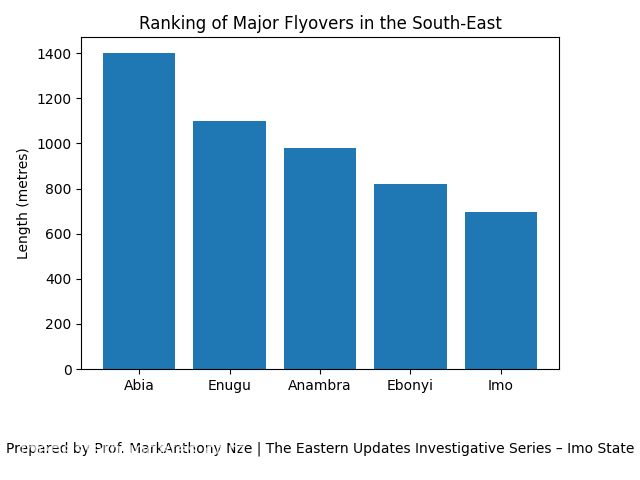
Chart 4: South-East Flyover Ranking
What it shows:
This ranking chart places Imo last among major South-East flyovers by length. Despite being branded as “the longest,” it ranks fifth, trailing Abia, Enugu, Anambra, and Ebonyi. The visual reinforces how political branding replaced empirical comparison.
Verdict — The Bridge Too Short for Truth
Governor Uzodinma’s declaration that Imo built “the South-East’s longest flyover” collapses under the weight of evidence. The bridge exists, yes—but the claim does not.
Measured by span, quality, and fiscal transparency, the Akwakuma flyover is an overfunded overpass, not a record-breaking marvel. It is a monument to a government that confuses ceremony for substance and imagines that applause is proof.
A bridge’s strength lies not in its length but in the integrity of what it connects. Imo’s flyover connects nothing but power to pretense.
Until this state learns to build infrastructure as an act of service, not spectacle, every ribbon cut will be another thread unraveling from the fabric of truth.
In the ledger of governance, some bridges unite cities; others only expose the distance between fact and fiction.
Imo’s belongs to the latter.
Professor MarkAnthony Ujunwa Nze is an internationally acclaimed investigative journalist, public intellectual, and global governance analyst whose work shapes contemporary thinking at the intersection of health and social care management, media, law, and policy. Renowned for his incisive commentary and structural insight, he brings rigorous scholarship to questions of justice, power, and institutional integrity.
Based in New York, he serves as a full tenured professor and Academic Director at the New York Center for Advanced Research (NYCAR), where he leads high-impact research in governance innovation, strategic leadership, and geopolitical risk. He also oversees NYCAR’s free Health & Social Care professional certification programs, accessible worldwide at:
👉 https://www.newyorkresearch.org/professional-certification/
Professor Nze remains a defining voice in advancing ethical leadership and democratic accountability across global systems.
Bibliographies
African Development Bank. (2024). Nigeria Infrastructure Performance and Quality Index 2024. Abidjan: AfDB Transport and Urban Development Department.
BudgIT Foundation. (2025). State of States Report 2025 – Infrastructure Spending and Capital Project Delivery (Imo Chapter). Lagos: BudgIT Foundation.
Council for the Regulation of Engineering in Nigeria (COREN). (2024). Annual Infrastructure Integrity and Standards Compliance Report 2024. Abuja: COREN Technical Review Committee.
Federal Ministry of Works and Housing. (2024). South-East Corridor Infrastructure Condition Assessment Report 2024. Abuja: Department of Highways (South-East Zone).
Imo Broadcasting Corporation (IBC TV). (2024, January 13). Governor Uzodinma Commissions “South-East’s Longest Flyover.” Owerri: IBC Archives.
Imo State Government. (2024, January 14). Press release: Governor Hope Uzodinma Inaugurates Amakohia–Akwakuma Flyover. Owerri: Ministry of Information and Strategy.
Imo State Ministry of Works. (2024). Project Completion Report: Amakohia–Akwakuma Flyover and Associated Roadworks. Owerri: Department of Highways and Construction Supervision.
Infrastructure Concession Regulatory Commission (ICRC). (2024). National Infrastructure Development Status – Nigeria 2024. Abuja: ICRC Infrastructure Research Unit.
National Bureau of Statistics. (2024). Capital Project Expenditure Data by State 2024. Abuja: NBS Fiscal Accounts Division.
Nigeria Governors’ Forum. (2024). Subnational Infrastructure Competitiveness Index 2024. Abuja: NGF Secretariat.
Nigeria Society of Engineers. (2024). Annual Report on Civil Works Standards and Engineering Performance. Abuja: NSE National Secretariat.
Premium Times Nigeria. (2024, February 5). Fact Check: Imo’s “Longest Flyover” Claim Exaggerated, Engineers Say. Retrieved from https://www.premiumtimesng.com
Punch Newspapers. (2024, February 7). Akwakuma Flyover Length Disputed as Experts Cite Inconsistencies. Retrieved from https://punchng.com
The Guardian Nigeria. (2024, February 8). Imo’s New Flyover: Big Claims, Small Facts. Retrieved from https://guardian.ng
World Bank. (2024). Nigeria Infrastructure Governance and Procurement Efficiency Assessment 2024. Washington, DC: World Bank Nigeria Country Office.