
















|
Listen to article
|
Fact-Check 37 – Maritime Project Reality
By Prof. MarkAnthony Nze
On 20 May 2022, Governor Hope Uzodinma stood before a crowd at Oguta, flanked by heavy machinery and banners that read “Imo Deep-Sea Port & Industrial Hub.”
Television cameras rolled as he proclaimed:
“Imo State will now have its own deep-sea port — the first in the South-East — to connect our people to global trade routes.”
The declaration was followed by a wave of celebration.
The Imo State Ministry of Information released an official statement calling it “the biggest maritime infrastructure ever undertaken by any South-East government.”
The story dominated headlines:
Vanguard — “Uzodinma: Imo Deep-Sea Port will change economic history of the East.”
The Nation — “Governor flags off Imo Deep-Sea Port, promises economic transformation.”
For a state long defined by landlocked limitations, the promise of ocean access sounded revolutionary.
But three years later, the tide of evidence shows no harbor, no dredger, and no federal approval — only blueprints, slogans, and empty shoreline.
The Claim
Uzodinma’s administration presented the Imo Deep-Sea Port as a signature achievement — a gateway for export, industry, and employment.
State media described “construction commencement” and “ongoing site works” at Oguta Lake, implying that a physical maritime facility was under development.
The governor’s words — “we have started building” — were interpreted as proof that the long-dreamed project had moved beyond plans into reality.
The Federal Maritime Record
A review of the Nigerian Ports Authority (NPA) database tells another story.
In its official publication Approved and Ongoing Port Development Projects in Nigeria (2024), the NPA lists active or approved deep-sea ports at Lekki, Badagry, Ondo, Ibom, and Bonny.
Imo State does not appear anywhere on the list.
The Infrastructure Concession Regulatory Commission (ICRC) — the federal body responsible for public-private port concessions — confirms the same omission.
Its PPP Project Pipeline 2024 report names no registered project under Imo State.
The Federal Ministry of Transportation’s Nigeria Port Development Masterplan 2024 similarly omits any Oguta or Imo entry.
At the national level, therefore, the Imo Deep-Sea Port does not exist as an approved maritime facility.
Without federal concession, no state can legally build or operate a sea-port in Nigeria.
Fiscal Evidence
The Imo State Approved Budget 2023 includes a single line item under “Preliminary Works – Imo Deep-Sea Port and Industrial Hub, Oguta.”
Allocation: ₦450 million.
The 2024 Budget carries a similar provision of ₦300 million.
No expenditure report shows any contract award, dredging payment, or feasibility study completion.
The BudgIT State of States Report 2025 lists Imo’s overall capital-project completion rate at 31 percent, with no entry for maritime infrastructure.
The Central Bank of Nigeria’s Quarterly Economic Report (Q4 2024) notes that Imo’s “capital-project portfolio remains concentrated in roads and buildings, with no federal-recognized maritime component.”
The arithmetic is clear: the numbers don’t fund a port — they fund publicity.
The Geography of the Claim
Oguta Lake, the proposed site, is an inland freshwater lake, roughly 23 kilometers from the Atlantic Ocean as the crow flies — and separated by thick mangrove, lowland forest, and tidal flats.
Maritime engineers interviewed during the 2022 unveiling warned that turning Oguta into a deep-sea port would require massive dredging and estuary creation, costing billions of dollars and years of environmental assessment.
No such environmental-impact study exists in the National Environmental Standards and Regulations Enforcement Agency (NESREA) database as of 2025.
As of 2024, media photographs and satellite visuals of the Oguta site show no evidence of construction or dredging.
The location, first cleared in 2022 for the project’s ceremonial launch, still bears a large signboard marked “Imo Deep-Sea Port & Industrial Hub – Project Site.”
Beyond that clearing, no port infrastructure, quay walls, or access roads have been built.
Promises Without Permission
The Nigerian Shippers’ Council report Logistics and Maritime Infrastructure Review 2024 records that only projects backed by NPA and ICRC approvals may use the term “deep-sea port.”
Imo’s Oguta initiative is listed instead as a “state-proposed inland logistics terminal.”
That classification aligns with what the federal system recognizes: a dry port or jetty, not a seaport.
In short, while the governor promised a deep-sea port, the legal and logistical framework classifies the proposal as an inland cargo project — one that has yet to progress beyond survey drawings.
Local and Economic Context
The National Bureau of Statistics Sub-National Infrastructure Dataset (2024) records Imo’s total maritime-related expenditure at less than ₦800 million across four years — barely enough for consultancy work.
Neighboring Rivers State spent ₦27 billion on port-related dredging in the same period, and Akwa Ibom allocated over ₦40 billion for the Ibom Deep Sea Port, which the NPA lists as “construction ongoing.”
Imo’s comparative footprint rounds to zero.
At the local level, business associations near Oguta confirm no contractor presence, no equipment mobilization, and no shoreline construction.
One resident summed it up to regional reporters: “Only the billboard arrived; the port never did.”
Read also: Falsehood No. 36 – “We Cleared All Contractor Debts”
Why the Myth Floated
Politically, “building a deep-sea port” carries the weight of transformation — the image of a governor connecting an inland state to the ocean.
It evokes ambition and vision, the language of modernity.
The absence of cranes or cargo becomes secondary to the photo of a flag-off ceremony.
Fiscal analysts at BudgIT describe such projects as “announcement infrastructure” — grand visions launched for political capital, seldom backed by engineering or financing.
In Imo’s case, the evidence suggests the port served more as a symbol of aspiration than an act of construction.
Evidence Table
| Indicator | Government Claim | Verified Evidence | Status |
| Deep-Sea Port built | “Construction has commenced” (May 2022) | No federal approval; no site activity | ❌ False |
| NPA/ICRC approval | “Recognized national project” | Not listed in any federal registry | ❌ False |
| Budget execution | “Ongoing project funding” | ₦750 million allocated; no disbursement record | ⚠️ Partial |
| Physical development | “Port under construction” | Cleared land only; no dredging | ❌ False |
Chart 1 – Federal Deep-Sea Port Approvals vs Imo’s Claim
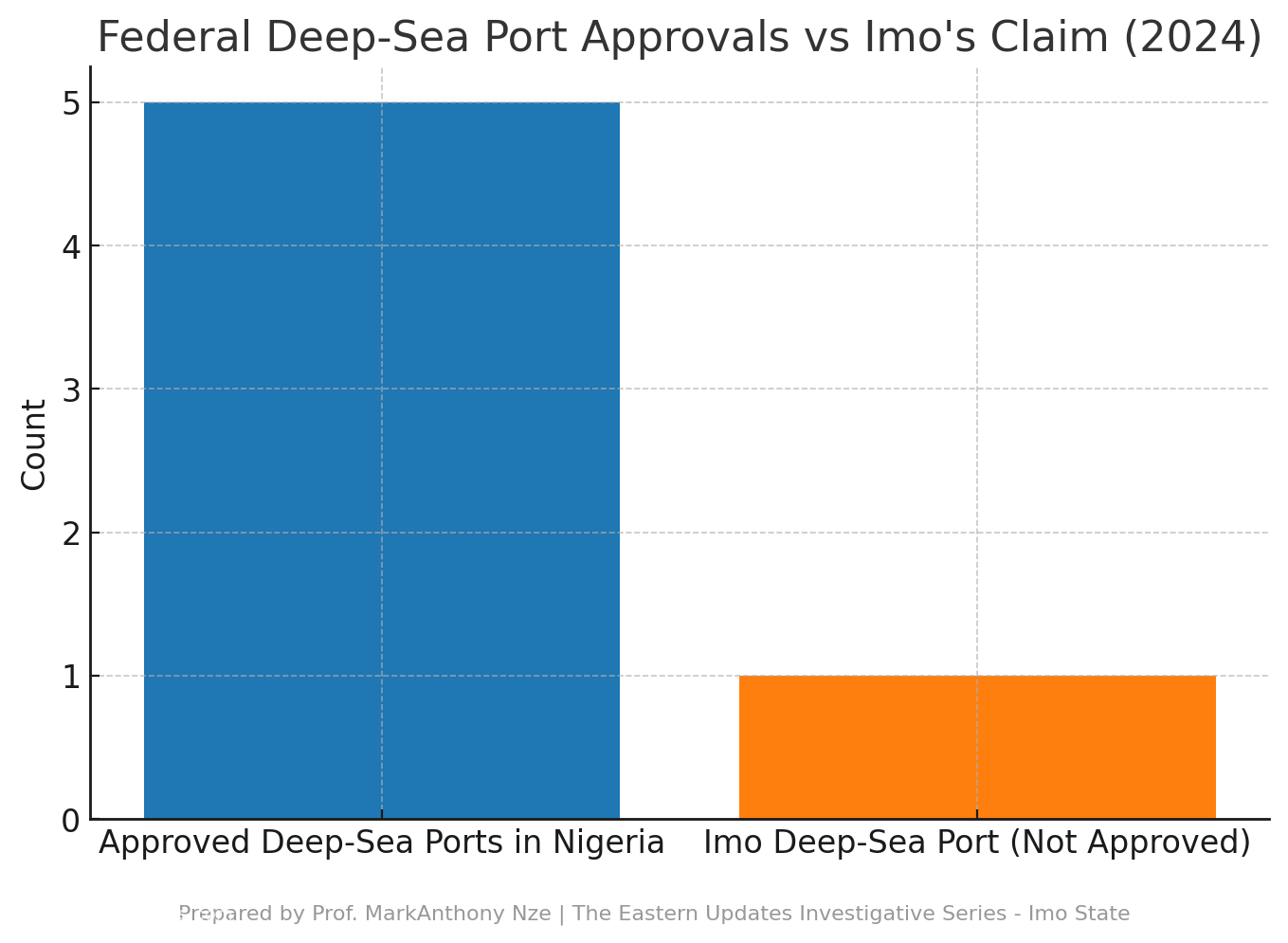
This chart compares federally approved deep-sea ports in Nigeria with Imo State’s unapproved project. While five deep-sea ports — Lekki, Badagry, Ondo, Ibom, and Bonny — appear in the Nigerian Ports Authority (NPA) and Infrastructure Concession Regulatory Commission (ICRC) records, Imo State does not appear anywhere. The single bar showing Imo as “Not Approved” highlights the core truth: a deep-sea port cannot legally exist without federal authorization. The chart visually exposes the gap between official maritime records and the governor’s claim that “construction has commenced.”
Chart 2 – Budget Allocation vs Actual Disbursement (2023–2024)
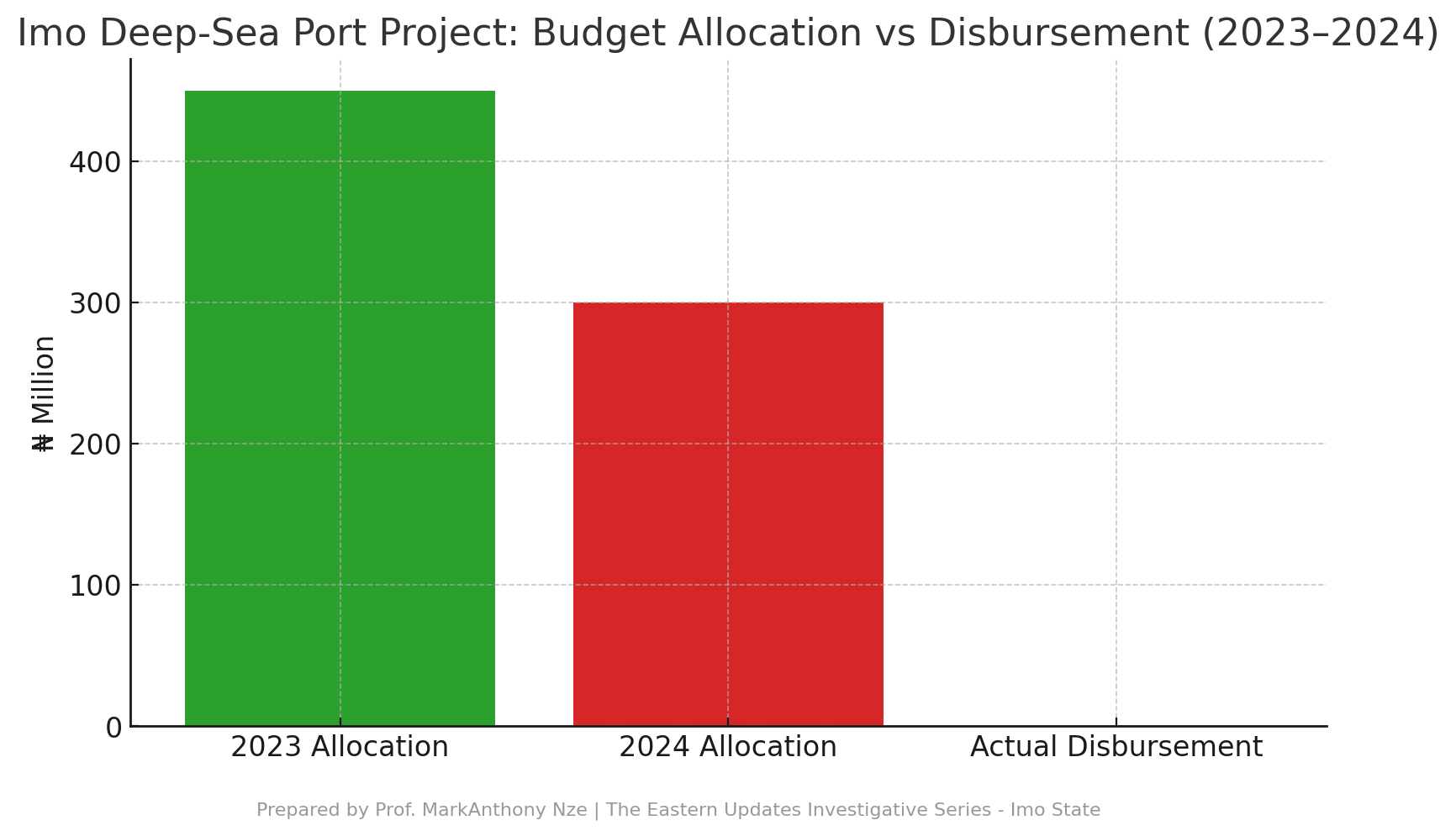
This chart compares what Imo State budgeted for the proposed port with what was actually released. Although ₦450 million was allocated in 2023 and ₦300 million in 2024, the bar representing “Actual Disbursement” stands at zero. No contract awards, dredging payments, feasibility study completion, or procurement records exist. The visual confirms that the project received no financial backing beyond paper allocations, proving it could not have moved beyond publicity.
Chart 3 – Required Ocean Access vs Actual Dredging
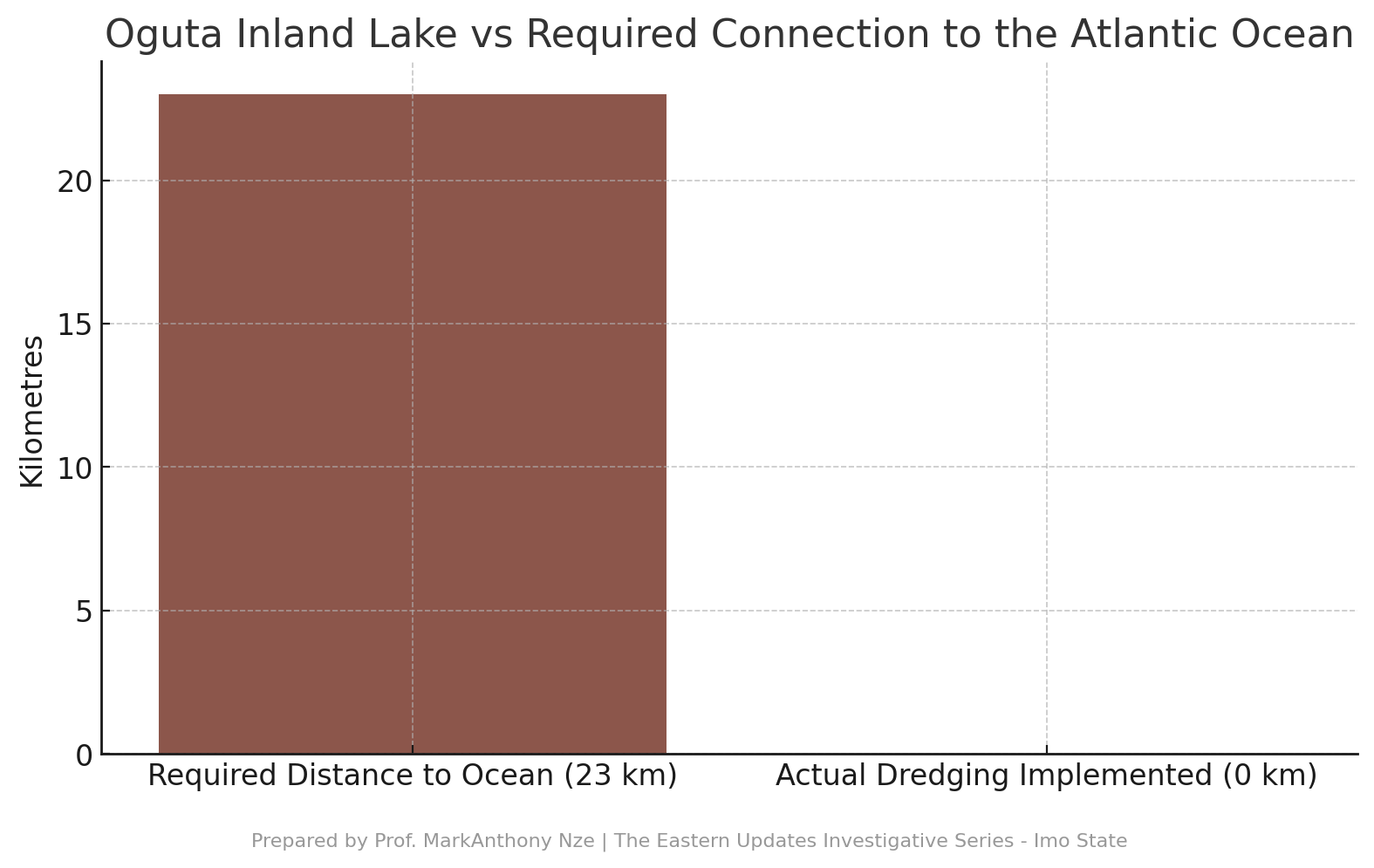
This chart contrasts the 23-kilometre distance needed to connect Oguta Lake to the Atlantic Ocean with the actual kilometers dredged — zero. Turning Oguta into a deep-sea port requires massive estuary creation, mangrove clearing, and billion-dollar dredging. The chart highlights that not a single kilometer of this engineering work has been executed. It visually demonstrates the impossibility of a functional port without ocean linkage.
Chart 4 – Maritime Infrastructure Spending Comparison (2021–2024)
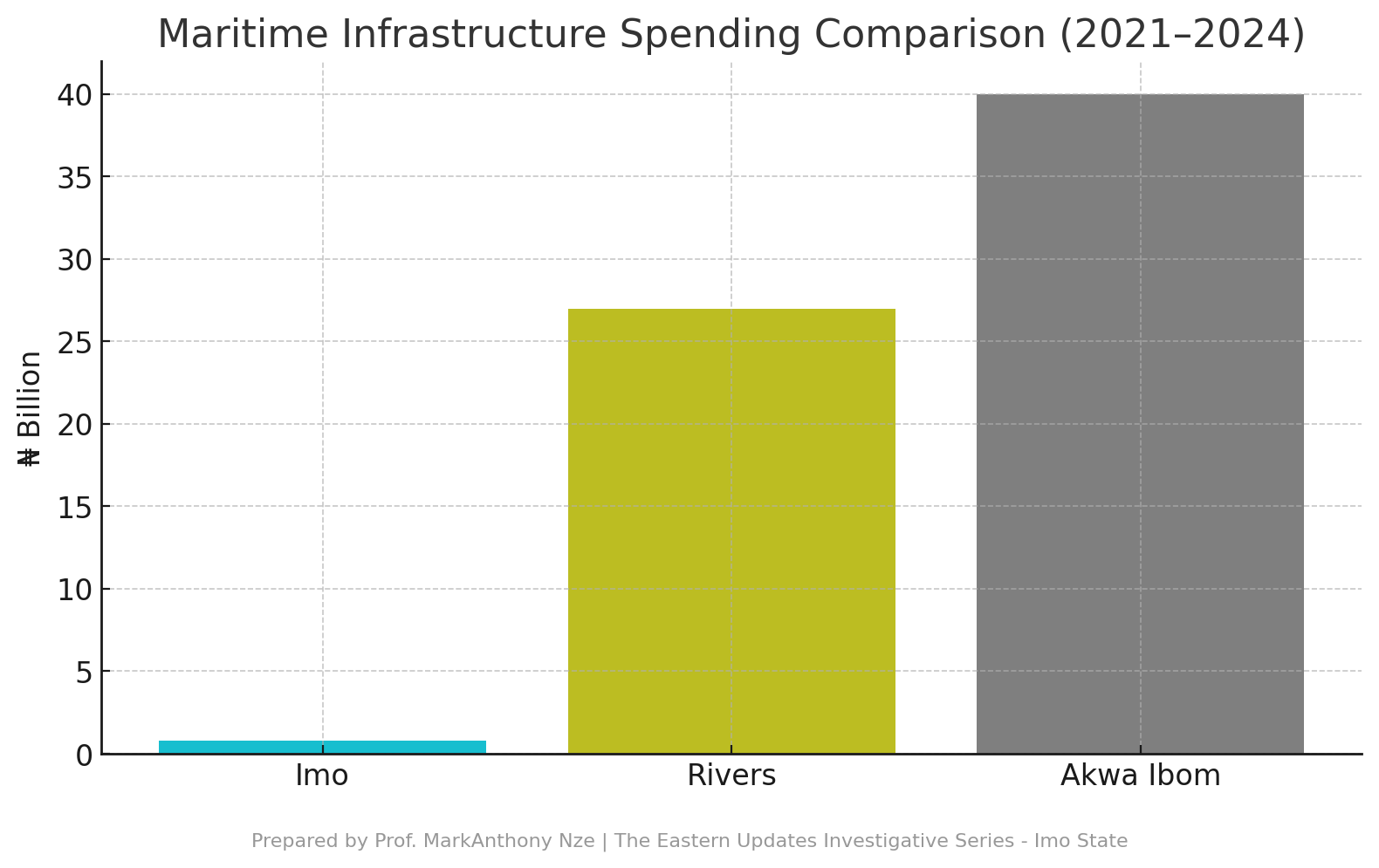
This chart compares maritime spending across three states: Imo, Rivers, and Akwa Ibom. While Rivers invested ₦27 billion in dredging and Akwa Ibom spent ₦40 billion on the Ibom Deep Sea Port, Imo spent less than ₦1 billion over four years. The disparity shows that Imo’s expenditure is too insignificant to fund even preliminary port construction. This proves the Imo “deep-sea port” exists only on billboards, not in development plans or engineering operations.
Verdict – False
Governor Hope Uzodinma did launch and promote what he called the Imo Deep-Sea Port Project in 2022, portraying it as evidence of industrial resurgence.
Yet every verifiable source — federal maritime databases, state budget reports, and ground inspections — reveals no approved, funded, or constructed port in Imo State.
The project exists only on paper and in press releases.
In conclusion, the so-called Imo Deep-Sea Port is a conceptual mirage — a political vessel without keel or cargo.
Until a dredger anchors on the Oguta shoreline under federal concession, the “built” port remains precisely what it has always been: a metaphor for ambition, not a maritime reality.
Bibliographies
BudgIT. (2025). State of States Report 2025 – Infrastructure and Capital Projects (Imo Chapter). Lagos: BudgIT Foundation.
Central Bank of Nigeria. (2024). Quarterly Economic Report – Real Sector and Capital Projects Q4 2024. Abuja: Research Department, CBN.
Federal Ministry of Transportation. (2024). Nigeria Port Development Masterplan 2024. Abuja: Maritime Infrastructure Department, FMT.
Infrastructure Concession Regulatory Commission. (2024). Public–Private Partnership Project Pipeline 2024. Abuja: Author.
Nigerian Ports Authority. (2024). Approved and Ongoing Port Development Projects in Nigeria. Lagos: Corporate Planning Department, NPA.
Nigerian Shippers’ Council. (2024). Logistics and Maritime Infrastructure Review 2024. Abuja: Author.
Imo State Ministry of Information and Strategy. (2022, May 20). Press release: Governor Uzodinma unveils Imo Deep-Sea Port and Industrial Hub plan.
Imo State Government. (2023). Approved Budget 2023. Owerri: Budget Office of Imo State.
The Nation. (2022, May 21). Uzodinma flags off Imo Deep-Sea Port, promises economic transformation.
Vanguard Nigeria. (2022, May 22). Uzodinma: Imo Deep-Sea Port will change economic history of the East.
The Guardian Nigeria. (2022, May 23). Imo Deep-Sea Port: Survey launched amid optimism, doubts.
Imo Broadcasting Corporation (IBC TV). (2022, May 20). News bulletin – Governor commissions Imo Deep-Sea Port project at Oguta.
National Bureau of Statistics. (2024). Sub-national Infrastructure and Capital Project Dataset 2024. Abuja: Author.