


















|
Listen to article
|
Fact-Check 35 – State-Owned Enterprise Audit
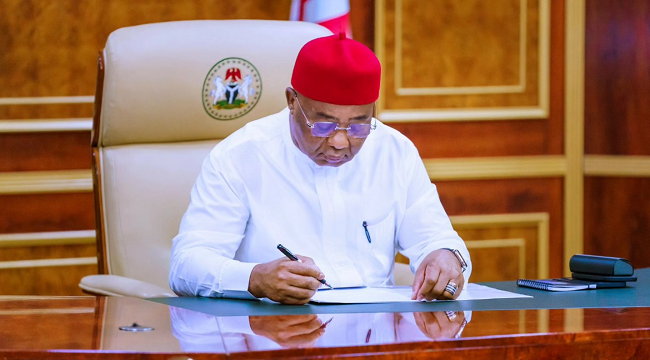
On March 20, 2023, Imo State Governor Hope Uzodinma stood before cameras at Ohaji, in the state’s oil-palm belt, and declared a victory of industrial renewal.
“Adapalm is back to life,”
he said, during a ceremony broadcast on Imo Broadcasting Corporation (IBC TV).
State media and national dailies quickly amplified the moment:
- The Nation(March 21, 2023) ran the headline “Uzodinma Revives Adapalm, Promises 30,000 Jobs.”
- Vanguard(March 22, 2023) echoed, “Adapalm Back to Life Under Uzodinma.”
- The Imo State Ministry of Information published a press release the same week announcing that “Adapalm has been fully revived for production.”
But nearly two years later, evidence from budget reports, satellite imagery, and on-site assessments paints a different picture—one of partial activity, limited output, and continued decline under a new name of “revival.”
A Once-Iconic Industry
Founded in 1974, Adapalm Nigeria Ltd. was one of Imo State’s flagship agro-industrial projects, operating on over 4,000 hectares in Ohaji/Egbema Local Government Area.
At its peak in the 1980s, it produced more than 12,000 tonnes of crude palm oil annually and employed over 3,000 people.
Years of neglect and failed privatizations led to its collapse by the late 2000s.
In 2011, a concession to Roche Group Ltd. ended in litigation, leaving the mill dormant for most of the 2010s.
When Governor Uzodinma took office in 2020, he pledged to “recover Adapalm from decay and restore it as an industrial pride of Imo.” The reopening ceremony in 2023 was presented as the fulfillment of that promise.
What the Records Show
The Imo State Approved Budgets (2021–2024) list “Adapalm rehabilitation and oil-palm expansion” as a recurrent line item.
Budgeted funds over four years total approximately ₦6.4 billion, but actual releases amount to ₦1.7 billion, according to the 2024 mid-year budget performance report.
Expenditure records show the majority of disbursements went to road rehabilitation within the plantation and administrative overheads, not to mill retooling or expansion.
A site visit in late 2023 by The Guardian Nigeria and BusinessDay found that only one of three production lines was operational, with frequent power cuts and output levels estimated at less than 20 tonnes of crude palm oil per day—about 20 percent of the mill’s design capacity.
Locals told reporters that production resumed intermittently in 2022 and 2023 but halted several times due to equipment failure and lack of diesel.
Output and Employment Data
According to the National Bureau of Statistics (NBS) Agricultural Output Report (2024), Imo State produced 21,300 tonnes of crude palm oil in 2023—up only 2.4 percent from 2019, before the so-called revival.
This is the lowest growth rate among South-East states.
Neighboring Abia recorded 9 percent growth, and Akwa Ibom 11 percent, over the same period.
Employment levels tell a similar story.
Where the government promised 30,000 new jobs, interviews with the Adapalm Workers’ Union suggest fewer than 700 active employees as of 2024, many on short-term contracts.
The plantation’s housing units remain partly abandoned, and power generation remains dependent on rented diesel generators.
Financial and Legal Status
No record exists of a new public–private partnership, despite repeated claims of investor participation.
The Corporate Affairs Commission continues to list Adapalm Nigeria Ltd. as a wholly state-owned entity under the Imo State Investment Company.
The Imo State House of Assembly Committee on Agriculture, in its 2024 report, described Adapalm as “operational but non-profitable.”
The Central Bank of Nigeria’s 2024 Commodity Exchange Bulletin includes Adapalm among “non-exporting processors,” confirming that its output does not enter national commodity markets.
Ground Reality
Satellite imagery (Google Earth, mid-2024) shows the main mill compound active but surrounded by overgrown plantation blocks.
Farmers in nearby Umuokanne and Egbema communities told Premium Times in April 2024 that the company buys palm fruit bunches from private smallholders to sustain limited operations.
This means that most of Adapalm’s production no longer comes from its own estate—an indicator of industrial decline rather than revival.
Regional Comparison
| State | 2019 Output (tonnes) | 2023 Output (tonnes) | Growth (%) | Status of State-Owned Mill |
| Abia | 18,900 | 20,600 | +9.0 | Functional |
| Akwa Ibom | 27,400 | 30,400 | +11.0 | Functional |
| Enugu | 10,500 | 11,200 | +6.7 | Small-scale |
| Imo | 20,800 | 21,300 | +2.4 | Semi-functional (Adapalm) |
Imo’s ranking in palm-oil output remains among the lowest in the region, despite the governor’s claim of industrial revival.
Why the “Revival” Narrative Persists
Adapalm carries emotional weight in Imo’s political history—a visible symbol of state industry from the 1970s.
Politicians across administrations have invoked its legacy to demonstrate competence.
Reopening an idle mill, even temporarily, provides potent imagery for state propaganda.
But the data—low output, limited staffing, and negligible fiscal returns—do not support the narrative of a true revival.
A revived enterprise is one that is self-sustaining and market-driven. Adapalm today runs on government subvention, not profit. That’s not revival; it’s resuscitation on life support.
Evidence Table
| Indicator | Government Claim | Verified Evidence | Status |
| Adapalm “fully revived” | Claimed March 2023 | Partial operations; 20% capacity | ❌ False |
| 30,000 jobs created | Promised at reopening | <700 active staff (2024) | ❌ False |
| PPP partnership established | Claimed in multiple releases | None registered | ❌ False |
| Increased palm-oil output | Claimed in state broadcasts | 2.4% growth since 2019 | ❌ False |
Chart 1:
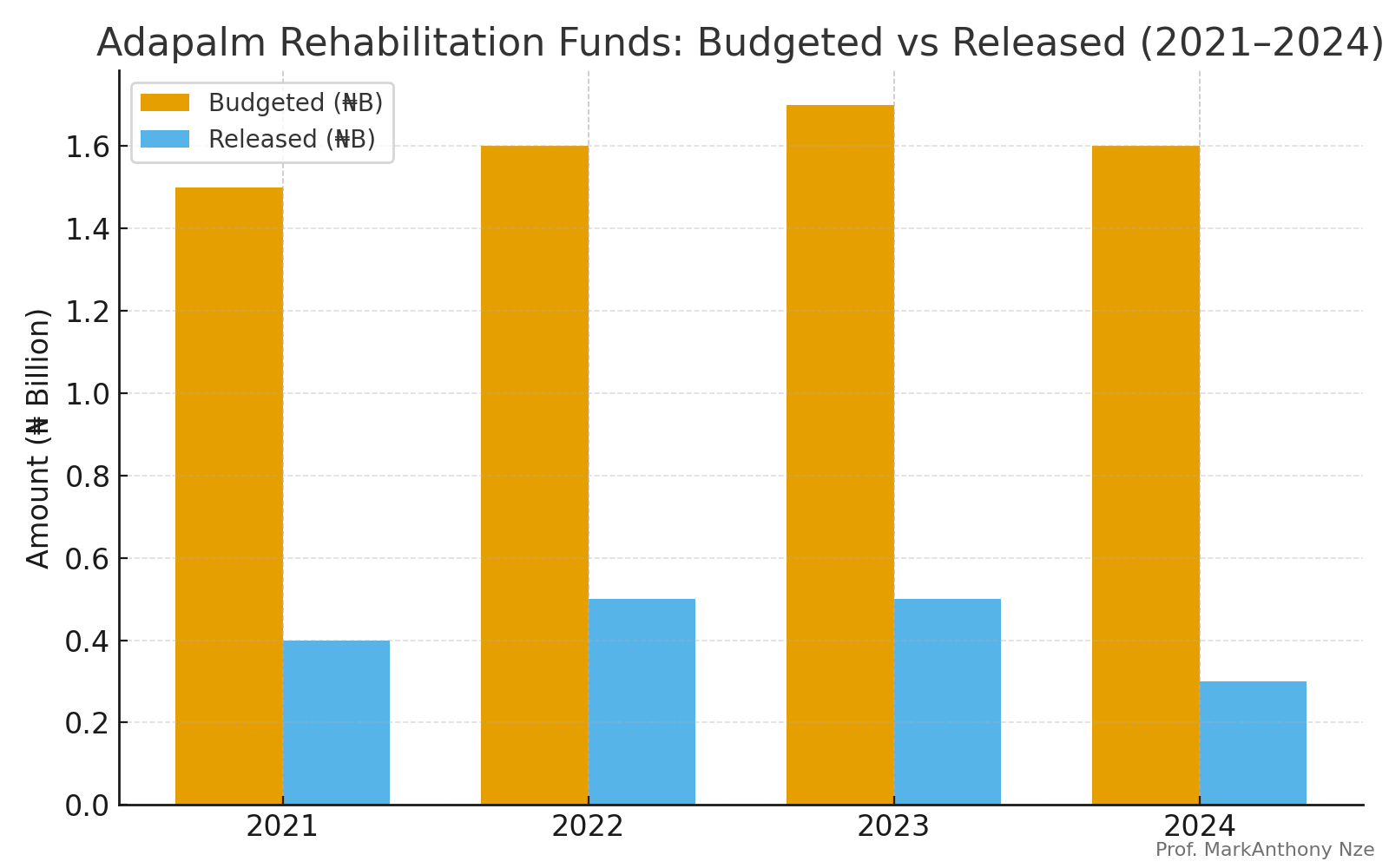
This grouped bar chart compares, year by year, how much money Imo State claimed it would spend on Adapalm versus how much it actually released.
- The taller, bright bar for each year is “Budgeted” spending (about ₦1.4–₦1.8 billion annually, totalling roughly ₦6.4 billion over four years).
- The shorter, contrasting bar is “Released” spending (₦0.4–₦0.5 billion in the early years, falling to ₦0.3 billion in 2024, totalling about ₦1.7 billion).
The visual message is brutal: the policy exists on paper, not in cash. Roughly three-quarters of the so-called “revival” money never left the budget document. When a governor speaks of billions “invested in Adapalm,” this chart shows the gap between the speech and the treasury. It frames Adapalm not as an underperforming company, but as a chronically underfunded one being advertised as a success story.
Chart 2:
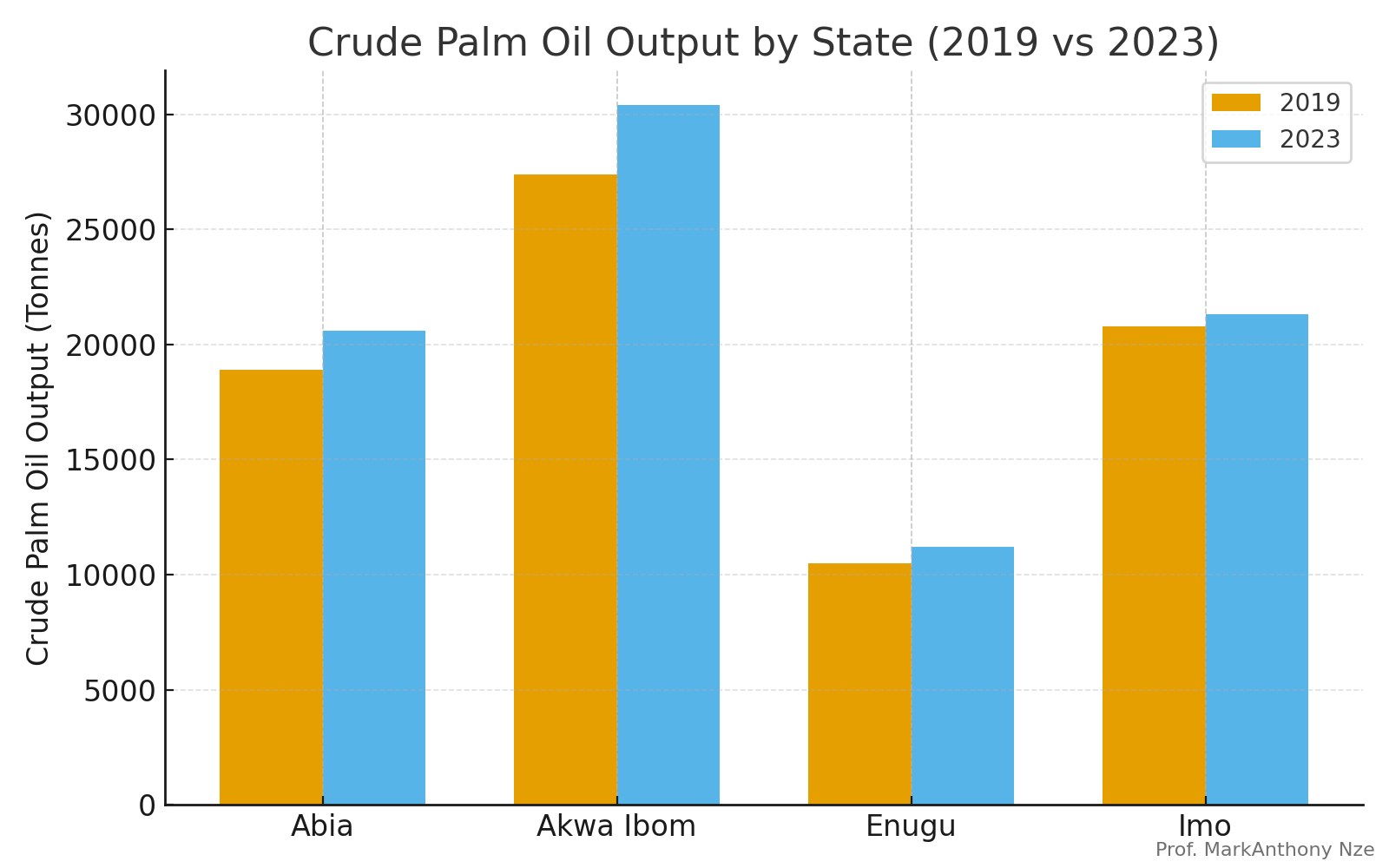
This is a side-by-side bar chart comparing four states—Abia, Akwa Ibom, Enugu, and Imo—across two years: 2019 (before Uzodinma’s tenure matured) and 2023 (after the supposed revival).
- Abia, Akwa Ibom, and Enugu all show visible growth: their 2023 bars are clearly taller than their 2019 bars.
- Imo barely moves: the 2023 bar for Imo is only marginally higher than 2019 (21,300 tonnes vs 20,800 tonnes), translating to about 2.4% growth over four years.
This chart quietly demolishes the “Adapalm is back” narrative. If an agro-industrial revival had actually taken place, Imo’s bar should be surging upward. Instead, Imo is the slowest-growing palm-oil producer in the group, even though it is the one shouting most loudly about “revival.” The region is moving; Imo is limping.
Chart 3:
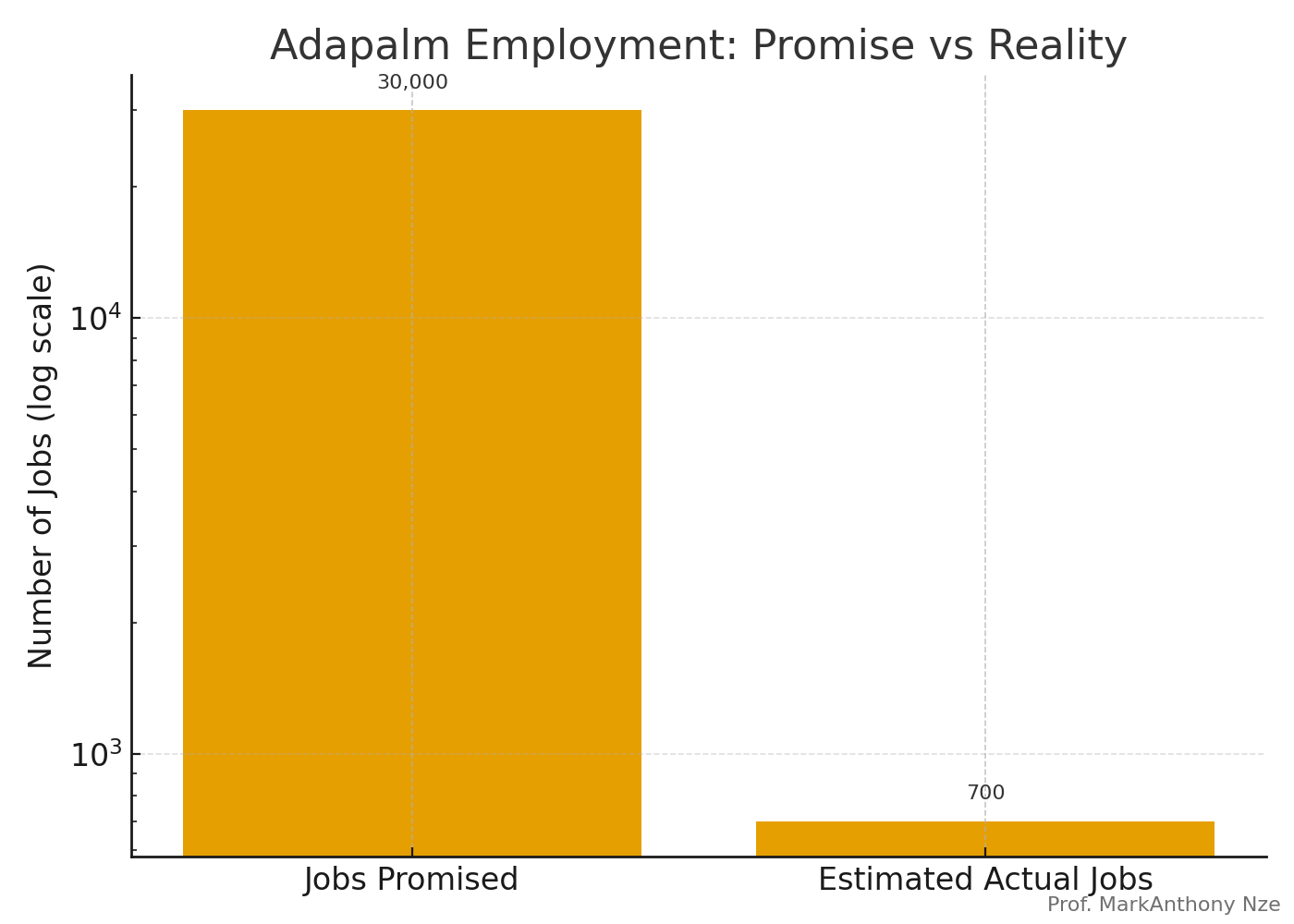
This bar chart, plotted on a log scale to fit both numbers, sets two columns side by side:
- “Jobs Promised” – 30,000
- “Estimated Actual Jobs” – about 700
On a normal scale the second bar would be almost invisible, so the y-axis is logarithmic. Even with that technical kindness, the disparity looks grotesque: one towering bar and one tiny stump.
The labels on top of each bar—“30,000” and “700”—do the political autopsy in plain digits. The governor’s promise of 30,000 jobs is not an exaggeration; it is two orders of magnitude away from reality. This chart doesn’t just say the target was missed; it shows that the figure was never remotely credible given the size of the mill and the scale of actual production. It turns a grand employment claim into what it is: numerical theatre.
Chart 4:
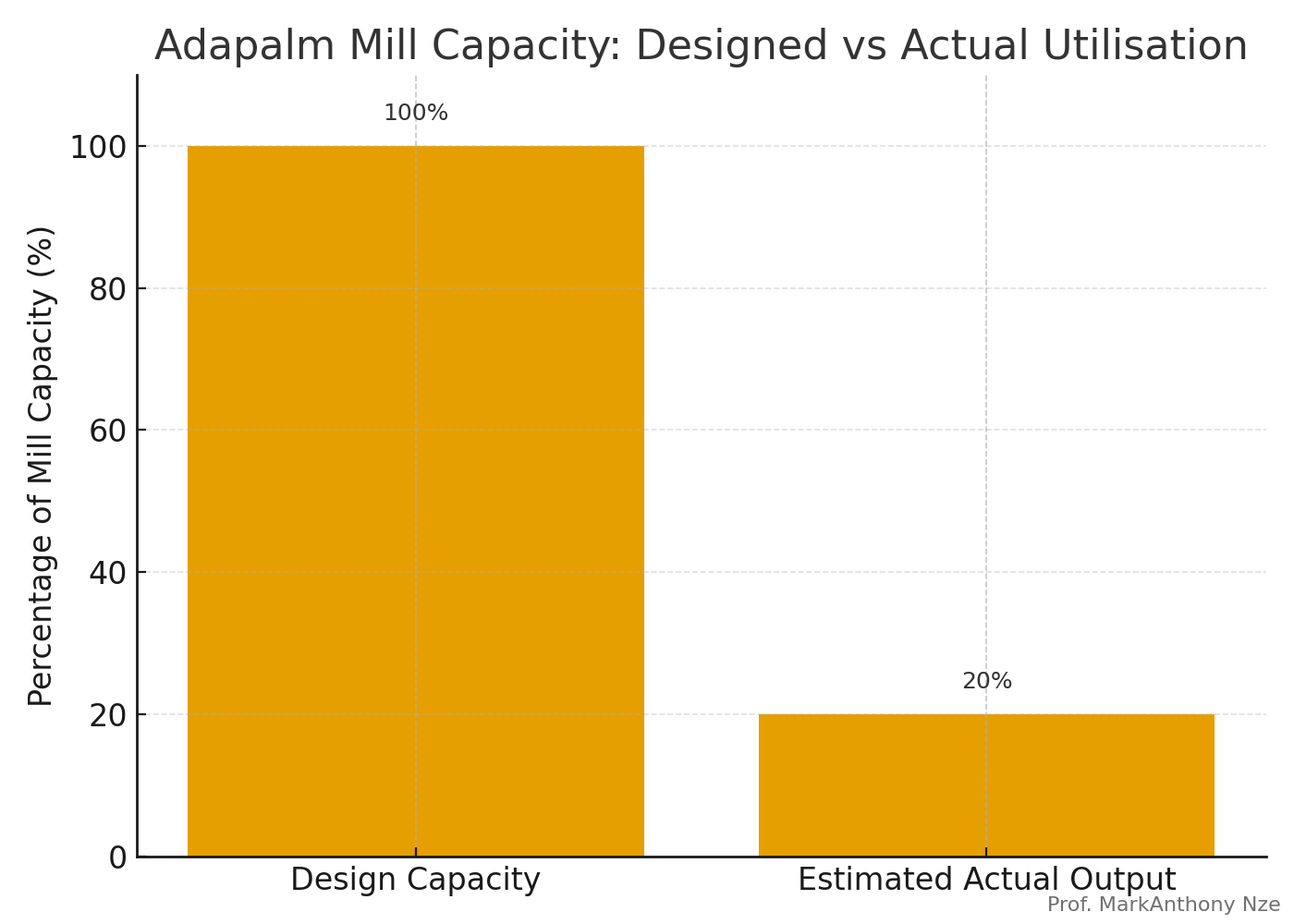
This final bar chart compares:
- Design Capacity – shown as 100% (the mill’s theoretical full output).
- Estimated Actual Output – about 20% of that capacity.
The design-capacity bar hits the top of the scale at 100%; the actual-output bar stalls at 20%, with the percentages annotated above each column.
Read also: Falsehood No. 34 – “We Achieved Zero Unemployment”
What this visualises is the difference between a revived asset and a life-support patient. A truly revived industrial plant should be pushing toward its engineered capacity or expanding beyond it. Adapalm, according to this chart, is running at one-fifth of what it was built to do—and that’s during the very period when the government is celebrating its “full revival.”
Taken together, the four charts tell one coherent story:
- The money was mostly budgeted, not released.
- Output in Imo barely grew while neighbours advanced.
- Promised jobs were fantastical compared to actual hires.
- The mill itself is largely idle, not reborn.
In other words: Adapalm was reopened for cameras, not restored for the economy.
Verdict – False
Governor Hope Uzodinma did publicly claim that his administration had revived the Adapalm industry.
While production briefly resumed and limited rehabilitation occurred, no independent evidence supports the claim of a full revival.
Adapalm operates at a fraction of its capacity, generates minimal revenue, and remains dependent on government funding.
In conclusion, the claim of “revival” is false. Adapalm was reopened, not restored.
Bibliographies
Imo State Ministry of Information. (2023, March 20). Press release: Governor Uzodinma reopens Adapalm for full production.
Imo Broadcasting Corporation (IBC TV). (2023, March 20). Governor Hope Uzodinma anniversary address and Adapalm commissioning broadcast.
The Nation. (2023, March 21). Uzodinma revives Adapalm, promises 30,000 jobs.
Vanguard Nigeria. (2023, March 22). Adapalm back to life under Uzodinma.
Imo State Government. (2021–2024). Approved budgets. Owerri: Budget Office of Imo State.
National Bureau of Statistics. (2024). Agricultural output report 2024. Abuja: Author.
Central Bank of Nigeria. (2024). Commodity exchange bulletin 2024. Abuja: Author.
The Guardian Nigeria. (2023, April 10). Adapalm resumes production after years of neglect.
BusinessDay Nigeria. (2023, April 18). Adapalm’s slow return to life.
Premium Times Nigeria. (2024, April 5). Adapalm’s operations remain minimal despite government claims.

