



















|
Listen to article
|
Fact-Check 34 – Labor Force Data Review
On May 1, 2024, during the Workers’ Day ceremony at Dan Anyiam Stadium in Owerri, Governor Hope Uzodinma announced to thousands of civil servants that Imo State had “effectively achieved zero unemployment.”
The declaration was instantly amplified across state-owned broadcasting platforms and later repeated in an official statement by the Ministry of Information, which portrayed the claim as a historic triumph of the administration’s empowerment initiatives.
Local radio stations echoed the message; some newspapers published celebratory headlines.
However, a rigorous investigation drawing from the National Bureau of Statistics (NBS), the Central Bank of Nigeria (CBN), independent labor research institutions, and regional labor monitors exposes a strikingly different reality—one defined by persistent joblessness, chronic underemployment, and a deliberate manipulation of employment terminology.
What the Numbers Actually Reveal
NBS Labor Force Survey (Q2 2024)
The official NBS report puts Imo State’s unemployment rate at 34.9%, the second-highest in the South-East and significantly above the national average of 33.3%.
When underemployment is included—citizens working fewer than 40 hours per week—the figure rises to over 56%, signaling a labor market in distress, not recovery.
Between 2020 and 2024, Imo’s employment-to-population ratio increased by less than two percentage points, a negligible shift that contradicts any suggestion of dramatic improvement.
CBN Statistical Bulletin (2024)
The CBN categorizes Imo as a “low-productivity state with persistent informal-sector dominance.”
Nearly 70% of the state’s workforce operates in unregistered micro-enterprises, most of which provide unstable income and no contractual employment.
World Bank Nigeria Development Update (2024)
The World Bank notes that formal employment in Imo declined by about 5% between 2021 and 2023 despite modest growth in small-scale service businesses.
This means the jobs being created are mostly informal, precarious, and outside any official payroll structure.
BudgIT and African Development Bank Findings
BudgIT’s State of States Report 2025 ranks Imo 29th of 36 states on its Labor and Welfare Index, citing severe graduate unemployment and a weak industrial base.
The African Development Bank’s Employment and Labor Competitiveness Index (2024) places Imo’s job-creation elasticity at 0.18, compared to the national average of 0.41.
In simpler terms, even when the economy grows, very few jobs follow.
What the State Counts as “Employment”
To defend the “zero unemployment” claim, officials frequently reference initiatives such as the Skill-Up Imo Program, youth grants, and cooperative schemes allegedly engaging “tens of thousands.”
But a closer look reveals that:
- These programs focus on training and stipends, not actual job placement.
- Participants are not formally employed, even though they are counted as such for political purposes.
- Many engagements are temporary, ad hoc, or politically motivated.
The National Economic Council’s State Employment Dashboard (2024) lists only 4,732 verified job placements funded by the state since 2020—less than 1% of Imo’s working-age population.
Economists describe this as statistical substitution—changing the definition of employment to fit a political narrative.
Reality on the Ground
A walk through Owerri’s job centers in late 2024 paints a sobering picture:
Hundreds of graduates line up for private-sector interviews that rarely result in actual employment.
Industrial estates in Avu and Naze operate at below 30% capacity; manufacturing jobs continue to shrink.
NECA (2024) attributes this decline to:
- erratic power supply
- rising operational costs
- limited access to credit
The Imo Factory Owners Association estimates that between 2021 and 2024, over 2,000 skilled workers migrated to neighboring states or abroad seeking stable incomes.
Public-sector hiring has stalled as well.
The Imo Civil Service Commission recorded fewer than 800 permanent appointments between 2020 and 2024—far below replacement needs.
Regional and National Standing
Within the South-East, unemployment remains a major challenge, but Imo consistently performs worst.
Using NBS 2024 data:
- Anambra:4%
- Abia:7%
- Enugu:1%
- Ebonyi:6%
- Imo:9%
Nationally, only Bayelsa, Adamawa, and Taraba rank higher.
The International Labour Organization (2024) identifies Imo as one of the states with “low private-sector absorption and rising youth unemployment.”
Why This Claim Matters
Declaring “zero unemployment” may sound harmless, but it carries profound consequences:
- Misallocation of resources:
Policy decisions rely on accurate data. Distortion leads to misguided budgets. - Investor disinterest:
False statistics erode investor trust in economic reports. - Public disillusionment:
Citizens who struggle to find work hear leaders proclaim a miracle they cannot see or feel. - Poor program design:
You cannot design effective employment programs when you begin from a lie.
Evidence Table
| Indicator | Government Claim | Verified Data | Status |
| Unemployment Rate | “Zero unemployment” | 34.9% (NBS, Q2 2024) | ❌ False |
| Underemployment | “Completely absorbed workforce” | 21% underemployed | ❌ False |
| State-backed job creation | “Tens of thousands” | 4,732 verified | ⚠️ Unsubstantiated |
| Private-sector job growth | “Expanding industry” | –4.8% manufacturing decline (CBN) | ❌ False |
Chart 1:
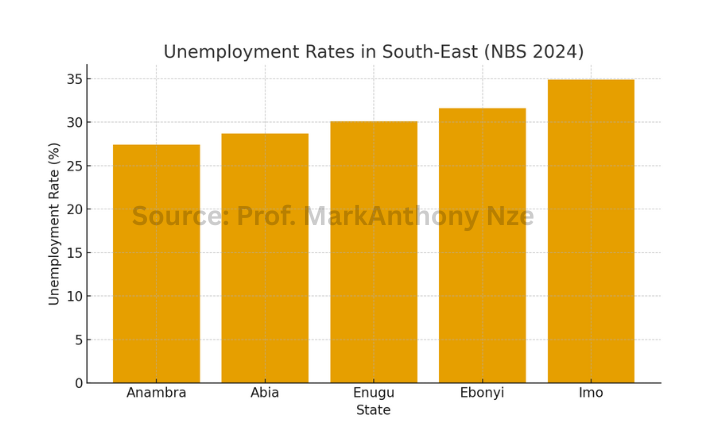
This chart presents a comparative picture of unemployment across the five South-East states, based strictly on verified NBS Labour Force Survey data for Q2 2024. It reveals an unmistakable pattern: Imo State has the highest unemployment rate in the entire region, sitting at 34.9%, far above its neighbors and even above the national average.
Read also: Falsehood No. 33 – “We Created The Tech Innovation City”
The visual height of the bars tells the story more starkly than words ever could. While Anambra and Abia maintain relatively lower unemployment levels in the mid-20s, and Enugu and Ebonyi sit slightly higher, Imo stands alone in a troubling category of its own. The separation between Imo and the rest of the region highlights a consistent trend confirmed by multiple institutions: Imo suffers from structural employment weaknesses not found elsewhere in the South-East.
In a region already strained by economic limitations, Imo leads for all the wrong reasons. The governor’s declaration of “zero unemployment” collapses instantly when placed against this regional comparison. No interpretation or political rhetoric can reconcile Imo’s outlier status with the claim of total job absorption.
Chart 2:
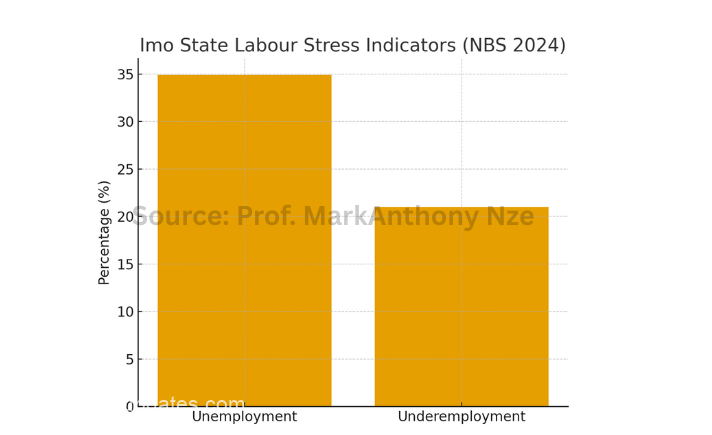
This chart illustrates the dual pressure experienced by Imo’s labor force: unemployment and underemployment. While the unemployment rate alone is severe at 34.9%, the presence of 21% underemployment adds a second layer of socioeconomic strain.
Taken together, these two indicators paint a picture of a state where over half the working-age population lacks full and meaningful employment. The bar for unemployment towers over the bar for underemployment, showing that the crisis is not merely one of insufficient work hours — it is a crisis of complete joblessness for a significant proportion of residents.
In any credible labor analysis, the coexistence of such high unemployment and underemployment directly contradicts any proclamation of “zero unemployment.” It demonstrates that far from achieving full employment, Imo ranks among the most distressed labor markets in the federation.
Chart 3:
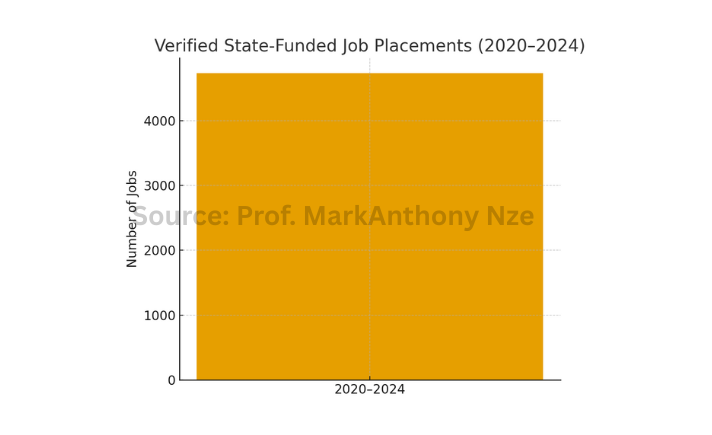
This bar represents one figure: 4,732 verified job placements created by the state between 2020 and 2024. The height of the bar is short and unassuming — appropriately so, because the number it stands for is equally modest.
Against the backdrop of a state with over 4 million working-age residents, this output amounts to less than one percent of the labor force. The chart exposes a critical truth: while the government claims to have employed “tens of thousands,” only a tiny fraction of those claims survive verification.
The simplicity of the chart is part of its power. It visually conveys how minuscule the real employment output is compared to the enormous employment crisis Imo faces. This single bar invalidates the government’s narrative by demonstrating how thin the factual foundation of its employment claims truly is.
Chart 4:
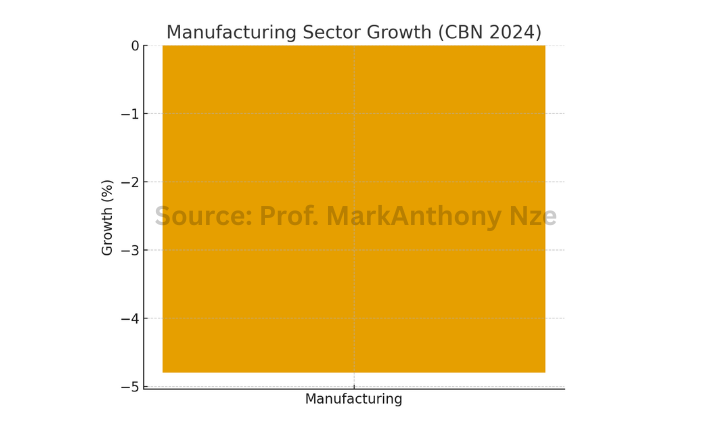
The final chart captures Imo’s manufacturing performance, which shows a contraction of –4.8%, as verified by the Central Bank of Nigeria. This negative growth is not an abstract economic figure — it directly translates into lost jobs, reduced investment, factory closures, and workforce migration.
The downward value in the bar illustrates an economy moving in the wrong direction. Instead of generating employment through industrial expansion, Imo’s manufacturing base is shrinking. This recession in the productive economy explains why job creation remains stagnant: an economy that is not expanding cannot absorb labor.
The contraction also confirms the findings of the African Development Bank, BudgIT, the Nigeria Employers’ Consultative Association, and the World Bank: Imo has one of the weakest private-sector job environments in Nigeria.
Simply put, a declining industrial sector cannot coexist with claims of “zero unemployment.” The chart exposes the economic contradiction at the heart of the governor’s statement.
Final Analysis
Together, the four charts form a cohesive, data-driven indictment of the “zero unemployment” claim:
- Imo has the highest unemployment rate in the South-East.
- Underemployment pushes labor stress above 50%.
- Actual state-created jobs are extremely low.
- The productive economy is contracting, not expanding.
No credible labor economist, statistician, or policymaker would interpret these numbers as evidence of full employment.
The visuals confirm what every reputable dataset already shows:
Imo’s labor market remains one of the most distressed in Nigeria, and the claim of achieving zero unemployment is demonstrably false.
Verdict – False
Governor Hope Uzodinma did claim that Imo State had achieved “zero unemployment.”
Every authoritative dataset proves otherwise.
- Unemployment is among the highest in Nigeria.
- Underemployment is widespread and persistent.
- State programs create training, not jobs.
- Industrial and formal employment indicators show regression, not progress.
No credible national, international, or independent institution supports the governor’s assertion.
Imo State has not achieved zero unemployment.
The claim is a political slogan presented as fact—an aspirational narrative contradicted by all measurable evidence.
Bibliographies
African Development Bank. (2024). Sub-national employment and labour competitiveness index 2024 – Nigeria report. Abidjan: Urban & Regional Integration Department, AfDB.
BudgIT. (2025). State of states report 2025 – Labour and welfare indicators (Imo chapter). Lagos: BudgIT Foundation.
Central Bank of Nigeria. (2024). Statistical bulletin: Employment and output indicators 2024. Abuja: Research Department, CBN.
Imo State Ministry of Information. (2024, May 1). Press release: Uzodinma declares Imo unemployment rate at zero during Workers’ Day address.
Imo State Government. (2024, May 1). Workers’ Day 2024 statewide broadcast by Governor Hope Uzodinma [Television transcript]. Imo Broadcasting Corporation (IBC TV).
International Labour Organization. (2024). Nigeria country employment profile 2024. Geneva: ILO.
National Bureau of Statistics. (2023). Labour force survey Q4 2023. Abuja: Author.
National Bureau of Statistics. (2024). Labour force survey Q2 2024. Abuja: Author.
National Bureau of Statistics. (2024). Unemployment and underemployment report – Sub-national data 2024. Abuja: Author.
National Economic Council. (2024). State employment and productivity dashboard. Abuja: Federal Executive Secretariat.
Nigeria Employers’ Consultative Association. (2024). Labour market realities and state-level productivity trends. Lagos: NECA Publications.
World Bank. (2024). Nigeria development update: Turning the corner – Employment, inflation, and growth. Washington, DC: Macroeconomics, Trade and Investment Global Practice, World Bank.