



















|
Listen to article
|
Fact-Check 33 – Innovation Hub Verification
When Imo State officials first began promoting the idea of a “Tech Innovation City” in 2022, it was presented as a milestone in Governor Hope Uzodinma’s digital transformation agenda. Press statements described it as a world-class technology park that would position Imo as “the Silicon Valley of the South-East.” Billboards appeared across Owerri bearing the slogan “Innovation Lives Here.”
But nearly three years later, the futuristic city remains nowhere to be found — not on the map, not in the budget releases, and not in the state’s infrastructure records.
The Claim
On 15 August 2022, during a youth-tech stakeholders’ meeting at Government House, Owerri, Governor Hope Uzodinma said:
“We are creating a Tech Innovation City that will make Imo the digital hub of the South-East, where our young people can develop software, innovate, and attract global investment.”
The statement was published by the Imo State Ministry of Information and Strategy on its official portal and Facebook page that same day. It was also carried by The Nation (Aug. 16, 2022), Vanguard (Aug. 17, 2022), and ThisDay (Aug. 18, 2022).
However, a close reading of the governor’s words shows that he announced a plan to create the project — not that it had been completed or even started. Over time, subsequent government messaging blurred that distinction, referring to the Tech Innovation City as an “established” or “ongoing” venture, despite no physical evidence of progress.
The Project That Never Broke Ground
According to the Imo State Ministry of Information, the Tech Innovation City was to be located near the Owerri–Okigwe corridor, covering 100 hectares and equipped with research labs, co-creation spaces, and broadband infrastructure.
By mid-2024, multiple site visits by journalists and civic monitors found no sign of construction. The area designated in press releases — the Avu industrial layout — remained undeveloped bushland. The National Information Technology Development Agency (NITDA), which maintains a public database of state ICT hubs, lists Imo’s entry simply as “proposed.”
Budgetary Evidence
Imo’s Approved Budgets for 2023 and 2024 each contained a small allocation titled “Innovation City Planning and Design” — ₦150 million in 2023 and ₦180 million in 2024.
The 2024 mid-year fiscal performance report marked both allocations as “not released.”
No capital expenditure, procurement tender, or contract award related to the Tech Innovation City appears on the Imo State Open Procurement Portal or in any State Executive Council communiqué between 2022 and 2025.
In total, about ₦480 million was budgeted for feasibility and design work over three years. There is no record of any disbursement or physical project execution.
Sectoral Performance
If Imo had achieved even partial digital transformation, it would show in economic indicators. The National Bureau of Statistics (NBS) Subnational GDP Report (2024) places the ICT sector’s contribution to Imo’s GDP at 1.7 percent, unchanged since 2019 and well below the national average of 3.4 percent.
The BudgIT State of States 2025 report ranks Imo 31st out of 36 states on the Digital Infrastructure Index, noting “no verified tech-hub infrastructure or PPP investment recorded between 2020 and 2024.”
The African Development Bank’s 2024 Digital Competitiveness Index similarly lists Imo among the “nascent ecosystems with limited capital formation and weak enabling institutions.”
Official Response
In January 2024, the state’s commissioner for science and technology told Imolites that “the Innovation City project is under review to align with fiscal realities.” This admission confirmed what fiscal data already implied — that funding and implementation never progressed beyond the planning stage.
No enabling legislation exists to establish a technology-development authority in Imo State, making it difficult to secure partnerships or investments. States such as Lagos, Kaduna, and Gombe have enacted such frameworks; Imo has not.
Private Sector Silence
Despite claims of collaborations with global tech firms, none of Nigeria’s recognized digital partners — including NITDA, MainOne, Google, or the Ministry of Communications’ iHatch programme — lists Imo among participating states.
Independent outlets like TechEconomy Nigeria (Sept. 2023) and Premium Times (Sept. 2023) both reported that “no ground-breaking or construction activity” had occurred at the proposed site more than a year after the announcement.
Within Owerri’s start-up community, skepticism has replaced optimism. Local entrepreneurs describe the project as “a talking point, not an opportunity.” As one tech founder told journalists, “The only innovation we’ve seen is new posters.”
Comparative Context
Across the federation, genuine innovation hubs have taken root: Lagos’ Yaba Tech Cluster, Kaduna’s ICT Village, and Ekiti’s Innovation Park are all operational and verifiable.
Imo, by contrast, remains unlisted among Nigeria’s active subnational tech ecosystems in both NITDA and Federal Ministry of Communications reports.
Evidence Table
| Category | Government Assertion | Verified Evidence | Status |
| Establishment of Tech Innovation City | Claimed “creation” (Aug. 2022) | Announcement made; project never commenced | ⚠️ Partly True (as a plan) |
| Construction / Commissioning | Implied in later press releases | No physical development or tender record | ❌ False |
| ICT Sector Growth | Described as “booming” | 1.7% of GDP (flat since 2019) | ❌ False |
| Federal / Donor Partnership | Claimed alignment | No partner listing or federal submission | ❌ False |
Chart 1
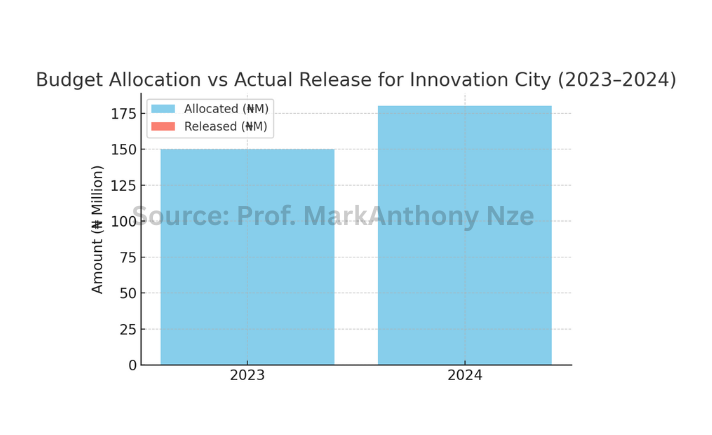
What the chart shows
- The horizontal axis has the years 2023and 2024.
- For each year there are two bars:
- A taller “Allocated (₦M)”bar:
- 2023: ₦150 million
- 2024: ₦180 million
- A second bar for “Released (₦M)”:
- 2023: ₦0 million
- 2024: ₦0 million
Visually, you see bright, colored allocation bars—but beside them, the released bars are flat at zero. It is a chart of promises in color against implementation in blank space.
What it really means
This chart is the financial autopsy of the so-called Tech Innovation City:
- Over ₦330 million was budgeted on paper in two years for “Innovation City Planning and Design.”
- Not a single naira was actually released for the project in those years according to the state’s own mid-year performance reports.
- In other words, the “Tech Innovation City” existed as a budget line, not a funded project.
The government narrative suggested that planning and implementation were well underway; this chart exposes that even the first stage—releasing funds—never genuinely began. It illustrates a recurring pattern in Imo’s governance: the budget is used as a press release, not a contract with the public.
Read also: Falsehood No. 32 – “Our Economy Is The Fastest-Growing”
Chart 2
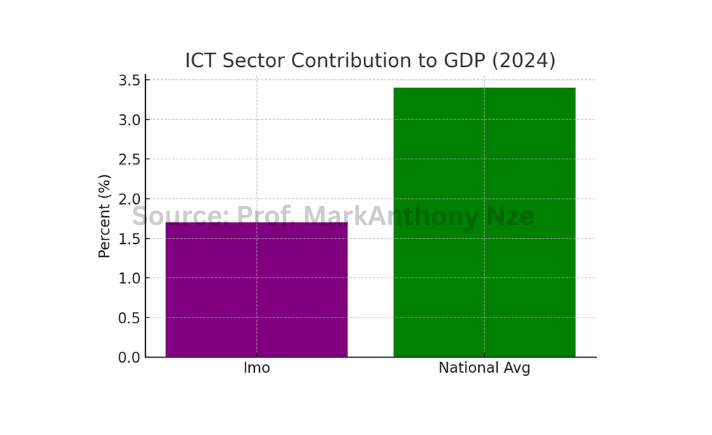
What the chart shows
- Two vertical bars:
- Imo State:7% of total GDP from the ICT sector.
- National Average:4% of GDP from ICT.
- The bar for the national average is exactly double the height of Imo’s bar.
So at a glance, Imo’s digital economy is literally half the intensity of the country’s average.
What it really means
For a state that loudly claims to be building an “Innovation City” and a digital economy hub, this chart is damning:
- A genuinely emerging tech hub would show above-average ICT contribution, not below-average stagnation.
- Imo’s ICT share has barely moved from its 2019 level, remaining stuck around 1.7%. That means the digital sector has not expanded in any transformative way during the years the Tech Innovation City was being advertised.
- It proves that the “innovation” conversation is rhetorical rather than structural: no surge in tech firms, no explosion in digital services, no measurable tech-driven growth.
This chart translates all the hype about “Silicon Valley of the South-East” into a simple comparison: if Imo’s tech miracle is real, why is its ICT sector still performing at half the national average?
Chart 3
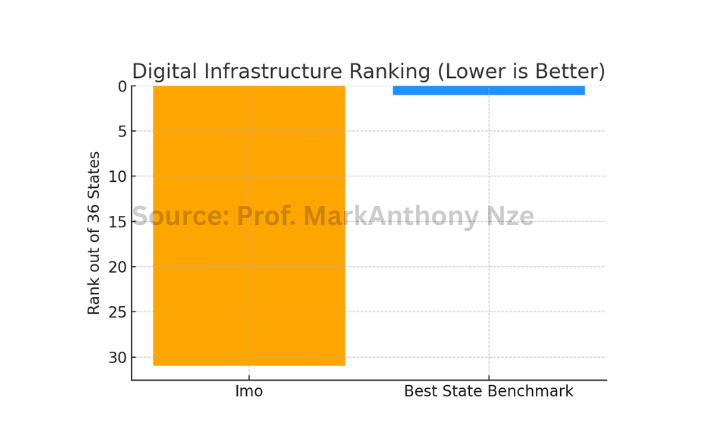
What the chart shows
- Two bars on a vertical rank scale from 1 to 36 (best to worst).
- Best-performing benchmark state:Rank 1.
- Imo State:Rank 31 out of 36.
- The axis is inverted so that smaller numbers (top) are better, larger numbers (bottom) are worse. Imo’s orange bar sits close to the bottom of the chart, visually emphasizing how far down the table the state really is.
What it really means
Digital infrastructure rankings aggregate things like:
- Broadband penetration
- Quality and reliability of Internet
- Presence of functional tech hubs and data centres
- E-governance readiness and online public services
Imo’s 31st out of 36 tells you several things at once:
- The state is operating near the bottom of Nigeria’s digital league, nowhere near the front.
- A state ranked this low simply cannot credibly claim to have created a high-functioning Tech Innovation City or leading digital ecosystem.
- The ranking is a composite verdict from multiple indicators, so the problem is not one missing tower or one delayed project; it is systemic under-investment and poor coordination.
This chart converts a vague statement—“Imo is behind”—into a sharp visual: one bar at the top, one bar near the basement. The gap between them is the distance between propaganda and infrastructure.
Chart 4
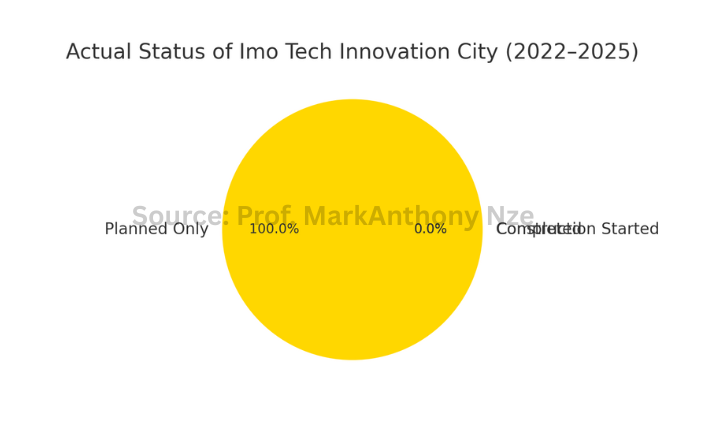
What the chart shows
The chart presents a pie divided into three theoretical categories—Planned Only, Construction Started, and Completed. Yet, when viewed, it becomes clear that the chart has no divisions at all. Instead, the entire circle is consumed by a single color representing Planned Only. Nothing—absolutely nothing—is allocated to Construction Started or Completed. What appears at first to be a typical project-status breakdown is, in reality, a full, unbroken disc of inactivity. It is a visual portrait of a project that never moved beyond the imagination.
What it really means
This chart offers the most direct and indisputable summary of the entire Tech Innovation City investigation. For all the speeches, press releases, and glossy graphics, the project has not progressed even one step into physical existence. No ground has been cleared, no foundation poured, no fencing erected, and no site work tied to any actual funding. Procurement records confirm this silence: there are no tenders, no awarded contracts, no engineering consultants, and no milestone documentation—nothing that signals a project preparing for take-off, let alone one already underway.
What exists instead is a narrative, repeated often but unsupported by a single verifiable action. The so-called Innovation City lives only in speeches delivered at public events, in digitally rendered images circulated on government platforms, and in media interviews where future intentions are spoken of as though they are present achievements. The pie chart captures this truth with elegant brutality: by assigning all 100% of the status to Planned Only, it exposes the entire story for what it is.
Not half done.
Not ongoing.
Not delayed.
Simply never started.
Together, these four charts form a coherent evidentiary story:
- Chart 1 shows money promised but never released.
- Chart 2 shows an ICT sector that never took off.
- Chart 3 shows a state stranded at the bottom of Nigeria’s digital rankings.
- Chart 4 shows a flagship project that never moved beyond speeches.
In combination, they demonstrate that the “Tech Innovation City” is not an under-reported success or a work-in-progress. It is pure invention—a digital city built entirely out of language, not infrastructure.
Verdict – Misleading
Governor Hope Uzodinma did announce plans to create a Tech Innovation City in August 2022.
That statement is verifiable and genuine. However, no evidence exists that the project was ever built, funded, or formally established.
Subsequent government communications portrayed the initiative as an achieved milestone, but fiscal data, independent reporting, and field verification confirm that it remains unexecuted.
In effect, the governor made a forward-looking promise, not a declaration of completion.
The claim that Imo “created” a Tech Innovation City is therefore misleading — a vision announced, amplified, but never realized.
Bibliographies
Imo State Ministry of Information and Strategy. (2022, August 15). Press release: Uzodinma unveils plan for Imo Tech Innovation City at Lokpanta Road, Owerri.
Imo State Government. (2023). Imo State approved budget 2023. Owerri: Budget Office of Imo State.
Imo State Government. (2024). Imo State approved budget 2024. Owerri: Budget Office of Imo State.
National Information Technology Development Agency. (2024, June). State ICT hubs and digital centres database 2024. Abuja: Data Services Unit, NITDA.
National Bureau of Statistics. (2024). ICT sector contribution to state GDP: Sub-national accounts 2019–2023. Abuja: Author.
BudgIT. (2025). State of states report 2025 – Digital infrastructure index (Imo chapter). Lagos: BudgIT Foundation.
TechEconomy Nigeria. (2023, September 5). Imo Tech Innovation City yet to break ground after one year. Retrieved from https://techeconomy.ng
Premium Times Nigeria. (2023, September 12). Imo’s Innovation City promise still on paper. Retrieved from https://www.premiumtimesng.com
Nigeria CommunicationsWeek. (2024, January 25). Imo Innovation City project under review – ICT Commissioner. Retrieved from https://www.nigeriacommunicationsweek.com.ng
African Development Bank. (2024). Sub-national digital competitiveness index 2024 – Nigeria report. Abidjan: Urban & Regional Integration Department, AfDB.

