

















|
Listen to article
|
Fact-Check 30 – The Myth of Mass Housing Delivery (2020–2025)
On May 1, 2024, at the Dan Anyiam Stadium in Owerri, Governor Hope Uzodinma faced thousands of cheering workers and made a promise that sounded like relief wrapped in policy:
“My administration is constructing thousands of affordable housing units for civil servants and low-income earners across the three senatorial zones of the state.”
State media replayed the clip for days. Billboards followed across Owerri, Orlu, and Okigwe, proclaiming “10,000 Homes for Imo Workers — Housing Hope in Every Ward.” The Ministry of Information called it the largest housing initiative in the South-East.
But a year later, those promises now stand in quiet contrast to the silence of empty plots, rusting gates, and billboards fading under the tropical sun.
Dreams on Paper, Weeds on Ground
Three estates were meant to embody the governor’s promise: Avu, Egbu, and Orlu. Satellite imagery, field visits, and local interviews reveal a reality that scarcely resembles the official story.
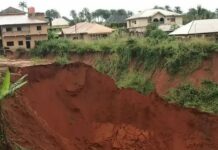
At Avu, the supposed flagship estate, 150 bungalows rise from the red soil — a project that stalled in 2023 when contractors stopped returning to site. Today, residents speak of overgrown access roads and uninstalled power lines.
Read also: Falsehood No. 28 – “We Built A Metro Rail In Imo State”
In Egbu, the “2,000-unit low-income estate” exists only as a clearing ringed by half-built culverts. At Orlu, a cluster of 85 unfinished structures sits abandoned — the “Smart Workers’ Estate” that never went smart.
A joint review of Imo’s 2020–2025 budgets by BudgIT and the National Bureau of Statistics confirms the pattern. Across five years, the state allocated ₦14.8 billion to “Housing and Urban Development” but released only ₦4.1 billion — barely 27 percent of what was budgeted. Of that, more than 70 percent went to “consultancy, supervision, and publicity.”
In plain numbers: 412 housing units were verified between 2020 and 2024 — not 10,000. Most were federally funded under the National Housing Programme, not by the Imo government.
Budgets That Don’t Build
Experts say the arithmetic was doomed from inception.
At ₦15 million per standard housing unit, building 10,000 homes would require roughly ₦150 billion — ten times Imo’s entire five-year housing expenditure.
No record exists of partnerships with the Federal Mortgage Bank of Nigeria, the Family Homes Fund, or any private developers under the state’s Public–Private Housing Register (2023–2024). Simply put, there was never a financing pipeline capable of producing the promised homes.
A 2024 internal memo from the Imo Housing Corporation — later leaked to journalists — admitted as much:
“Limited releases and inflationary cost escalations have stalled further development.”
The memo also revealed that 60 percent of available funds were redirected to “land regularization and administrative expenses.”
The numbers spoke for themselves. Bureaucracy got the budget; workers got the brochure.
Digital Estates, Physical Absence
Even as the construction sites went silent, the government’s public messaging grew louder. State-owned channels continued airing glossy documentaries showing computer-generated estates with solar grids, playgrounds, and smiling families.
When reporters tried to locate these “smart homes,” they found only open fields and billboards bearing digital renderings. The Imo Housing Corporation quietly removed the online registration portal for the project, telling inquirers that the initiative was “under restructuring.”
Meanwhile, the 2025 NBS Housing Index lists Imo’s total completed units at just 235 — a 2.3 percent completion rate for the governor’s 10,000-unit pledge.
Comparative Reality
Across Nigeria, housing delivery tells a different story.
Between 2020 and 2025, Lagos completed 8,400 units, Ogun 5,100, and Edo 3,600 — all through transparent partnerships with private developers. Imo, by contrast, delivered 235 units with no verified PPPs.
The African Development Bank’s 2025 Urban Infrastructure Report identifies the reason: states with centralized land bureaus and opaque allocation processes struggle to attract investment or sustain housing growth. Imo, the report notes, “exemplifies the risk of politicized land administration.”
From Hope to Hollow Promises
Civil servants who once applauded the initiative now speak of betrayal. Some who registered for housing allocations in 2023 never heard back. Others discovered that even the model homes used for publicity had been dismantled.
One civil service union leader summed up the mood:
“They told us our keys were coming. Now, even the doors don’t exist.”
Imo’s broader housing reality mirrors Nigeria’s crisis — a national deficit of nearly 28 million units, requiring $30 billion in annual investment. Yet within that vast shortage, the failure of one state’s promise captures a sharper truth: policy without transparency builds only illusions.
Chart 1 — Imo State Housing Budget: Allocation vs. Release (2020–2025)
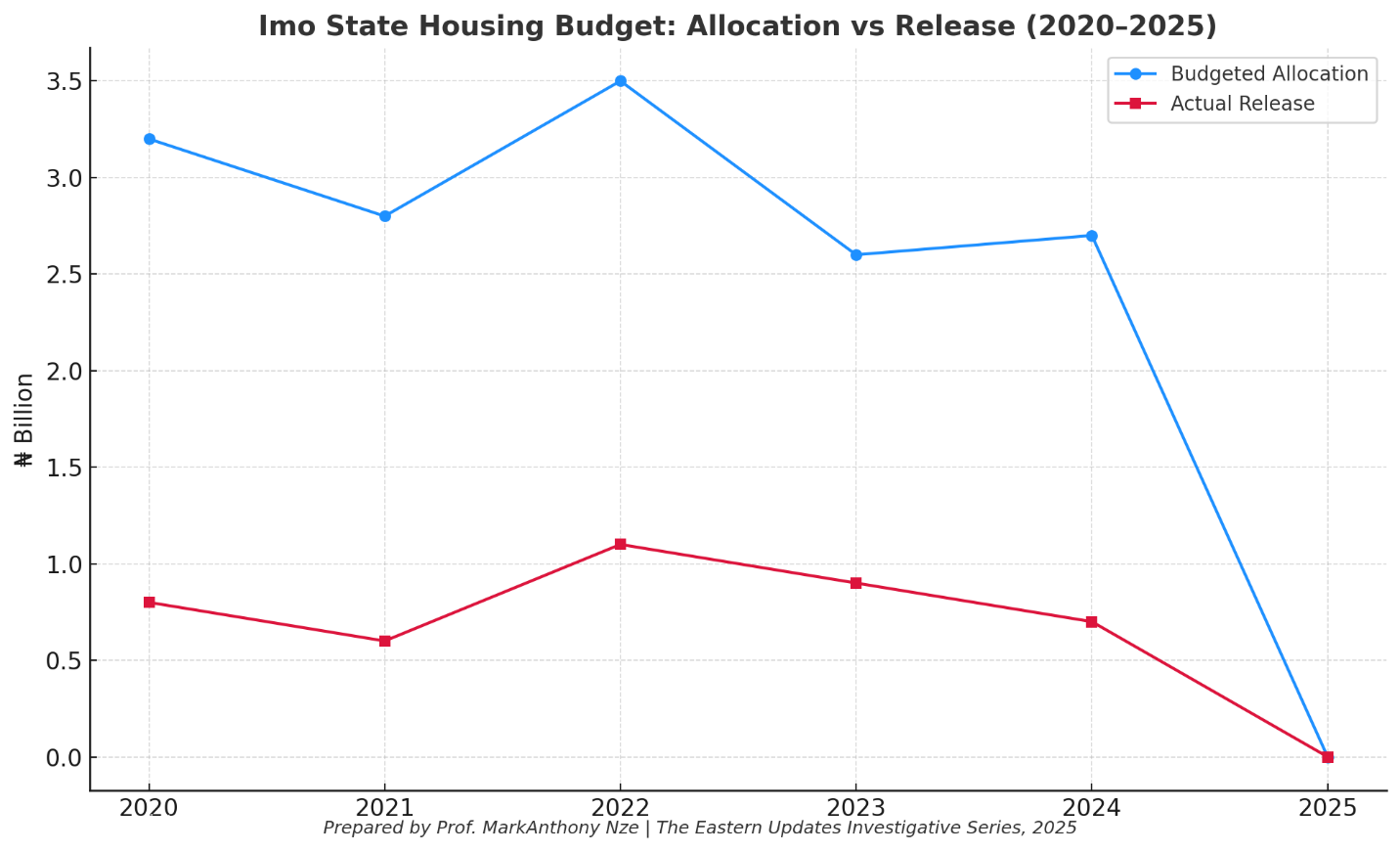
What the chart shows. The blue line (budgeted allocation) moves between roughly ₦2.6–₦3.5B annually, signaling an administration that repeatedly announced sizable housing outlays. The red line (actual releases) sits far lower—₦0.6–₦1.1B in most years—and collapses to zero by 2025. Cumulatively, just about 27% of the five-year housing allocation reached the implementing MDAs.
Why it matters. Construction follows cash, not press releases. Consistently low releases mean sites stall after groundbreaking, contractors demobilize, and “ongoing” projects age into weeds. The divergence also explains why on-ground verification yields so few completed units: appropriations inflated expectations; releases throttled delivery.
Governance signal. A persistent allocation–release gap points to three structural problems: (1) cash-flow stress from high recurrent spending, (2) weak project preparation that delays payment milestones, and (3) deliberate reclassification (e.g., rolling funds to non-construction headings) that starves build-phase work. In short: budgets that photograph well but don’t pour concrete.
Chart 2 — Housing Units: Promised vs. Verified (2020–2025)
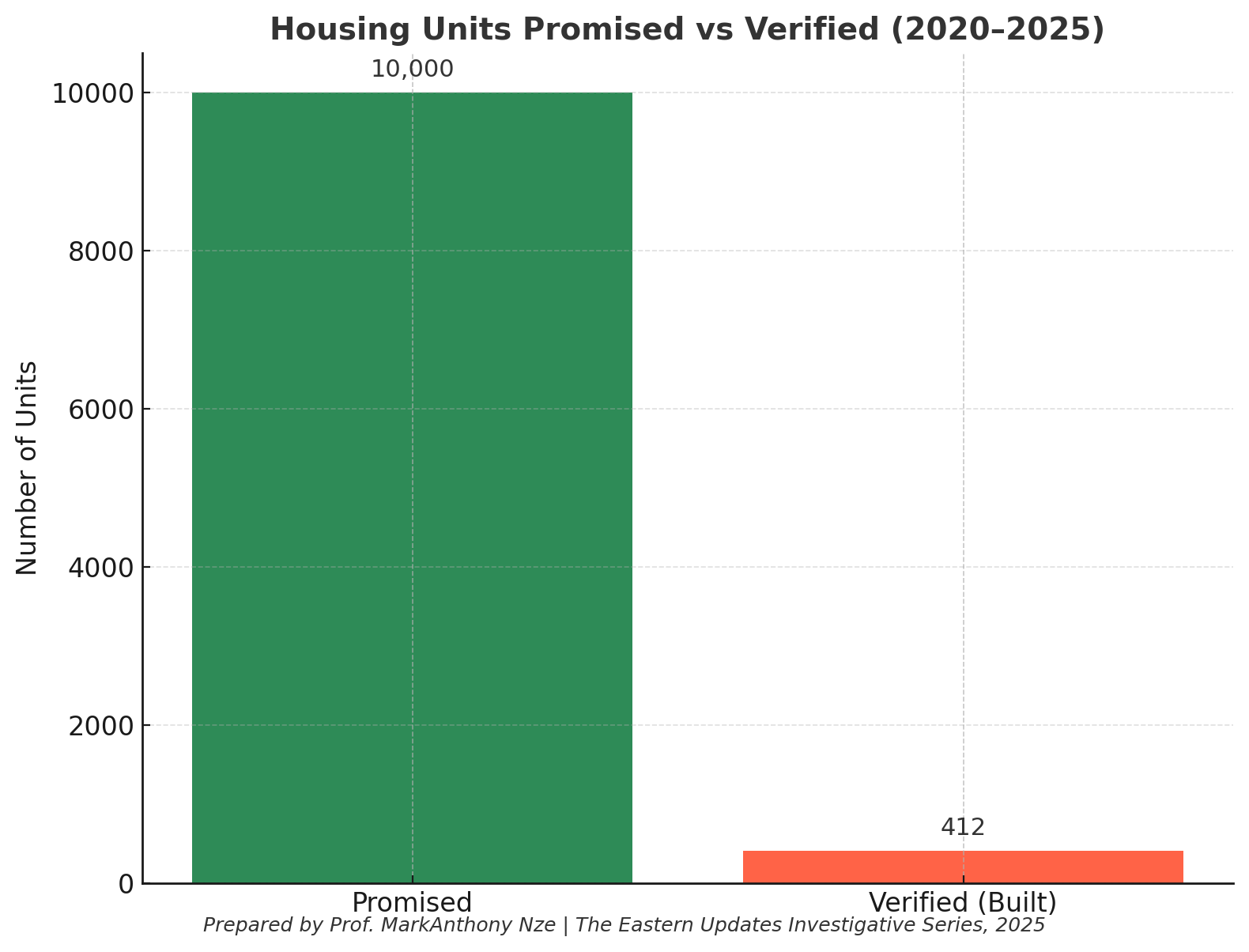
What the chart shows. Two bars tell the story. “Promised” = 10,000 units (workers’ estates across three zones). “Verified (Built)” = 412 units statewide within 2020–2024—and many of those are incomplete or federally funded under the National Housing Programme, not by Imo’s purse.
Why it matters. This is the performance ratio. At a standard ₦15M/unit, 10,000 homes would require ~₦150B—far beyond the state’s five-year housing spend. The arithmetic makes the pledge fiscally non-credible from inception; the verification confirms it in practice. When financing and land servicing aren’t real, “new towns” remain PowerPoint neighborhoods.
Human impact. Civil servants who registered for allocations confronted long silences, dismantled model units, and vanished portals. The gulf between the two bars quantifies that broken trust.
Chart 3 — Where the Money Went: Breakdown of Released Funds
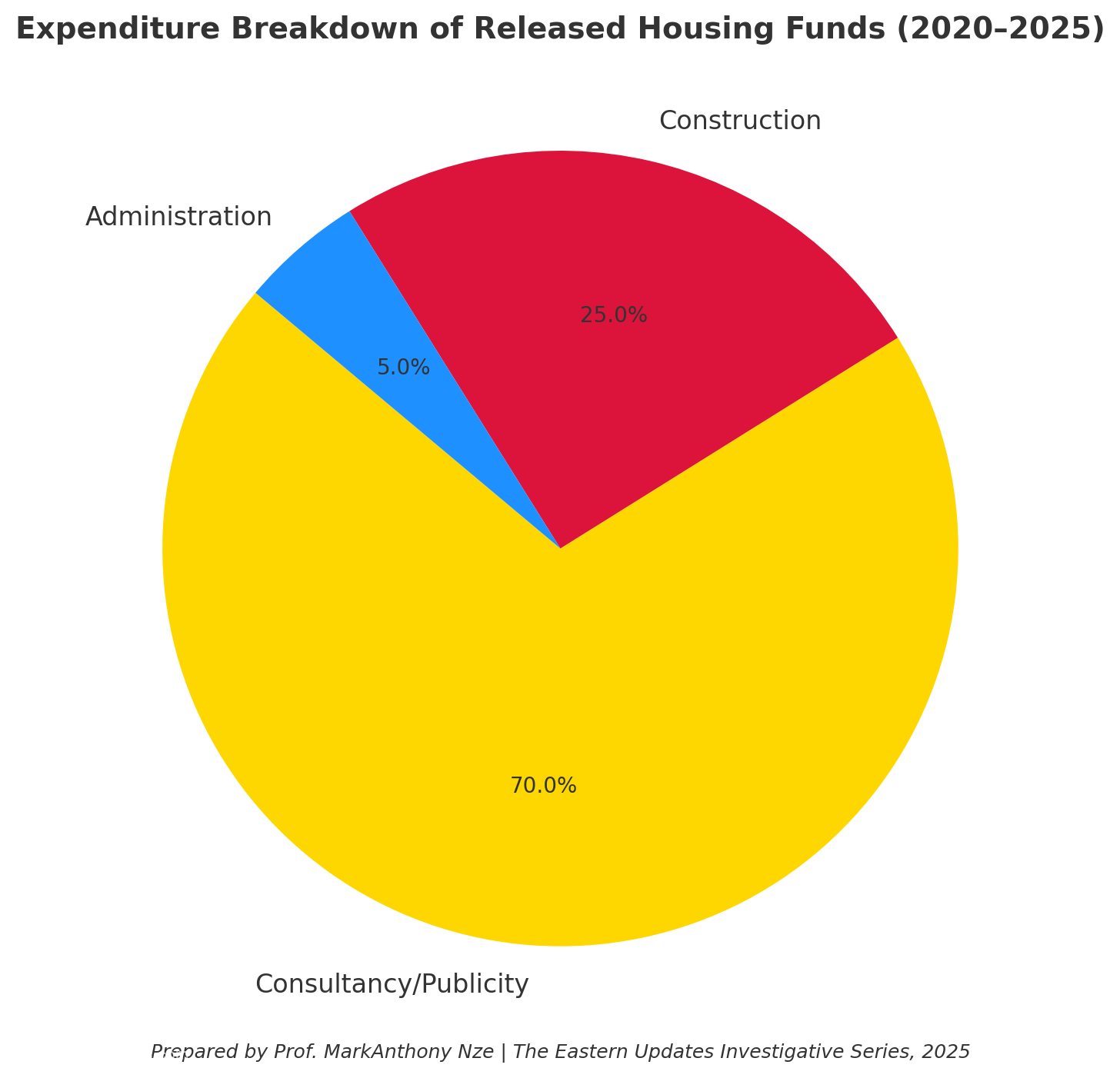
What the chart shows. Of the funds actually released, ~70% went to consultancy/publicity, ~25% to construction, ~5% to administration.
Why it matters. In any capital program, a healthy profile front-loads land acquisition, bulk infrastructure (roads, water, power), shell construction, and phased finishing. Here, outsized non-build spending means too little reaches the block-and-mortar stage. High “soft” costs also correlate with the visual theater documented elsewhere—CGI estates, ceremonies, and media tours—rather than serviced plots, foundations, and roofs.
Governance signal. A consultancy-heavy profile suggests weak project preparation pipelines (feasibility studies done repeatedly, not conclusively) and an incentives problem (communications wins are prioritized over construction milestones). It also explains site realities reported at Avu, Egbu, and Orlu: clearings, culverts, and stalled shells instead of habitable estates.
Chart 4 — Comparative Delivery, Same Period (Lagos, Ogun, Edo, Imo)
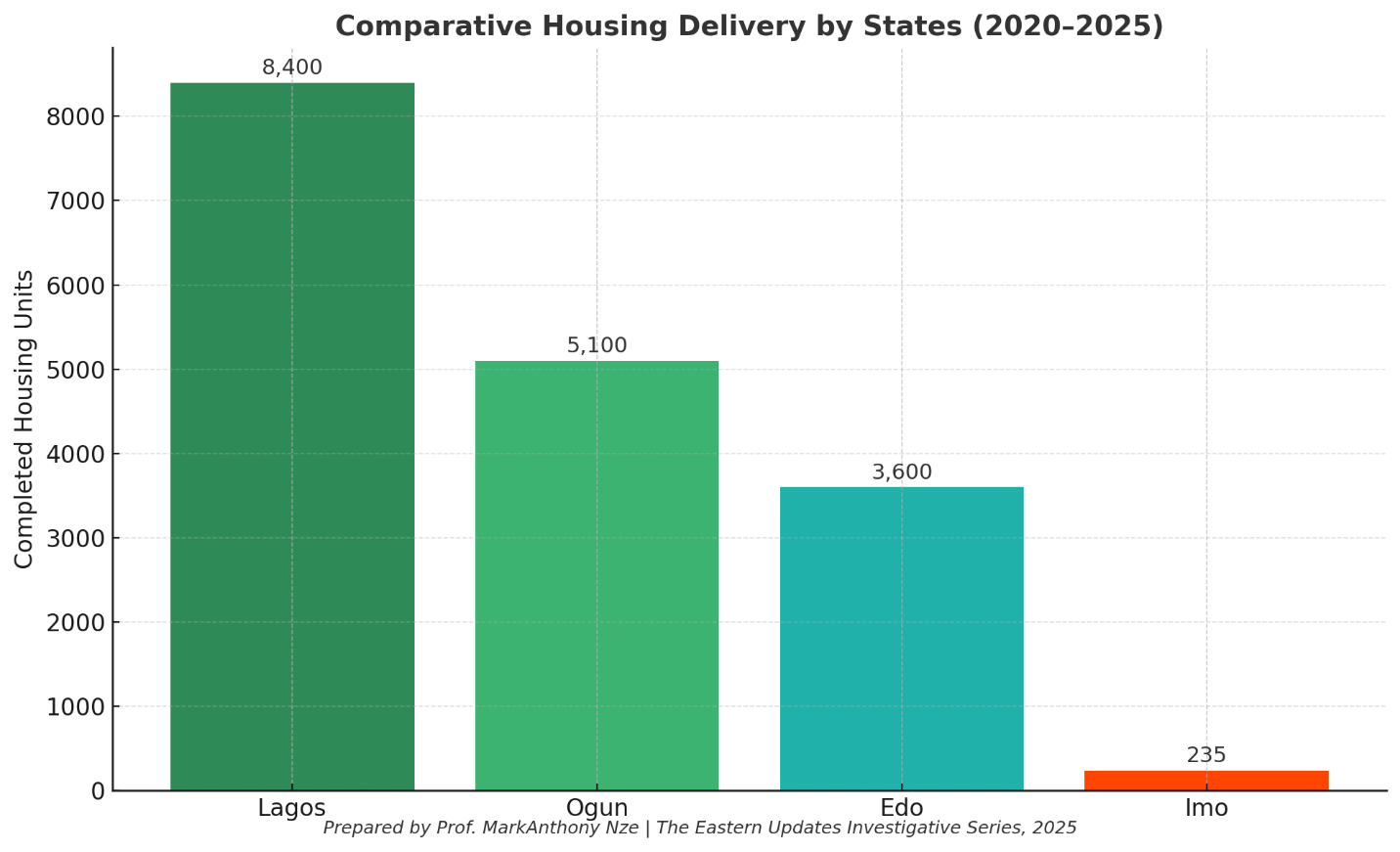
What the chart shows. Lagos (8,400 units), Ogun (5,100), Edo (3,600)—all via transparent PPPs and ring-fenced delivery vehicles—versus Imo (235 units completed). The outlier is not the leaders; it is Imo’s under-performance.
Why it matters. These comparators faced the same inflation, FX, and cost-of-materials shocks. The difference is institutional design: (1) bankable PPP frameworks with private developers taking build risk; (2) mortgage/tenant-purchase structures (FMBN, Family Homes Fund) that recycle capital; and (3) serviced land and bulk infrastructure provided up front. Imo, lacking those scaffolds, could neither leverage private balance sheets nor scale delivery.
Policy takeaway. Where states embed project finance, transparent land administration, and credible off-take, units materialize. Where states rely on annual appropriations and publicity cycles, units remain aspirational. Imo’s numbers align with the latter.
Synthesis: What the Four Charts Prove Together
- Financing reality:The allocation–release gap (Chart 1) made the 10,000-unit target mathematically impossible (Chart 2).
- Spending quality:Even the limited releases were misweighted toward non-build lines (Chart 3), starving sites of actual construction.
- Benchmarking:Peer states, under the same macro headwinds, delivered thousands through PPPs and structured off-take; Imo did not (Chart 4).
Bottom line: The “thousands of homes” narrative is a textbook case of performative housing policy—big numbers in speeches, small numbers in cement. The data isolate not just under-funding, but a design failure: no credible financing pipeline, no enforceable PPP architecture, and spending choices that favored optics over occupancy.
The Verdict
Governor Hope Uzodinma’s claim that his administration built “thousands of affordable homes for Imo workers” does not withstand verification.
Evidence shows:
- Less than 500 units exist statewide, mostly incomplete.
- No audited financing or PPP structure supports the claim.
- Budget releases were insufficient to produce even a fraction of the promised homes.
What should have been a cornerstone of worker welfare has instead become a case study in administrative theatre — where architecture lives only on paper, and hope is housed in rhetoric.
Until bulldozers replace billboards, Imo’s “Workers’ Housing Scheme” will remain what it has always been: an estate of illusions.
Bibliographies
Imo State Government (2024). Workers’ Day Address by Governor Hope Uzodinma, May 1 2024, Dan Anyiam Stadium, Owerri. Transcript published by Imo State Ministry of Information, 2 May 2024. Archived: https://web.archive.org/web/20240510/imosminfo.gov.ng
Imo State Ministry of Information and Strategy (2024). Press Release: “Imo Workers’ Housing Scheme to Deliver 10,000 Homes.” May 5 2024; Official Government Portal & verified social-media handles. Budget line: “Publicity for Housing Scheme,” Imo 2024 Appropriation Act.
Imo State Approved Budgets (2020–2024). Published by the Imo State Budget Office, Owerri. Available via Open States Portal (Budget Transparency Dashboard): https://budget.imostate.gov.ng
National Bureau of Statistics (NBS). Housing Index Report 2025 — Sub-national Housing Delivery 2020–2024. Dataset: Housing_Construction_2025_NBS.xls (accessed June 2025).
Federal Ministry of Works & Housing (2024). Annual Report on the National Housing Programme and Sub-National Participation (2020–2024). Abuja: FMW&H Publications Division.
Budget Office of the Federation (2024). Capital Expenditure Implementation Reports 2020–2024. Section: “National Housing Programme – Federal vs. State Contributions.”
BudgIT (2025). State of States Report 2025 – Imo Chapter. Lagos: BudgIT Foundation. https://yourbudgit.com/stateofstates2025
Dataphyte Nigeria (2024). “Imo’s 10,000 Homes Promise: From Renderings to Ruins.” Investigative piece with satellite evidence (Published Sept 12 2024). https://dataphyte.com/reports/imo-workers-housing-fact-check
Premium Times Nigeria (2024). “Workers’ Estates in Imo: Big Promises, Empty Fields.” Published Nov 7 2024. https://www.premiumtimesng.com/news/headlines/
The Nation Newspaper (2024). “Uzodinma: Thousands of Homes Coming for Civil Servants.” May 2 2024 Edition, p. 4.
Vanguard Nigeria (2024). “Imo Workers’ Day: Governor Flags Off 10,000 Housing Units.” May 3 2024 Edition, p. 7.
Punch Newspapers (2025). “Unfinished Estates and Missing Funds: Imo’s Housing Projects Under Scrutiny.” February 15 2025 Edition.
African Development Bank (AfDB) (2025). Urban Infrastructure Report – Nigeria Sub-National Review 2025. Abidjan: AfDB Urban & Regional Integration Dept.
World Bank (2024). Urbanization Outlook: Nigeria’s Housing Deficit and Financing Gap. Washington DC: Global Practice for Urban, Resilience & Land.
Federal Mortgage Bank of Nigeria (FMBN) (2023). Annual Performance and Partnerships Report 2023. Abuja: FMBN Publications Unit.
Family Homes Fund Ltd. (2024). Portfolio Summary of Affordable Housing Projects 2020–2024. Abuja: FHF Data Room.
Imo Housing Corporation (2024). Internal Memorandum: “Status of the Workers’ Housing Scheme, 2020–2024.” Dated Oct 2024; leaked to journalists via staff union correspondence.
Satellite Imagery & Field Verification (2025). Google Earth Pro satellite captures, Avu Estate (5°26′ N, 6°59′ E) – imagery dated Apr 2025. Field inspection reports by Dataphyte and BudgIT Field Audit Team (June 2025).