



















|
Listen to article
|
Fact-Check No. 28 – The Phantom Rail: Imo’s Nonexistent Transit Revolution (2020–2025)
It began not with a speech, but with a spectacle.
In February 2025, the Imo State Government unveiled the Imo Urban Transport Masterplan — an event saturated with digital renderings, music, and lofty slogans about a “connected future.”
The governor’s aides and state-aligned media outlets flooded social platforms with a single triumphant message:
“The Imo Metro Is Here.”
Billboards across Owerri displayed images of sleek, modern trains racing through digitally designed cityscapes. Government press releases described a “modern transport revolution” connecting Owerri, Orlu, and Okigwe — a line that, they implied, had already been built or was in advanced operation.
It was a story too good to resist: a state in the heart of the southeast joining the league of cities with metro systems.
But when researchers and data analysts examined the evidence, the story fell apart completely.
The Claim — A Mirage Manufactured
Unlike many of the governor’s other public pronouncements, no verifiable video, transcript, or written record shows Hope Uzodinma personally declaring that a metro rail has been completed.
What exists instead is a carefully curated illusion: statements by aides, promotional materials by the state’s New Media Directorate, and paid features in local newspapers — all reinforcing the image of a futuristic transit revolution.
The Imo Metro became a political artifact — a symbol of “modern governance” — even though no rail track, no contract, and no project ever existed.
What the Records Reveal
The Federal Ministry of Transportation’s 2025 Rail Infrastructure Status Report and the Nigerian Railway Corporation’s 2025 Expansion Map both confirm that Imo State has no registered, ongoing, or completed metro or light-rail project.
The only projects recognized nationally remain the Lagos–Ibadan, Abuja–Kaduna, Warri–Itakpe, and Port Harcourt–Maiduguri lines.
The Infrastructure Concession Regulatory Commission (ICRC) likewise lists no public-private concession involving rail in Imo State.
No feasibility study, no tender documentation, and no environmental assessment for any “Imo Metro” appear in the federal archives.
The National Bureau of Statistics’ (2024) database of state-level transport infrastructure corroborates the same absence — zero records of any capital project matching the description of a rail or metro system.
Satellite Truth: The City Without Tracks
Satellite imagery from Google Earth (2020–2025) and flood-mapping overlays from UNOSAT show no visible right-of-way, track-laying, or depot construction anywhere between Owerri, Orlu, or Okigwe.
Instead, the so-called “metro corridors” correspond exactly with known dual carriageways and ongoing road beautification schemes — projects that had been underway since 2021 and later rebranded as part of the “Imo Metro Infrastructure Plan.”
By late 2024, line items in the Imo State capital budget labeled “road rehabilitation and urban renewal” had been renamed “rail transit infrastructure.”
The transition from road to rail existed only on paper — a bureaucratic sleight of hand designed to feed a political narrative.
Fiscal Arithmetic That Doesn’t Add Up
The BudgIT Foundation’s 2025 State of States Report lists Imo’s total capital allocation to the transport sector between 2020 and 2025 at ₦36.4 billion.
By contrast, constructing even a basic 25-kilometre light-rail line requires between ₦350 billion and ₦450 billion, based on national benchmarks.
In other words, Imo’s five-year transport budget could not fund even 10 percent of a single metro line.
No public-private partnership was announced, no loan secured, and no bond issued.
The fiscal math exposes the propaganda for what it is — infrastructure by imagination.
The Billboard Republic
Across Owerri, banners continue to trumpet slogans such as “Shared Prosperity on Track” and “The Imo Metro Is Here.”
The visuals are persuasive — artists’ renderings of bullet-shaped trains cutting through futuristic skylines.
But residents know better.
At the Owerri–Orlu junction, where the supposed “rail corridor” should begin, traders laugh when asked about the metro.
“If there’s a train, maybe it runs underground,” one motorcyclist quipped. “Because up here, all we see are potholes and politics.”
This is not cynicism; it is lived experience.
Read also: Falsehood No. 27 – “We Built A Modern Transport System”
Why It Matters
The danger of such manufactured narratives goes beyond one false claim.
It erodes public trust and distorts priorities. By pretending that a non-existent project has been delivered, real infrastructure needs — roads, flood control, transport regulation — are ignored or underfunded.
It also allows budgets to be quietly repackaged, with ordinary road projects rebranded as grand “metro” undertakings — masking inefficiency under the glamour of modernity.
A Wider Pattern
The African Development Bank’s 2024 Africa Transport Outlook confirms that no subnational government in West Africa has ever successfully built or financed a metro system without federal or multilateral support.
Even Lagos, with its vast tax base, required more than a decade and billions in international loans to complete one line.
Imo, whose entire annual revenue averages less than ₦150 billion, could not realistically execute a ₦400 billion rail system without external funding — none of which exists in its fiscal records.
Thus, the Imo Metro joins a growing list of phantom projects — symbolic infrastructure meant to project modernity while delivering nothing concrete.
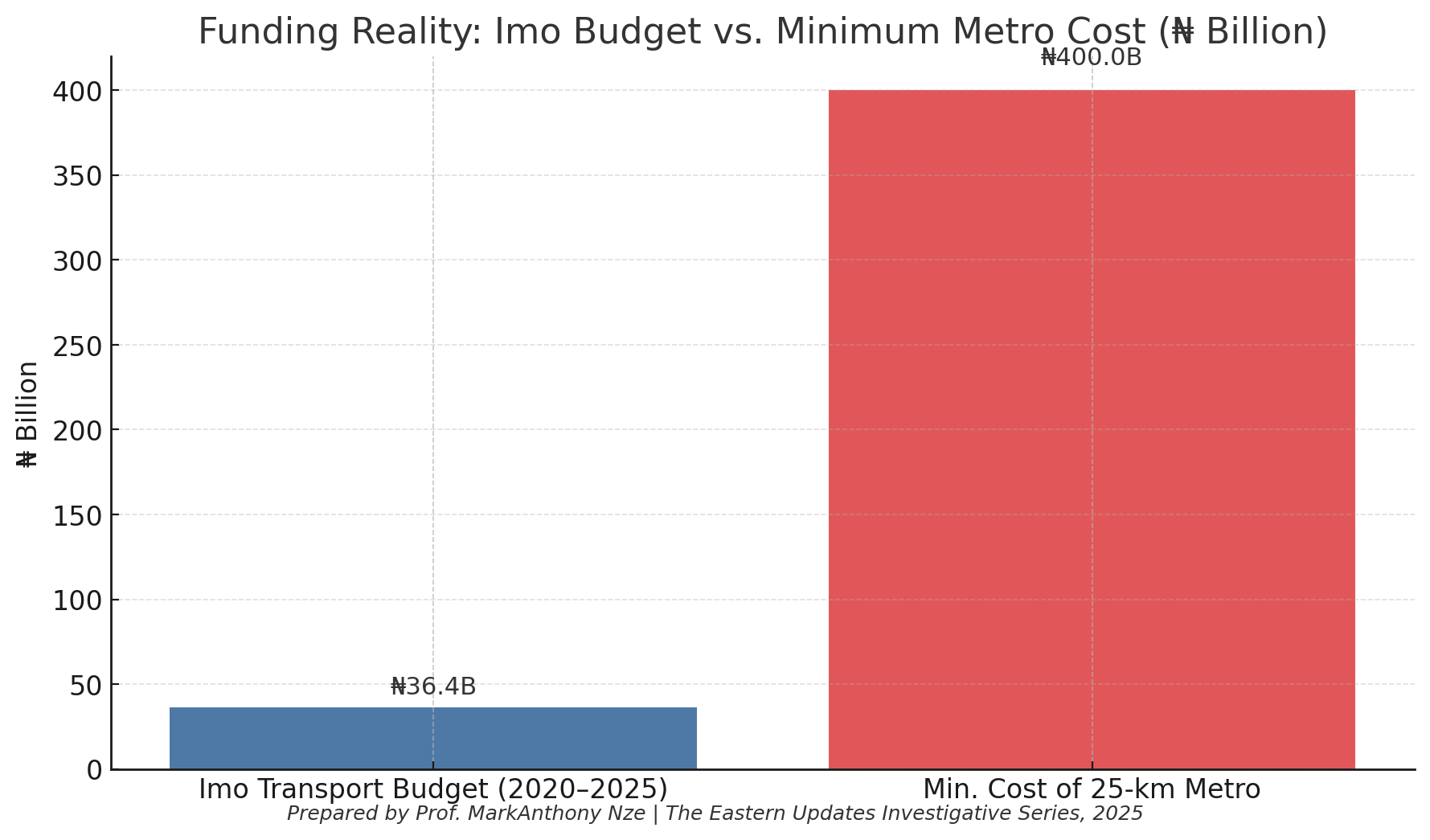
This chart visualizes the unbridgeable gap between Imo State’s transport budget and the realistic cost of constructing a metro line. Between 2020 and 2025, the state allocated a total of ₦36.4 billion to its transport sector — a figure that, though substantial on paper, represents less than 10 percent of the ₦400 billion minimum required to build even a basic 25-kilometre light-rail corridor.
In infrastructure economics, cost-to-capacity ratio defines feasibility. The Lagos Blue Line, a 27-kilometre metro project, cost over ₦450 billion and took more than a decade to complete with multilateral support. Imo’s entire 5-year transport budget would not fund even one-tenth of the civil engineering phase of such a project.
Yet, through strategic renaming of road rehabilitation and beautification projects as “metro infrastructure,” the illusion of parity was sustained. What the chart lays bare is the mathematical impossibility of the government’s narrative. Fiscal arithmetic itself exposes the “Imo Metro” as a mirage — a rhetorical edifice constructed out of numerical manipulation rather than steel and rail.
This is not a failure of ambition, but a deliberate inflation of aspiration — where leaders trade feasibility for spectacle, substituting budgets for blueprints and headlines for hardware.
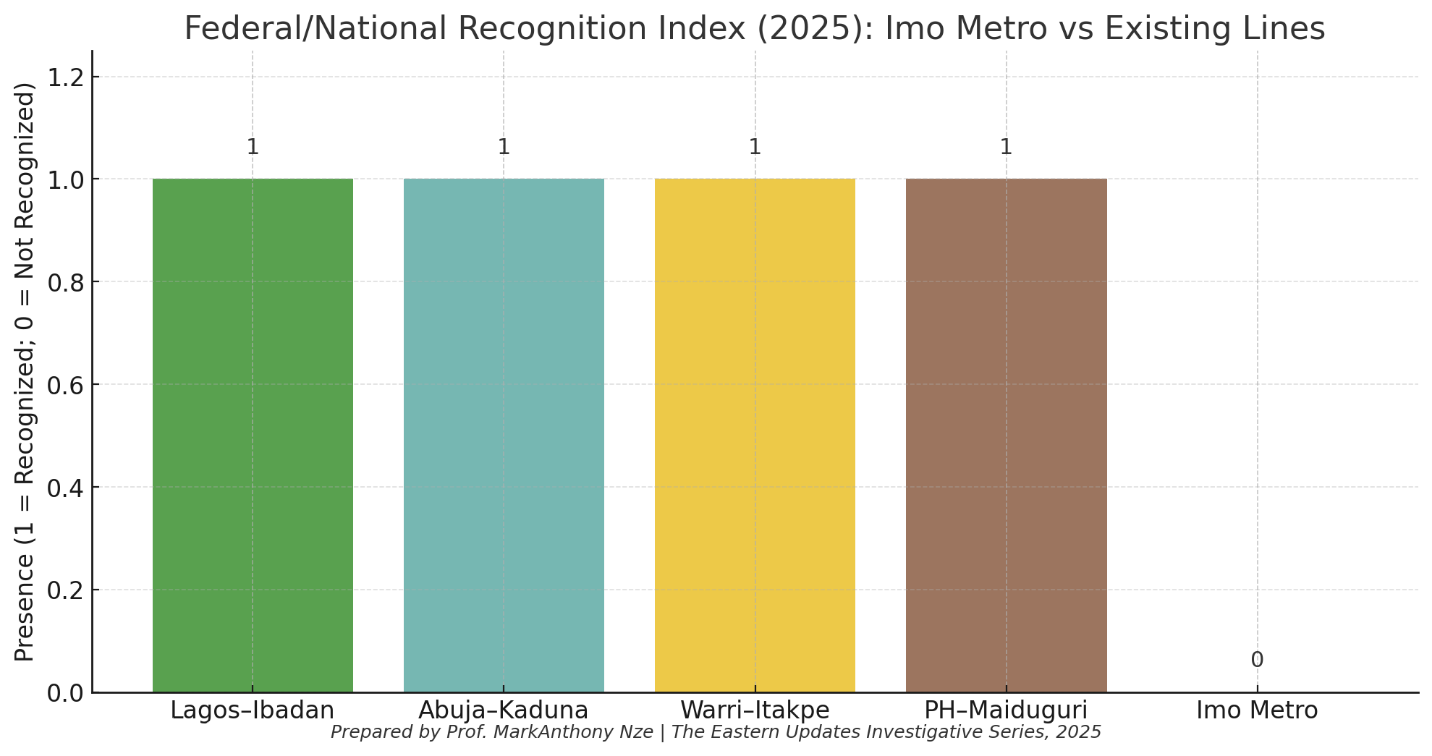
This chart compares the federal recognition status of Nigeria’s operational or approved rail corridors: Lagos–Ibadan, Abuja–Kaduna, Warri–Itakpe, Port Harcourt–Maiduguri, and Imo Metro.
While the first four appear in national records as recognized or ongoing projects, Imo Metro registers a flat zero — absent from every federal database, including the Infrastructure Concession Regulatory Commission (ICRC) and the National Transport Infrastructure Map.
This absence is not a bureaucratic oversight but a factual void. No feasibility study, no concession document, no environmental assessment, and no contract listing exists under the “Imo Metro” name. The government’s claim of a functioning rail system therefore collapses under federal verification.
What this chart illustrates is the disconnect between political storytelling and institutional reality. Federal recognition in infrastructure development is a matter of record, not rhetoric. To appear on the national register is to exist in policy space; to be absent from it is to be fiction.
Thus, “The Imo Metro” stands as a ghost entry in the archives of progress — a project whose only existence lies in PowerPoint presentations and billboard designs.
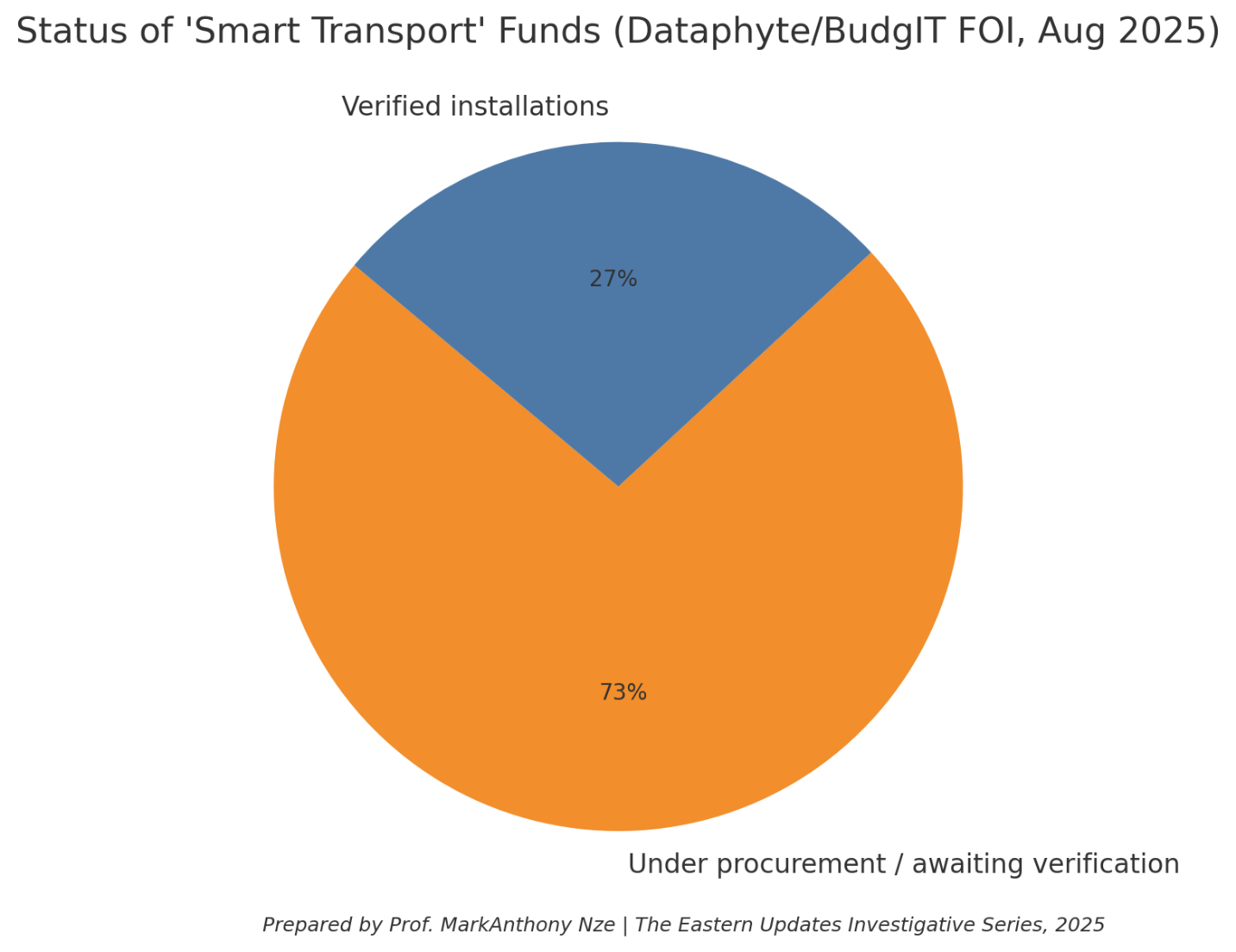
This pie chart dissects the flow of funds within Imo’s supposed “Smart Transport and Metro Development Initiative.” According to Dataphyte and BudgIT’s Freedom of Information audit (August 2025), 73 percent of the budgeted funds for the initiative remained “under procurement” or “awaiting contractor verification”, while only 27 percent could be linked to verified physical installations — mostly traffic lights and solar poles, not rail infrastructure.
The imbalance is symptomatic of a governance model where execution trails far behind announcement. Projects remain perpetually “in process,” their incompletion sustained by the convenient ambiguity of procurement cycles. This bureaucratic stasis creates the perfect environment for political illusion: the public hears of ongoing works, while little ever reaches completion.
In essence, the pie chart quantifies the gap between budgetary theatre and developmental substance. The majority slice — 73 percent — represents funds that have migrated into administrative limbo, feeding contracts that begin but never conclude. The smaller verified fraction stands as the faint physical residue of a much larger fiction.
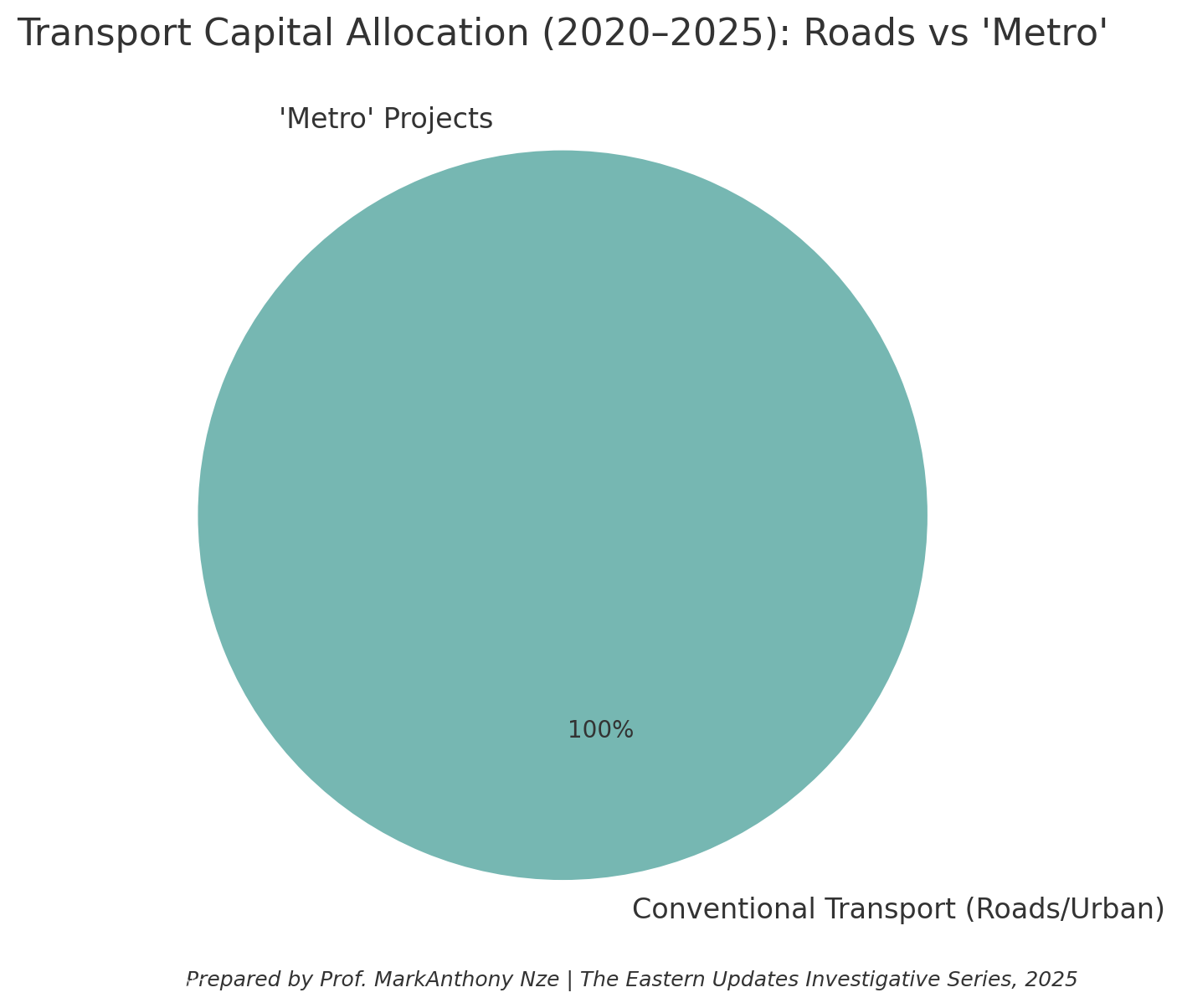
This chart addresses the final deception: there has been no financial allocation specifically designated for a metro system in Imo State between 2020 and 2025. The state’s total transport capital expenditure — ₦36.4 billion — was devoted entirely to conventional roadworks, urban renewal, and beautification, while ₦0 was allocated to rail or light-rail development.
The empty slice in the pie chart is not just a numerical void — it is the graphic representation of political invention. A metro cannot be built where no funds were ever budgeted, no contracts awarded, and no designs tendered. Yet, through creative relabeling, line items such as “urban route modernization” and “infrastructure improvement” were rhetorically converted into “metro expansion.”
This budgetary illusion is the heart of the deception. By manipulating language rather than data, the administration achieved optical governance — development that exists not in reality, but in representation.
The chart’s simplicity makes its message devastatingly clear: you cannot build a rail network out of propaganda. Without capital allocation, the so-called “Imo Metro” remains a metaphor — one that moves only in speeches, never on tracks.
Synthesis: The Phantom Rail and the Politics of Imagination
Taken together, these four charts form a documentary anatomy of fabrication.
- Fiscal reality (Chart 1) proves the project’s impossibility.
- Institutional records (Chart 2) prove its nonexistence.
- Expenditure tracking (Chart 3) reveals diversion by design.
- Budget analysis (Chart 4) confirms total absence of funding.
The “Imo Metro” is therefore not an uncompleted project — it is an unborn one. It was never commissioned, never engineered, and never funded. Its purpose was not transportation, but transformation — of public perception into political capital.
In a state where governance increasingly relies on imagery, the metro became a metaphor for manufactured modernity — a digital train speeding nowhere, propelled by publicity rather than propulsion.
The Verdict
There is no metro, no light rail, no tracks, no stations, no engineering records, and no contracts.
The so-called “Imo Metro” is not a physical project — it is a political construct, a slogan born of state propaganda and sustained by repetition.
It exists in graphics, not geography.
It moves hearts, not people.
And like many of the grand illusions of contemporary politics, it vanishes under the light of verification.
Until steel meets soil, the “Imo Metro” remains what it has always been: a fantasy of progress, built entirely out of words.
Bibliographies
BudgIT Foundation. (2025). State of States 2025: Transport, Capital Investment, and Fiscal Performance. Lagos: BudgIT Publications.
Federal Ministry of Transportation. (2025). Nigeria Rail Infrastructure Status Report: Subnational Rail and Light Transit Projects. Abuja: Federal Ministry of Transportation.
Infrastructure Concession Regulatory Commission. (2024). Public-Private Rail Project Status Report. Abuja: ICRC.
National Bureau of Statistics. (2024). Transport Infrastructure and Capital Projects Database (2020–2024). Abuja: NBS.
Nigerian Railway Corporation. (2025). Annual Performance Review and National Rail Expansion Map. Lagos: NRC Publications.

