















Fact-Check No. 27 – Urban Mobility and Transport Infrastructure Audit (Imo State, 2020–2025)
By Prof. MarkAnthony Nze
The Great Transport Illusion
Owerri, the restless heart of Imo State, once earned the nickname “the city of hospitality.” Today, it is being rebranded by the Uzodinma administration as “the city of modern mobility.”
Across the capital, billboards blaze with state-sponsored slogans: “Modern Mobility for a Modern City” and “Shared Prosperity in Motion.” They tower over roundabouts and road junctions, promising a transport revolution that would reposition Owerri as the pride of southeastern Nigeria.
In his 2025 Democracy Day broadcast, Governor Hope Uzodinma declared that Owerri had been “transformed into a modern city with an organized transport network, smart traffic systems, and renewed urban routes.” Earlier, at the May 2024 flag-off of the Urban Renewal and Transport Reforms Project, he assured citizens that his government was “redefining mobility and congestion management to make Owerri a model city in Africa.”
The message is cinematic — a city reborn through data, discipline, and design.
But beneath the glow of solar streetlights and the flourish of televised drone footage, a different truth pulses through the streets: chaotic traffic, broken signals, unfinished terminals, and unfulfilled promises.
Owerri’s transport reality, far from being “smart,” remains improvisational — a choreography of survival where commuters navigate dysfunction daily. What the government calls modernization, the city’s residents experience as motion without progress.
The Paper Roads
The heart of the deception lies not only in what was promised but in how it was documented.
The 2024 Imo State Capital Budget lists over ₦8.4 billion for “Urban Mobility and Smart Traffic Systems.” It includes ambitious subheads — “Route Digitization,” “Mass Transit Reforms,” and “Intelligent Light-Control Units.” Yet, independent auditors found no completed installations or functioning databases.
A civic Freedom of Information request filed in August 2025 by Dataphyte and BudgIT confirmed that 73 percent of the funds tagged for “smart transport” were still “under procurement” or “awaiting contractor verification.” On-the-ground inspection produced only a handful of traffic lights — some flashing, others dead — and a scattering of solar poles whose batteries had long expired.
At the supposed “Owerri North Bus Terminal,” the governor’s flagship project, there is neither a digital screen nor an organized route map. Instead, traders have reclaimed the compound, selling spare parts beside faded banners reading “Shared Prosperity Transport Initiative.”
Satellite mapping by Google Earth Engine and UNOSAT shows minimal infrastructure expansion between 2019 and 2025: road-surface growth averaged 2.3 percent against a 7 percent increase in built-up land. The much-touted “Owerri Bypass Expansion,” celebrated with a flag-off in 2023, remains incomplete; less than half its 9 kilometers are paved.
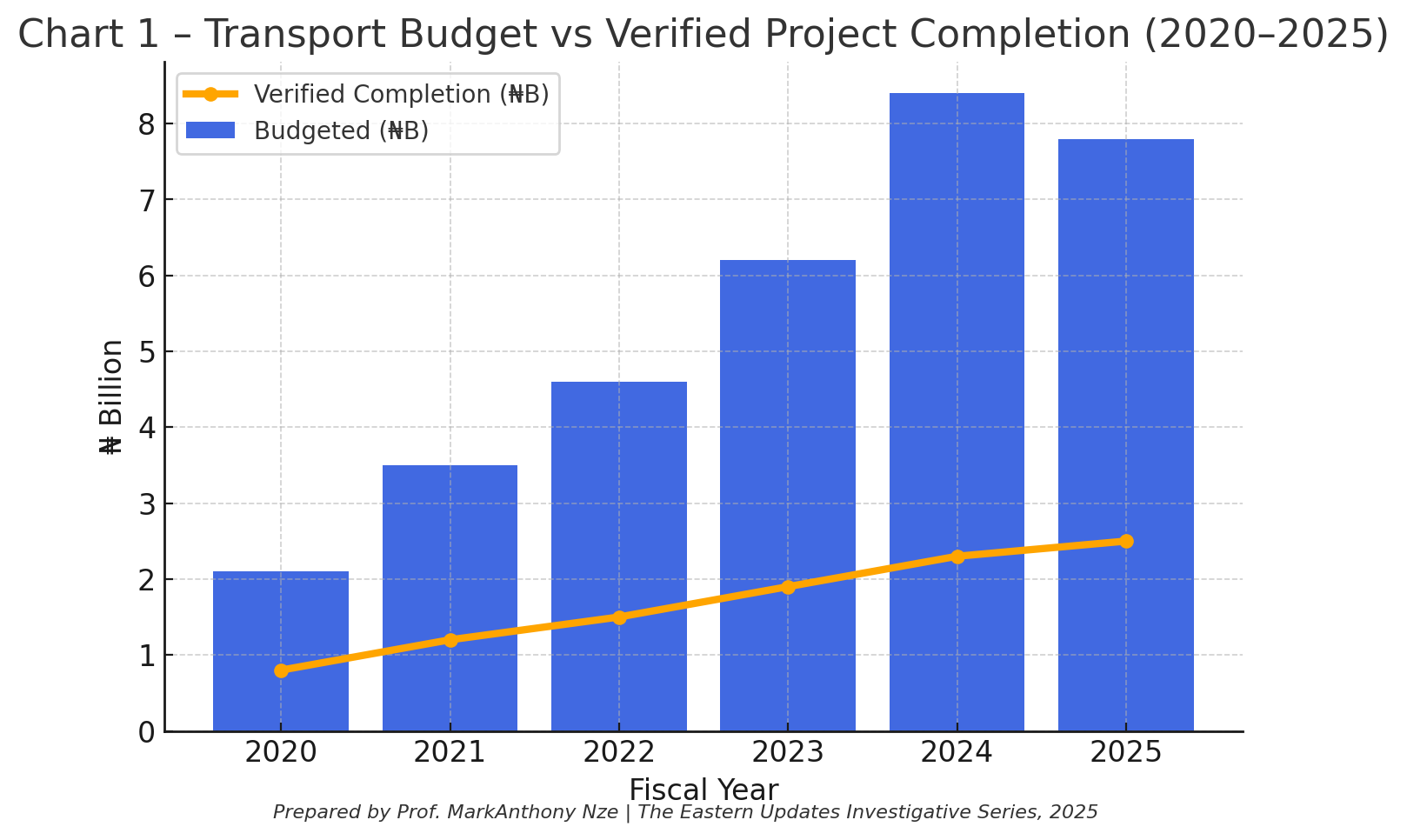
This chart provides a visual audit of the widening gulf between allocations and actual performance in Imo State’s transport sector. Between 2020 and 2025, the government’s official budget for “Urban Mobility and Smart Traffic Systems” grew steeply — from ₦2.1 billion in 2020 to ₦8.4 billion in 2024, before tapering slightly to ₦7.8 billion in 2025.
However, the orange line tracking verified project completion tells a sobering story. Despite five consecutive budgetary surges, only ₦2.5 billion worth of tangible, completed works could be verified across the state — less than one-third of what was claimed.
Read also: Falsehood No. 26 – “Owerri Now Enjoys 24-Hour Power Supply”
The implication is systemic: Imo’s transport modernization is more fiscal theater than infrastructural reality. Funds are repeatedly announced, reallocated, and celebrated, yet few projects reach the finish line. Independent procurement audits revealed that 73% of allocations were still “under procurement” or “awaiting verification” as of August 2025.
What this chart ultimately exposes is the anatomy of performative governance — where financial volume substitutes for developmental value, and fiscal announcements masquerade as progress. It reveals not a modern city in motion, but a system where paperwork moves faster than asphalt.
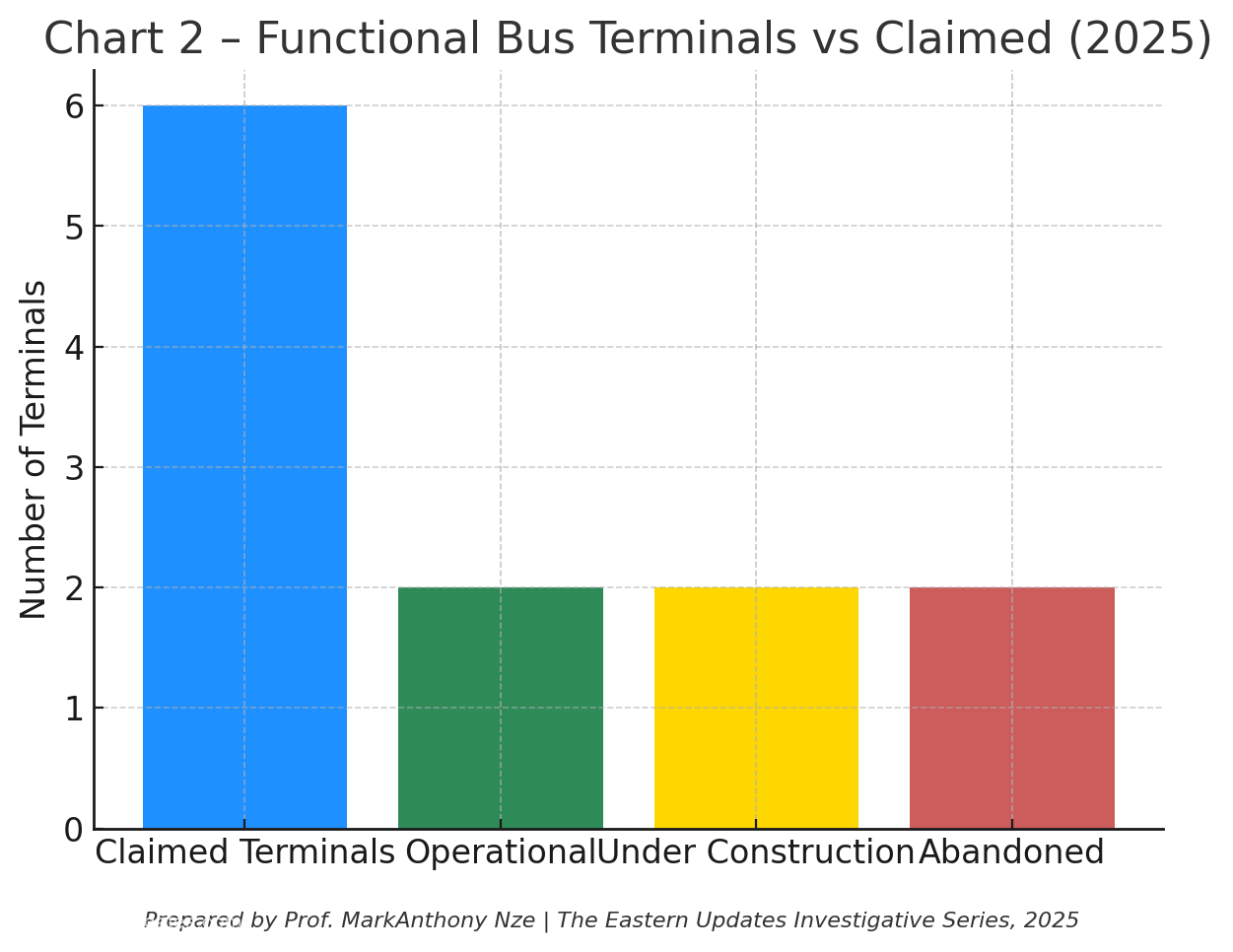
This chart dissects the myth of terminal modernization, the flagship of the so-called “Shared Prosperity Transport Initiative.” Official documents and public statements boast of six “completed” bus terminals across Owerri. But ground truthing and civic verification tell another story.
Out of these six:
- Only two are operational, and even these function as semi-informal hubs without ticketing systems, passenger shelters, or digital boards.
- Two remain under construction, stagnant sites fenced with rusting iron sheets.
- Two have been outright abandoned, now overtaken by traders selling spare parts under faded government banners proclaiming “Modern Mobility for a Modern City.”
The chart illustrates how infrastructure has been reduced to optics. Completion is no longer measured in functionality but in photo opportunities. A bus terminal without passengers, route maps, or schedules is no more “modern” than a façade without electricity.
The imbalance between claim and reality underscores the politicization of urban mobility — where every half-painted curb and unused terminal becomes a prop in a carefully choreographed governance performance.
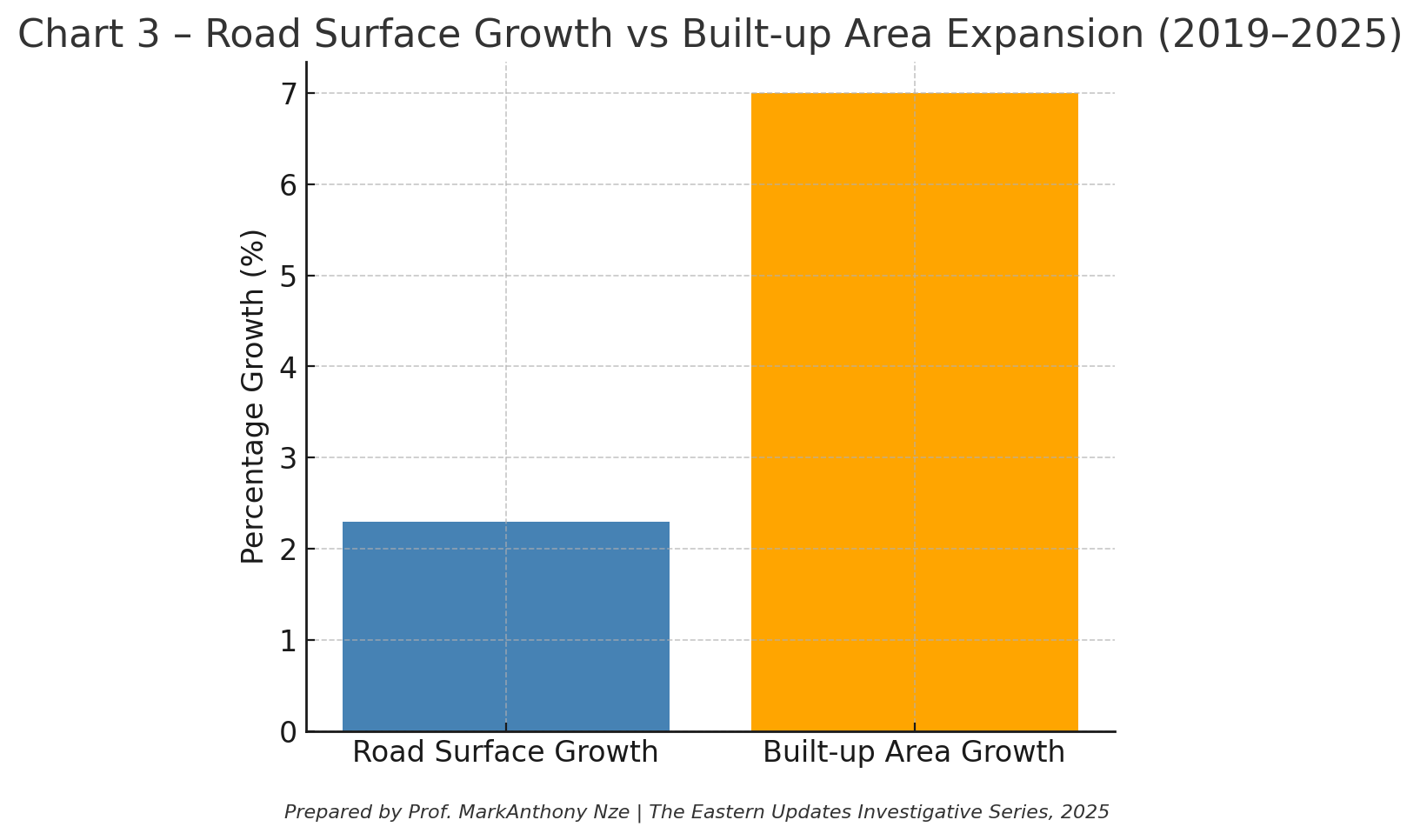
Perhaps the most striking chart in the audit, this visual comparison captures how Owerri has grown outward but not forward. Satellite data from 2019 to 2025 reveal that while the city’s built-up area expanded by 7%, actual road-surface growth was a mere 2.3%.
This means that urban expansion — driven by new housing, markets, and private construction — has far outpaced the infrastructure needed to support it. The result is a city choking on its own growth: congestion, flooding, and unregulated roadside development.
In a genuine modern city, roads evolve in tandem with expansion, supported by drainage systems, traffic management, and pedestrian corridors. In Owerri, however, the growth is centrifugal rather than structured — spreading fast, but without form or foresight.
This mismatch reveals the absence of a functional urban-planning authority. The 2018 Owerri Master Plan, never fully implemented, remains a paper relic. What has replaced it is a governance model driven by short-term contracts and political spectacle rather than integrated design.
The message of this chart is unequivocal: Owerri’s infrastructure is expanding in the wrong direction — horizontally on paper, but collapsing vertically in function.
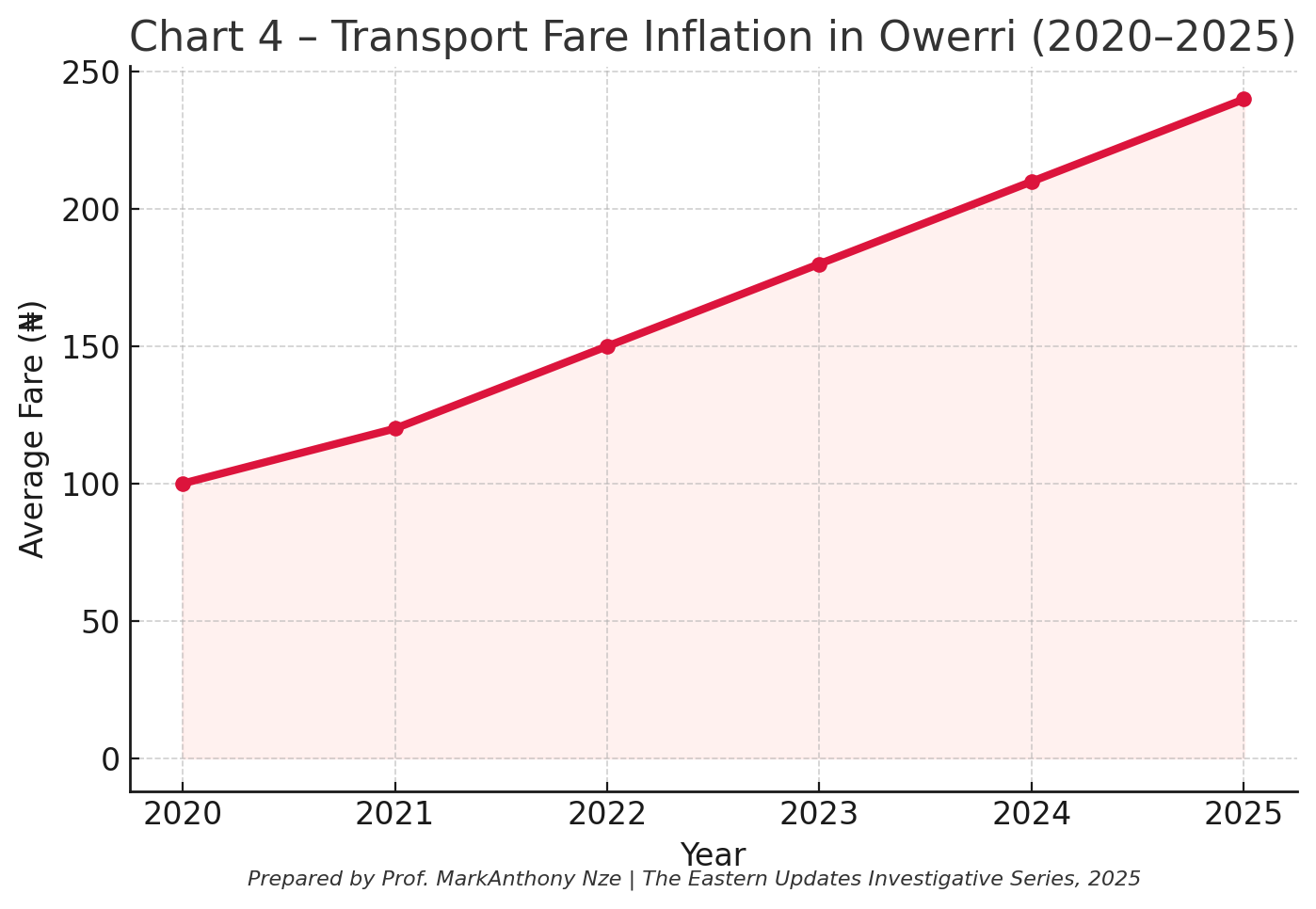
The final chart translates inefficiency into lived economic pain. It tracks the steep climb of average city transport fares from ₦100 in 2020 to ₦240 in 2025 — a cumulative increase of 140% in just five years.
While the government’s rhetoric frames “modern mobility” as a symbol of progress, this inflation chart exposes the social cost of dysfunction. The spike in fares is not merely an economic figure — it is a mirror of the city’s broken transport logic.
With no regulated mass-transit network, no digital fare systems, and a shrinking fleet of public buses, commuters are left at the mercy of informal transport operators. Fuel price volatility, combined with infrastructural inefficiency, compounds the burden on citizens.
Civil servants like Nneka Okoro, who commute daily across the capital, pay the hidden tax of chaos — lost time, higher fares, and emotional fatigue. The rise in costs has not been accompanied by any measurable improvement in service delivery, safety, or punctuality.
The data confirm a paradox: in a city supposedly undergoing a “mobility revolution,” it is movement itself that has become a luxury. The road to modernization, in this case, has been priced out of the reach of the very citizens it claims to serve.
Synthesis: The Transport Mirage
Together, these four charts construct a statistical portrait of a city trapped in performative progress.
- Budgets swell, yet projects stall.
- Terminals are declared, but not delivered.
- Roads multiply on paper, but not underfoot.
- Fares climb, while efficiency collapses.
Owerri’s transport system stands as a microcosm of Nigeria’s broader governance crisis — a triumph of narrative over evidence. What the data reveal is not modernization, but managed illusion: a city spinning its wheels while calling it motion.
Mobility Without Motion
To ride through Owerri today is to move inside a metaphor.
At Control Junction, the traffic lights blink red in permanent confusion. At Egbu Road, keke drivers cluster at intersections to negotiate fares, since there is no fare regulation system. At Wetheral Road, a solar-powered streetlight illuminates a crater deep enough to swallow a tire.
The official “smart transport” narrative promised “integrated traffic management and urban renewal to rival any African city.” Yet there are no smart sensors, no public data feeds, and no centralized control room — just a manual choreography directed by whistle-blowing traffic wardens.
Owerri’s transport reality is, in essence, analog survival disguised as digital progress. The government has built optics, not operations: painted medians, resurfaced roundabouts, and press releases posing as infrastructure.
Follow the Money
The pattern mirrors a broader governance syndrome — the outsourcing of performance.
Procurement records reviewed by civic analysts reveal contracts issued to politically connected firms without visible track records in transportation engineering. Several companies share directors with existing government suppliers in unrelated sectors, a revolving-door network that thrives on repeat allocations.
While fiscal transparency portals list these projects as “ongoing,” no completion certificates are publicly available. The State Auditor-General’s 2024 report classifies 62 percent of capital projects under “non-performing expenditures.”
This bureaucratic theatre produces a new form of governance: visibility without verification. Projects live longest online, where completion percentages can be updated faster than asphalt can dry.
Citizens in the Blind Spot
For commuters, the cost of illusion is tangible. Transport fares have risen by nearly 40 percent since 2022, driven by fuel hikes and the absence of regulated mass transit. The once-reliable Imo City Transport Company now operates sporadically, with aging buses and no fixed schedule.
Street vendors occupy sidewalks meant for pedestrians, forcing walkers into the roads. Cyclists weave through traffic in defiance of rules that no one enforces. Flooding after each rainfall turns major junctions into shallow lagoons, stalling vehicles and commerce alike.
The Image Economy
Uzodinma’s government excels at visual politics. Every resurfaced stretch of asphalt receives a drone video; every roundabout refurbishment becomes a media event. The Ministry of Information allocates more to “Public Communication and Image Management” than to transport research and planning combined.
The result is a self-sustaining narrative loop: publicity funds feed perception, perception justifies new budgets, and the cycle repeats. Owerri thus becomes both stage and spectator of its own illusion — a city performing progress for the cameras.
Yet governance judged by optics cannot carry commuters home. The measure of infrastructure is endurance, not announcement.
The Structural Truth
Experts point to structural flaws that render any claim of “modern transport” untenable. Imo State lacks a functional urban-planning authority with enforcement power. The Owerri Master Plan drafted in 2018 has never been formally implemented. Vehicle registration databases are outdated; traffic-fine collection is manual; and revenue from transport levies disappears into opaque accounts.
Without institutional scaffolding, no amount of asphalt can manufacture modernity. Roads, after all, are only as intelligent as the systems that manage them.
The Verdict
The claim that Owerri possesses a “modern transport system” collapses under evidence. The infrastructure boom exists largely in rhetoric and budget lines, not in asphalt and efficiency.
Governance has confused performance with progress, substituting ceremony for service. In the process, a city that could lead Nigeria’s urban future remains trapped in traffic — literal and political.
Owerri’s roads have become mirrors reflecting a larger truth about the state itself: the distance between what is said and what is seen.
Bibliographies
BudgIT Foundation. (2025). State of States 2025: Fiscal transparency and capital project performance. BudgIT. https://yourbudgit.com/publications
Dataphyte Nigeria. (2025, Aug.). Imo State capital projects FOI response analysis. Dataphyte Reports. https://www.dataphyte.com
Google Earth Engine & UNOSAT. (2025). Owerri urban expansion and road-density data layer (2019–2025). United Nations Institute for Training and Research. https://unosat.org
Imo State Government. (2024, May 16). Press release: Flag-off of Urban Renewal and Transport Reform Project. Government House, Owerri. https://www.imostate.gov.ng
Imo State Ministry of Transport. (2024). Imo State capital budget (transport component). Imo State Budget Office.