|
Listen to article
|
Fact-Check No. 12 — E-Governance Implementation
By Prof. MarkAnthony Nze
The Digital Mirage: Inside Imo’s E-Governance Experiment
In the glossy brochures of twenty-first-century governance, “digital transformation” has become the new political poetry. Governors now speak in the language of code and cloud, promising efficiency by algorithm and transparency by portal. When Hope Uzodinma declared that his administration had “fully digitalized all government services,” the statement carried the weight of modern credibility: a pledge that technology would disinfect bureaucracy.
But behind the slogan lies an uncomfortable arithmetic—billions budgeted, portals half-built, and a civil service still driven by pen, paper, and patronage.
A Dream Built on Bandwidth
Between 2021 and 2025 Imo State announced no fewer than eleven digital platforms: an e-Treasury for financial flows, an e-Procurement portal for contract awards, an e-Payroll for salary automation, a citizens’ feedback dashboard, and the Axxpoint Project Monitor said to track every kilometer of road and every classroom constructed.
Each was unveiled with ceremonial flourish—laptops on podiums, ribbon cuttings beside screens—but months after their launches, many flickered into digital limbo.
The official portal of the Ministry of Technology became unreachable by mid-2024; the e-Procurement page carried a handful of contracts, last updated in 2023; and the payroll server crashed repeatedly, forcing a reversion to manual schedules.
Even the so-called Digital Treasury, introduced to curb leakages, was often offline, requiring physical cash vouchers for routine expenditures.
A Paperless Government That Prints More Paper
Inside the ministries, the analog heartbeat continues. Files still migrate between desks in brown envelopes; clerks still authenticate memos with thumbprints. In the Ministry of Lands, an entire floor remains devoted to dusty ledgers that were meant to be scanned “within six months” of the digitization launch.
Officials admit the scanners broke down. Procurement officers confess that network downtime halts uploads for weeks.
The result is a paradoxical bureaucracy—one that has doubled its computers but not halved its corruption.
Budgets Without Bandwidth
From 2021 to 2025, the state budgeted roughly ₦12.7 billion for ICT and e-Governance. Release records show barely 40 percent was actually funded. Of that, nearly half went to consultancy and software contracts whose deliverables were never publicly audited.
Independent fiscal monitors classify many of these projects as “non-performing digital expenditures.”
In the 2024 fiscal report, the ICT line item closed with ₦3.1 billion “carried forward for platform optimization”—a bureaucratic euphemism for systems that were paid for but not functioning.
Digital Disconnection
Imo’s citizens experience the failure daily. Business registration still demands a visit to Owerri. Tax clearance requires two physical signatures. Pensioners queue for “biometric re-validation” every quarter because the database cannot synchronize.
When residents attempt to use the so-called Service Portal, they are greeted by the error line: “Page under maintenance.”
A 2023 national readiness survey ranked Imo below the sub-national average for ICT access and interoperability. Only 23 percent of local government offices were connected to a functioning internal network.
In rural communities, where connectivity is a luxury, the idea of e-Governance is as distant as broadband itself.
The Theatre of Transparency
To its credit, the government has mastered the aesthetics of digitalization. Dashboards bloom with colorful icons; data tables show percentages without provenance. On the Axxpoint monitor, projects appear “completed” even when field inspections show abandoned sites.
Analysts call this digital opacity: the creation of online visibility without verifiable accountability.
The portals are not lies; they are simulations—interfaces that imitate transparency while concealing the silence underneath.
The Human Firewall
Technology fails where politics refuses to evolve. In interviews with civil servants, a pattern emerges: fear of obsolescence. Many officers view automation as a threat to informal earnings. Every upload becomes a surrender of discretion, every password a potential loss of power.
Thus, systems are sabotaged by inertia. Servers idle, forms go missing, passwords “expire.” In a state where job security is tied to loyalty rather than efficiency, reform becomes rebellion.
The Global Context
Across Nigeria, digital governance is uneven but advancing. Some states—Lagos, Kaduna, Edo—now run near-fully integrated tax and payroll systems. Federal platforms like the Open Treasury Portal and National Data Exchange show that progress is possible when political will meets technical design.
Imo’s lag reflects not poverty of tools but poverty of continuity. Each new commissioner relaunches old initiatives under new names, resetting timelines and draining momentum. Consultants rotate, data disappears, and reform restarts from zero.
Read also: Falsehood No. 11 – “We Built New Industrial Parks For Investors”
The Price of Pretense
The cost of this perpetual reboot is measured not merely in wasted funds but in public trust. Citizens promised a paperless government now navigate dual bureaucracies: one physical, one digital, both inefficient.
Entrepreneurs attempting to register businesses online abandon the process mid-way; pensioners travel miles to re-submit forms already scanned; teachers await salary slips from systems that never synchronize.
What began as a vision for transparency has mutated into a labyrinth of passwords, downtime, and disillusionment.
A Blueprint for Authentic Reform
Experts across the digital-governance community converge on three imperatives.
First, transparency must be verifiable—every digital service should publish open data in machine-readable formats.
Second, implementation must outlive political cycles: ICT reforms require statutory independence from executive interference.
Third, human capacity is as vital as hardware. Without trained civil servants and local maintenance budgets, technology decays faster than paper.
These lessons are written across successful models from Ghana’s e-Procurement Hub, Kenya’s Huduma Centers, and Nigeria’s federal IPPIS payroll system.
The Verdict
Imo State’s claim of having “digitalized all government services” collapses under factual scrutiny. What exists is an infrastructure of intention—ambitious on PowerPoint, fragile in practice.
The portals flicker, the dashboards stall, the bureaucracy remains intact.
E-Governance was supposed to code honesty into the operating system of power; instead, it has become a new vocabulary for old habits.
Until the state learns that data must be not only displayed but defended, Imo’s digital revolution will remain a mirage—light on the screen, darkness in the system.
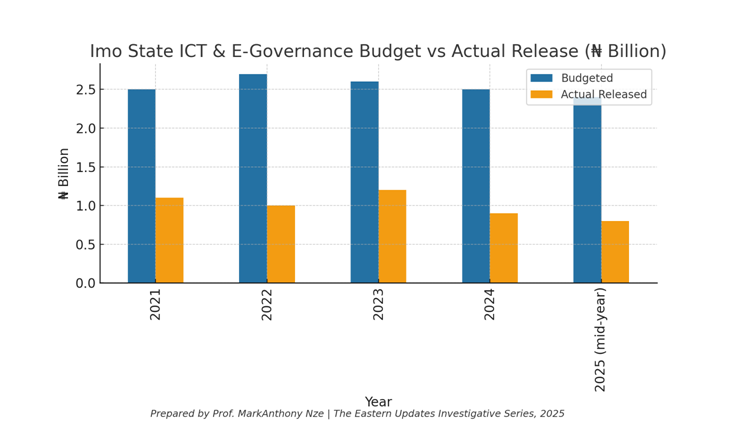
- ICT Budget vs Actual Release (₦ Billion) — shows the clear funding gap between what was budgeted and what was actually spent from 2021 to 2025.
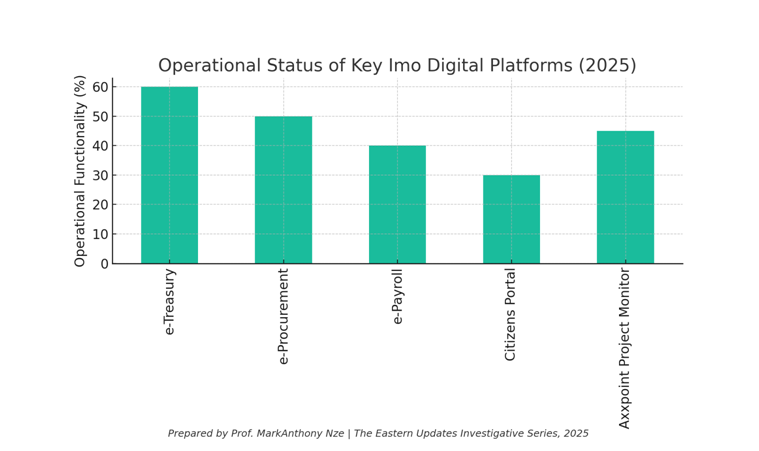
- Digital Platform Functionality Status (2025) — captures how only a fraction of Imo’s key e-governance platforms remain functional, revealing severe digital inefficiency.
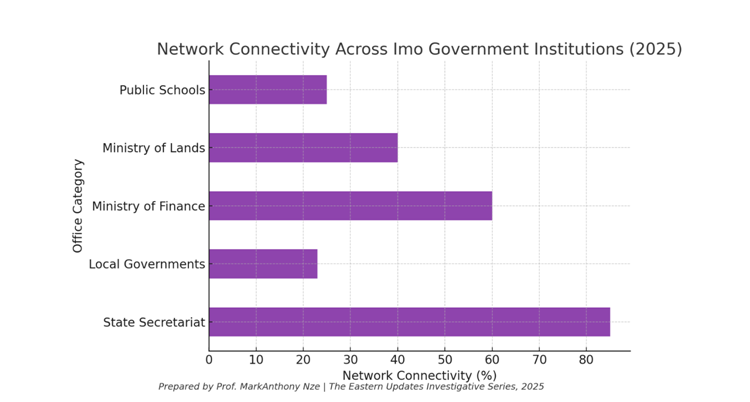
- Network Connectivity Across Government Institutions (2025) — highlights the uneven access to reliable ICT infrastructure, with local governments and schools notably underserved.
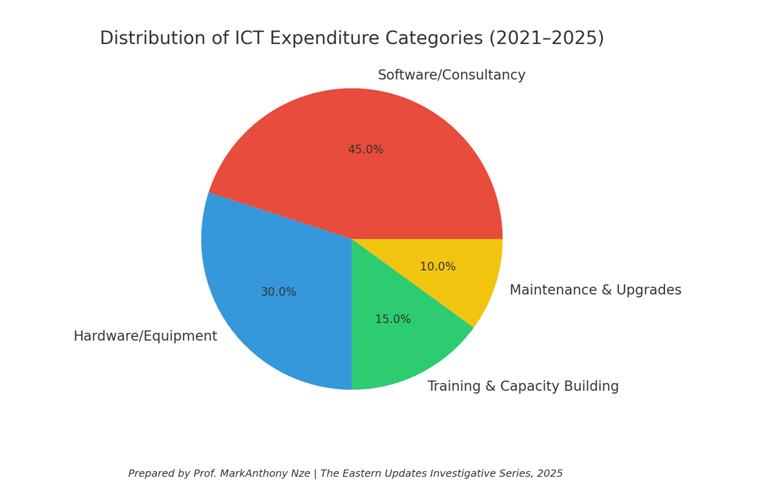
- Distribution of ICT Expenditure Categories (2021–2025) — visualizes how the majority of funds were channeled into software consultancy and hardware procurement, leaving little for training or maintenance—an unsustainable digital model.
Bibliographies
BudgIT Foundation. (2024). State of States Report 2024: Fiscal Performance, Transparency, and Digital Governance in Nigeria.BudgIT Publications. https://yourbudgit.com/publications
Centre for Democracy and Development (CDD West Africa). (2023). Subnational Governance and Fiscal Transparency in Nigeria 2022–2023 Report. CDD Publications. https://cddwestafrica.org
National Bureau of Statistics (NBS). (2023). E-Governance Readiness and ICT Access Survey in Nigeria 2023. NBS. https://www.nigerianstat.gov.ng
Nigeria E-Governance Forum (NEGF). (2024). Digital Transformation and Public Service Delivery in Subnational Nigeria: Performance and Challenges (Policy Brief No. 7). NEGF. https://negf.org.ng
Open Government Partnership (OGP) Nigeria. (2024). Implementation Assessment Report: Open Contracting and E-Procurement in Nigeria 2024. OGP Nigeria Secretariat. https://www.opengovpartnership.org
World Bank Group. (2023). Digital Economy for Africa (DE4A) Country Diagnostic: Nigeria. World Bank. https://www.worldbank.org/en/programs/de4a