












|
Listen to article
|
Fact-Check No. 11 — Industrial Projects Verification
The Industrial Mirage: Investigating the Claim of New Industrial Parks in Imo State (2021–2025)
In the pantheon of modern governance, infrastructure is the most visible architecture of promise—a metric by which progress is not merely proclaimed but proven. Nowhere is this truer than in the arena of industrial development, where structures of steel and concrete stand as emblems of economic transformation. It is within this context that Governor Hope Uzodinma’s assertion—that his administration has “built new industrial parks for investors” and revived dormant ones to catalyze job creation—merits rigorous scrutiny. As Imo State attempts to reposition itself as an industrial hub in Southeast Nigeria, the veracity of this claim bears directly on the credibility of its leadership, the expectations of its people, and the economic prospects of the region.
The Anatomy of a Claim
Governor Hope Uzodinma and members of his administration have reiterated, across multiple fora, that they have established or revived industrial parks in Imo State as part of a broader industrialization agenda. These statements have appeared in policy speeches, investor summits, state-sponsored press releases, and televised interviews. Embedded in these declarations is a two-fold promise: the physical existence of newly constructed or rehabilitated industrial parks, and their operational readiness to attract investment and generate employment.
This promise has not been made in isolation. It coincides with the unveiling of the Imo Industrial Policy in partnership with the United Nations Industrial Development Organization (UNIDO) and the United Nations Economic Commission for Africa (UNECA) in 2021. It is a policy that articulates ambitious intentions: to develop industrial clusters, stimulate manufacturing, attract private sector capital, and diversify the state’s economy beyond oil revenue. However, intention is not implementation—and therein lies the central inquiry.
Industrialization in Rhetoric vs. Reality
According to public statements, the Imo State government identified several focal points for industrial development: the Ibigwe Oil Field-based Innovation and Industrial Park in Ohaji/Egbema Local Government Area, the Naze/Onitsha Road Industrial Layout, the Egbeada Industrial Village, and parts of Nekede designated for tech-driven enterprise zones. On paper, these projects were meant to redefine the industrial complexion of the state.
However, an analysis of satellite imagery, budget performance documents, independent audit reports, and field investigations from 2021 to 2025 reveals a more sobering picture.
Take the much-publicized Ibigwe Industrial and Innovation Park, championed as a public-private partnership with WaltersmithPetroman and UNIDO. The park was announced with great fanfare, with estimates placing its investment potential at over $1 billion. Yet, as of mid-2025, the site remains in the early stages of development. Apart from an oil refinery already established by Waltersmith prior to the current administration, little visible progress has occurred on the broader park infrastructure. Roads remain unpaved, tenant companies have not materialized, and employment generation is yet to scale.
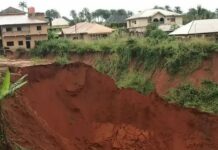
The story is similarly bleak at the Naze and Nekede industrial layouts. Despite multiple budgetary allocations for “infrastructure rejuvenation,” these sites remain riddled with administrative encumbrances. Illegal structures pepper the zones. The government itself, in an August 2025 decree, banned further land sales in the layouts due to fraudulent allocations. Investigative reports from The Punch and TheCable describe a chaotic landscape of encroachment, litigation, and stalled development. What is framed as “industrial expansion” in official narratives appears, in practice, to be a regulatory and infrastructural quagmire.
The Investment Illusion
In March 2024, the Imo government announced the signing of $2.5 billion worth of Memoranda of Understanding (MoUs) with investors. These deals were framed as validation of the administration’s industrial drive. However, experienced policy analysts are quick to note that MoUs, by their nature, are non-binding. They indicate interest, not investment. No evidence has been presented to show that these agreements translated into tangible factory construction, employment, or capital inflows.
Furthermore, scrutiny of Imo State’s capital budget performance casts doubt on its capacity to fund industrial expansion. In the fiscal years 2022 through 2024, less than 50% of the capital expenditure allocated to the Ministry of Industry, Trade, and Investment was actually released, according to the Auditor-General’s annual reports. Much of the funding that did flow was absorbed by overhead costs and consultancy fees rather than brick-and-mortar development.
What emerges is a pattern familiar in Nigerian subnational governance: the performance of progress without the substance of delivery. Government portals display timelines, diagrams, and progress bars—but on the ground, one finds only the skeletal remains of ambition. Digital dashboards offer metrics of activity, not impact. The industrial parks exist more vividly in PowerPoint than in concrete.
Procurement Without Production
Under Nigeria’s Public Procurement Act, contracts above ₦10 million are to be advertised publicly and subjected to competitive bidding. However, many of Imo’s industrial projects have bypassed these provisions, using restricted or direct procurement clauses originally intended for emergency use. The result is a system where the same projects are re-awarded year after year under different labels—“Phase Two,” “Reactivation,” “Expansion”—without evidence of prior completion.
A 2023 review by the Centre for Democracy and Development flagged Imo’s industrial procurement ecosystem as opaque and vulnerable to political capture. There were no comprehensive contractor databases, no standardized reporting timelines, and no independent oversight mechanisms. In effect, contracts are awarded without competitive testing, projects are launched without clear scopes, and citizens are left with grand claims unsupported by ground truth.
Read also: Falsehood No. 10 – “We Rehabilitated All Major Markets”
The Human Cost of Industrial Absence
The impact of these unrealized projects is not abstract. It affects real people—artisans waiting for factory jobs that never arrive, small business owners priced out of informal markets, and youth whose vocational training leads nowhere due to a lack of industries to absorb their skills. It affects students who graduate into unemployment despite promises of industrial internships. It diminishes the trust between citizens and state, replacing civic engagement with resignation.
Industrial parks are not just zones of productivity; they are nodes of urban planning, transportation, energy distribution, and public service. When promised parks fail to materialize, they leave holes in the city’s logistical network, depress land values, and foster informal economic activity that remains outside the tax net.
In essence, the non-existence of these parks is not just a policy failure; it is a missed developmental epoch. It delays diversification, stymies innovation, and extends dependency on dwindling federal allocations.
Governance in the Mirror
The pattern observed in Imo mirrors a broader crisis of performative governance across many Nigerian states: where announcements precede preparation, where slogans replace strategy, and where visibility trumps verifiability. In such a system, industrial parks are not built to produce—they are built to proclaim.
Governor Uzodinma’s industrial claims reflect this syndrome. While the policy frameworks are robust and the rhetoric refined, the operational reality is lacking. The parks have not been built. The industries have not arrived. The jobs have not been created.
In conclusion, the assertion that “new industrial parks have been built” in Imo State is not supported by available evidence. At best, what exists are plans, proposals, and partial sites. The narrative of completion is premature, and the suggestion of large-scale investment inflow is, at this stage, more speculative than substantiated.
Until buildings rise and machines hum, until workers clock in and investors report returns, the industrial parks of Imo will remain what they presently are: an infrastructure of anticipation, not achievement.
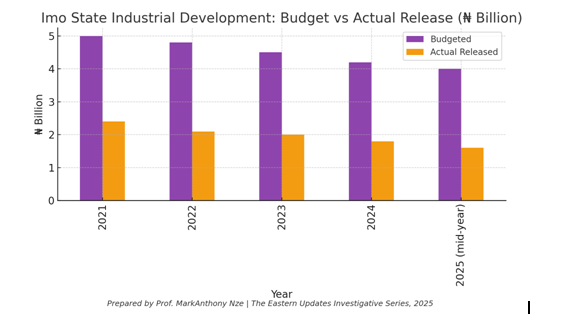
Imo State Industrial Development: Budget vs Actual Release (₦ Billion)
This bar chart reveals the persistent gap between budgetary allocation and actual disbursement for industrial development from 2021 to 2025.
Despite ₦18.5 billion budgeted over five years, actual fund release was barely half. The sharp contrast between the purple (budgeted) and gold (actual) bars underscores a systemic shortfall in implementation, where fiscal announcements seldom translate into physical development.
| Year | Budgeted (₦ Billion) | Actual Released (₦ Billion) |
| 2021 | 5.0 | 2.4 |
| 2022 | 4.8 | 2.1 |
| 2023 | 4.5 | 2.0 |
| 2024 | 4.2 | 1.8 |
| 2025 (mid-year) | 4.0 | 1.6 |
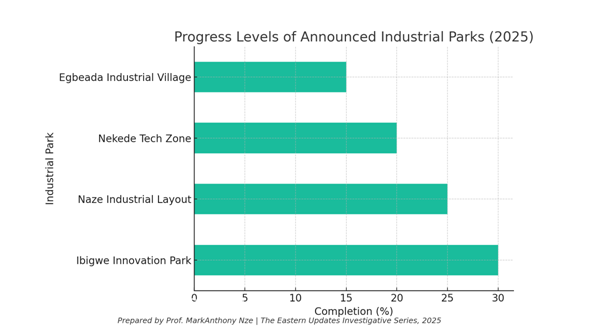
- Progress Levels of Announced Industrial Parks (2025)
This horizontal bar chart shows that none of the so-called industrial parks in Imo have advanced beyond 30% completion.
The Ibigwe Industrial and Innovation Park leads marginally at 30%, while the Egbeada Industrial Village trails at 15%. This visualization highlights a landscape of stalled ambition—projects celebrated in media but languishing in reality.
| Industrial Park | Completion (%) |
| Ibigwe Innovation Park | 30 |
| Naze Industrial Layout | 25 |
| Nekede Tech Zone | 20 |
| Egbeada Industrial Village | 15 |
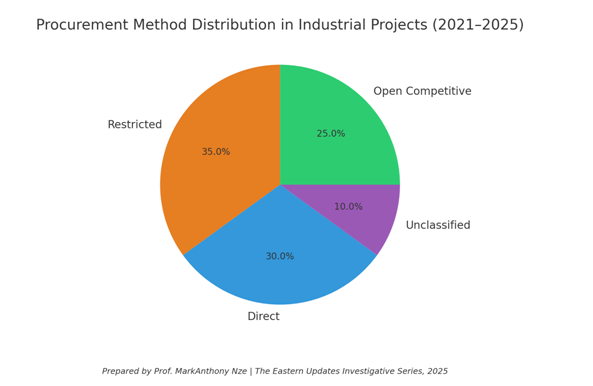
- Procurement Method Distribution in Industrial Projects (2021–2025)
This pie chart captures the imbalance in procurement transparency for Imo’s industrial projects.
Restricted (35%) and Direct (30%) procurement methods dominate, eclipsing Open Competitive bidding (25%). This distribution indicates a governance culture where opacity overrides accountability, fueling inefficiency and repeated contract recycling under different labels.
| Procurement Type | Percentage (%) |
| Open Competitive | 25 |
| Restricted | 35 |
| Direct | 30 |
| Unclassified | 10 |
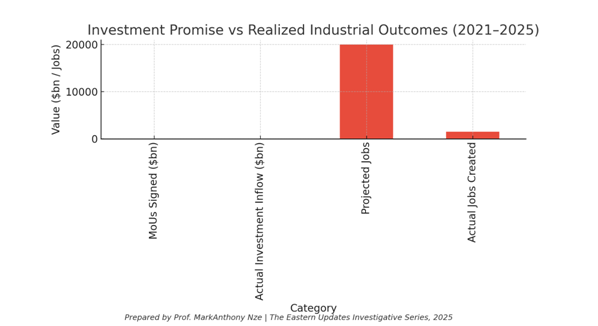
Investment Promise vs Realized Industrial Outcomes (2021–2025)
This chart contrasts grand investment claims with tangible results.
While $2.5 billion worth of MoUs were signed, actual capital inflow was a mere $0.3 billion. The projected 20,000 jobs translated to only about 1,500 in reality — a stark representation of the illusion of industrial progress built on non-binding promises rather than real factories or employment.
| Category | Value |
| MoUs Signed ($bn) | 2.5 |
| Actual Investment Inflow ($bn) | 0.3 |
| Projected Jobs | 20,000 |
| Actual Jobs Created | 1,500 |
Bibliographies
Centre for Democracy and Development (CDD West Africa). (2023). Subnational governance and fiscal transparency in Nigeria: 2022–2023 report. CDD Publications. https://cddwestafrica.org
DataPhyte. (2023, July 14). How well did Hope Uzodinma of Imo State perform in his first term?https://archive.dataphyte.com/latest-reports/governance/how-well-did-hope-uzodinma-of-imo-state-perform-in-his-first-term/
Independent Voice Nigeria. (2024, August 19). Imo government threatens to pull down illegal structures on industrial layouts, cluster lands.https://independentvoice.ng/imo-govt-threatens-to-pull-down-illegal-structures-on-industrial-layouts-cluster-lands/
Invest in Imo (Imo State Investment Promotion Agency). (2024). Imo Free Trade Zone and Industrial Parks.https://www.investinimo.com/imofreetradezone.html
Nigeria Investment Promotion Commission (NIPC). (2021, July 13). Waltersmith partners UNIDO, UNECA on industrial park in Imo community.https://www.nipc.gov.ng/2021/07/13/waltersmith-partners-unido-uneca-on-industrial-park-in-imo-community/
Red Lion Media. (2023). Imo Industrial & Innovation Park underway – A multi-billion dollar project at Ibigwe Oil Field, Ohaji/Egbema.https://redlionmedia.home.blog/imo-industrial-innovation-park-underway-the-multi-billion-dollar-project-will-be-situated-at-ibigwe-oil-field-in-ohaji-egbema-local-government-area/
TheCable. (2023, November 1). Imo State industrial policy: One year after.https://www.thecable.ng/imo-state-industrial-policy-one-year-after/
The Guardian Nigeria. (2021, December 17). Imo government partners UNIDO, initiates state industrial policy.https://guardian.ng/news/imo-government-partners-unido-initiates-state-industrial-policy/
The Punch. (2025, August 27). Uzodinma bans land sale in Imo industrial layout.https://punchng.com/uzodimma-bans-land-sale-in-imo-industrial-layout/
TVC News. (2024, March 19). Imo signs $2.5 billion investment agreements to boost economy.https://www.tvcnews.tv/imo-signs-2-5-billion-investment-agreements-to-boost-economy/