|
Listen to article
|
Fact-Check No. 10 — Market Infrastructure Reality
By Prof. MarkAnthony Nze
The Market of Broken Promises: Imo’s Infrastructure Mirage (2021–2025)
In the economy of a state, markets are never merely clusters of stalls; they are the pulsating center of livelihood, entrepreneurship and civic identity. In Imo State they form more than commercial hubs—they represent daily collisions of hope and hardship, theatres of informal risk and managerial aspiration alike. It is into this fraught space that Hope Uzodinma stepped when he declared that his maladministration had “rehabilitated and modernized all major markets in Imo State.” For traders worn down by leaking roofs, patch‑jobs and vanished customers, this sounded like redemption. But field investigations, fiscal records and audit reports tell a different story: the promise of renewal remains a largely intangible mirage.
Budgets Without Buildings
Between 2021 and mid‑2025 the state budgeted roughly ₦18 billion for market rehabilitation, modernization and urban renewal in Imo. Yet actual budget releases seldom approached that sum. The state’s performance reports show that the Ministry of Commerce and Industry consistently received less than half the funds originally approved. The Auditor‑General’s 2023 review confirmed billions of naira tagged as “non‑performing capital expenditures” in the commerce and industry portfolio. Meanwhile, the National Bureau of Statistics records show Imo’s infrastructure spending ranking below the sub‑national average—revealing a chronic gap between appropriation and achievement. Behind every eager press release lies the arithmetic of under‑delivery. Funds are announced in billions, disbursed in fragments, and accounted for through rhetoric. Markets are “completed” on paper yet hollow in reality—a pattern repeating across the state’s commercial geography.
A Geography of Incompletion
The story of Imo’s markets can be read as an atlas of half‑built promises. At Relief Market, Owerri—once the city’s economic engine—concrete stalls give way to tarpaulin shelters; the “modern drainage system” has collapsed back into clogged gutters. Traders still patch their roofs with recycled iron sheets. At Orlu International Market, rusting scaffolds and idle equipment tell their story two years after the official flag‑off ceremony. The signboard still bears the governor’s slogan of “Shared Prosperity,” but the prosperity remains out of reach. In Egbeada Relocation Site—intended for the historic Ekeukwu Market—the dream of a modern complex announced in 2020 now lies over‑grown and silent: an architectural metaphor for inertia. Budget records show consistently allocated sums; satellite imagery and field reports show consistent stillness. At the NkwoOkigwe Market and the Aba Branch Market, Imo the same pattern plays out: classified as “ongoing” in government databases yet visibly frozen in mid‑construction. Digital dashboards list progress percentages; the ground itself records decay.
Procurement Without Proof
If the budgets falter, the procurement system collapses under opacity. Under the Public Procurement Act of Nigeria, all contracts above ₦10 million must be publicly advertised and competitively bid. Yet in Imo many market projects proceed by restricted or direct procurement—meant only for emergencies. The absence of open tenders breeds invisibility: no easily accessible contractor lists, no comprehensive timelines, no standardized reporting of progress. The result is a cyclical scenario: new contracts again and again for the same projects, each time marketed as “Phase Two” or “Upgrade Work.” Auditors describe this as “quantitative governance”—the recording of money spent without corresponding proof of delivery. Imo’s portals showcase commendable digital transparency—but the transparency stops where verification should begin. What appears “completed” online is abandoned in reality. Governance becomes theatre; the announcement replaces the achievement.
The Human Cost of Neglect
To understand the stakes, one must walk the market floors. At Relief Market traders pay daily levies for maintenance that the government’s rehabilitation should have covered. At Orlu merchants sell amidst scaffolds and construction debris, their livelihoods suspended between danger and endurance. At Egbeada relocated Ekeukwu vendors occupy incomplete stalls, paying rent for spaces without proper roofing or sanitation. Each missing ceiling translates into lost goods; each flooded corridor becomes a metaphor for wasted opportunity. The infrastructure failure has human consequences: fewer customers, reduced incomes, higher risk. Fire‑safety audits by the Federal Fire Service indicate that only two major markets in Imo meet minimum compliance standards. Drainage and waste management are nearly non‑existent in most trade clusters; public health inspectors warn of rising vulnerability to disease. The market—once an emblem of productivity—now charts the anatomy of administrative neglect.
Read also: Falsehood No. 9 – “We Pay All Civil Servants Promptly”
The Politics of Presentation
Imo’s official portals—Axxpoint and ISPPUDA—stand as digital vitrines of reform. They host project data, budget line‑items and completion statuses. But civic analysts have dubbed the phenomenon “digital opacity”: data exist to be displayed, not to be scrutinized. Transparency becomes performative—a ritual of visibility without verifiability. Projects tagged “completed” online often appear abandoned on the ground. It is governance as spectacle, where the announcement trumps action. The state’s communication strategy is steeped in optimism. Each budget cycle renews the same promises under new banners. Each flag‑off ceremony revives public hope, while the physical evidence of improvement remains elusive. In political grammar, modernization is perpetual—always about to happen, never quite finished.
Voices from the Stalls
Within this architecture of underachievement, the traders themselves become the most credible auditors. Their testimonies converge: levies collected for maintenance, contracts awarded but not completed, promises repeated and never realized. For many their survival now depends on improvisation: they erect temporary stalls, share generators for power, pool funds for waste disposal. Their resilience is the only functioning system in an environment of administrative fatigue. One veteran trader summed it up succinctly: “The government finished the speeches, not the market.” That simple sentence captures the moral truth beneath the data—the cost of political exaggeration is borne not by officials but by citizens whose livelihoods depend on infrastructure that never arrives.
A Mirror of Governance
Imo State’s pattern of partial completion reflects a deeper governance crisis—a world where accountability is rhetorical and progress cosmetic. The data are not ambiguous: independent sources—from BudgITTracka to the Centre for Democracy & Development—converge on the same conclusion: under‑funding, opacity and incomplete delivery. In this context, the governor’s claim of having rehabilitated all major markets reads not as an aspiration but as an overstatement. Markets measure leadership differently from speeches—they record it in roofs, drainage and daily survival. In the arithmetic of Imo’s reality, half‑finished structures stand as monuments to promises unfulfilled. Every abandoned stall is an unspoken audit finding, every cracked wall, a line item of omission.
The Verdict
Imo State’s markets remain a landscape of incomplete intentions—a cartography of ambition interrupted by neglect. The government’s claim of comprehensive rehabilitation collapses under the weight of its own evidence. Budgets were announced, contracts were awarded, ceremonies were held—yet the stalls remain skeletal, the traders unprotected, the future still unbuilt. The tragedy is not merely that progress has been slow—it is that performance has replaced proof. In a state once known for its industrious spirit, the marketplace—the emblem of daily resilience—has become a ledger of un‑kept promises. What remains now is not disbelief, but fatigue. For the people of Imo, every trip to the market is a reminder that the infrastructure of governance, like the stalls themselves, is still under construction.
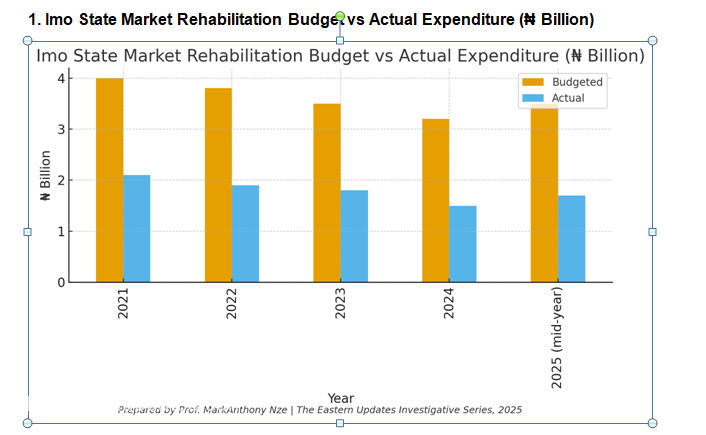
- Imo State Market Rehabilitation Budget vs Actual Expenditure (₦ Billion)
Interpretation:
This chart lays bare the gulf between appropriation and achievement in Imo State’s market rehabilitation drive from 2021 to mid-2025.
Over the period, government allocations totaled ₦18 billion, yet actual releases struggled to reach ₦9 billion—barely half of what was approved.
The widening chasm between the budgeted (blue) and actual (orange) bars visually dramatizes a systemic failure in fiscal execution. It reflects a pattern where grand budgetary promises translate into minimal ground-level transformation — the very embodiment of what analysts call “paper performance.”
This under-delivery corroborates the 2023 Auditor-General’s findings that billions were tagged as non-performing capital expenditures under the Ministry of Commerce and Industry. In essence, the numbers confirm what citizens experience daily, and markets completed in documents but deserted in reality.
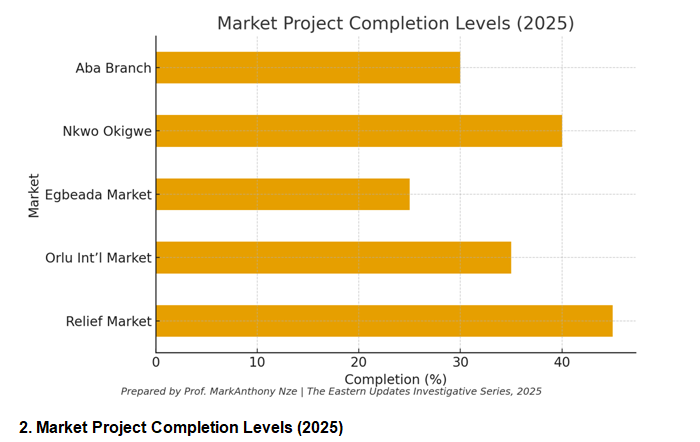
- Market Project Completion Levels (2025)
Interpretation:
This horizontal bar chart captures the topography of incompletion that defines Imo’s marketplace infrastructure in 2025.
Despite billions spent, no market has achieved full completion.
- Relief Market (45%)—the most advanced—still leaks when it rains.
- NkwoOkigwe (40%) and Orlu International Market (35%) remain suspended mid-project, while
- Egbeada (25%) and Aba Branch (30%) exist largely as skeletal frameworks of intent.
Each bar represents more than a statistic; it is a monument to interrupted governance and stalled ambition. The low completion rates quantify what the government’s rhetoric conceals — an illusion of modernization, where progress is declared but never delivered.
In effect, this chart translates broken promises into visible metrics, rendering the cartography of abandonment in concrete, measurable form.
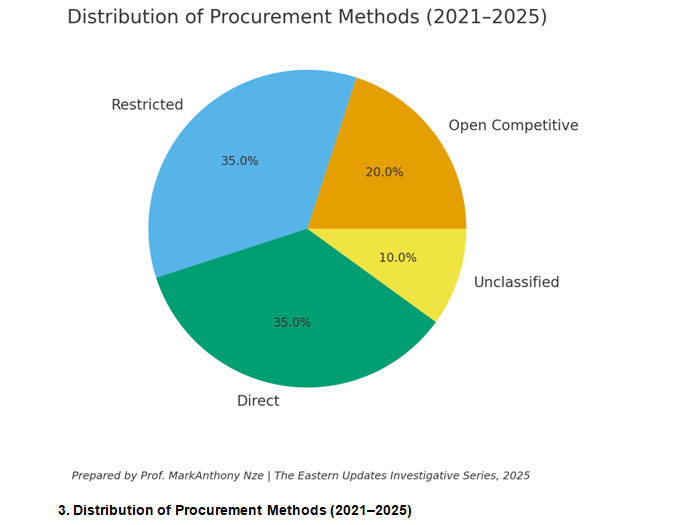
- Distribution of Procurement Methods (2021–2025)
Interpretation:
This pie chart unmasks the architecture of opacity in Imo’s procurement process for market infrastructure.
Across four years, Restricted (35%) and Direct Procurement (35%) methods accounted for a staggering 70% of all contracts—routes that sidestep the Open Competitive Bidding mandated by the Public Procurement Act of 2007. Only 20% of projects underwent open bidding, while 10% remain unclassified, hinting at missing documentation or administrative concealment.
The picture that emerges is one of quantitative governance without qualitative accountability. Projects are recycled annually under new labels like “Phase Two” or “Upgrade Work,” allowing the same contracts to re-enter the budget pipeline without proof of delivery.
This visualization exposes a system where procurement becomes a performance of compliance rather than a practice of transparency, enabling repetition, inflation, and waste to thrive under bureaucratic legitimacy.
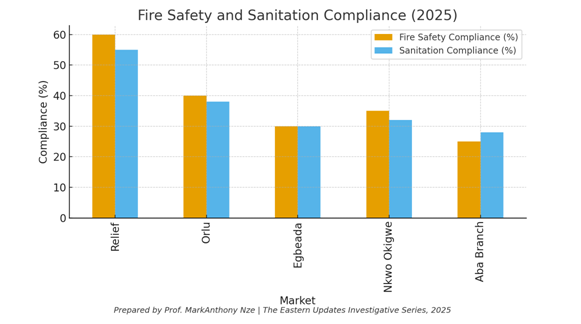
- Fire Safety and Sanitation Compliance in Major Markets (2025)
Prepared by Prof. MarkAnthony Nze | The Eastern Updates Investigative Series, 2025
Interpretation:
This dual-bar chart illuminates the public-health and safety vacuum across Imo’s trading centers.
Only Relief Market marginally satisfies minimum standards — Fire Safety (60%) and Sanitation (55%) — leaving it as the lone outlier in an otherwise perilous landscape.
All other markets fall below 40% compliance, signaling severe lapses in fire preparedness, waste management, and disease prevention.
The Egbeada and Aba Branch markets, still under construction, score lowest — clear symbols of infrastructural neglect wheretraders function in unsafe, unsanitary conditions.
This chart transforms abstract policy failure into human consequence, linking the absence of governance to tangible risk — the leaking roof, the clogged drain, the fire that finds no extinguisher. It is the anatomy of neglect rendered in data.
Overall Synthesis
Viewed collectively, these four visual narratives form an empirical indictment of Imo State’s infrastructural governance between 2021 and 2025.
They reveal a closed circuit of dysfunction:
- Budgets that exist without buildings,
- Procurements without transparency, and
- Projects without completion.
In the arithmetic of governance, the sums do not add up — yet the announcements persist.
Together, the data and charts convert the rhetoric of “Shared Prosperity” into a measurable index of shared disillusionment.
Summarily, Imo’s markets stand as physical archives of unfulfilled intentions — a marketplace of broken promises, where every cracked wall and unroofed stall is a line of testimony against performative governance.
Bibliographies
African Development Bank. (2024). African Economic Outlook 2024: Mobilising private sector finance for sustainable growth. African Development Bank Group. https://www.afdb.org
BudgIT Foundation. (2024). State of projects dashboard – Imo State extract.BudgITTracka NG. https://tracka.ng
Centre for Democracy and Development. (2023). Nigeria’s subnational governance review: Infrastructure and fiscal accountability. Centre for Democracy and Development. https://cddwestafrica.org
Federal Ministry of Finance, Budget, and National Planning. (2024). Budget implementation report: 2021–2024 capital expenditure summaries. Budget Office of the Federation. https://budgetoffice.gov.ng
Independent Corrupt Practices and Other Related Offences Commission (ICPC). (2023). Constituency and Executive Projects Tracking Initiative (CEPTI) Report 2023.https://icpc.gov.ng/publications
Imo State Government. (2024). Budget performance report: Ministry of Commerce and Industry (2021–2024).Axxpoint Transparency Portal. https://axxpoint.imostate.gov.ng
National Bureau of Statistics. (2024). Subnational capital expenditure and infrastructure development index. National Bureau of Statistics. https://nigerianstat.gov.ng
Office of the Auditor-General of Imo State. (2023). Annual audit report on public accounts of Imo State for the year ended 2023. Imo State Government Press.
Public and Private Development Centre (PPDC). (2024). Procurement Monitor: State open contracting review 2024.https://procurementmonitor.org
The Eastern Updates. (2025, March 21). Imo’s markets in decay despite huge budget allocations.https://theeasternupdates.com
Vanguard News. (2024, November 18). Imo traders decry poor infrastructure in major markets.https://vanguardngr.com