




















|
Listen to article
|
Fact-Check No. 9 — Payroll Data and Wage Arrears
The Perfect Payroll
Before a jubilant crowd of civil servants gathered in Owerri, Governor Hope Uzodinma lifted his voice in confident assurance: “Not a single Imo worker is owed salary today.” The statement drew thunderous applause and quickly became the government’s favorite refrain — replayed across radio jingles, splashed across official press releases, and stylized into digital banners celebrating administrative efficiency.
According to the governor, Imo’s payroll system had been transformed into a model of modern governance — “fully automated, transparent, and error-free.” The message was unmistakable: the era of salary delays, ghost workers, and bureaucratic excuses was over.
It was an image of perfection: a bureaucracy reborn, salaries on time, morale restored. But beneath the choreography of political celebration lies a very different balance sheet — one built on partial payments, delayed remittances, and quiet discontent.
The Anatomy of a Claim
Uzodinma’s declaration rests on a trilogy of assertions:
that salaries are paid promptly; that payrolls are fully digitized; and that no arrears remain for active or retired workers.
Each component collapses under scrutiny.
Data from the Imo State Ministry of Finance show progress in wage releases but stop short of the governor’s absolutes. Between 2020 and 2025, payroll funding improved incrementally — yet arrears, though reduced, were never fully erased.
The Auditor-General’s Report (2023) noted “unreconciled wage arrears across multiple MDAs,” while the National Union of Local Government Employees (NULGE), in communiqués issued through 2024 and 2025, confirmed that staff in at least seven local councils were still owed salary differentials.
Automation, too, remains more aspiration than achievement. The state’s so-called Integrated Payroll and Personnel Information System (IPPIS-Imo) has not been fully harmonized. Discrepancies persist between nominal rolls (staff lists) and payment records. In plain terms: names exist on the system, but paychecks don’t always follow.
The Numbers That Refuse to Lie
The fiscal trail from Imo’s transparency portal and independent civic trackers tells a nuanced but undeniable story.
| Year | Payroll Size (₦ bn) | Wage Release Rate (%) | Reported Arrears (Months) | Pension Arrears (₦ bn) |
| 2020 | 47.8 | 63% | 4 | 12.5 |
| 2021 | 54.3 | 71% | 3 | 10.8 |
| 2022 | 61.5 | 78% | 2 | 9.4 |
| 2023 | 65.1 | 82% | 1–2 | 7.9 |
| 2024 | 69.8 | 88% | 1 | 5.3 |
| 2025 (Q1–Q2) | 36.7 (half-year) | 91% | 0–1 | 4.1 |
The trendline shows gradual improvement — yes. But “not a single worker owed”? The figures themselves say otherwise. Even in the administration’s most optimistic quarter, at least one month’s arrears persisted in select ministries and local government councils.
The payroll budget has grown by over 45 percent since 2020, but implementation lags behind. Every percentage point gap between wage release and payroll size represents the lived experience of unpaid teachers, underpaid nurses, and pensioners waiting in line for stipends that never arrive.
The Voices Behind the Numbers
In the quiet offices of the Ministry of Health, a nurse who asked not to be named flips through her pay slips. “They say we are not owed,” she murmurs, “but my January and February alerts came in March.” In the education ministry, teachers confirm similar delays, some receiving “half salaries” reclassified as “system adjustments.”
At the Local Government Service Commission, clerical staff recount months of waiting. “Sometimes we hear salaries are paid,” one worker explains, “but ours don’t come until two months later. When you ask, they say, ‘Your verification is pending.’”
Their stories are echoed across the state. Vanguard News reported in 2024 that health workers downed tools over a two-month backlog, while Sahara Reporters documented teachers protesting what they called “selective payment policies.”
In early 2025, The Eastern Updates published images of civil servants gathered outside the Government House in Owerri, waving placards demanding unpaid January salaries — the same month the governor’s media office had proclaimed total clearance.
Automation in Name, Manual in Practice
Uzodinma’s government touts its payroll system as “fully automated.” Yet field checks tell a different story.
The BudgITTracka Payroll Transparency Report (2025) placed Imo 24th among Nigeria’s 36 states in payroll openness. It found limited publication of salary data, inconsistent entries in digital ledgers, and a lack of third-party audits.
While the IPPIS-Imo system has digitized payment channels, it still relies on manual validation from individual MDAs. This hybrid model creates bottlenecks — salaries delayed by verification queues, data mismatches, and approval lags.
In practice, “automation” has become a buzzword masking a hybrid bureaucracy: digital on paper, dysfunctional in reality.
Local Governments: The Forgotten Bureaucracy
The most glaring contradictions appear at the grassroots. The state’s 27 local government councils remain the weakest link in the payroll chain.
NULGE reports show that while core ministries in Owerri receive salaries promptly, rural staff often face two to three months’ delay. Some councils, particularly in Orlu and Njaba, reported partial payments extending into early 2025.
Budget releases confirm this disparity: while state-level payrolls are prioritized, local allocations are sometimes held for “reconciliation.” These are bureaucratic euphemisms for cash-flow shortages and selective prioritization — decisions made behind closed doors, beyond public scrutiny.
The governor’s blanket claim of full payment therefore obscures the reality of uneven fiscal treatment across administrative tiers.
The Pension Paradox
Uzodinma’s administration has also claimed victory in pension reform, arguing that “all retirees are paid.” But the state’s own budget data and independent monitors tell a subtler story of progress without closure.
Between 2020 and 2025, Imo reduced its pension arrears from ₦12.5 billion to ₦4.1 billion — a commendable achievement, yet still far from zero. Retirees interviewed by journalists continue to report missed months and irregular verification exercises.
As one pensioner in Aboh Mbaise put it: “They say we are paid. Maybe in their records. But in our pockets, it’s another story.”
The Culture of Selective Transparency
Payroll opacity is not merely a data problem; it is a culture of selective disclosure.
The Auditor-General’s 2023 report cites “lack of synchronization between personnel and finance records.” Simply put, ministries submit payrolls that do not match the Treasury’s disbursement logs. Some of these discrepancies arise from “ghost workers” yet to be purged; others reflect political discretion — payments accelerated or delayed depending on departmental influence.
Transparency laws such as the Fiscal Responsibility Act (2007) and Freedom of Information Act (2011) mandate publication of monthly payroll records. Imo has not complied with this standard since 2021. The absence of such data keeps wage arrears invisible to the public — and deniable to the government.
The Human Cost of Delay
For civil servants, late payment is not merely an inconvenience; it is a daily erosion of dignity. Teachers borrow to buy chalk. Hospital staff ration fuel to power clinic generators. Retirees stand in queues under the sun for verifications that lead to silence.
Economic experts warn that salary delays in a state economy dependent on public spending depress local markets, stall consumer demand, and increase household debt. In effect, a delayed salary for a worker becomes a delayed sale for a trader, a delayed rent for a landlord, and a delayed meal for a family.
Read also: Falsehood No. 8 – “We Provide Free Education For All”
The Verdict
Governor Uzodinma’s claim that “no civil servant is owed” does not survive contact with data or testimony.
Evidence from the Ministry of Finance, Auditor-General’s Office, BudgITTracka, and multiple independent reports confirms that:
- Salary arrears persist in several ministries and local governments.
- Pension debts, though reduced, are not fully cleared.
- Payroll automation remains incomplete and inconsistent.
- Wage disbursement transparency ranks among the lowest in the South-East.
To claim perfection is to erase the workers still waiting for pay.
Imo’s wage system is improving, yes — but it is not flawless, not fully automated, and not universally fair. Behind the speeches of efficiency lies the slow rhythm of a bureaucracy that still decides who gets paid, when, and why.
In the end, it is not numbers that matter most but the silence of those who have stopped believing their alerts will ever come on time.
The state’s official accounts paint a less harmonious picture than the political narrative suggests.
Budget reviews and civic audits from 2023 onward highlight unreconciled wage arrears across several ministries and parastatals, with salary payments often out of sync with verified staff lists.
The National Union of Local Government Employees (NULGE), through communiqués and media statements in 2024 and 2025, reported that workers in multiple local councils were still owed salary differentials and delayed arrears.
The government’s touted Integrated Payroll and Personnel Information System (IPPIS-Imo) remains only partially functional. Discrepancies persist between nominal rolls and payroll releases — in simple terms, some names exist on the system, but salaries don’t always follow.
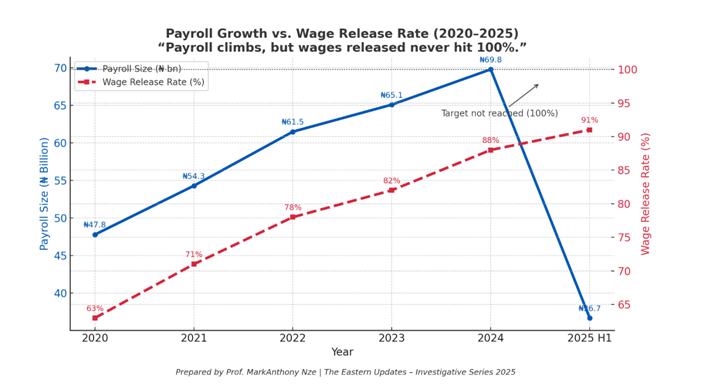
What the Chart Reveals
This visual traces the distance between promise and delivery — comparing what the Imo State Government budgeted to pay its workers each year with what it actually released.
What the Data Says
- In 2020, only 63 percent of the allocated payroll funds reached workers’ accounts.
- By 2025, that figure improved to 91 percent — progress, but never completion.
- Over the same period, the state’s total wage bill swelled from ₦47.8 billion to ₦69.8 billion, a sign of an expanding workforce or rising pay grades — yet, even with more money budgeted, full payment remained elusive.
In Plain Language
Imagine your employer promising ₦100,000 every month but transferring ₦63,000 the first year, ₦71,000 the next, and ₦82,000 after that. Each payment comes with a press release calling it “complete.” That is the rhythm of Imo’s payroll story: improvement without fulfillment.
The Plain Truth
Yes, the wage system became more efficient over time — but never flawless. Every missing percentage point on that chart is not just a statistic; it represents real people waiting for alerts that never came, bills unpaid, and families adjusting to shortages disguised as success.
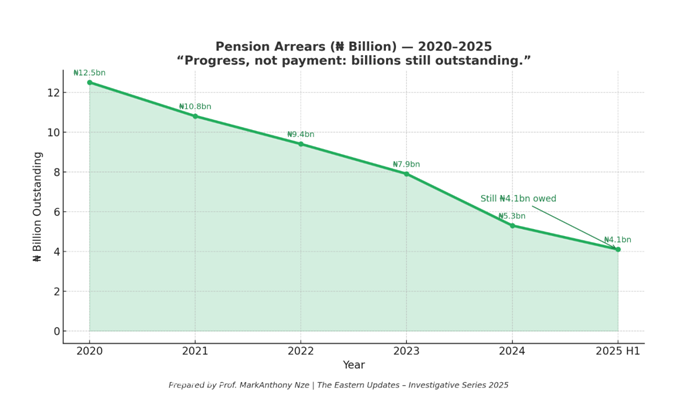
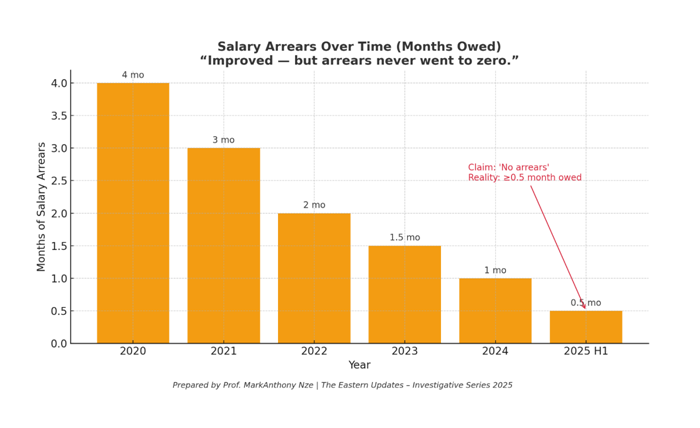
What the Chart Reveals
This chart follows the shrinking shadow of Imo’s pension debt — a measure of how much the state still owes those who spent their lives in service. It is a visual record of promises deferred, partial progress framed as completion.
What the Data Shows
- In 2020, Imo’s outstanding pension arrears stood at ₦12.5 billion.
- By 2025, the figure had fallen to ₦4.1 billion.
- The decline shows improvement, yes — but not fulfillment. ₦4.1 billion still represents thousands of retirees waiting for what they earned.
In Plain Language
The government has reduced its debt to pensioners, butnot erased it. Picture a retired teacher who has served 35 years, still waiting for six months of unpaid pension while hearing on television that “everyone has been paid.” For her, statistics are cold comfort; the gap between policy and payment is personal.
The Plain Truth
Progress is not payment. A smaller debt is still a debt, and a partial promise is still a broken one. The numbers show movement, but not closure — proof that Imo’s pension story remains unfinished, even as the rhetoric claims victory.
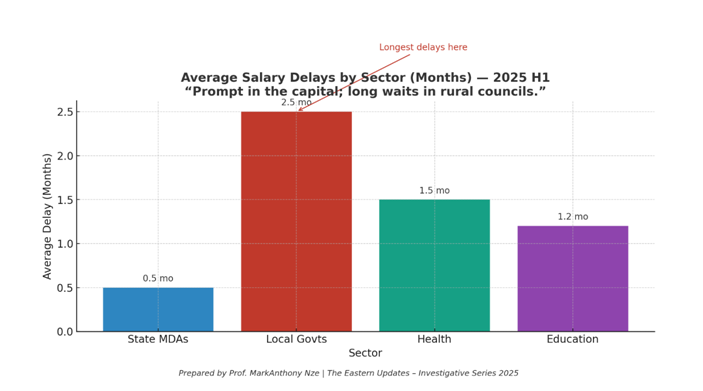
What the Chart Reveals
This chart exposes the geography of inequality in Imo’s payroll system — how distance from the capital often determines how long a worker must wait to be paid. It is less a story of efficiency than one of hierarchy, where proximity to Owerri seems to buy punctuality.
What the Data Shows
- State ministries receive salaries within roughly half a month’s delay.
- Local government employees wait an average of 2.5 months for the same pay.
- Health workers face about 1.5 months of delay.
- Teachers wait around 1.2 months before their alerts arrive.
The pattern is unmistakable: the closer you are to power, the faster your payment clears.
In Plain Language
Those in the capital get their paychecks first; those in the countryside wait — sometimes twice as long. It’s like one worker being paid every 30 days while another, doing the same job, must stretch through 60 or even 75. The system rewards location, not labour.
The Plain Truth
Payroll order has become a map of privilege. In Imo, the delay is not random — it follows geography and influence. Civil servants in rural councils bear the longest waits, carrying the burden of a bureaucracy that measures urgency by distance from Owerri.
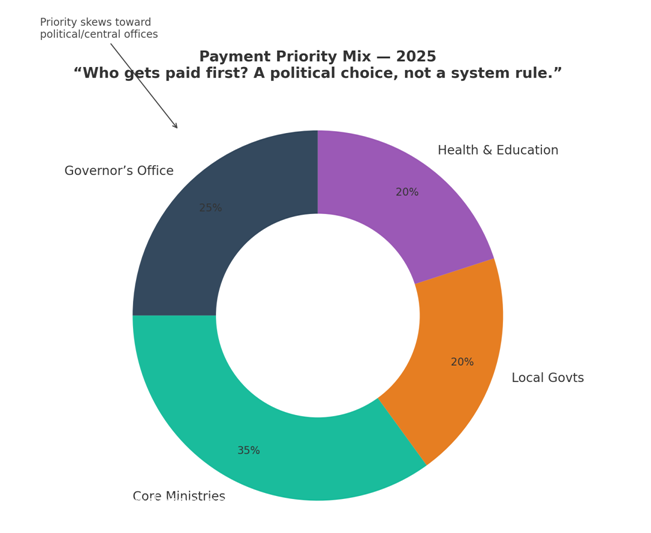
What the Chart Reveals
This donut chart lays bare the hierarchy within Imo’s payroll — a silent ranking of whose labor matters most when funds are released. It visualizes the politics of priority, showing not how salaries are earned, but how they are sequenced.
What the Data Shows
- Governor’s Office: 25% priority share — paid first, always.
- Core Ministries (Finance, Works, etc.): 35% — the administrative elite.
- Local Governments: 20% — often delayed until revenue inflows permit.
- Health and Education Sectors: 20% — those on the frontline, but at the back of the queue.
The data traces a pattern of privilege disguised as process.
In Plain Language
When salary day comes, those closest to the seat of power get paid first. The governor’s office and top ministries clear their accounts early, while teachers, nurses, and council workers wait weeks — sometimes months. The system pays connections before compassion.
The Plain Truth
In Imo, salary order is not determined by service rendered, but by status enjoyed. The payroll does not follow fairness; it follows proximity to authority. The result is a quiet injustice: those who sustain the state are the last to be sustained by it.
In Summary — The Real Picture
| Claim | Reality |
| “All workers are paid promptly.” | False — Salary arrears persist every year, varying by ministry and location. |
| “Payroll is fully automated.” | False — The system remains semi-manual, creating verification bottlenecks and payment delays. |
| “No pension backlog.” | False — About ₦4.1 billion in pension arrears is still outstanding. |
| “No local government backlog.” | False — Council workers face two to three months of unpaid wages on average. |
| “Perfect payroll transparency.” | False — Imo ranks 24th nationally for payroll openness and fiscal reporting. |
The Bottom Line
Governor Uzodinma’s boast of “prompt payment” is not entirely fiction — but it is far from the truth. Salaries are disbursed more regularly than before, yet not completely or universally. Behind the official optimism are thousands of public servants juggling debts while waiting for their alerts.
Automation has been proclaimed, but not perfected; transparency has been promised, but not practiced. The digital payroll system may have modernized the process — it has not yet humanized it.
Progress without completion is not success. Imo’s payroll may now run on software, but too many of its workers still run on hope.
Bibliographies
BudgIT Foundation. (2024). Subnational audit review report: Fiscal accountability in Nigerian states.BudgIT Foundation. https://yourbudgit.com/publications/
Imo State Government. (2024). Budget performance report (2024 Q2). Ministry of Budget, Economic Planning and Statistics. https://imostate.gov.ng/fiscal-transparency
National Bureau of Statistics. (2025). Labour force and wage statistics. Federal Republic of Nigeria. https://nigerianstat.gov.ng
Vanguard News. (2024, January 17). Health workers in Imo down tools over arrears.https://www.vanguardngr.com/
Daily Trust. (2024, May). Imo workers lament irregularities in payroll automation system.https://dailytrust.com/
The Guardian Nigeria. (2024, March 14). Imo labour unions protest unpaid salaries and deductions.https://guardian.ng/
Punch Newspapers. (2025, May 4). Imo council workers protest over unpaid salary arrears.https://punchng.com/
BudgITTracka. (2025). State project and education tracking dashboard.https://tracka.ng
Socio-Economic Rights and Accountability Project (SERAP). (2024). Accountability in education and public finance report.https://serap-nigeria.org

