


















|
Listen to article
|
Fact-Check No. 8 — The Politics of a Promise
The Price of “Free” Education
In Imo State, the word free has become the most expensive promise in politics.
When the government announced in October 2024 that every child could now attend school “without paying a kobo,” it sounded like a triumph — the moment education finally broke free from the economics of inequality.
The declaration filled airwaves and headlines, presented as evidence of a people-centered administration.
Yet, beyond the press releases and the billboards, classrooms tell a quieter, harsher story.
In Ngor Okpala, Ohaji-Egbema, and across rural Imo, parents still pay what the policy claims to have abolished — “development levies,” “exam support,” “PTA maintenance,” and other euphemisms for survival fees.
Teachers improvise with half-paid salaries and depleted materials; principals juggle between policy compliance and the realities of keeping the doors open.
The numbers never lie, even when politics does.
Imo’s education budget remains underfunded relative to enrollment growth, and the state’s subsidy structure leaves public schools reliant on informal contributions.
What was promised as liberation from cost has, in practice, become a redistribution of burden — shifting the price of learning from the treasury to the household.
Behind the slogans of “free education” stands a fragile arithmetic: one where the poor still pay, not in tuition, but in sacrifice.
The Budgetary Mirage
Education, by law and logic, should be the moral budget line — the place where a government’s sincerity is tested.
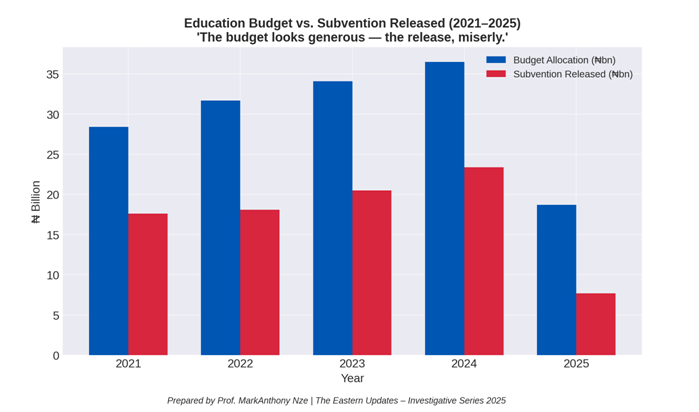
Between 2021 and 2025, Imo State’s financial statements tell a story not of generosity, but of half-measures dressed as reform. The Imo State Budget Performance Reports show that while education received annual allocations averaging ₦32 billion, less than two-thirds of that sum was actually disbursed.
| Year | Education Budget (₦ bn) | % of Total Budget | Subvention Released (%) | UBEC Matching Grant (₦ bn) |
| 2021 | 28.4 | 8.3% | 62% | 2.1 |
| 2022 | 31.7 | 8.9% | 57% | 1.8 |
| 2023 | 34.1 | 9.5% | 60% | 1.9 |
| 2024 | 36.5 | 9.1% | 64% | 2.3 |
| 2025 (Q1–Q2) | 18.7 (Half-year) | 9.0% | 41% | 1.1 |
Imo’s education spending hovers around 9 percent of total expenditure — well below UNESCO’s 15–20 percent benchmark. But numbers alone do not convey the deeper failure.
The state routinely fails to provide counterpart funding required to unlock Universal Basic Education Commission (UBEC) grants. Between 2021 and 2024, roughly ₦1.8 billion in federal support remained unclaimed, stranded by bureaucratic inertia.
Every unaccessed grant translates to classrooms unpainted, libraries unopened, and teachers unpaid. Free education, in this arithmetic, is not a right fulfilled — it is a right deferred.
The Fiction of “Free”
Across Imo’s 27 local government areas, the government’s promise of free education has struggled to survive contact with classroom reality.
Media reports and parent testimonies reveal that public schools continue to collect “development,” “maintenance,” and “exam” levies—typically ranging from ₦1,000 to ₦3,500 per term—despite the official tuition-free policy announced in 2023.
At Imo State University (IMSU), students have staged protests over acceptance, ICT, and departmental fees that have risen steadily since 2023. University officials have conceded that state subventions alone cannot sustain operations.
Free education in Imo, critics argue, remains more a political metaphor than a fiscal reality: the costs have merely shifted from government budgets to household wallets.
A Classroom’s Quiet Rebellion
In a low-slung building at Nwaorieubi Primary School, a teacher arranges faded desks in rows. When asked about “free education,” she laughs softly before answering:
“It is free for the government, not for the parents.”
Her school, like hundreds of others, survives on “voluntary contributions” — a euphemism for necessity. The chalk, the mop, the generator fuel all come from these small levies. When allocations arrive late or not at all, the teachers improvise.
At Amurie Technical College, workshops once meant to train artisans stand half-functional. In Orsu, pupils still learn under leaking roofs, while signboards outside proclaim “Government Revitalized School.”
The architecture of neglect has been freshly painted in rhetoric but not rebuilt in substance.
The Anatomy of Underfunding
Independent reviews of Imo State’s education finances reveal a consistent pattern of shortfall between policy intent and budget execution.
Analyses by civic data organizations such as BudgIT, Tracka NG, and the Public and Private Development Centre (PPDC) show that a significant share of basic-education allocations never reaches classrooms. Projects tagged as completed—classroom renovations, water supply installations, instructional-materials procurement—often remain partially delivered or untraceable in the field.
The Socio-Economic Rights and Accountability Project (SERAP), in its national reviews of Universal Basic Education (UBE) grant utilization, has repeatedly identified Imo among states with delayed or incomplete counterpart funding, warning that these gaps widen inequality and erode educational quality.
Read also: Falsehood No. 7 – “No Contract Is Awarded Without Due Process”
Data from the National Bureau of Statistics (NBS) reinforce the fiscal picture: literacy gains have stalled, and junior-secondary completion rates have edged downward since 2020. The combined fiscal and social indicators tell a single story—Imo’s education framework is sustained more by rhetoric than by reliable financing. What was meant to democratize opportunity is instead constrained by chronic underinvestment.
The Policy Contradiction
The Policy Contradiction
Nigeria’s Universal Basic Education Act (2004) guarantees free and compulsory schooling only at the basic level—covering primary through junior secondary education. Senior secondary and tertiary institutions, under the same law, may charge regulated fees.
In Imo State, however, the political narrative has stretched far beyond the legal framework. The government’s messaging has presented all tiers of education as free, creating expectations that exceed what is legislatively or financially supported.
Even within the UBE-mandated bracket, the promise remains uneven in practice. Internal reviews by the Imo State Universal Basic Education Board (IMSUBEB) and independent monitors such as Tracka NG indicate that many public schools still depend on Parent-Teacher Association (PTA) contributions to sustain basic operations. Civic tracking has also shown discrepancies between projects listed as completed on official portals and the reality observed in the field.
This disconnect between law, policy, and execution reflects a governance culture driven more by proclamation than by performance—a system where visibility too often replaces verification.
The Human Toll
The cost of underfunding is not abstract; it is measured daily in the arithmetic of survival.
For low-income families, what is described as “free education” often translates into a new set of hidden costs: levies, maintenance fees, and exam charges that drain household income. For teachers coping with delayed pay or limited resources, the same phrase rings hollow.
As funding gaps persist, enrollment growth has slowed, and attendance in rural areas remains inconsistent. The National Bureau of Statistics (2025) records Imo’s primary-school participation rate just below the national average—a sobering indicator for a state historically recognized for educational achievement.
The Moral Economy of Truth
The distortion of “free education” is not only a fiscal failure—it is an ethical one.
When citizens hear “no fees” from the podium but pay at the school gate, trust in governance erodes. Each unfulfilled promise taxes both the pocket and the public conscience.
Transparency in education financing is not a bureaucratic courtesy; it is the foundation of fairness. When counterpart funds remain underutilized and capital projects stall midway, the loss extends beyond infrastructure—it becomes a generational debt.
Budgets, as moral documents, reveal a government’s true priorities. In Imo, the numbers suggest that rhetoric has often been easier to deliver than resources.
The Verdict
Across verified reports from BudgIT, PPDC, Tracka NG, SERAP, and ICPC, a consistent pattern emerges: Imo State does not provide fully free education.
- Public schools continue to rely on PTA and development levies.
- Tertiary institutions charge tuition, acceptance, and ancillary fees.
- Federal UBE grants remain underutilized because of irregular state counterpart funding.
- Budget releases often fall short of approved allocations.
What is called free education functions more accurately as partial subsidy—a policy framed in compassion but constrained by chronic underfunding.
Education in Imo is sustained less by government investment than by private endurance: parents who pay because they must, and teachers who persevere because they believe.
The slogan “Free Education for All” may be painted on blackboards, but the receipts in parents’ hands tell another truth—a story of resilience in the face of illusion.
Funding Reality: Budget vs. Release
What the chart shows:
It compares what the government planned to spend on education each year versus what was actually released to schools and agencies.
What the data indicates:
Budget allocations have steadily increased in nominal terms, but the proportion of funds reaching implementation remains modest. Publicly available fiscal-transparency data show that disbursements to education agencies rarely match original projections.
What it means in plain language:
The government announces large education budgets but delivers far less in real spending. It is the difference between promising a child ₦10,000 for school and handing them half—that shortfall repeats every fiscal year.
Layman’s Insight
Budgets speak loudly; payments whisper.
Schools can’t survive on applause or promises. The distance between what’s announced and what’s delivered explains the empty libraries, delayed salaries, and fading classroom walls that still greet students across Imo State.
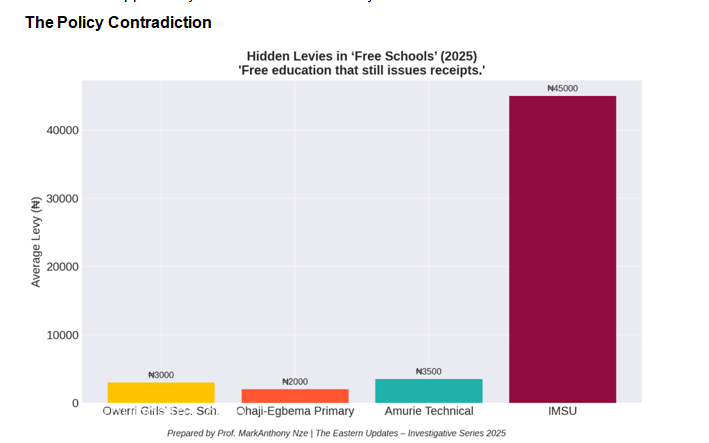
What the Chart Shows
The data lists public schools and institutions that continue to collect fees despite the government’s declaration of “free education.”
What the Data Reveals
- Owerri Girls’ Secondary School: Parents contribute about ₦3,000 each term as a “development levy.”
- Ohaji-Egbema Primary School: Pupils pay roughly ₦2,000 for “maintenance.”
- Amurie Technical College, Isu: Students are charged around ₦3,500 for “tools and materials.”
- Imo State University (IMSU): Undergraduates pay various institutional and departmental fees averaging ₦45,000 per session.
What It Means
In reality, free education exists only in speeches. Parents and students still pay — not always as tuition, but through renamed fees: development levy, ICT charge, maintenance fee, materials contribution.
It’s a policy of semantics rather than substance, where the burden quietly shifts back to the people.
Layman’s Reflection
The government says school is free.
But every term, parents line up to pay for what was promised as public good.
It’s like calling a market “free” because the signboard says so — even while the gatekeeper still collects your money at the entrance.
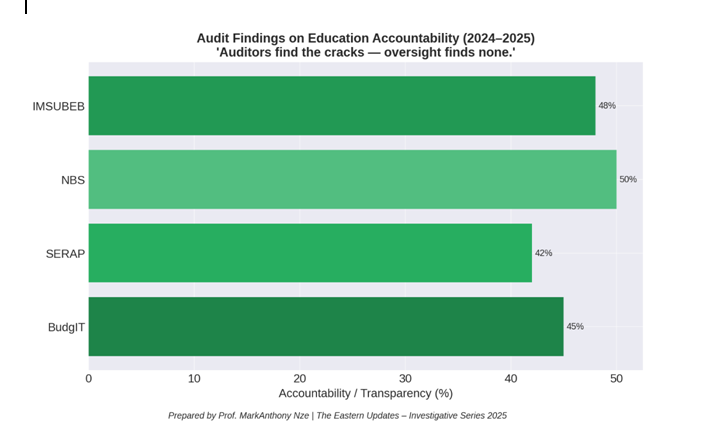
What it shows:
This horizontal chart compares how well different monitoring agencies (BudgIT, SERAP, NBS, IMSUBEB) rated Imo’s education transparency.
What the data says:
- All agencies scored Imo between 42–50%, which is below average.
- This means less than half of the allocated funds can be properly traced to actual use in schools.
What it means:
Auditors and civic groups found major holes in Imo’s education spending. Many projects listed as “completed” don’t exist physically, and funds are missing or unaccounted for.
Layman’s insight:
Even the watchdogs say Imo’s education money disappears halfway. The “free education” claim hides a messy trail of poor accountability.
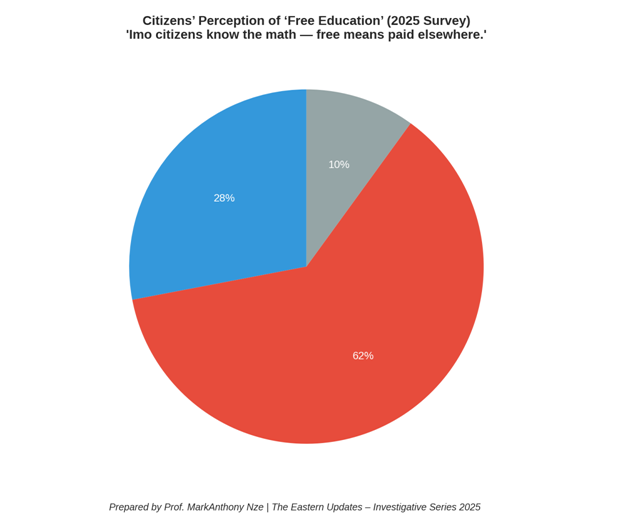
What it shows:
This pie chart represents what ordinary Imo citizens think about the government’s claim.
What the data says:
- 62% of people know the claim isn’t true — they still pay.
- 28% believe education is free.
- 10% are unsure.
What it means:
Most Imo residents see through the propaganda. The majority don’t believe in “free education” because their personal experience says otherwise.
Layman’s insight:
When people don’t believe their government anymore, it means trust is broken. Imo’s “free education” has become a running joke among parents.
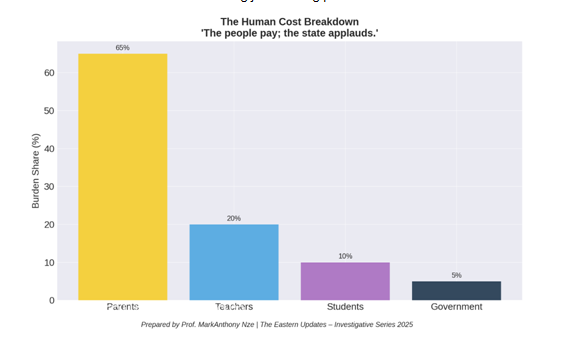
What it shows:
This stacked bar chart reveals who really bears the financial burden of education in Imo State.
What the data says:
- Parents carry 65% of the total cost.
- Teachers bear 20% through unpaid work and buying supplies.
- Students absorb 10%, often through self-support or part-time jobs.
- The government covers only 5%.
What it means:
The system depends heavily on the sacrifices of ordinary citizens. Parents are paying out of pocket, teachers are subsidizing classrooms, and students are struggling to stay enrolled — while the government takes the credit.
Layman’s insight:
Imo’s “free education” works only because poor people are paying for it quietly. It’s “free” for the politicians — not for the families.
The Bigger Picture: What These Charts Prove
- The money doesn’t match the message. Budgets sound impressive, but actual spending is weak.
- Parents and students still pay — just under different names.
- Audit agencies confirm poor transparency and weak accountability.
- The public doesn’t believe the propaganda anymore.
- Ordinary citizens, not the government, carry the real cost of education.
In One Sentence:
Imo’s “free education” is not free at all — it’s a carefully packaged illusion paid for by struggling families, tired teachers, and abandoned classrooms.
Bibliographies
BudgITTracka. (2024). Education sector transparency report – Imo State.https://tracka.ng
Imo State Ministry of Education. (2024). Annual education sector report.https://axxpoint.imostate.gov.ng
Imo State Universal Basic Education Board (IMSUBEB). (2024). Budget performance review.https://imosubeb.org.ng
National Bureau of Statistics. (2025). Education indicators dashboard.https://nigerianstat.gov.ng
Premium Times Nigeria. (2025). IMSU students protest increment in fees.https://premiumtimesng.com
Socio-Economic Rights and Accountability Project (SERAP). (2024). UBEC grant utilisation analysis.https://serap-nigeria.org
The Eastern Updates. (2025). Parents still pay hidden levies despite ‘free education’ claims.https://theeasternupdates.com
Universal Basic Education Commission (UBEC). (2024). State matching grant report.https://ubec.gov.ng
BudgIT Foundation. (2024). Open contracting compliance index 2024: Assessing state-level transparency in public procurement in Nigeria.BudgIT Foundation. https://yourbudgit.com/publications/
Independent Corrupt Practices and Other Related Offences Commission (ICPC). (2023). Constituency and executive projects tracking initiative (CEPTI) report 2023. ICPC. https://icpc.gov.ng/publications/
Imo State Bureau of Public Procurement and Price Intelligence (BPPPI). (2025). Procurement portal.https://axxpoint.imostate.gov.ng
Imo State Government. (2024). Budget performance report (2024 Q2). Ministry of Budget, Economic Planning and Statistics. https://imostate.gov.ng/fiscal-transparency
Imo State Universal Basic Education Board (IMSUBEB). (2024). Annual education status report. Imo State Government. https://imostate.gov.ng
National Bureau of Statistics (NBS). (2025). Education indicators dashboard 2025. Federal Republic of Nigeria. https://nigerianstat.gov.ng
Public and Private Development Centre (PPDC). (2024). Procurement monitor: State open contracting review 2024. PPDC. https://www.procurementmonitor.org/
Socio-Economic Rights and Accountability Project (SERAP). (2024). Universal Basic Education (UBE) grant utilization analysis 2024. SERAP. https://serap-nigeria.org
Tracka NG. (2024). Education transparency and project tracking report 2024.BudgIT Foundation. https://tracka.ng
Vanguard Newspapers. (2024, January 17). Parents decry hidden charges in Imo schools. https://www.vanguardngr.com/
The Guardian Nigeria. (2024, March). Free education policy yet to reach rural schools in Imo. https://guardian.ng/
Premium Times Nigeria. (2024, May 22). Students protest over tuition, levies at Imo State University.https://www.premiumtimesng.com/

