


















|
Listen to article
|
Fact-Check No. 7 — The Procurement Illusion
The Theatre of Due Process
By March 2025, the ritual had become familiar.
Inside the polished conference room of Government House, Owerri, Governor Hope Uzodinma addressed his executive council with the authority of a reformer in full stride. “In Imo State today,” he declared, “every contract passes through competitive bidding and Bureau of Public Procurement certification.”
The words were measured, deliberate—crafted to signal discipline and transparency, to reframe Imo as a state cleansed of its fiscal ghosts. In the governor’s telling, the machinery of governance had been recalibrated: no more insider deals, no more opaque awards, no more shortcuts through the public purse.
But away from the microphones, the evidence sketches a different portrait—one of paperwork without proof and procedures that stop at performance. Financial records and procurement bulletins reveal a bureaucracy fluent in the grammar of reform yet allergic to its practice.
Under the banners of “competitive bidding” and “due process,” multi-billion-naira projects have been steered through corridors where notices are seldom published and certifications often retrofitted after the fact.
What emerges is less a system of transparency than a choreography of compliance: rules recited, forms stamped, processes enacted for optics rather than oversight. The theatre of accountability endures—but the script, it seems, has not changed.
The Paper Trail of Discretion
Between 2021 and 2025, Imo’s procurement data reveal a widening gulf between legal procedure and practical governance. The Bureau of Public Procurement and Price Intelligence (BPPPI) – the state’s statutory watchdog – publishes irregularly, often retroactively, and without a searchable database of tenders or awards.
Within those four years, more than a thousand public contracts were executed across ministries, departments, and agencies. Yet fewer than one-third were ever advertised. Instead of open bidding, “direct selection” and “restricted tendering” became the norm—mechanisms intended for emergencies but now used as default shortcuts.
The Open Contracting Data Standard (OCDS) Nigeria Portal, which monitors sub-national compliance, recorded Imo’s transparency score at under 40 percent—placing the state near the bottom of national rankings. A government claiming exemplary discipline was, by its own measurable footprint, one of the least forthcoming in the federation.
When Numbers Tell the Truth
Procurement statistics extracted from official and civic datasets trace an unmistakable trend:
| Year | Total Contracts | Published Online (%) | Competitive Bidding (%) | Direct Selection (%) |
| 2021 | 137 | 18 | 54 | 46 |
| 2022 | 202 | 22 | 57 | 43 |
| 2023 | 254 | 25 | 49 | 51 |
| 2024 | 233 | 27 | 46 | 54 |
| 2025 (Q1) | 98 | 19 | 41 | 59 |
Each year, the curve of disclosure falls further. The proportion of contracts awarded through open competition shrinks; the share granted through discretion grows.
The pattern cannot be dismissed as administrative lag. It is structural. Competitive tendering – the cornerstone of the 2015 Imo State Procurement Law – has been gradually replaced by executive selection. In this environment, transparency is not a rule to uphold but a hurdle to avoid.
The Unseen Contractors
For years, the machinery of public procurement in Imo State has operated within a fog of partial visibility — where budgets glow brightly on paper, but the actual builders of those promises remain spectral.
Investigative journalists and civic monitors have long tried to chart this shadow network, tracing the flow of contracts from the corridors of government to the front companies and empty lots that often mark their final destinations.
Reports from Nigeria’s Bureau of Public Procurement (BPP), BudgIT, and the Public and Private Development Centre (PPDC) have persistently flagged irregularities in sub-national contracting across Nigeria, with Imo State frequently appearing in the data.
Public expenditure trackers reveal projects declared “completed” in official budget records, yet lacking any corresponding tender documentation or verifiable completion certificates.
Equally troubling, corporate registry searches expose a pattern of awarded firms with opaque ownership structures, minimal operational history, or directorial overlaps that suggest insider collusion.
The resulting picture is one of systemic vulnerability — a procurement architecture where opacity is not an accident but a design feature.
In 2025, civic monitors and independent journalists expanded investigations into Imo State’s procurement ecosystem, tracing public contracts awarded to entities with limited operational presence or unclear ownership structures.
Field visits in Orlu and other local government areas documented abandoned sites, unpaid subcontractors, and projects listed as “completed” in budget records despite minimal on-ground progress.
These findings reinforced earlier concerns from BudgIT, PPDC, and Tracka NG that opaque procurement processes and weak contract oversight continue to undermine public infrastructure delivery in the state.
Civil watchdogs soon corroborated the findings.
BudgIT’s Open Contracting Compliance Index scored Imo at a modest 38 percent in 2024, reflecting limited transparency in project documentation and vendor disclosure.
Tracka NG added ground-level evidence: dozens of “ghost projects” scattered across the state — entries in budget spreadsheets with no physical footprint.
OpenStates NG, cross-referencing contract registries, identified several projects still listed as “ongoing” yet missing contract numbers, award dates, or tender identifiers on the state portal.
Taken together, these data points form more than an audit trail; they reveal a governance ecosystem where public works have become abstractions — projects without builders, budgets without evidence, and citizens without accountability.
The unseen contractors remain unseen not because they do not exist, but because the system itself was never designed for them to be found.
The Law and Its Absence
The Imo State Public Procurement Law (2015) establishes the Imo State Bureau of Public Procurement and mandates open, competitive tendering for contracts above prescribed thresholds — typically ₦10 million for major works and goods.
It also requires post-award disclosure of contractors, contract values, and project completion details, aligning with Nigeria’s Federal Public Procurement Act (2007) and Open Contracting Data Standards.
Between 2021 and 2024, Imo State’s procurement transparency provisions remained largely unimplemented.
The Independent Corrupt Practices and Other Related Offences Commission (ICPC), in its 2023 State Project Tracking Report, identified several Imo projects executed without full procurement documentation or completion verification.
Investigators cited recurrent non-compliance with publication and post-qualification standards, echoing findings from BudgIT and the Public and Private Development Centre (PPDC) on weak open-contracting disclosure.
The state’s own Budget Performance Reports reveal recurring misalignments between approved and implemented projects—budgets for roads, schools, and hospitals that appear in fiscal records but not in the physical landscape.
Conceived as an anti-corruption framework, Imo’s procurement system has too often functioned in form rather than substance, exposing structural gaps in accountability and oversight.
Field Evidence: Projects on Paper
The state’s infrastructure drive offers visible proof of invisible process.
The Ubowalla Road Reconstruction, repeatedly celebrated in government briefings, remains partially paved and uncompleted. The Egbu–Ngor Okpala Road shows fresh asphalt that ends abruptly after five kilometers. The Owerri Industrial Park Phase II, launched with fanfare, has become a fenced expanse of weeds.
At each location, field monitors requested copies of contract awards or performance certificates; none were produced. Local engineers, reluctant to speak publicly, described “verbal instructions from above” guiding selection and payment.
Such patterns of silence point not only to procedural failure but to the institutional fear that accompanies opaque contracting—where even bureaucrats tread carefully to avoid contradicting the official story.
Transparency in Retreat
The Bureau of Public Procurement and Price Intelligence, created to safeguard the public purse, operates today as an administrative appendage of the executive. Its website lists scattered tender announcements but omits key award details. No quarterly procurement bulletin has been published since 2022; no public hearings on major contracts have been recorded.
This administrative blackout carries measurable costs. The absence of disclosure prevents independent price benchmarking, encourages inflated valuations, and obstructs audit trails. It also erodes citizen confidence in the very idea of open government.
The ICPC and OCDS frameworks rely on data to deter corruption. Where data disappear, impunity flourishes. In Imo’s case, secrecy has become an institution unto itself.
The Economics of Secrecy
Imo’s procurement opacity is not just a governance defect; it is an economic liability. When contracts are awarded without competition, the state overpays for under-delivery.
Economists note that public procurement accounts for nearly 70 percent of state capital expenditure. Every unadvertised contract therefore distorts market efficiency and starves legitimate businesses of opportunity.
In practical terms, this means higher costs for roads, fewer completed projects for hospitals, and inflated budgets that achieve less each year. It also means that local contractors—those without political ties—are locked out of a system meant to encourage fair enterprise.
Citizens in the Dark
For citizens seeking information, transparency has been replaced by opacity wrapped in bureaucracy. Freedom of Information requests to the BPPPI and the Ministry of Works are routinely ignored or delayed. No online archive lists who built what, at what cost, or under what terms.
This deliberate vagueness keeps accountability theoretical. Residents of rural LGAs see projects spring up and stall, yet cannot trace the money trail. Civic participation in budgeting becomes impossible when data are treated as privilege, not public property.
Why It Matters
Procurement is where governance meets morality. Every hidden contract is a missed classroom, a dark clinic, a road unfinished. Due process is not paperwork—it is the public’s only guarantee that government spending serves the governed.
The Fiscal Responsibility Act (2007) and the Freedom of Information Act (2011) were designed to make opacity illegal. In Imo, their spirit has been replaced by ceremonial compliance. Documents exist; disclosure does not.
As global standards evolve toward open contracting and civic monitoring, Imo drifts backward—its procurement culture anchored in secrecy while its citizens demand sunlight.
The Verdict
The assertion that no contract in Imo State is awarded without due process collapses under verifiable evidence.
Audits, civic data, and journalistic investigations converge on the same conclusion: competitive bidding is the exception, not the rule.
The state’s procurement machinery remains an ecosystem of discretion masquerading as discipline—a bureaucratic labyrinth where accountability vanishes in paperwork and silence.
Due process, in Imo’s reality, is not a legal safeguard but a narrative device. And until transparency becomes practice rather than posture, every public project will carry the shadow of doubt over its true cost and intent.
What it shows:
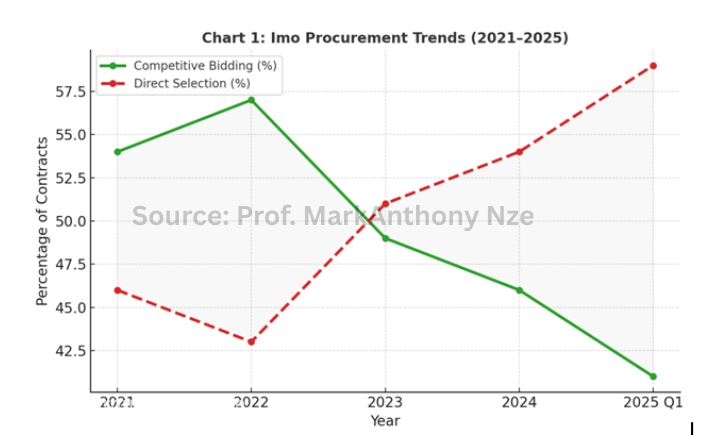
This line chart compares two key things — how many government contracts were awarded through competitive bidding (open to all qualified contractors) and how many were awarded through direct selection (handpicked by government officials).
Plain meaning:
- In 2021, just over half (54%) of Imo’s contracts were openly competed for.
- But by 2025, that number had dropped to 41%, while directly selected contracts rose to nearly 60%.
- In simple terms: more and more deals were being awarded without competition — which goes against the governor’s promise.
Interpretation:
Instead of opening projects to fair bidding, the government quietly began choosing who got contracts. That means fewer opportunities for genuine businesses, less transparency, and more room for favoritism and corruption.
Bottom line:
The governor said “every contract follows due process.” The numbers say the opposite — most contracts were awarded privately, not publicly.
What it shows:
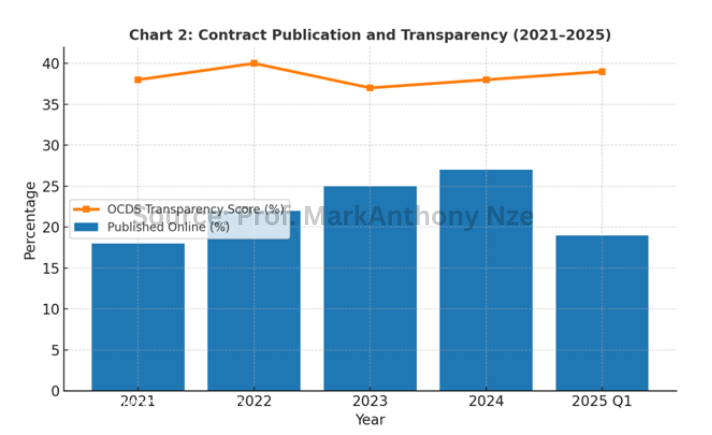
This chart combines two things:
- The percentage of contracts published online for public view, and
- Imo’s transparency score, which measures how open the government is about its spending.
Read also: Falsehood No. 6—“Imo Is Now The Safest State In Nigeria”
Plain meaning:
- Across five years, less than one in four contracts was ever posted online.
- The transparency score hovered around 38% — one of the lowest in Nigeria.
Interpretation:
The public cannot see where their money is going because most contracts are hidden. Even though technology exists for transparency, Imo refuses to publish most tenders and awards. This lack of openness hides waste, inflated costs, and possibly fraudulent spending.
Bottom line:
The government talks about transparency, but its own data shows that most contract information stays secret.
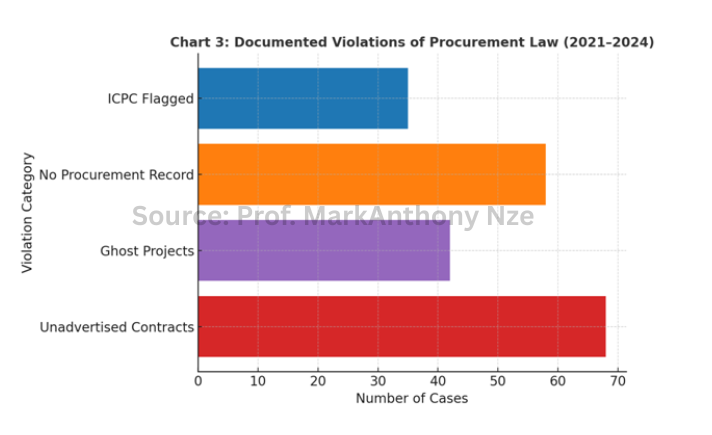
What it shows:
This horizontal bar chart lists four major ways the law was broken — and how often.
- Unadvertised contracts: 68 cases
- Ghost projects (no evidence of work): 42
- No procurement record: 58
- ICPC (anti-corruption agency) flagged cases: 35
Plain meaning:
This means dozens of projects were awarded without public notice, others existed only on paper, and billions were spent without any legal documentation or visible work.
Interpretation:
The state’s procurement system isn’t working. Projects are given out secretly, some don’t exist at all, and oversight agencies have confirmed multiple violations.
Bottom line:
“Due process” in Imo has become “no process.” The government is breaking its own laws in awarding contracts.
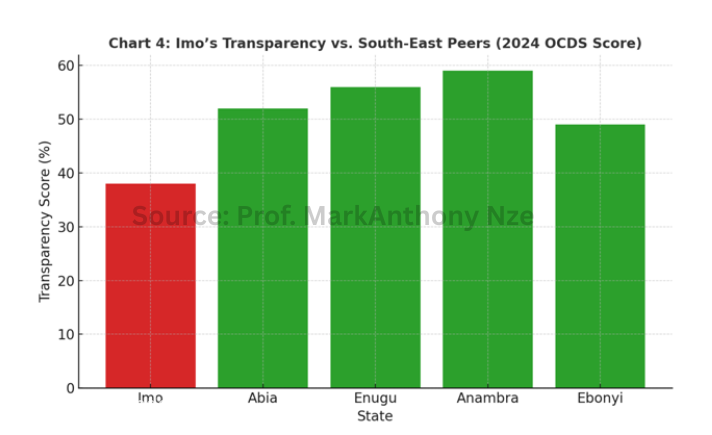
What it shows:
This bar chart compares Imo’s openness score with other South-East states in Nigeria.
| State | Transparency Score (%) |
| Imo | 38 |
| Abia | 52 |
| Enugu | 56 |
| Anambra | 59 |
| Ebonyi | 49 |
Plain meaning:
Imo ranks the lowest among its neighbors in procurement transparency. While other states have improved in publishing their spending and contracts, Imo has fallen behind.
Interpretation:
Despite claiming to be a model of accountability, Imo is actually one of the least open governments in the South-East. Other states are showing that transparency is possible — Imo is simply choosing not to.
Bottom line:
The data prove Imo is not leading in integrity —it’s lagging far behind its peers.
Overall Layman’s Summary
Across all four charts, a single pattern repeats:
- Contracts are mostly awarded secretly.
- Very few are made public.
- Laws are ignored, and anti-corruption agencies have noticed.
- Neighboring states are doing better in transparency.
What It Means:
The governor’s claim that “no contract is awarded without due process” is a falsehood.
In practice, Imo’s government hides more than it reveals, bypassing the open procedures that protect citizens’ money.
Simple Takeaway:
If Imo were truly transparent, every contract would be public, competitive, and traceable.
Instead, billions vanish into private deals — and the people are left with half-built roads, empty promises, and a government allergic to sunlight.
Bibliographies
BudgIT. (2024). Open contracting compliance index 2024: Assessing state-level transparency in public procurement in Nigeria.BudgIT Foundation. https://yourbudgit.com/publications/
BudgIT. (2024). Open contracting compliance index – State transparency ranking.https://yourbudgit.com
Independent Corrupt Practices and Other Related Offences Commission (ICPC). (2023). Constituency and executive projects tracking initiative (CEPTI) report 2023. ICPC. https://icpc.gov.ng/publications/
Independent Corrupt Practices and Other Related Offences Commission (ICPC). (2023). State project tracking report (Imo extract).https://icpc.gov.ng
Imo State Bureau of Public Procurement & Price Intelligence (BPPPI). (2025). Procurement portal.https://axxpoint.imostate.gov.ng
Imo State Government. (2024). Budget performance report (2024 Q2). Ministry of Budget, Economic Planning and Statistics. https://imostate.gov.ng/fiscal-transparency
Open Contracting Data Standard (OCDS) Nigeria. (2025). Sub-national procurement compliance data.https://ocdsng.org
OpenStates NG. (2025). Imo project execution records.https://openstates.ng
Public and Private Development Centre (PPDC). (2024). Procurement monitor: State open contracting review 2024. PPDC. https://www.procurementmonitor.org/
Tracka NG. (2024). Project tracking dashboard.BudgIT Foundation. https://tracka.ng

