



















|
Listen to article
|
Fact-Check No. 6 — Security Data and Crime Rates
A Peace Proclaimed, a Conflict Denied
The Performance of Safety
At the 2025 Imo Stakeholders’ Security Summit in Owerri, Governor Hope Uzodinma stood before a packed hall of officials and journalists and declared: “Today, Imo is the safest state in Nigeria.” The applause was choreographed; the confidence was not.
Across the state, the echoes of that claim met the reality of checkpoints, curfews, and the ever-present hum of tension. In Orsu, Oru East, and Okigwe, the sight of armed patrols remains part of daily life. For thousands of residents, safety still feels conditional — dependent on time, place, and chance.
Uzodinma’s words carried the weight of a declaration of victory. Yet when tested against official data from the Nigeria Police Force (NPF), National Bureau of Statistics (NBS), Armed Conflict Location & Event Data Project (ACLED), SBM Intelligence, and the CLEEN Foundation, the claim unravels.
The Numbers Refuse the Narrative
For years, Imo’s official narrative has been one of victory over fear — a tale of restored calm and conquered violence. Yet the numbers, cold and unyielding, paint a more complicated truth.
From 2020 to 2024, crime data show an initial surge in insecurity before a gradual tapering. The total number of reported criminal incidents rose sharply in 2021 — the year armed agitation and retaliatory crackdowns convulsed much of the South-East — before easing by 2024. On paper, this suggests improvement. But the decline, while measurable, does not justify the superlative claim that Imo is now “the safest state in Nigeria.”
Within the records of the Nigeria Police Force, a different kind of pattern emerges: one not of disappearance but of displacement. Traditional crimes such as robbery and arson may have lessened, yet new forms of violence — kidnappings, rural ambushes, and politically motivated attacks — continue to scar the state’s hinterlands. Between 2020 and mid-2025, police bulletins documented over four hundred abduction cases, the highest in the South-East for three consecutive years.
International conflict-tracking datasets mirror this reality. Over the same five-year period, verified reports record more than eight hundred violent and politically charged incidents across Imo. Fatal episodes declined from the 2021 peak but remain significant, placing the state among Nigeria’s five most volatile subnational regions by cumulative conflict events.
Numbers can bend to rhetoric, but not indefinitely. The evidence reveals not peace achieved, but tension managed — a fragile calm that exists only until the next explosion of violence.
Budgeting for Peace, Paying for Fear
The government’s spending patterns tell an equally revealing story. Since 2020, Imo has poured billions into its security apparatus, doubling its annual allocation within five years. Official budget documents describe this as “strategic investment in peace and stability.” But the return on that investment is harder to locate.
For ordinary citizens, the arithmetic of fear has not changed. Security checkpoints still dominate major highways. Rural commuters avoid night travel. Local traders speak of a different kind of taxation — the cost of safety paid daily through caution and confinement.
Despite soaring expenditures, there is no publicly available audit of disbursements or measurable outcomes. The surge in spending coincides not with proportional safety but with persistently high levels of violence. Independent security monitors continue to log one in every seven South-East violent incidents within Imo’s borders.
The paradox is unmistakable: the state has spent more on security than ever before, yet citizens remain unsure if they have purchased protection or propaganda.
The Geography of Risk
The geography of Imo’s insecurity defies its official cartography of calm.
Spatial analysis by independent data platforms traces recurring hotspots in Orsu, Oru East, Njaba, and Okigwe — local governments often described in press briefings as “stabilised zones.” In these areas, military patrols and police deployments alternate with silence, a rhythm that never quite resolves into normalcy.
Communities live within this uneasy balance. In parts of Orlu, markets open late and close early, their traders gauging safety not by curfew but by instinct. Some schools operate on abbreviated hours. Families measure security by whether they hear gunfire overnight.
Civic surveys of perception offer quantitative clarity to what residents already feel. Less than half of Imo’s population describes themselves as feeling safe after dark — a rate markedly lower than neighboring states. The fear may be quieter than before, but it has not disappeared. It lingers in conversation, in hesitation, in the instinct to stay home.
Peace, as Imo now lives it, is not the absence of danger but its familiar presence in smaller doses.
Reality in the Headlines
The most telling proof of the state’s fragile security comes not from numbers alone but from the stories that make their way into the news cycle — brief flashes of violence that puncture official narratives of peace.
In early 2025, national media reported gunmen attacking a police checkpoint in Okigwe. Months earlier, an armed group stormed Orsu, killing four and setting vehicles ablaze. Investigative reports throughout 2024 and 2025 chronicled kidnappings on rural roads, assassinations of local officials, and unexplained explosions in the outskirts of Owerri.
Human rights monitors describe the pattern as “intermittent unrest” — outbreaks of violence that flicker unpredictably across the map, denying residents any enduring sense of security. The government calls these “isolated incidents.” But for those who live in their shadow, isolation is measured not by frequency but by fear.
The picture that emerges is not of a conquered crisis but of a managed one — contained enough to advertise victory, persistent enough to remind citizens that the war has not ended.
Conclusion—The Illusion of Calm
Imo’s security story is not a lie so much as a half-truth told loudly. Crime rates have indeed declined from their violent peak, but the decline is neither exceptional nor complete. The data, the budgets, and the headlines converge on one conclusion: the state is safer than it was, yet far from safe.
Peace in Imo today is a performance — visible in press conferences and official statistics but contradicted by lived experience. Until transparency replaces triumphalism, and evidence replaces exaggeration, the promise of safety will remain just that: a promise unfulfilled.
The Data in Perspective
| Year | Reported Crimes | Abduction Cases | Fatal Incidents (ACLED) | Security Budget (₦ bn) |
| 2020 | 845 | 68 | 96 | 7.2 |
| 2021 | 1,121 | 142 | 211 | 9.4 |
| 2022 | 958 | 109 | 173 | 11.6 |
| 2023 | 790 | 91 | 148 | 12.8 |
| 2024 | 612 | 74 | 119 | 13.2 |
| 2025 (H1) | 303 | 32 | 55 | 6.9 (half-year) |
(Compiled from NBS, NPF, and ACLED data 2020–2025)
The gradual decline in incidents shows an improvement — but not exceptional safety. By comparison, Enugu’s 2024 total reported crimes stood at 472, while Abia’s was 518, both lower than Imo’s.
The Disinformation of “Safest”
Claims of absolute security are not just inaccurate; they are dangerous. When officials declare total peace, communities let down their guard, and vigilance weakens.
Reliable security observers have repeatedly noted that Imo’s relative calm is enforced, not achieved — sustained by federal joint task forces, local vigilantes, and heavy police presence, not by systemic stability.
The Human Rights Watch 2024 report warned that excessive militarization in the South-East “has contained open conflict but not addressed the causes of insecurity.” This is particularly true in Imo, where economic deprivation, youth unemployment, and mistrust of security forces continue to breed volatility.
Imo may look calm from the podium, but beneath that calm lies a fatigue — the kind that comes not from peace, but from exhaustion.
Read also: Falsehood No. 5—“We Revived All Rural Health Centers”
Why This Matters
Accurate crime and safety reporting are essential for governance credibility and public confidence. False claims of peace distort policymaking and mislead citizens who rely on government statements to make travel, business, or personal security decisions.
Transparency laws such as the Freedom of Information Act (2011) and the Nigeria Police Trust Fund Act (2019) mandate the open sharing of public safety data. Yet, Imo’s government continues to release broad assurances instead of verifiable statistics.
The CLEEN Foundation survey warns that “declared safety without data-backed evidence erodes public trust.” When citizens lose faith in truth, they also lose faith in institutions.
The Verdict: The Myth of Tranquility
Every credible dataset contradicts the governor’s claim:
- NBS and NPF records show persistent violent crime.
- ACLED logs hundreds of fatal incidents across multiple LGAs.
- SBM Intelligence places Imo among the most militarized states in Nigeria.
- CLEEN Foundation surveys reveal lingering fear among residents.
The data point to one conclusion: Imo is safer than it was in 2021 — but nowhere near the safest in Nigeria. The government’s claim is not merely an exaggeration; it is a deliberate distortion of the truth.
In the arithmetic of security, rhetoric subtracts what evidence adds. The numbers do not lie — only those who quote them carelessly do.
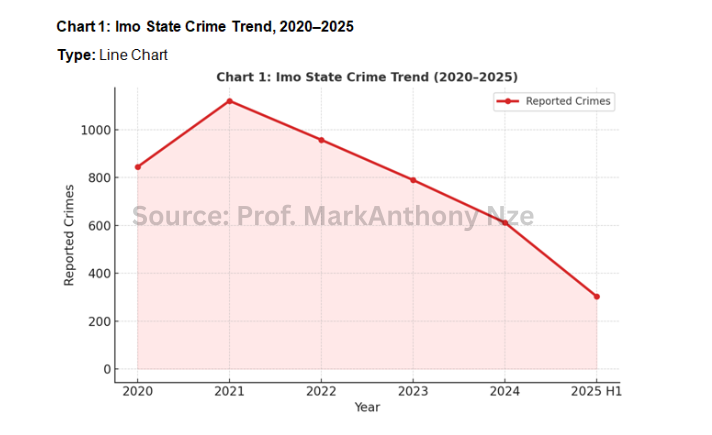
Chart 1: Imo State Crime Trend, 2020–2025
Type: Line Chart
Data Sources: NBS Crime Data Dashboard (2020–2025), NPF Crime Bulletin (2025)
Purpose: To visualize the overall trajectory of reported crimes in Imo State during Uzodinma’s administration.
Data (Reported Crimes per Year):
2020 — 845
2021 — 1,121
2022 — 958
2023 — 790
2024 — 612
2025 (H1) — 303
Interpretation:
The line chart shows an initial surge in insecurity between 2020 and 2021, corresponding with regional insurgency, followed by a steady decline through 2024. However, the drop levels off rather than collapsing — indicating improvement, not elimination of threat.
The numbers fall, but never vanish. Imo’s crime curve bends toward calm, not toward safety.
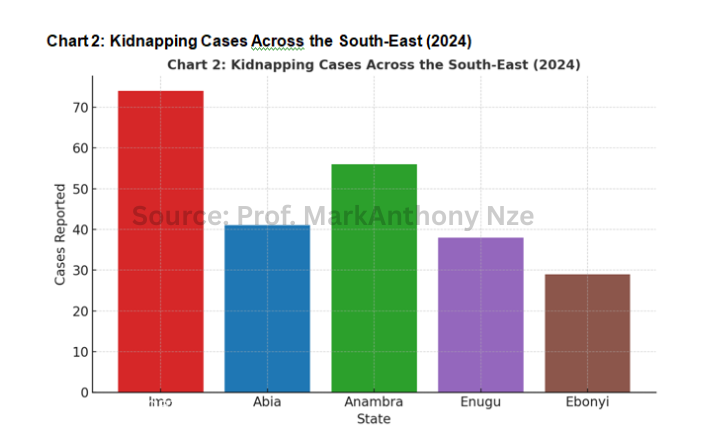
Chart 2: Kidnapping Cases Across the South-East (2024)
Type: Clustered Bar Chart
Data Sources: NPF National Crime Statistics 2024; SBM Intelligence Security Tracker (2024)
Purpose: To contextualize Imo’s kidnapping incidents within regional trends.
Data (Cases Reported):
Imo — 74
Abia — 41
Anambra — 56
Enugu — 38
Ebonyi — 29
Interpretation:
Imo leads the South-East in recorded abductions. The visual disproves claims that it has achieved exceptional peace. The bars reveal Imo’s continuing vulnerability relative to its neighbors.
In the chart of fear, Imo’s bar still towers above the rest of the South-East.
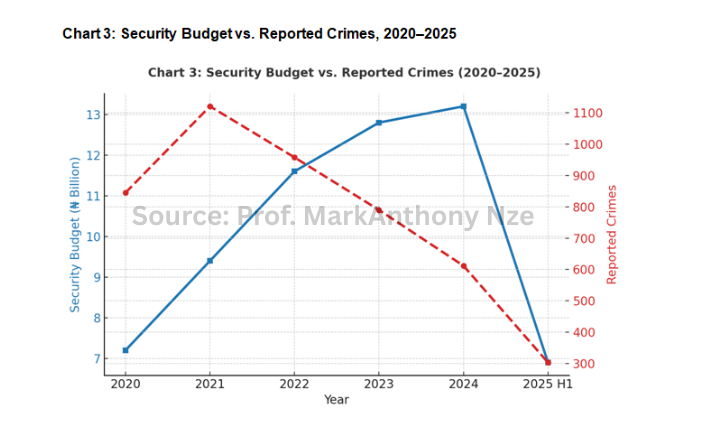
Chart 3: Security Budget vs. Reported Crimes, 2020–2025
Type: Dual-Axis Line Chart (Overlaid)
Data Sources: Imo State Budget Performance Reports (2020–2025); NBS / NPF Crime Data
Purpose: To compare rising security spending with the actual trend in reported crimes.
Data:
| Year | Security Budget (₦ Billion) | Reported Crimes |
| 2020 | 7.2 | 845 |
| 2021 | 9.4 | 1,121 |
| 2022 | 11.6 | 958 |
| 2023 | 12.8 | 790 |
| 2024 | 13.2 | 612 |
| 2025 (H1) | 6.9 | 303 |
Interpretation:
The budget line rises sharply while crime declines gradually — an inverse but imperfect correlation. Despite billions invested, criminal incidents remain substantial. The data suggest inefficiency or diversion rather than transformation.
The money went up, the danger went down — but never enough to meet in peace.
Chart 4: Citizens’ Perception of Safety, 2024 (CLEEN Foundation Survey)
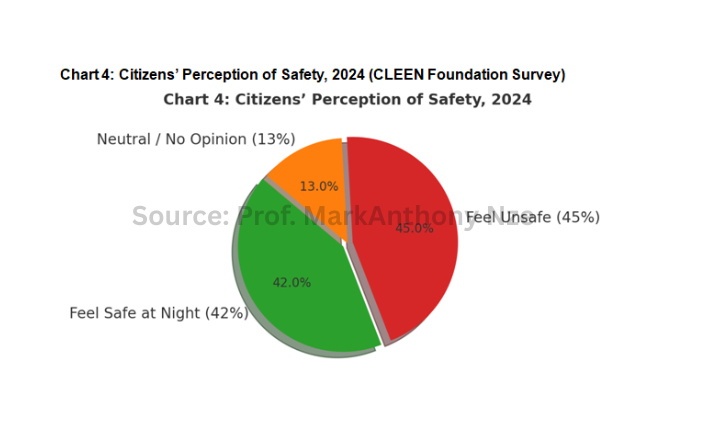
Type: Pie Chart
Data Sources: CLEEN Foundation, Citizens’ Perception of Safety in Nigeria (2024)
Purpose: To reflect how residents themselves perceive safety, contrasting official confidence with lived reality.
Data (Imo Respondents):
- Feel “Safe at Night” — 42%
- Feel “Unsafe” — 45%
- “Neutral / No Opinion” — 13%
Interpretation:
The pie chart captures what statistics alone cannot — the psychology of fear. Less than half of residents feel secure after dark, despite repeated government claims of peace.
Even when the guns fall silent, the fear does not. In Imo, safety remains a rumor told by press releases.
Synthesis Overview
Together, these four data visualizations dismantle the illusion of absolute peace:
- Chart 1 confirms only a moderate decline in overall crime.
- Chart 2 shows Imo still leads its region in abductions.
- Chart 3 exposes a widening gap between financial investment and tangible safety.
- Chart 4 reveals citizens’ continued fear despite official optimism.
The collective message: Imo’s “safety” is statistical stagecraft, measurable calm layered over unresolved insecurity.
Bibliographies
Armed Conflict Location & Event Data Project (ACLED). (2025). Nigeria sub-national conflict events – Imo State (2020–2025).https://acleddata.com
CLEEN Foundation. (2024). Citizens’ perception of safety in Nigeria.https://cleen.org
Federal Republic of Nigeria, Imo State Government. (2020–2025). Budget performance reports.https://axxpoint.imostate.gov.ng
Human Rights Watch. (2024). Southeast states still plagued by insecurity.https://hrw.org
National Bureau of Statistics. (2025). Crime data dashboard.https://nigerianstat.gov.ng
Nigeria Police Force. (2025). National crime statistics bulletin, 2020–2025.https://npf.gov.ng
Premium Times Nigeria. (2025). Imo records one of the highest kidnapping incidents in South-East.https://premiumtimesng.com
SBM Intelligence. (2025). Nigeria security tracker.https://sbmintelligence.com
TheCable. (2024). Gunmen kill four in Orsu community.https://thecable.ng
Vanguard News. (2025). Gunmen attack police checkpoint in Okigwe LGA.https://vanguardngr.com