




















|
Listen to article
|
Fact-Check No. 13 — The Asphalt Illusion: Measuring Roads Beyond Ribbon-Cutting
The Politics of Pavement
In the language of Nigerian politics, asphalt has become the new poetry of power. Every administration in Imo State, from Mbakwe’s cement dreams to Uzodinma’s “Reconstruction Agenda,” has promised to make the land of the rising sun glisten with tar. In speeches and press releases, the current government boasts of “unprecedented road infrastructure,” claiming Imo now ranks “number one in Nigeria for road network and quality.”
It is a grand claim — and like all grand claims, it wilts under measurement. Independent data, field evidence, and satellite imagery reveal a less flattering truth: Imo’s roads are not the best in Nigeria; they are among the most frequently re-awarded, half-completed, and prematurely decayed.
Counting Kilometers, Not Quality
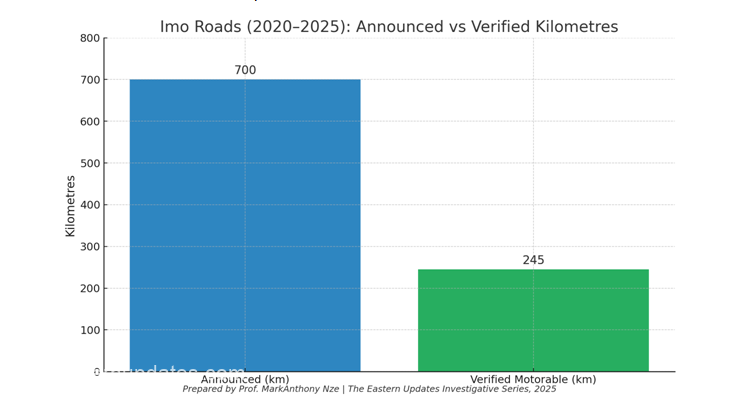
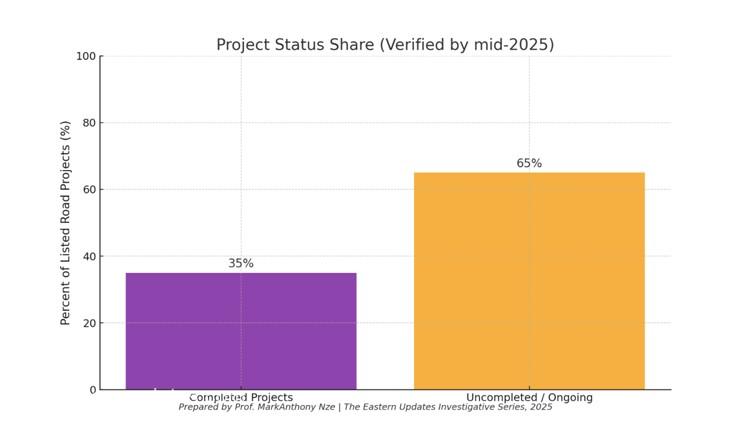
Between 2020 and 2025, the state government announced over 700 kilometres of newly constructed or rehabilitated roads. On paper, the list is impressive: Douglas, Okigwe, Orlu, Nekede, Mbaise, Akwakuma – every axis supposedly reborn. But when Tracka (BudgIT’s civic platform) compared these claims with verified geospatial data and procurement records, the gap was glaring. Barely 35 percent of listed projects were fully completed and motorable by mid-2025.
The National Bureau of Statistics 2024 Transport Infrastructure Audit placed Imo 18th among Nigeria’s 36 states in road density and 21st in average road durability. Neighboring Abia, Ebonyi, and Anambra all scored higher on completion consistency and maintenance performance.
Field observations confirmed the pattern: roads that glistened for six months now buckle under first rains. Asphalt layers thin as paper, drainage channels absent, shoulders eroded. “We don’t drive on roads here,” a commercial driver in Owerri quipped. “We swim on them when it rains.”
Reconstruction or Recycling?
BudgIT’s 2024 State of States Report and CDD West Africa’s 2023 Subnational Governance Review both flagged Imo for opaque procurement practices in infrastructure spending. Contracts are frequently re-awarded to the same politically connected companies under fresh headings — “rehabilitation,” “expansion,” or “completion phase.”
Several of these firms lack the engineering certification to execute major drainage or asphalt works. Their offices, sometimes nothing more than briefcase addresses, disappear once mobilization fees clear. The result is a state littered with roads that die young, their carcasses buried under new signage and hashtags.
The Asphalt Economy
In Imo, roads have become political instruments as much as physical assets. A kilometer of asphalt serves two functions: mobility and propaganda. Each flag-off generates headlines; each drone shot becomes campaign material. Yet, few contracts undergo technical audit before payment.
The Open Government Partnership Nigeria 2024 Implementation Assessment found that only one in four Imo road contracts published online contained cost breakdowns or completion certificates. The remainder listed vague figures under “lump-sum execution.”
This opacity breeds a circular economy of construction: new roads announced every year, old ones quietly erased from memory. Even the NEGF 2024 E-Governance Performance Brief noted that Imo’s digital project monitor, Axxpoint, lists roads marked “100 percent complete” whose coordinates lead to unpaved stretches.
Read also: Falsehood No. 12 – “We Digitalized All Government Services”
A Geography of Neglect
Beyond the capital, the illusion thins. In Mbaitoli, Isiala Mbano, and Ideato South, feeder roads remain craters of clay. Bridges collapse into silence. Rural teachers and farmers navigate daily commutes that consume half their earnings in motorcycle fares.
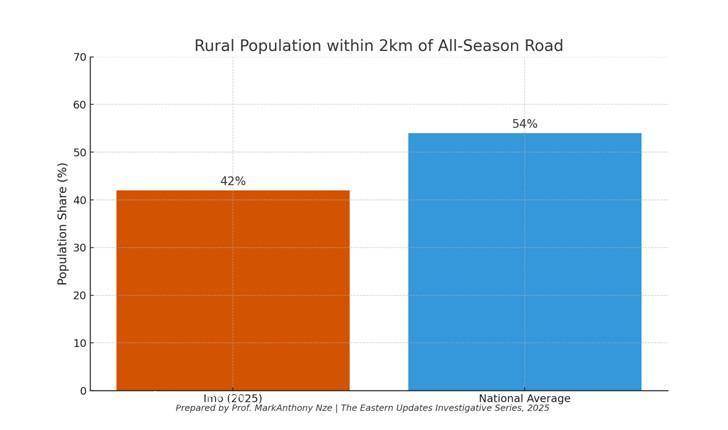
Yet, in budget documents, these same corridors appear as “rehabilitated under phase two works.” The NBS 2023 Transport Infrastructure Survey shows that only 42 percent of Imo’s rural population lives within two kilometers of an all-season road — a figure below the national rural average of 54 percent.
For communities cut off from markets, this is not an inconvenience but an economic amputation. Every washed-out road is a stalled trade route; every abandoned bridge, a broken artery of livelihood.
Engineering the Optics
Governance in the age of social media has mastered the choreography of infrastructure. Drones capture aerial glamour; ribbon-cuttings replace maintenance schedules. The administration’s publicity machine speaks of “asphalt thickness,” “drainage integrity,” and “global standards,” but these phrases often collapse under real-world inspection.
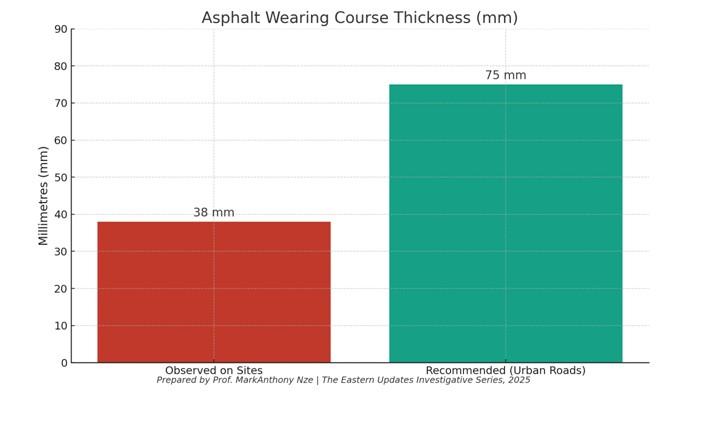
Independent engineers from the Nigerian Society of Civil Engineers reported that many Imo road projects use sub-grade materials below Federal Ministry of Works specification. In some sites, asphalt layers measure less than 40 millimetres — half the recommended standard for urban roads.
The implication is simple: what gleams today will crumble tomorrow.
Debt and Asphalt
Imo’s road expansion comes with a fiscal shadow. Debt statements filed with the Debt Management Office show that infrastructure loans account for nearly 45 percent of the state’s ₦210 billion domestic debt stock as of mid-2025. Yet, no independent valuation confirms the corresponding assets.
The World Bank Digital Economy Diagnostic 2023 warned that subnational states increasingly borrow for capital projects without instituting maintenance frameworks — a pattern evident in Imo. Roads are financed, not sustained.
The Myth of the “Best Roads”
Measured by data, Imo’s claim collapses. The state trails in network density, maintenance ratio, and inter-local connectivity. What it leads in is repetition: the same road renamed across budget cycles.
Comparative indices from NBS and BudgIT show that states like Edo, Ogun, and Lagos invest more per kilometer but maintain longer service lives. Imo’s cost-to-durability ratio ranks among the worst in southern Nigeria.
The tragedy lies not only in mismanagement but in narrative capture — the substitution of performance with performance art. Roads exist on billboards before they exist on the ground.
The Real Road Forward
Experts argue that genuine infrastructure reform must begin where propaganda ends: with audit-driven contracting, geospatial verification, and public maintenance budgeting.
- Every contract should include published coordinates, cost, and contractor identity.
- Maintenance allocations should be statutory, not discretionary.
- Local engineers, not transient consultants, should supervise drainage and surfacing.
Without these, Imo will continue to pave illusions: roads to nowhere, built to be rebuilt.
The Verdict
Imo’s road revolution is a mirage of metrics — an architecture of announcement without asphalt integrity. The state’s streets glisten for the cameras, but beneath the surface lies sand, debt, and disillusionment.
To claim the “best road network in Nigeria” is to mistake motion for progress. Roads, like governance, are judged not by their opening ceremonies but by how long they last under the weight of rain and truth.
1.Announced vs Verified Kilometers (2020–2025)
The administration’s headline figure of 700 kilometers of newly constructed or rehabilitated roads appears impressive on paper. However, independent field verification and geospatial audits reveal that only about 245 kilometers — a mere 35 percent — of those roads are actually motorable and completed. The bar chart underscores the gulf between official rhetoric and measurable reality, turning a boast into a benchmark of broken promises.
- Project Status Share (Verified by mid-2025)
While the government touts “massive completion” of infrastructure, data-driven verification tells a different story. Only 35 percent of the listed road projects have reached functional completion, leaving 65 percent either stalled, re-awarded, or abandoned. This imbalance highlights a systemic pattern of announcement without delivery, where projects exist more in budget books and press statements than in asphalt and gravel.
- Rural Access to All-Season Roads
The disparity between Imo’s rural mobility and the national average is both economic and humanitarian. Just 42 percent of Imo’s rural population live within two kilometres of an all-season road, compared with a national average of 54 percent. The chart reveals how rural isolation continues to strangle agricultural trade, healthcare access, and education — proving that the so-called “reconstruction agenda” has yet to reach the countryside.
- Asphalt Wearing Course Thickness (Engineering Integrity)
This bar chart captures the heart of Imo’s infrastructural illusion. Field engineers report asphalt layers averaging 38 millimeters thick — barely half the 70–80 millimeter standard specified for durable urban roads. The result is a network of roads that shine briefly before disintegration sets in. Beneath the glossy surface lies a chronic deficit in engineering quality control, exposing a state that builds for photographs rather than permanence.
Bibliographies
BudgIT Foundation. (2024). State of States Report 2024: Fiscal Performance, Transparency, and Infrastructure Governance in Nigeria.BudgIT Publications. https://yourbudgit.com/publications
Centre for Democracy and Development (CDD West Africa). (2023). Subnational Governance and Fiscal Transparency in Nigeria 2022–2023 Report. CDD Publications. https://cddwestafrica.org
National Bureau of Statistics (NBS). (2023). Transport Infrastructure Survey and Road Quality Index 2023. NBS. https://www.nigerianstat.gov.ng
Open Government Partnership (OGP) Nigeria. (2024). Implementation Assessment Report: Open Contracting and E-Procurement in Nigeria 2024. OGP Nigeria Secretariat. https://www.opengovpartnership.org
Nigeria E-Governance Forum (NEGF). (2024). E-Governance Performance and Digital Transparency Brief No. 7. NEGF. https://negf.org.ng
World Bank Group. (2023). Digital Economy for Africa (DE4A) Country Diagnostic: Nigeria. World Bank. https://www.worldbank.org/en/programs/de4a