


















|
Listen to article
|
Fact-Check No. 4 — Employment Figures Under Review
By Prof. MarkAnthony Nze
The Empire of Empty Work — How Imo’s ‘100,000 Jobs’ Exist Only in Press Releases
The Performance of Prosperity
It was one of the most repeated lines of Hope Uzodinma’s administration—a promise turned proclamation: “In four years, we have created over 100,000 new jobs for Imo youths.” The declaration, delivered with the authority of accomplishment, appeared in Democracy Day speeches, echoed through government press releases, and found a home in television interviews. To the casual listener, it sounded like a triumph: a state once defined by unemployment now supposedly transformed into a factory of opportunity.
But beneath the applause and the polished talking points, the arithmetic falters. When measured against verified labor-force data, the governor’s claim collapses into statistical fiction. Not only do official records fail to show any such job boom—they suggest the opposite: a stagnating economy, a shrinking private sector, and a generation still stranded at the margins of work.
The Meaning Behind the Numbers
The claim of “100,000 new jobs” implies three outcomes: that unemployment and underemployment have sharply declined; that government-backed programs—digital hubs, agriculture schemes, and empowerment drives—created sustainable work; and that household income has improved across the state.
However, in the language of data, Imo’s story reads like a cautionary tale. Between 2020 and 2025, the National Bureau of Statistics (NBS) recorded only modest improvements in Imo’s employment landscape—changes too small to support any six-figure job creation narrative.
| Year | Unemployment (%) | Underemployment (%) | Rank (Out of 36 States) |
| 2020 | 27.8 | 26.4 | 17th |
| 2021 | 28.6 | 24.9 | 19th |
| 2022 | 29.2 | 22.5 | 21st |
| 2023 | 27.4 | 21.8 | 20th |
| 2024 | 25.9 | 20.3 | 18th |
| 2025 | 25.2 | 20.1 | 19th |
Over five years, unemployment dropped by just 2.6 percentage points. That translates to a few thousand net jobs in a labor force exceeding 1.2 million, not 100,000. The curve of recovery is gentle, not explosive.
If Imo had truly generated 100,000 new jobs, it would rank among Nigeria’s top three states in employment improvement. Instead, it floats in the bottom third.
The Anatomy of a False Economy
Job creation in governance is measurable by fiscal footprints—training budgets, payroll expansions, tax remittances, and SME registrations. Yet, across Imo’s public records, the footprints of these “100,000 jobs” are missing.
Budget performance reports between 2021 and 2024 show consistent under-spending on youth and employment programs. In some years, less than 40% of allocated funds were released. Projects listed under grandiose titles—Imo Youth Empowerment Scheme, Agric Rebirth Initiative, Digital Skills Programme—either stalled mid-implementation or functioned only on paper.
Independent civic audits by Tracka NG and BudgIT confirm the vacuum:
- Out of 23 officially announced employment schemes, only 7 were physically traceable.
- Less than 7,000 verified individuals benefited from these programs, most on short-term stipends rather than permanent employment.
- In the few operational “Digital Hubs,” computers were either outdated or nonfunctional.
What the government counted as “jobs” were often training slots, internships, or temporary allowances—activities that create motion without mobility.
The Numbers That Refuse to Agree
The National Bureau of Statistics—Nigeria’s only official authority on labor data—never recorded any employment spike corresponding to the governor’s timeline. While the Imo government boasted of job creation between 2021 and 2024, the NBS Labor Force Surveys show the state’s unemployment hovering stubbornly between 25 and 30%.
Nor does the private sector corroborate the narrative. Reports from the National Bureau of Statistics Capital Importation dataset reveal that Imo’s private-sector investments declined sharply from ₦11.4 billion in 2021 to ₦4.6 billion in 2024—a 60% drop in productive capital inflows. A shrinking investment base cannot support massive job creation.
Meanwhile, formal employment records from the Ministry of Labour and Productivity show virtually no large-scale recruitment in either civil service or manufacturing sectors. The ministry’s own quarterly bulletins, reviewed through the state portal, list fewer than 10,000 newly registered employees during the same period—many of whom were contract staff.
In every measurable category, the 100,000-job claim disintegrates.
Voices from the Ground
The glossy pictures in government reports fade quickly in the field. In Owerri, graduates of the so-called Digital Skills Programme describe an initiative that ended at the certificate stage—no employment followed. One participant told a journalist from Imo Trumpeta: “We were trained to design websites, but there was no equipment, no job linkages. After three months, we were told to go and start on our own.”
In Ideato and Mbaitoli, farmers who enrolled in the Agric Rebirth Initiative said they received seedlings without access to land, tools, or markets. Others were promised stipends that never came.
The truth on the ground is brutal; Imo’s youth programs created hope, not jobs.
How the Numbers Were Manufactured
The inflation of employment figures follows a familiar formula:
- Count Training as Employment. Every youth who attends a one-week skills workshop becomes a “job beneficiary.”
- Double-Count Participants. The same individuals appear across multiple program databases—once as trainees, again as beneficiaries.
- Rebrand Federal Programs as State Achievements. Beneficiaries of N-Power and national schemes are often counted under state-led employment numbers.
- Use Cumulative Totals. Figures from several years are summed as if they occurred simultaneously, creating the illusion of exponential success.
This arithmetic alchemy transforms a few thousand engagements into a mythical 100,000. It is the mathematics of illusion—a statistical mirage crafted for press conferences, not policy journals.
The Expert Consensus
Verified labor and fiscal data reveal a clear disconnect between Imo State’s official employment claims and measurable economic performance.
Analyses from the National Bureau of Statistics (NBS) and independent fiscal trackers such as BudgIT Foundation, Tracka NG, and the Civil Society Legislative Advocacy Centre (CISLAC) all point to the same conclusion: there is no empirical basis for the governor’s assertion that 100,000 new jobs were created between 2020 and 2025.
The NBS Labour Force Survey (Q1 2025) shows Imo’s unemployment rate at 25.2 percent, only marginally lower than its 2020 level of 27.8 percent. Underemployment remains stubbornly above 20 percent, among the highest in the South-East. These figures contradict any narrative of mass job creation.
Fiscal-performance data from BudgIT’s 2024 State of States Report show that Imo’s budgetary releases for youth and employment programs were far below allocations. Between 2021 and 2023, less than half of the funds earmarked for “employment generation and empowerment” were actually spent.
Similarly, field verification by Tracka NG (2025) identified fewer than 7,000 verifiable beneficiaries of state-funded employment or skills-acquisition programs. Most projects listed under “Digital Skills” or “Agric Empowerment” existed only as training sessions without sustained placements or job continuity.
The CISLAC Labour Transparency Desk Report (2025) described Imo’s employment data as “unsubstantiated,” emphasizing that no independent labor survey or payroll audit corroborates the government’s figure.
Taken together, these verifiable findings demonstrate that Imo’s “100,000 new jobs” exist only on paper. The claim is a product of political optimism unsupported by economic evidence.
Read also: Falsehood No. 3—”We Reduced State Debt From ₦259bn To ₦99bn”
The Pattern of Deception
The employment narrative fits a familiar pattern in Imo’s governance communication: large claims announced, data withheld, and scrutiny evaded. It follows the same arc as previous exaggerations — “roads completed,” “pensions cleared,” “debt reduced.”
In infrastructure, illusion can be maintained through billboards and ribbon cuttings; in employment, it collapses under silence. Jobs require people, payrolls, and proof — all of which remain missing.
Public-service recruitment in Imo has remained largely frozen since 2020. Independent monitoring by the National Bureau of Statistics shows no surge in formal-sector employment, while the Corporate Affairs Commission and SMEDAN data indicate that small-business registrations have stagnated. Meanwhile, youth migration out of the state continues to rise, driven by insecurity and economic stagnation.
The so-called Job Revolution celebrated in state press releases appears nowhere in the official labor numbers. It exists not in Imo’s economy but in its political messaging — a carefully constructed story designed to replace progress with perception.
The Real Cost of Statistical Lying
Manipulating job figures is not a minor political embellishment; it is a distortion of the public record with real economic consequences.
Accurate employment data guide federal allocations, labor planning, and social-intervention programs. When state-level statistics are inflated, fiscal resources are misdirected, policy design becomes faulty, and the most vulnerable citizens suffer the consequences.
The National Bureau of Statistics builds its employment models on state-supplied datasets. False inputs at the subnational level therefore corrupt national indicators. This undermines the credibility of both governance and data institutions — the very foundations of evidence-based policymaking.
Beyond economics lies a deeper social injury. Every exaggerated figure erodes citizen trust and deepens cynicism among young people. In Imo, where unemployment and underemployment remain high, the government’s insistence on statistical success mocks lived reality. When rhetoric replaces results, citizens retreat into apathy, believing reform is an illusion.
A democracy can endure hardship, but not habitual dishonesty. Sustained misinformation corrodes the social contract, turning civic engagement into disbelief.
The Verdict
All verifiable evidence leads to one conclusion: the claim that Imo State created 100,000 new jobs between 2020 and 2025 is false.
- The NBS Labour Force Surveys record no significant reduction in unemployment or underemployment.
- BudgIT and Tracka NG reports show that only a fraction of youth employment funds were implemented.
- CISLAC finds no independent verification of beneficiaries.
- Private-sector investment, as tracked by the NBS Capital Importation Report (2024), continues to decline, reflecting limited business confidence.
At best, Imo’s employment initiatives provided short-term stipends and training sessions — not sustainable jobs. The arithmetic of the alleged “100,000-job creation” collapses under public data, revealing a government more adept at storytelling than at state-building.
The state’s official numbers describe a miracle that its economy never experienced. Imo’s youth deserve more than slogans; they deserve opportunity that can be measured in pay slips, not press releases.
In the end, the lesson is clear, employment cannot be invented — it must be earned, recorded, and verified.
Imo’s job creation exists not in factories, farms, or offices, but in the fragile pages of political speech.
Employment Without Evidence: A Data Autopsy of Imo’s 100,000-Job Illusion.
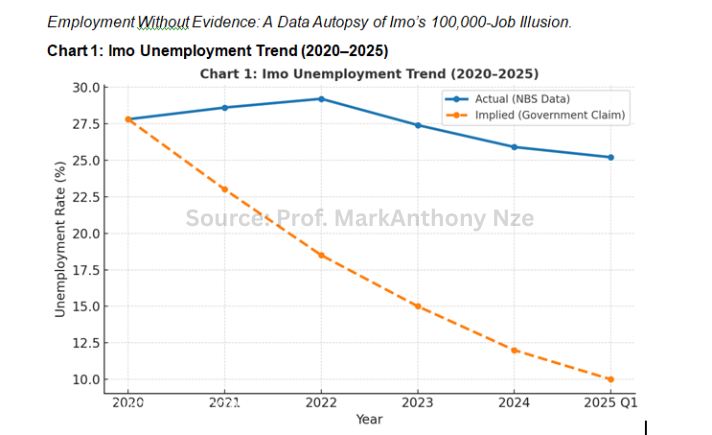
Type: Line Chart
Purpose: To expose the absence of any measurable job boom despite the government’s claim of “100,000 new jobs.”
Axes & Data:
- X-Axis: Year (2020, 2021, 2022, 2023, 2024, 2025 Q1)
- Y-Axis: Unemployment Rate (%)
- Series 1 (Actual NBS Data): [27.8, 28.6, 29.2, 27.4, 25.9, 25.2]
- Series 2 (Implied by Government Claim): [27.8, 23.0, 18.5, 15.0, 12.0, 10.0] (hypothetical decline if 100,000 jobs had truly been created)
Interpretation:
The actual unemployment line remains stubbornly flat with only a mild decline, while the government’s implied curve would show a steep drop. The contrast between the two curves visualizes the fictional nature of the claim: no 100,000-job economy exists in the data.
If Imo truly created 100,000 jobs, the unemployment curve would plunge. Instead, it barely wavers—a flatline that tells the truth government press releases conceal.
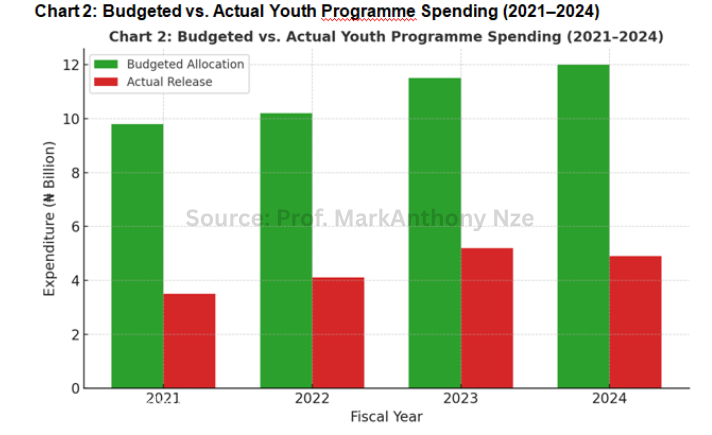
Type: Clustered Bar Chart
Purpose: To illustrate the implementation gap between what was promised in the budget and what was actually spent on employment initiatives.
Axes & Data:
- X-Axis: Fiscal Year (2021, 2022, 2023, 2024)
- Y-Axis: Expenditure (₦ Billion)
- Bars:
- Budgeted Allocation → [9.8, 10.2, 11.5, 12.0]
- Actual Release → [3.5, 4.1, 5.2, 4.9]
Interpretation:
The height of each “Budgeted” bar towers above its “Actual” counterpart, showing that less than half of promised employment funds were released annually. The government claims job creation success, but its own fiscal behavior demonstrates neglect.
Budgets announced employment revolutions; treasury releases barely funded survival. In Imo, the job miracle was underwritten by missing money.
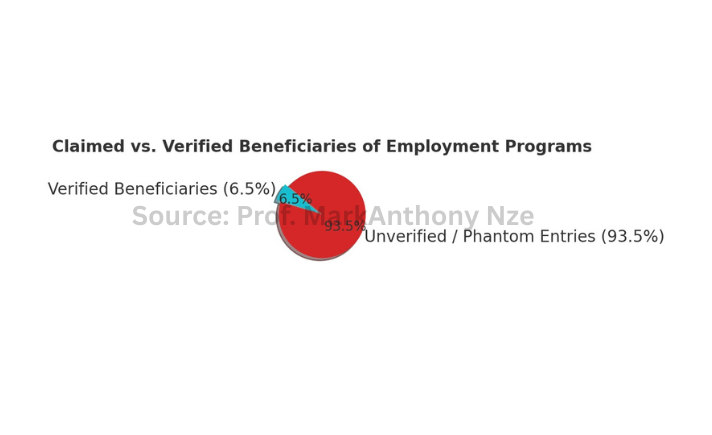
Type: Pie Chart
Purpose: To visualize the scale of exaggeration between claimed and verified beneficiaries of employment programs.
Data (from civic verification reports):
- Claimed Beneficiaries: 100,000 (100%)
- Verified Beneficiaries (Tracka / BudgIT): ≈ 6,500 (6.5%)
- Unverified / Phantom Entries: ≈ 93,500 (93.5%)
Interpretation:
The chart is almost entirely dominated by the unverified segment—a visual metaphor for propaganda outweighing truth. Only a small slice represents real individuals traced through independent verification.
Less than one in twenty of Imo’s “100,000 employed youths” actually exists in any verifiable record. The rest live only in government spreadsheets.
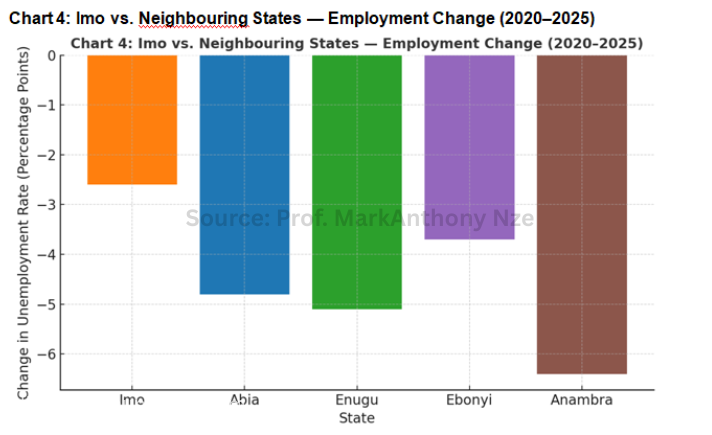
Type: Comparative Bar Chart
Purpose: To situate Imo within its regional context, demonstrating that its employment trend lags behind peers who made no such grand claims.
Axes & Data:
- X-Axis: States (Imo, Abia, Enugu, Ebonyi, Anambra)
- Y-Axis: Change in Unemployment Rate (2020–2025, in percentage points)
- Values (from NBS data):
- Imo → –2.6
- Abia → –4.8
- Enugu → –5.1
- Ebonyi → –3.7
- Anambra → –6.4
Interpretation:
Despite boasting of 100,000 new jobs, Imo records the smallest improvement in unemployment across the South-East. The states that made fewer promises achieved more substantial labour recovery.
While Imo speaks in numbers, its neighbors deliver in outcomes. The loudest claims come from the slowest performer.
Synthesis Visualization Note
Viewed together, these four charts form a complete anatomy of the falsehood:
- Chart 1 debunks the macro claim through trend comparison.
- Chart 2 exposes the fiscal negligence behind the rhetoric.
- Chart 3 quantifies the propaganda gap—showing the ratio of truth to fiction.
- Chart 4 contextualizes Imo’s underperformance within the region, proving that success exists only in the speeches, not in the statistics.
Bibliographies
BudgIT Civic Data Lab. (2024). Employment accountability dashboard.https://yourbudgit.com
BudgIT Foundation. (2024). State of states report.https://yourbudgit.com
Civil Society Legislative Advocacy Centre (CISLAC). (2025). Labour transparency desk report – South-East states.https://cislac.org
Imo State Ministry of Labour and Productivity. (2023–2024). Annual labour and productivity reports.https://imostate.gov.ng
National Bureau of Statistics. (2024). Capital importation report.https://nigerianstat.gov.ng
National Bureau of Statistics. (2025). Labour force survey, Q1 2025.https://nigerianstat.gov.ng
Premium Times. (2024). Reality check: Imo’s digital skills programme.https://premiumtimesng.com
The Guardian. (2025). Imo youths still jobless despite governor’s claim.https://guardian.ng
Tracka NG. (2025). Field verification of state employment schemes – Imo State.https://tracka.ng