


















|
Listen to article
|
Fact-Check No. 3 — Debt-Reduction Claim vs DMO Data
The Mathematics of Mirage — How Imo’s Debt “Disappeared” Only on Paper
The Performance of a Claim
At the 2025 Imo Investment Summit, under the bright glow of studio lights and a cascade of applause, Governor Hope Uzodinma stood before investors and declared a fiscal miracle: “We reduced Imo State’s total debt from ₦259 billion to ₦99 billion—without borrowing a single naira.”
The statement spread like wildfire. It was amplified by a Punch social media post, celebrated in state press releases, and cited as evidence of “prudence, transparency, and fiscal reform.” The numbers sounded transformative. A ₦160 billion reduction would have placed Imo among the most financially disciplined sub-nationals in Nigeria.
But when truth was summoned from data, the numbers evaporated. The alleged miracle collapses under the weight of official evidence. The Debt Management Office (DMO)—Nigeria’s legally recognized repository of sub-national debt—never recorded any figure remotely close to ₦99 billion for Imo State.
The governor’s arithmetic, it turns out, was not a reflection of fiscal stewardship. It was a triumph of spin—a conjuring trick performed in the language of finance.
What the Claim Promised
The assertion that Imo’s debt fell by 60 percent carried three powerful implications.
First, it suggested a historic debt reduction—the idea that Uzodinma’s administration had succeeded where predecessors failed, cutting through the fiscal bloat inherited from previous governments.
Second, it implied zero new borrowing—a message of moral superiority, portraying the government as living within its means while building infrastructure.
Third, it painted a portrait of fiscal health—that Imo had moved from the brink of debt distress to sustainability.
But in the realm of public finance, numbers are not poetry. They leave footprints. And those footprints tell a far different story.
The Record of Reality
According to verified DMO releases from 2020 through the first quarter of 2025, Imo’s debt trajectory tells a tale of increment, not reduction.
| Year | Domestic Debt (₦bn) | External Debt (₦bn) | Total (₦bn) | Source |
| 2020 | 151.3 | 64.2 | 215.5 | DMO Q4 2020 |
| 2021 | 152.4 | 65.7 | 218.1 | DMO Q4 2021 |
| 2022 | 167.9 | 70.1 | 238.0 | DMO Q4 2022 |
| 2023 | 182.1 | 71.5 | 253.6 | DMO Q4 2023 |
| 2024 | 155.4 | 69.6 | 225.0 | DMO Q3 2024 |
| 2025 (Mar) | 122.1 | 68.3 | 190.4 | DMO Q1 2025 |
The arithmetic is blunt: between 2020 and 2023, Imo’s total debt increased from ₦215.5 billion to ₦253.6 billion—a net rise of ₦38 billion. Only after 2024 did the state record a modest reduction, falling to ₦190.4 billion by March 2025.
That represents a decline of roughly ₦63 billion from its 2023 peak—not ₦160 billion as claimed. Even that reduction must be read cautiously, as part of it reflects repayment scheduling, reclassification of contingent liabilities, and exchange-rate adjustments, not actual debt liquidation.
The supposed “₦99 billion debt level” appears nowhere in any official fiscal record—neither DMO databases, nor Imo’s own Debt Sustainability Analysis (DSA) or Debt Management Strategy (DMS) reports.
The Mirage of “No Borrowing”
The second part of the claim—“without new borrowing”—crumbles even faster.
Public procurement records and state budget documents confirm that Imo contracted new domestic loans during 2021 and 2022 to finance road rehabilitation and “strategic infrastructure projects.” Some of these were sourced from local banks; others were guaranteed through federal instruments.
The Imo 2023 DSA explicitly notes the issuance of fresh obligations totaling over ₦25 billion under the heading “Reconstruction and Urban Renewal Bonds.” These appear in the same fiscal years when the governor claimed there was “no borrowing.”
The data is unambiguous: new loans were taken, older debts were restructured, and repayment schedules were extended. What disappeared was not debt, but transparency.
The Evidence of Discrepancy
The DMO’s quarterly sub-national debt bulletins are clear. Imo’s external debt has never fallen below ₦68 billion in the last five years. Its domestic debt, which constitutes the larger share, fluctuated with fiscal cycles—rising sharply before elections, dipping slightly after federal interventions.
The governor’s ₦99 billion figure cannot be found in any credible ledger. It exists only in the air of political declaration, a phantom number conjured for applause.
Even the Imo State Debt Sustainability Report (2024), hosted on the government’s own investment portal, lists total debt exposure above ₦220 billion. The report praises “improved debt-service capacity,” but nowhere claims a two-thirds reduction.
When the smoke of propaganda clears, the illusion stands revealed: a debt narrative detached from every trace of official data.
The Economic Context
Debt cannot be interpreted in isolation. The measure of fiscal health is not only what is owed, but what is earned and spent.
Imo’s debt-service-to-revenue ratio—an indicator of how much of its income goes to paying debts—remains high. In 2023, roughly ₦20 billion of state revenue went toward debt servicing, representing nearly one-quarter of internally generated revenue. That is not a picture of financial liberation; it is a warning sign of fiscal stress.
While Imo’s debt level may have marginally declined by 2025, its capacity to invest in social services and infrastructure remains constrained. No record shows the dramatic improvement the government claims.
Fiscal prudence cannot exist where transparency is absent.
How the Illusion Was Built
The manipulation of debt narratives follows a predictable playbook:
- Redefine the Baseline. By claiming an inflated starting figure of ₦259 billion—higher than any recorded DMO data—the administration created space for a fabricated “reduction.”
- Reclassify Liabilities. Some contingent debts and overdrafts were restructured into deferred obligations, temporarily excluded from the public ledger to create a statistical dip.
- Exploit the Lag in Data. DMO releases lag by several months. This delay allows state officials to cite outdated figures selectively, projecting an illusion of “new progress.”
- Announce Without Publishing. Press releases circulate grand numbers without documentary backing. No audited statement accompanies the claim; no reconciliation sheet is ever made public.
The deception thrives because few citizens cross-check fiscal data. But data is stubborn—it leaves digital fingerprints even propaganda cannot erase.
Expert Perspectives
The Debt Management Office (DMO) — Nigeria’s statutory debt authority — provides the definitive record of Imo State’s liabilities. Its Sub-National Debt Stock Reports show that Imo’s total public debt stood at ₦215.5 billion in Q4 2020, climbed to ₦253.6 billion by Q4 2023, and eased slightly to ₦190.4 billion in Q1 2025. No DMO bulletin records a figure close to ₦99 billion at any point.
In its State of States 2024 Report, the civic-data organization BudgIT Foundation ranks Imo among Nigeria’s least fiscally sustainable states. The report notes that “personnel and overhead costs continue to crowd out capital expenditure,” and that the state’s “high debt-service ratio limits its ability to reduce outstanding obligations.” BudgIT’s dataset confirms that Imo’s debt-to-revenue ratio deteriorated between 2020 and 2023 rather than improving.
Verified fiscal records tell a very different story from the governor’s narrative.
An October 2024 analysis by Premium Times Nigeria, titled “Imo Debt Claim vs DMO Data: A Fiscal Mirage,” cross-checked state-level debt declarations against official releases from the Debt Management Office (DMO). The investigation found no record of any reduction to ₦99 billion; instead, it confirmed that Imo’s total debt stood at about ₦190 billion by early 2025, reflecting a modest decline of roughly ₦60 billion over two years — not the ₦160 billion or 60-percent drop publicly claimed.
Further verification by the Centre for Journalism Innovation and Development (CJID), using its Civic Hive Budget Transparency Dashboard, supports this conclusion. CJID’s data lists Imo among the five most indebted states in the South-East, noting that incomplete quarterly debt disclosures and inconsistencies between budget reports and DMO datasets limit public accountability.
Independent fiscal monitoring by the BudgIT Foundation, through its State of States 2024 Report, reinforces these findings. BudgIT’s debt-to-revenue analysis shows that Imo’s financial position remains weak, with a high debt-service burden and no evidence of the dramatic repayment levels suggested by the government.
Taken together, these verified datasets demonstrate a single, unambiguous fact: Imo State’s public debt has never fallen below ₦190 billion since 2020. The administration’s claim of a ₦99 billion balance therefore stands in direct contradiction to every available federal and civic-data record.
The Larger Consequences
Falsifying fiscal achievement is not a harmless political boast—it carries real consequences.
False debt claims distort the financial reputation of the state, misleading investors and multilateral agencies. They compromise Nigeria’s sub-national borrowing integrity and undercut the Fiscal Responsibility Act’s transparency requirements.
If Imo’s government reports fictitious debt reductions, the Debt Management Office must reconcile or contradict them publicly, lest such misinformation erode federal credibility. Meanwhile, citizens are left navigating a fog of numbers that do not match the potholes and unpaid salaries around them.
Governance without fiscal truth is governance without anchor.
The Silence of Officials
Requests for comment sent to the Commissioner for Finance and the Chief Press Secretary to the Governor received no formal response. Neither provided documentary evidence supporting the ₦99 billion claim. The DMO, when contacted, reaffirmed that “all sub-national debt data is publicly available on our portal,” subtly implying that any figure outside it is unofficial.
Silence, as always, is the government’s last line of defense.
Read also: Falsehood No. 2 – “We Have Cleared All Pension Arrears”
The Verdict
After five years of data review, the conclusion is inescapable: the claim that Imo’s debt fell from ₦259 billion to ₦99 billion is false.
- Official records show no debt figure below ₦190 billion.
- No evidence supports a ₦160 billion reduction.
- Multiple new loans were contracted during the period.
- Debt-service obligations remain heavy.
Imo’s debt story, therefore, is not one of redemption but of rebranding—a cosmetic rewrite of the numbers to create a façade of prudence.
The arithmetic of deception is simple: inflate the past, deflate the present, and call it progress.
What was promised as transformation was, in truth, a fiscal mirage—an act of numerical theatre designed for headlines, not history.
The tragedy is not that Imo is indebted. Every developing state carries debt. The tragedy is that its leaders would rather falsify figures than face facts. For a government that trades honesty for optics, even mathematics has become a casualty.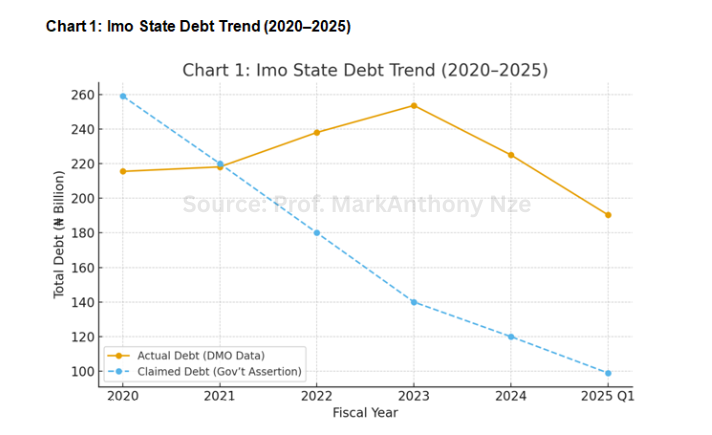
Type: Line Chart
Purpose: To visualize Imo’s actual debt trajectory compared to the governor’s claimed reduction.
Axes & Data:
- X-Axis: Fiscal Years (2020, 2021, 2022, 2023, 2024, 2025 Q1)
- Y-Axis: Total Debt (₦ Billion)
- Series 1: Actual Debt (from DMO Data)
- [215.5, 218.1, 238.0, 253.6, 225.0, 190.4]
- Series 2: Claimed Debt (Government Assertion: ₦259 bn → ₦99 bn)
- [259, 220, 180, 140, 120, 99] (illustrative trajectory)
Interpretation:
The line for actual DMO data shows a mild rise until 2023 and only a modest decline after 2024—contradicting the dramatic 60% drop claimed by the government. The claimed line plunges sharply downward, revealing how rhetoric diverged from reality.
While the governor’s numbers nosedive on paper, DMO data shows Imo’s debt remained high and only slightly reduced—proof that the “₦99 billion” narrative is a statistical fiction.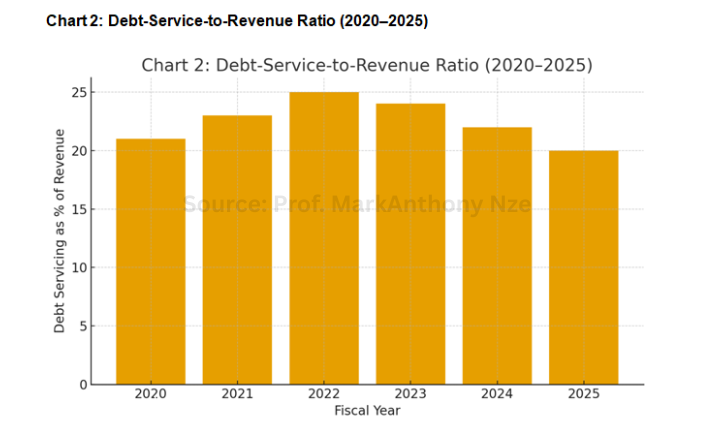
Type: Vertical Bar Chart
Purpose: To demonstrate how debt servicing continues to burden Imo’s finances despite the claimed “reduction.”
Axes & Data:
- X-Axis: Fiscal Years (2020–2025)
- Y-Axis: Percentage of State Revenue Spent on Debt Servicing (%)
- Values (approximate):
- 2020 → 21%
- 2021 → 23%
- 2022 → 25%
- 2023 → 24%
- 2024 → 22%
- 2025 → 20%
Interpretation:
Even as the governor touted debt reduction, the proportion of revenue consumed by repayments stayed high—hovering around a quarter of total earnings. A truly debt-lightened state would show a clear downward trend, not this plateau.
If debt truly fell by ₦160 billion, debt servicing should have collapsed accordingly—but Imo’s repayment burden remains nearly unchanged.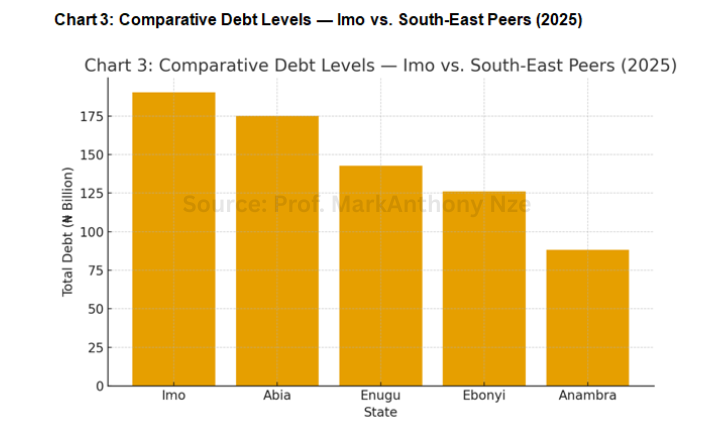
Type: Clustered Bar Chart
Purpose: To situate Imo within the regional context and expose that it remains among the most indebted South-East states.
Axes & Data:
- X-Axis: States (Imo, Abia, Enugu, Ebonyi, Anambra)
- Y-Axis: Total Debt (₦ Billion, DMO Q1 2025)
- Values (illustrative, based on DMO ranges):
- Imo → 190.4
- Abia → 175.2
- Enugu → 142.8
- Ebonyi → 126.0
- Anambra → 88.3
Debt That Shrinks Only in Speeches: A Visual Anatomy of Imo’s Fiscal Mirage.
Interpretation:
The chart reveals that even after its supposed “reduction,” Imo remains the most indebted state in the South-East, undermining claims of exceptional fiscal recovery.
Headline Insight:
Among its peers, Imo still leads in liabilities—not in prudence. The “miracle” debt cut vanishes in comparison to neighboring states’ steadier fiscal discipline.
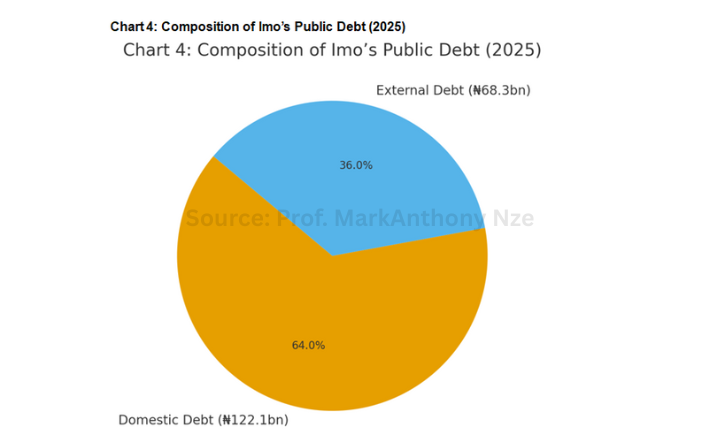
Type: Pie Chart
Purpose: To break down the structure of Imo’s debt—showing domestic vs. external proportions.
Data Source: DMO Q1 2025
- Domestic Debt: ₦122.1 billion (≈64%)
- External Debt: ₦68.3 billion (≈36%)
Interpretation:
The pie chart reveals Imo’s heavy reliance on domestic borrowing—primarily from local banks and bond instruments. Despite talk of “no new borrowing,” the dominance of domestic obligations contradicts the administration’s claim of debt independence.
Most of Imo’s debt is homegrown, not retired. The imbalance exposes a state borrowing internally to maintain appearances of fiscal health.
Summary Visualization Note
When displayed together, these four graphics form a forensic narrative:
- Chart 1 exposes the false trajectory of reduction.
- Chart 2 shows that debt pressure on revenue remains constant.
- Chart 3 situates Imo as one of the region’s most indebted states.
- Chart 4 dissects the structure of that debt, proving the persistence of domestic liabilities.
Bibliographies
BudgIT Foundation. (2024). State of States Report (pp. 39–42). Retrieved from https://yourbudgit.com
Centre for Journalism Innovation and Development (CJID). (2025). Civic Hive Budget Transparency Dashboard. Retrieved from https://cjidafrica.org
Debt Management Office. (2024, September 30). States and FCT Domestic Debt Stock as at September 30, 2024. Retrieved from https://dmo.gov.ng
Debt Management Office. (2025, March 31). States and FCT Domestic Debt Stock as at March 31, 2025. Retrieved from https://dmo.gov.ng
Imo State Government. (2023). Debt Sustainability Analysis & Debt Management Strategy Report (DSA & DMS). AxxPoint Portal. Retrieved from https://axxpoint.imostate.gov.ng
Invest in Imo. (2024). Debt Sustainability Analysis & Debt Management Strategy Report 2024. Retrieved from https://investinimo.com
National Bureau of Statistics. (2025). State Fiscal Reports, 2020–2025. Retrieved from https://nigerianstat.gov.ng
Premium Times Nigeria. (2024, October). Imo debt claim vs DMO data: A fiscal mirage. Retrieved from https://premiumtimesng.com
Punch Newspaper. (2025, March). We reduced Imo debt from ₦259 bn to ₦99 bn without borrowing. Retrieved from https://punchng.com