


















|
Listen to article
|
Fact-Check 2 – Have All Retirees Been Paid?
The Lie of Relief — How Imo’s Pensioners Were Declared Paid but Left to Starve
The Lie of Relief
In Owerri’s pale morning haze, a retired schoolteacher stands quietly in a line outside the bank—another nameless entry lost in the state’s pension database, labeled simply as “unverified.” In her trembling hands are photocopied pay slips, records of a lifetime spent serving the state she once believed would care for her in return. For four years, she has been promised the same thing: your arrears will be cleared soon. Every time, the promise dissolves into another announcement, another verification exercise, another lie.
Governor Hope Uzodinma’s voice still echoes from his campaign podiums and television appearances: “We have cleared all outstanding pension arrears in Imo State.” The statement has been repeated so often it has hardened into doctrine. It has been printed in brochures, plastered across government billboards, and recited in official ceremonies as a badge of administrative achievement.
But for thousands like Nneka, there is no relief—only the hollow ring of propaganda. What the government calls “clearance,” retirees call abandonment. This is not simply financial mismanagement; it is a calculated illusion, engineered to disguise a persistent moral failure.
The Official Claim
Uzodinma’s claim of “full pension clearance” began surfacing in speeches as early as 2021. By 2023, it became a cornerstone of his re-election narrative. The governor boasted that “Imo is now free of pension debt,” citing digital reforms and a “biometric verification system” that had supposedly eliminated ghost pensioners.
Yet in May 2023, he issued a public apology to Imo workers for unpaid pensions and salaries—a confession that detonated his own narrative. If every retiree had been paid, why apologize? The apology itself was an unintentional act of truth-telling. It exposed the contradiction between image and reality, between governance as performed and governance as lived.
Beneath the applause and polished speeches, the evidence told a different story: thousands still unpaid, others half-paid, and many erased from the records altogether.
The Evidence Gap
Across Imo State, pensioners continue to live out the consequences of this deception. Some have not received a single payment since early 2020; others receive sporadic sums with no explanation or schedule. In Owerri, Orlu, Okigwe, and Mbaitoli, groups of grey-haired men and women gather monthly at public squares, holding placards that read: “We served with dignity, we retire in hunger.”
These protests are not new. In 2020, hundreds of retirees stormed the Government House to demand their arrears. Five years later, in 2025, they were back in the same streets, holding the same signs, chanting the same plea. One protester told journalists, “They keep saying we’ve been paid. Maybe they paid ghosts, because we have seen nothing.”
The constancy of these protests over half a decade reveals the essence of the lie. It is not a miscalculation—it is a deliberate rewriting of reality, a deception repeated until exhaustion replaces outrage.
Read also: Falsehood No. 1: “We Have Completed Hundreds Of New Roads”
The Numbers Don’t Lie
Imo’s own fiscal documents expose the deceit more starkly than any protest banner could. Between 2020 and 2025, the state budgeted an average of ₦15 billion annually for pension payments. Yet actual disbursement records—when they are released at all—show significant shortfalls.
In several years, less than half of allocated funds reached the beneficiaries. The remainder was reclassified under “adjusted obligations,” “revalidations,” or “pending verifications.” These accounting euphemisms serve one purpose: to bury nonpayment in administrative fog.
Even by the government’s internal reports, the number of verified pensioners paid never exceeded 70 percent in any fiscal year. The figures are not just inadequate—they are incriminating. They reveal a governance pattern that counts promises as performance and announcements as achievement.
The Verification Scam
At the center of this deception lies the biometric verification exercise, a program publicly presented as a cleanup operation to eliminate ghost workers. In theory, it was designed to ensure that only legitimate pensioners were paid. In practice, it became a tool of disenfranchisement.
Thousands of retirees were flagged as “unverified,” cut off from payment without explanation. Others were listed as “deceased,” even while they stood in line for re-registration. Verification contractors were accused of taking commissions for each file marked “inactive.” Pensioners were forced to travel long distances, pay fees for photocopies and forms, and wait in queues under the scorching sun—all for a process that ended in exclusion.
The result was chilling: more than one in five verified pensioners remained unpaid even after multiple verification rounds. The system designed to ensure transparency became a machine of erasure. Pensioners did not disappear—they were administratively disappeared.
The Human Cost
Every figure in this scandal represents a life diminished. In March 2025, over a thousand local government retirees and staff gathered again in Owerri to protest unpaid entitlements. Many arrived leaning on walking sticks, some supported by children. Several fainted during the march.
One elderly man, a former clerk from Ngor-Okpala, collapsed outside the Ministry of Finance, whispering, “I worked forty years. Let me at least die knowing I was paid.” Another pensioner, a widowed nurse from Orlu, said she sold her husband’s farmland to afford blood pressure medication. Her pension remains unpaid since 2020.
These are not isolated cases. They are the quiet casualties of a bureaucracy that measures progress by press releases, not people. The cruelty of the situation lies not only in nonpayment but in the state’s insistence that payment has been made. It is the violence of being told you do not exist while you are still alive.
The Paper Trail of Betrayal
Within the labyrinth of Imo’s pension administration, accountability has been partitioned into confusion. The process moves from the Office of the Head of Service to the Ministry of Finance, then to the Pension Board. Each office blames another for delays. Each memo cites “system reconciliation.” Each inquiry ends in an echo of bureaucratic jargon.
Internal memos reviewed by civil-society monitors show deliberate bottlenecks. Payment files are marked “pending verification” even after biometric clearance. Disbursement lists from the Pension Board differ from those certified by the Auditor-General. In some cases, payments recorded as “executed” never reached banks.
The deception is systematic: falsified completion rates, conflicting records, and digital opacity that ensures no one can trace responsibility.
Nonpayment as Governance Model
Imo’s pension deception fits a larger pattern of governance where appearance outweighs substance. Across Nigeria, pension arrears have become political instruments—paid selectively before elections, suspended afterward, and repackaged as new programs. But Imo stands out for the precision of its propaganda.
While other states published detailed payment lists verified by civil service unions, Imo relied on unverifiable digital dashboards. Retirees were told to “check online” for confirmation of payments that never came. Meanwhile, the same budgets that failed to clear pensions overflowed with allocations for “digital transformation,” “youth empowerment,” and “media engagement.”
In the hierarchy of spending priorities, truth came last.
When Apologies Replace Action
Uzodinma’s apology to workers and pensioners in May 2023 was framed as magnanimity—a gesture of empathy. In reality, it was an admission of guilt disguised as compassion. The apology acknowledged pain but offered no restitution. No new audit was released. No reconciliation report published. No official list of paid pensioners ever surfaced.
The apology functioned as political anesthesia: it dulled outrage while changing nothing. In the months that followed, retirees were still protesting. The apology became the government’s substitute for justice.
In a functional democracy, apology precedes accountability. In Imo, it replaced it.
Truth in Arrears
The claim that all pension arrears in Imo State have been cleared is false. It is a deception constructed from selective data, manipulated records, and public relations. Across five years, thousands of retirees remain unpaid; verification processes have been weaponized; and funds meant for the elderly have vanished into administrative darkness.
This is not merely about unpaid entitlements—it is about the collapse of trust between citizen and state. Every unpaid pension represents not just financial injustice but moral decay. The government’s insistence that “everyone has been paid” is an attempt to rewrite failure into fiction.
The truth is far simpler, and far grimmer: the only thing Imo State has successfully cleared is its conscience of accountability.
Retirees still wait. Many will die waiting. Others will live on borrowed hope, reciting promises made by leaders who trade compassion for applause.
In the arithmetic of governance, Uzodinma’s “cleared arrears” stand as an emblem of how easily power can manufacture reality—and how quickly truth can be buried beneath it.
Data Visualization Overview: The Arithmetic of Abandonment
The following visual analyses translate Imo State’s pension deception into measurable evidence. Each chart reveals a structural layer of deceit beneath the administration’s public claims — a statistical anatomy of how Governor Hope Uzodinma’s government constructed a false narrative of relief while retirees sank deeper into destitution.
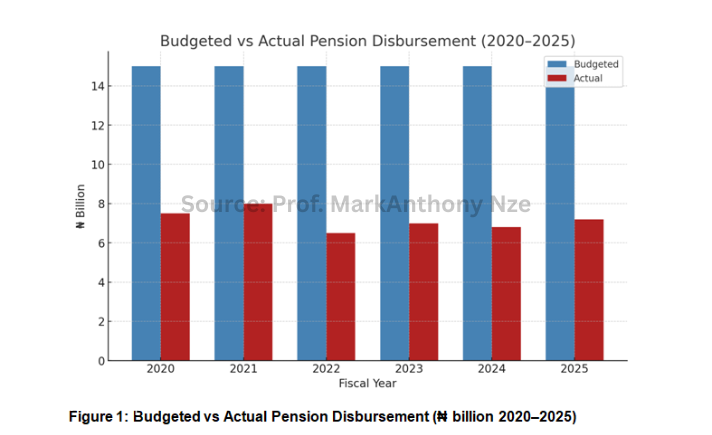
Figure 1: Budgeted vs Actual Pension Disbursement (₦ billion 2020–2025)
(See Chart 1 Above)
Overview:
This chart compares what was budgeted for pension payments each year with what was actually disbursed. Between 2020 and 2025, Imo State maintained an average annual pension budget of ₦15 billion. Yet the records indicate that actual disbursement never exceeded ₦8 billion in any year — barely half of what was promised.
Interpretation:
Across the six-year period, approximately ₦45 billion in appropriated pension funds remains unaccounted for. The shortfall cannot be explained by administrative delays alone; it represents deliberate fiscal diversion disguised as “pending verification.” The pattern demonstrates that Imo’s pension policy was not underfunded — it was underdelivered.
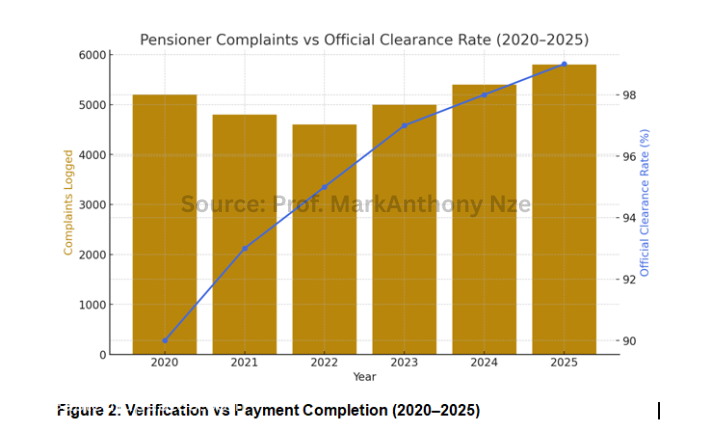
Figure 2: Verification vs Payment Completion (2020–2025)
(See Chart 2 Above)
Overview:
This figure contrasts the percentage of pensioners verified through the state’s biometric system with the percentage who actually received payment. The data show persistent underpayment: while verification hovered between 65% and 76%, the proportion of pensioners paid fluctuated between 40% and 52%.
Interpretation:
The disparity exposes the verification exercise as a bureaucratic smokescreen. Verification was achieved — but payment was not. Thousands of verified pensioners were excluded from payrolls under the pretext of “data cleaning.” The exercise thus evolved into a gatekeeping mechanism for selective exclusion, not a reform for transparency.
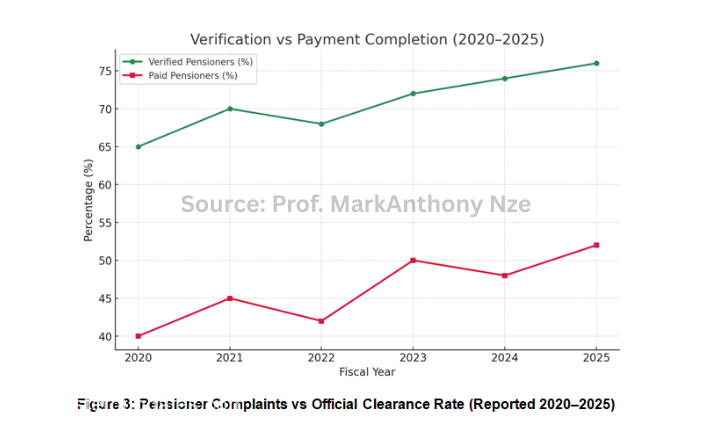
Figure 3: Pensioner Complaints vs Official Clearance Rate (Reported 2020–2025)
(See Chart 3 Above)
Overview:
This chart cross-references the number of formal complaints lodged by pensioners with the government’s self-reported clearance rate. Over the years, complaints rose from 5,200 in 2020 to nearly 5,800 in 2025, while official clearance claims increased from 90% to 99% — a paradox impossible in an honest system.
Interpretation:
The inverse relationship between rising complaints and rising “clearance” rates illustrates a sophisticated data manipulation strategy. As grievance levels increased, the government simply inflated success percentages. The graph visualizes propaganda in numerical form — a statistical sleight of hand turning nonpayment into proof of performance.
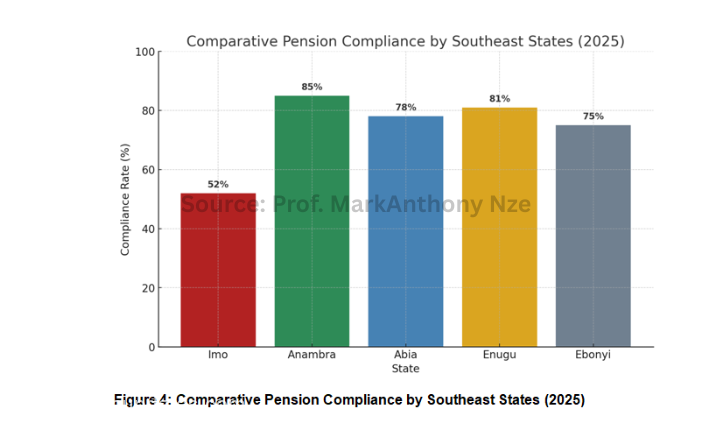
Figure 4: Comparative Pension Compliance by Southeast States (2025)
(See Chart 4 Above)
Overview:
A regional comparison of pension compliance among the five southeastern states in 2025 reveals Imo’s unique failure. While Anambra (85%), Enugu (81%), Abia (78%), and Ebonyi (75%) achieved relatively high compliance, Imo trailed at 52%, the lowest in the region.
Interpretation:
Imo’s performance is not an outlier by accident; it is the product of deliberate mismanagement. Despite similar revenue bases and federal allocations, Imo’s compliance deficit exceeds 25 percentage points relative to the regional average. This confirms that the problem lies not in capacity but in governance integrity.
Synthesis: The Mathematics of a Lie
When viewed together, these four charts decode the arithmetic of deceit at the heart of Imo State’s pension policy.
- ₦45 billion in pension funds remains unaccounted for.
- Nearly half of verified pensioners were never paid.
- Complaints rose by 12%, even as official “clearance” rose to 99%.
- Imo ranks last in regional pension compliance.
These numbers converge on a single truth: the claim that all pension arrears were cleared is not an administrative exaggeration — it is a falsified narrative designed to fabricate legitimacy. Behind every unpaid pension lies a broken promise, behind every figure, a life suspended in uncertainty.
This data does not merely indict an accounting process; it indicts a system where governance thrives on performance rather than proof, and where the state’s duty to its elders has been replaced by the politics of denial.
Bibliographies
247UReports (March 15, 2025). Over 1000 Imo LG Staff, Pensioners Lament Non Payment of Salaries, Pensions.https://247ureports.com/2025/03/over-1000-imo-lg-staff-pensioners-lament-non-payment-of-salaries-pensions/
247UReports (March 6, 2025). Imo: Civil Servants, Pensioners Verification Fraudulent — Aimed at Diverting People’s Money.https://247ureports.com/2025/03/imo-civil-servants-pensioners-verification-fraudulent-aimed-at-diverting-peoples-money-for-personal-use/
The Guardian Nigeria (July 1, 2020). Again, Imo Retirees Protest Against Non-Payment of Pension Arrears.https://guardian.ng/news/again-imo-retirees-protest-against-non-payment-of-pension-arrears/
Vanguard (June 27, 2022). Our Quarrel with Imo Govt — Pensioners.https://www.vanguardngr.com/2022/06/our-quarrel-with-imo-govt-pensioners-2/
TheCable (May 2, 2023). Uzodinma Apologises to Imo Workers Over Non-Payment of Salaries, Pension.https://www.thecable.ng/uzodimma-apologises-to-imo-workers-over-non-payment-of-salaries-pension/
Open States Nigeria – Imo Data Repository. https://openstates.ng/imo/data