


















|
Listen to article
|
More than 1,000 teachers in Abia State have received health education training under a UNESCO partnership that officials say demonstrates how targeted international collaboration can reshape struggling education systems, even as Nigeria grapples with millions of children locked out of classrooms nationwide.
The United Nations Educational, Scientific and Cultural Organisation praised Governor Alex Otti’s administration Tuesday for reforms it said are building a foundation for improved learning outcomes, citing infrastructure upgrades, fiscal discipline and a 20 percent budget allocation for education that exceeds what many Nigerian states commit to schools.
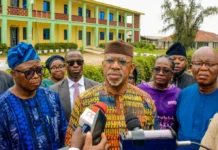
Dr Jean-Paul Ngome-Abiaga, UNESCO’s head of office and country representative to Nigeria and ECOWAS, led a delegation to Nvosi in Isiala Ngwa South Local Government Area where he outlined collaboration spanning teacher training, community engagement and school-level interventions since the governor launched the Abia First Education Programme.
The partnership has reached more than 700 community and religious leaders on HIV and health awareness while involving over 300 schools in the state program, according to Ngome-Abiaga, who said visible results from Otti’s reforms had emerged since 2023.
“We would like to continue to support you in that very important agenda,” he said, urging deeper collaboration and expanded budgetary provisions for health education.
UNESCO stands ready to provide technical expertise and institutional support in designing and implementing programs across education, health and other areas within its mandate, Ngome-Abiaga said. He emphasized the organization’s availability to assist Abia whenever support is needed.
“We are here for you. We are here to assist you, to support your work,” he said. “We will put all our technical expertise at your disposal in any area you need it.”
Olapeju Ibekwe, chief executive of Sterling One Foundation, highlighted the Africa Social Impact Summit as a platform convened with the UN system in Nigeria to accelerate achievement of Sustainable Development Goals. The summit, launched in 2022 after the COVID-19 pandemic, promotes partnerships among government, private sector entities and development organizations.
Read also: Enugu Aims For UNESCO World Heritage Listing For Sacred Sites
That initiative has unlocked more than $100 million in development financing, Ibekwe said.
She also described the Business Coalition for Education, launched with the Office of the Vice President to tackle Nigeria’s out-of-school crisis through private sector participation.
Ibekwe invited Otti to the summit scheduled for July 22-23 at Lagos’s Eko Convention Centre and pressed Abia to join as a pioneer public sector partner in the coalition.
Otti said his government could not refuse what he characterized as essential requests: partnership, support to reduce out-of-school numbers and calls for greater health education investment. “Those are good, and they are imperative for a government that is serious,” he said.
The governor said Abia devotes 15 percent of its budget to health alongside the education allocation. His administration introduced free and compulsory schooling after determining that fees were keeping children away, a policy shift that triggered enrollment surges and forced the government to recruit thousands of teachers.
That expansion prompted massive school reconstruction, introduction of smart schools, curriculum standardization and improved security for facilities, Otti said. He assured the delegation Abia would continue working closely with UNESCO and other partners to strengthen education and shrink out-of-school populations.
Nigeria faces one of the world’s largest education crises, with an estimated 20 million children not attending school—the highest number globally. Poverty, insecurity, cultural practices and inadequate infrastructure have combined to keep millions locked out of classrooms, particularly in northern regions where poverty rates are highest and insurgent violence has displaced entire communities.
Read more: 68 Media Workers Killed Globally In 2024 – UNESCO
State governments control most education delivery in Nigeria’s federal system, creating wide disparities in quality and access. Wealthy states with strong revenue bases can invest more in teachers, buildings and materials, while poorer states struggle to maintain basic services. Abia’s decision to dedicate one-fifth of its budget to education places it among the better-resourced states, though implementation challenges persist.
International organizations including UNESCO, UNICEF and various development banks have worked with Nigerian governments for years to address education gaps, providing technical support, funding and policy guidance. Results have been mixed, with progress in some states offset by deterioration in others facing security threats or governance failures.
The Abia collaboration reflects a model some education experts favor: sustained partnerships between international agencies and committed state governments willing to implement reforms and allocate resources. Whether such efforts can be replicated at scale across Nigeria’s 36 states remains uncertain, particularly in regions where political will or financial capacity falls short.
Ngome-Abiaga’s visit came as UNESCO intensifies engagement with African governments on education quality and access issues. The organization has identified health education as particularly critical, given that preventable diseases and inadequate health knowledge contribute to absenteeism and poor learning outcomes across the continent.
The teacher training component of the Abia partnership addresses gaps in how health topics are taught, equipping educators with skills to deliver age-appropriate information on HIV prevention, nutrition, hygiene and reproductive health. Community and religious leader engagement aims to shift attitudes that sometimes conflict with evidence-based health education in schools.
How broadly those interventions will affect student outcomes and community health practices will take years to measure.
Education reform in Nigeria has often stumbled over sustainability—programs launched with donor support or political enthusiasm fade when funding dries up or leadership changes.
Otti did not specify how long Abia’s budget commitment to education would continue or what mechanisms exist to ensure consistency across electoral cycles. Nigerian governors serve four-year terms with a two-term limit, meaning policy continuity depends partly on whether successors maintain predecessors’ priorities.
The invitation to join the Business Coalition for Education represents an attempt to leverage private sector resources and expertise to supplement government efforts.
Corporate involvement in education has grown across Nigeria as companies recognize that workforce quality depends on school system performance, though results have varied based on how partnerships are structured and monitored.

