












|
Listen to article
|
Iran’s Assembly of Experts selected Mojtaba Khamenei as the country’s next supreme leader Sunday, installing the son of the slain ayatollah in a hereditary succession that defies decades of revolutionary ideology rejecting dynastic rule and comes despite public warnings from Washington that he would not be tolerated.
The clerical body announced what it called a “decisive vote” in favor of the 56-year-old mid-ranking cleric, whose ties to the Islamic Revolutionary Guard Corps and years operating behind the scenes in his father’s office positioned him as the establishment’s choice despite internal discomfort over the appearance of monarchical transfer within a system founded on opposition to the shah’s dynasty.
President Donald Trump had insisted days earlier that Iran’s next leader required his approval and dismissed the younger Khamenei as an unacceptable “lightweight.” He told ABC News the appointee would not “last long” without US backing, assertions Tehran rejected as interference in its domestic affairs.
The Assembly urged Iranians in its statement to pledge allegiance and preserve national unity, directing its appeal “especially to the elites and intellectuals of the seminaries and universities.”
The wording suggested authorities anticipate resistance or skepticism among constituencies whose support matters for regime stability.
Read also: New Iran Leader Won’t Last Long Without My Approval – Trump
Mojtaba Khamenei assumes power as Iranian forces sustain drone and missile campaigns across the Middle East while Israeli strikes pummel Tehran and other cities nine days into fighting that killed his father.
Ali Khamenei died February 28 when American and Israeli warplanes hit leadership sites in the capital during a joint operation that marked the most direct assault on Iran’s ruling structure since the 1979 revolution.
Whether Mojtaba can command the authority his father wielded for 36 years remains uncertain. Ali Khamenei inherited the position in 1989 after Ayatollah Ruhollah Khomeini’s death and gradually consolidated power by balancing factions, controlling security forces and positioning himself as final arbiter on matters of state. His son lacks that accumulated credibility and takes office during a military crisis that demands immediate decisions about retaliation, resource allocation and potential negotiations.
The Assembly of Experts holds constitutional authority to select the supreme leader, Iran’s highest political and religious office with ultimate control over the military, judiciary and state policy. The body comprises 88 senior clerics elected by popular vote but screened by the Guardian Council, which ensures candidates meet ideological requirements.
Speculation about succession had intensified since Ali Khamenei’s death, with Mojtaba emerging as the leading candidate despite concerns within parts of Iran’s political and religious establishment.
Read also: Iran War Pushes Dangote Petrol Above Import Cost
Critics within the system have questioned whether hereditary transfer contradicts principles the Islamic Republic claims to uphold, though such objections carry limited weight when the Revolutionary Guards and clerical networks backing Mojtaba control enforcement mechanisms.
His appointment marks Iran’s most significant political transition in decades and unfolds as the country confronts sustained military pressure from Israel and the United States. How Mojtaba responds to that pressure—whether by escalating, seeking diplomatic resolution or attempting to outlast the attacks—will define his leadership and determine whether Trump’s threat to remove him carries any weight beyond rhetoric.
Under Iran’s constitutional framework, the supreme leader serves for life unless the Assembly deems him incapable of fulfilling his duties. That provision has never been invoked, and removing a sitting leader would require consensus among clerics unlikely to challenge someone backed by the Revolutionary Guards.
Trump suggested Saturday that Iran’s economy could be rebuilt if a leader “acceptable” to Washington replaced Ali Khamenei. The choice of Mojtaba directly contradicts that demand and sets up a confrontation between Tehran’s insistence on sovereign decision-making and Trump’s assertion of veto power over Iranian governance.
Foreign Minister Abbas Araghchi said earlier Sunday that Iran would “allow nobody to interfere in our domestic affairs” and called on Trump to “apologize to people of the region” for the expanding war.
Those remarks came hours before the Assembly’s announcement but reflected the posture Tehran has maintained throughout the succession process.
Israel’s military warned any new supreme leader that “we will not hesitate to target you,” underscoring the vulnerability of Iran’s top leadership even as it attempts to project continuity and strength. Whether Mojtaba will modify his father’s policies of confrontation with Israel and the United States or double down on resistance remains unclear.
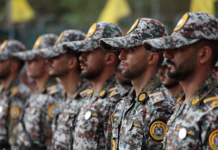
Revolutionary Guards spokesman Ali Mohammad Naini said Sunday that Iran possesses supplies to sustain missile and drone operations for up to six months and would deploy “advanced and less-used long-range missiles” in coming days. That statement suggests the military establishment backing Mojtaba plans to continue current operations regardless of diplomatic pressure or leadership transitions.
The hereditary transfer breaks with the Islamic Republic’s founding mythology, which portrayed the 1979 revolution as a rejection of the Pahlavi dynasty’s corruption and concentration of power in a ruling family.
Reza Pahlavi, son of the deposed shah, has positioned himself as a potential transitional leader should Iran’s current system collapse, though he commands no military force and lives in exile.
Mojtaba Khamenei’s selection ensures policy continuity at a moment when Iran’s leadership structure faces existential pressure from external military threats and internal questions about legitimacy. Whether that continuity serves the country’s interests or entrenches approaches that led to the current crisis will determine if the Assembly’s choice stabilizes or accelerates Iran’s trajectory toward wider conflict.