
















|
Listen to article
|
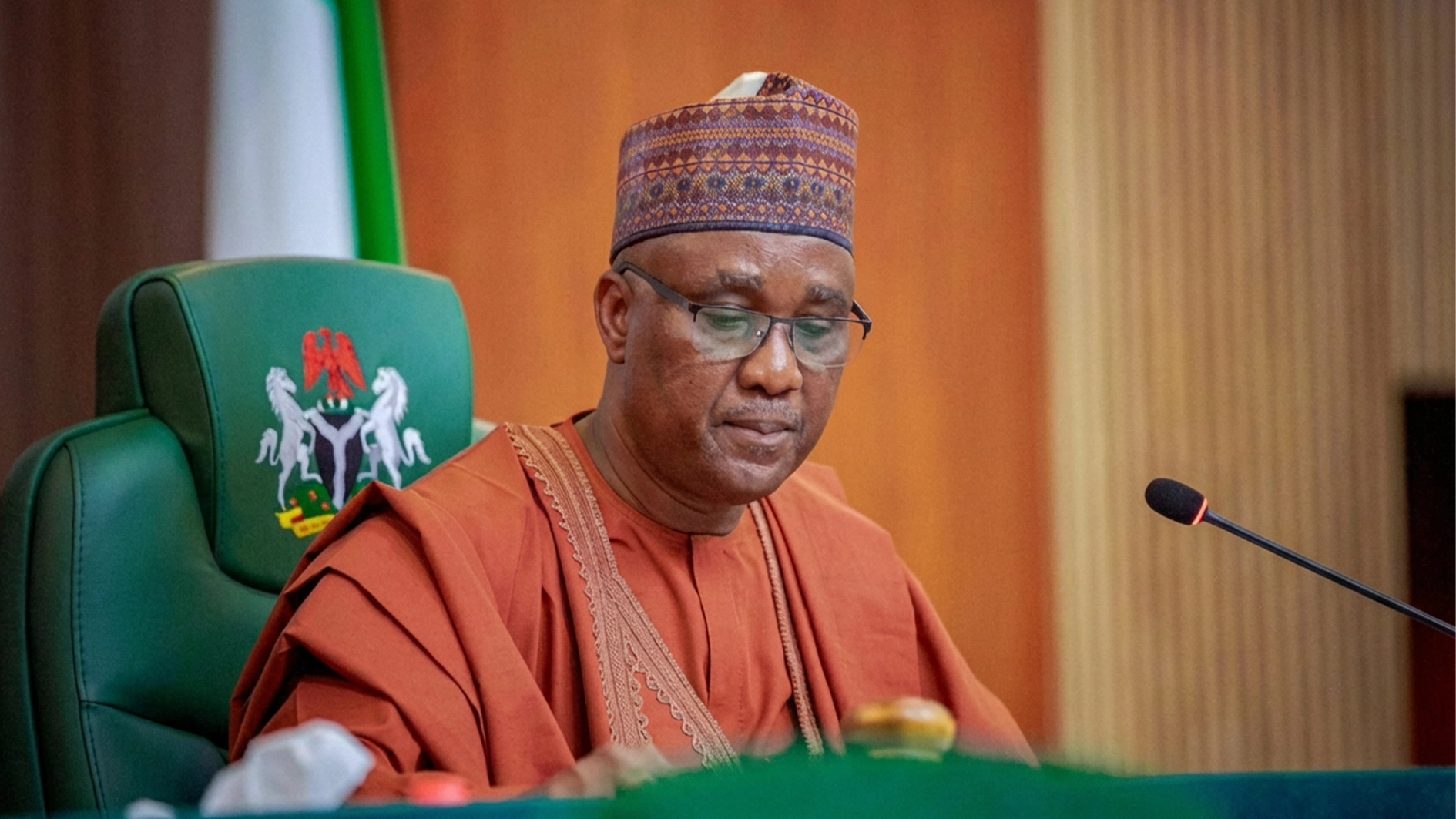
House of Representatives Speaker Tajudeen Abbas defended the National Assembly’s decision to embed both electronic and manual result transmission in Nigeria’s newly signed Electoral Act 2026 on Sunday, arguing that the country’s internet coverage gaps and chronic electricity failures made purely digital transmission impractical, even as a broad opposition coalition formally demanded the law be scrapped and rewritten before the 2027 general elections.
President Bola Ahmed Tinubu signed the Electoral Act 2026 into law on February 18, 2026 at the Presidential Villa in Abuja, with Senate President Godswill Akpabio and Speaker Abbas among the principal officers present. The legislation, which replaces the Electoral Act of 2022, formally codifies the Bimodal Voter Accreditation System, embeds electronic transmission of polling unit results to INEC’s Independent Results Viewing portal, and retains physical Form EC8A as a manual fallback where electronic systems fail. It was the latter provision, Clause 60, that generated the most controversy during passage and continues to drive the sharpest political disagreements over the reform.
Speaker Abbas made his public defence of the hybrid model during a courtesy visit to his office at the National Assembly complex in Abuja by Spain’s Ambassador to Nigeria, Ambassador Felix Costales. He was accompanied by House Committee on Appropriations Chairman Honourable Abubakar Kabir Bichi, House Committee on Foreign Affairs Chairman Honourable Wole Oke, and Chairman of the Nigeria-China Parliamentary Friendship Group Honourable Jafaru Yakubu. Speaker Abbas said the provision was designed to protect participation, not enable manipulation, pointing to data from the Nigerian Communications Commission showing that approximately 40 percent of Nigerian territory lacks adequate internet coverage.
“There is no way one form, particularly the electronic, can be used entirely in all parts of the country for the elections,” he said.
He acknowledged the scale of Nigeria’s voter turnout problem in unusually candid terms. Only 12 to 15 percent of registered voters typically participate in elections under the current manual arrangement, he said, and the exclusive adoption of electronic transmission would, in his assessment, depress that figure further by effectively excluding rural and underserved communities from the electoral process. He also pointed to the country’s energy crisis as compounding the digital infrastructure problem, noting that internet connectivity depends on electricity and that guaranteeing stable power nationwide on election day was not currently achievable.
Speaker Abbas also told Ambassador Costales that he had met personally with INEC Chairman Professor Joash Amupitan, and that if the Chairman’s stated plans were implemented, the 2027 elections would be “more transparent, accommodating, and inclusive” than previous cycles.
The Spanish envoy did not dispute the hybrid model’s logic, noting that Spain itself employs manual result transmission. He described his visit as aimed at deepening legislative diplomacy between the two countries, pledged Spain’s support for Nigeria’s democratic consolidation, and said Madrid would closely monitor the 2027 electoral process.
Read Also: 2027 Presidential Election Holds On February 20 – INEC
The passage of the Electoral Act was not smooth. During Senate consideration of Clause 60, Senator Enyinnaya Abaribe of Abia South demanded a formal vote to remove the proviso permitting manual fallback transmission, arguing that it weakened accountability. A voice vote was called, the “nays” were audibly louder, but Senate President Akpabio initially suggested the demand had been withdrawn. Senator Abaribe subsequently withdrew his request under pressure, and the clause survived. The episode triggered protests on the Senate floor and an executive session.
The opposition response has been coordinated and unambiguous. A coalition of opposition leaders, including former Vice President Atiku Abubakar, former Anambra State Governor Peter Obi, former Osun State Governor Rauf Aregbesola, former Rivers State Governor Rotimi Amaechi, and former Senate President David Mark, all now operating under the African Democratic Congress, held a joint press conference at the Transcorp Hilton Hotel in Abuja on Thursday under the theme “Urgent Call to Save Nigeria’s Democracy.” They demanded that the National Assembly immediately commence a fresh amendment to remove what they called “obnoxious provisions.” The Peoples Democratic Party separately condemned the Act as a “treachery” against Nigerian voters.
Civil society groups under the banner of the “Occupy NASS” campaign had also staged protests at the National Assembly complex during the bill’s passage, demanding mandatory real-time electronic transmission without any manual fallback provision, arguing that the physical collation chain was precisely where historical result manipulation had occurred.
Former INEC Resident Electoral Commissioner Mike Igini described the final version of the Act as “a recipe for chaos,” telling Arise Television that the judiciary bore significant responsibility for electoral reform setbacks and warning that without decisive legal interpretation of the new law’s provisions, democracy would suffer.
President Tinubu defended his position at the signing ceremony, saying that electronic transmission in Nigeria was “supportive” rather than a replacement for manual collation, and pointing to the IReV portal as a transparency mechanism that would allow Nigerians to compare polling unit results against subsequently declared figures, “that had always been the problem in the country,” he said, describing the portal’s statutory embedding as its elimination.
Read Also: CBN Warns Liquidity, Election Spending Risk Economic Gains
The Electoral Act 2026 now provides the legal framework under which INEC will conduct the presidential and National Assembly elections scheduled for January 16, 2027, and the governorship and state assembly polls fixed for February 6, 2027, dates established following a separate revised timetable that INEC published last week to comply with the new law’s 300-day notice requirement.
No party had filed a legal challenge to the Act in court as of Sunday, though opposition leaders said they would pursue “every constitutional means” available to them.