

















|
Listen to article
|
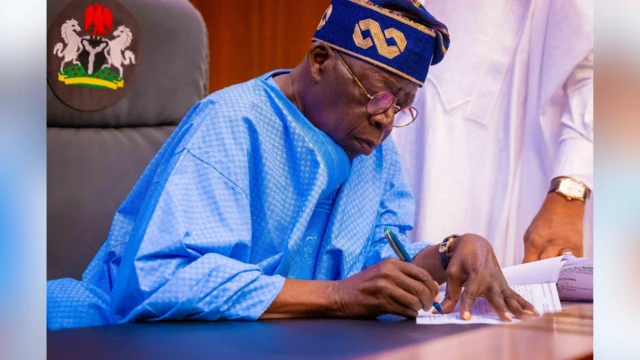
President Bola Tinubu signed the Electoral Act 2026 (Amendment) into law Wednesday, days after the Independent National Electoral Commission released the timetable for the 2027 general elections. The signing ceremony was held at the Presidential Villa in Abuja on Wednesday at about 5:00 p.m. in the presence of principal officers of the National Assembly. The amended legislation had been passed by lawmakers on Tuesday.
The new electoral law repeals the Electoral Act 2022 and re-enacts the Electoral Act 2026, introducing fresh provisions expected to strengthen Nigeria’s electoral framework ahead of the 2027 general election. The Senate had earlier amended clause 28 of the bill, reducing the notice period for general elections from 360 days to 300 days to prevent a clash with the Ramadan period. The House of Representatives passed the Electoral Act (Amendment) bill, 2026, through Third Reading on Tuesday, with approval of both manual and electronic transmission of election results from each polling unit to the IREV portal, as prescribed in Form EC8A. The Senate on Monday approved electronic transmission of election results, with manual collation retained as a backup. Lawmakers also retained a proviso in clause 60 allowing manual transmission of election results in the event of network failure.
The compromise position adopted by the National Assembly allows for electronic transmission but stops short of mandating real-time uploads, a distinction that civil society organizations argued was critical to preventing result manipulation at collation stages. Last week, protests erupted at the National Assembly complex as civil society organisations and opposition figures mounted pressure on lawmakers to mandate live transmission of results from polling units directly to INEC’s central server. The protesters argued that real-time transmission would reduce result manipulation and strengthen public confidence in the electoral process.
The 2023 general elections remain a source of contention. Protesters cited failures during the 2023 elections when INEC’s Results Viewing Portal collapsed, triggering widespread allegations of rigging. The Independent National Electoral Commission had promised that results would be uploaded to the IReV portal in real time during that election cycle, but technical failures prevented the system from functioning as advertised, fueling accusations of deliberate sabotage and manual manipulation of results during collation.
Read Also: 2027 Presidential Election Holds On February 20 – INEC
The ruling All Progressives Congress, APC and other stakeholders have raised concerns about network limitations in remote areas, advocating a flexible system that accommodates manual collation where electronic transmission is not feasible. Nigeria’s telecommunications infrastructure remains uneven, with mobile broadband coverage and internet penetration significantly lower in rural areas than in urban centers, a reality that proponents of the fallback provision cited as justification for the manual alternative.
The Independent National Electoral Commission released the 2027 general election timetable on February 12, setting Presidential and National Assembly elections for February 20, 2027, and Governorship and State Houses of Assembly elections for March 6, 2027.
With the new 2026 Electoral Act, INEC is expected to release new dates for the general election. Whether the commission will adjust the timeline to reflect the reduced 300-day notice period mandated by the new law has not been confirmed.
The Independent National Electoral Commission (INEC) is expected to issue updated guidelines in line with the new law. The commission has not publicly commented on how it will operationalize the electronic transmission provisions or what specific technical safeguards will be implemented to prevent a recurrence of the 2023 portal failures.
The speed with which the legislation moved from passage to presidential assent, less than 48 hours, contrasts sharply with the months of deliberations, public hearings, and rowdy legislative sessions that preceded Tuesday’s final votes in both chambers. Despite the walkout protest staged by opposition lawmakers, the House adopted Clause 60 on ‘Counting of votes and forms’, during the Committee of the Whole, chaired by the Deputy Speaker, Benjamin Kalu.
Read Also: E-Transmission: Senate Reveals Why ‘Real Time’ Was Removed
The law introduces additional changes beyond result transmission, including adjustments to the administrative procedures governing party primaries, the timeline for submitting candidate lists, and the mechanisms for adjudicating electoral disputes, though specific details of those provisions were not disclosed in the immediate announcements following the signing. The full text of the signed legislation had not been published by the presidency or the National Assembly as of Wednesday evening.
Civil society groups that had mobilized protests demanding mandatory real-time transmission issued initial statements expressing disappointment that the final version fell short of their demands, while acknowledging that the inclusion of electronic transmission represented incremental progress over previous legislative frameworks. Opposition parties similarly criticized the manual fallback provision as creating an exploitable loophole but stopped short of calling for outright rejection of the new law.
The Electoral Act 2026 now governs all aspects of the electoral process for the 2027 general elections and subsequent polls. Its implementation will be closely watched by domestic and international observers as Nigeria prepares for what is expected to be one of the most consequential election cycles in the country’s democratic history.