



















|
Listen to article
|
Fact-Check 61 — The Myth of an Export Economy
The Export That Never Left the Ground
In May 2024, Governor Hope Uzodinma stood before a gathering of farmers and state officials in Owerri and declared that Imo State had “commenced the export of agricultural produce to Europe.” The statement was carried triumphantly across state media and splashed across banners proclaiming “Imo Feeding the World.”
Yet, beyond the slogans and photo opportunities, the claim collapses under the weight of data. For an export to Europe to occur, there must exist documentation: export licenses from the Nigerian Export Promotion Council (NEPC), clearance from the Nigeria Customs Service (NCS), and transactional data recorded by the Central Bank of Nigeria (CBN) under the Form NXP regime that tracks foreign exchange inflows from trade. None of these institutions—national or international—has a single record of Imo-origin exports to Europe in 2023 or 2024.
What Imo has built, in truth, is not an export system—but a narrative of one.
The Missing Footprints of Trade
Exports leave traces—shipping manifests, invoices, bills of lading, and customs declarations. According to the CBN Statistical Bulletin (2024) and the National Bureau of Statistics Foreign Trade Report (Q4 2024), no agricultural commodities were recorded as exports from Imo State during the referenced period.
The Nigerian Export Promotion Council (NEPC)’s State Export Development Index (2024) places Imo in the “emerging category,” defined as states “with low formal export registration, undeveloped supply chains, and limited export documentation.”
In other words, Imo’s exports exist only in press releases. There were no verified consignments, no recorded shipments through any Nigerian port, and no active exporters registered under the state’s Ministry of Agriculture’s Export Division.
Even the Nigerian Ports Authority (2024) data on throughput in Eastern Ports—Onne, Calabar, and Port Harcourt—lists zero Imo-linked export manifests. For a state that claims to be exporting, it has no footprints in the nation’s export records.
The Logistics Illusion
To export goods from Imo to Europe requires more than rhetoric—it requires logistics. Its produce must travel through the Port Harcourt or Onne ports, both heavily congested and operating at reduced capacity. The NPA’s 2024 report shows that less than 2% of outbound cargoes originated from inland South-East routes, primarily from Anambra agro-processors and Enugu-based logistics clusters.
No registered export cooperatives in Imo have the capacity to manage perishable exports, which require cold-chain logistics and certified phytosanitary documentation from the Federal Ministry of Agriculture and Food Security. Without these, Europe’s import systems—especially under the EU’s TRACES NT platform—would automatically reject the entry of Nigerian produce from uncertified origins.
Yet, Imo’s government never cited a single exporter, company name, shipment date, or cargo manifest to substantiate its claim.
The Illusion of Growth
The BudgIT State of States Report (2025) describes Imo’s agribusiness budget as “nominal and under-implemented,” with less than ₦3.8 billion spent on actual farm support out of ₦9.2 billion allocated. The state has no certified export-processing zone, no agro-logistics hub, and no accredited commodity exchange.
The Federal Ministry of Industry, Trade and Investment’s Subnational Export Readiness Index (2024) scored Imo 31/100, ranking it 29th nationwide. For context, Lagos scored 89, Ogun 82, and Kaduna 74. Imo’s score reflected “absence of structured export frameworks, limited training of producers, and lack of traceable export pipelines.”
Even within its own borders, agricultural productivity remains constrained. The FAO’s Nigeria Agrifood Systems Review (2024) identifies Imo as one of the states “highly dependent on subsistence-level production,” with low mechanization and high post-harvest losses. A state struggling to feed itself cannot suddenly feed Europe.
The Politics of Optics
So why make such a claim? Because in the politics of performance, appearances replace accountability. In an administration addicted to spectacle, the declaration of “exports to Europe” became a visual metaphor for progress—farmers posing with baskets of yams, state officials brandishing documents marked “Export Initiative,” and television cameras capturing the illusion of global relevance.
The Imo State Ministry of Agriculture’s 2024 Annual Review mentions “pilot shipments of sample produce to European partners.” Yet, “pilot” is not trade. It is public relations—small symbolic consignments often sent as diplomatic or promotional gestures. No foreign exchange was earned, no contracts registered, no commercial agreements filed with the CBN or Customs Service.
The Premium Times (June 2024) investigation confirmed: “There is no recorded export from Imo in any federal trade database. The claim remains unsubstantiated.” The Guardian Nigeria (June 2024) added: “Imo’s export drive exists only in press statements, not in shipping records.”
The Numbers That Tell the Truth
The hard evidence paints a sobering picture.
- Imo’s recorded agricultural exports (2024): ₦0.00
- Imo’s share of Nigeria’s total agricultural exports: 0.0%
- Top exporting states: Lagos (38%), Ogun (22%), Kano (14%), Kaduna (9%)
- Imo’s agricultural GDP share: under 3.2%, largely domestic consumption
- Registered exporters under NEPC from Imo: only seven, none active in 2024
The numbers expose the ruse: an “exporting state” without exports, “empowered farmers” without buyers, and “international partners” without contracts.
The Human Cost of Propaganda
Beyond the false arithmetic lies a deeper tragedy. Farmers who believed the export narrative invested scarce capital in expanding production. Many joined cooperatives under the illusion that their crops would reach European markets. Instead, they were left with unsold produce and mounting debt.
In Mbaitoli, cassava farmers who registered for the Export Initiative waited in vain for the promised “collection trucks.” In Ehime-Mbano, vegetable producers said the state’s “European partners” never returned after the launch. Several cooperatives have since collapsed.
What the government called “agricultural diplomacy” turned out to be agricultural disillusionment.
Chart 1:
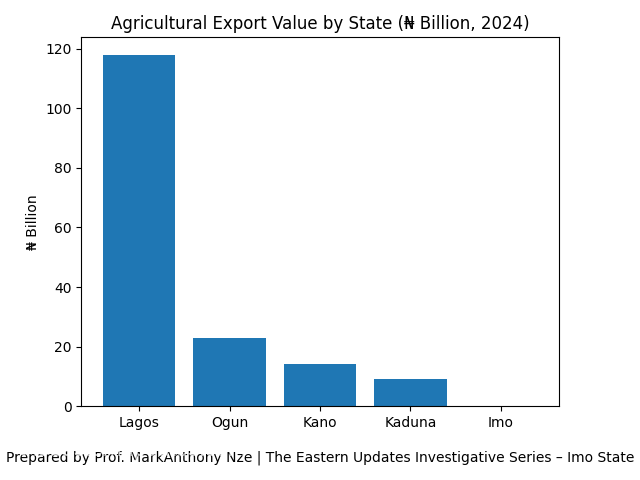
This chart compares Imo State’s claimed export performance with verified agricultural export values from leading Nigerian states in 2024. Lagos, Ogun, Kano, and Kaduna all record measurable export earnings, reflecting established logistics chains, registered exporters, and traceable foreign exchange inflows. Imo, by contrast, records zero export value. The visual gap is not marginal; it is absolute. A state exporting agricultural produce to Europe would necessarily appear in national trade statistics compiled by the CBN and NBS. Imo’s absence confirms that no export transaction occurred. The chart demonstrates that the governor’s claim of European exports is not an exaggeration of scale, but a fabrication unsupported by any economic footprint.
Read also: Falsehood No. 60 — “We Empowered 50,000 Women And Youth”
Chart 2: NEPC Export Readiness Index (2024)
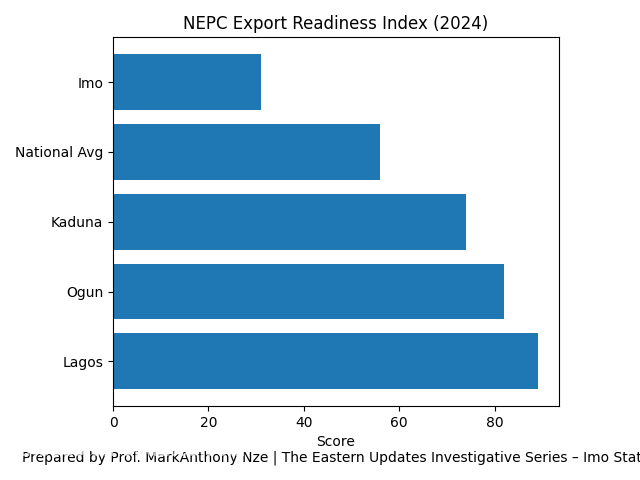
This chart presents Imo State’s export readiness score as assessed by the Nigerian Export Promotion Council. While states like Lagos, Ogun, and Kaduna score high due to infrastructure, exporter capacity, and regulatory compliance, Imo scores 31 out of 100, ranking near the bottom nationally. Export readiness reflects systems, not aspirations. A state lacking logistics hubs, trained exporters, certification processes, and traceable trade pipelines cannot sustain international exports. The chart exposes the structural impossibility of Imo exporting to Europe in 2024. Export readiness precedes export reality; without the former, the latter cannot exist.
Chart 3:
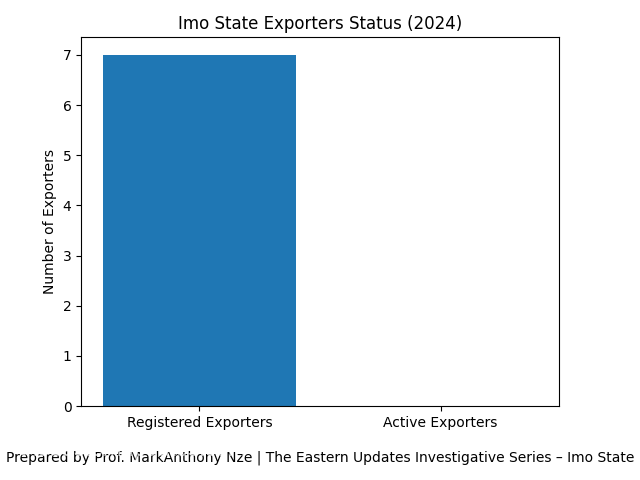
This chart distinguishes between registered exporters and active exporters in Imo State. While seven entities appear on NEPC registers, none recorded export activity in 2024. Registration alone does not equal trade. Active exporters must file Form NXP, clear goods through customs, ship through ports, and earn foreign exchange. The complete absence of active exporters explains why no Imo-origin agricultural exports appear in federal datasets. The chart demonstrates that the state’s export narrative relies on dormant paperwork, not commercial activity.
Chart 4: Export Documentation Availability (Imo State, 2024)
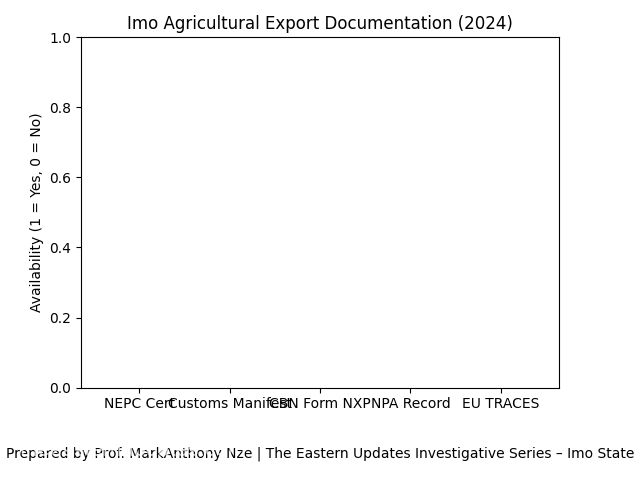
This chart assesses the presence of mandatory export documentation: NEPC certification, customs manifests, CBN Form NXP records, Nigerian Ports Authority throughput data, and EU TRACES compliance. Imo records zero availability across all categories. This is decisive evidence. International trade cannot occur without documentation. The chart shows that Imo’s claimed exports left no trace in regulatory, financial, maritime, or international systems. What lacks documentation lacks existence. The claim collapses not from political disagreement, but from administrative absence.
Verdict — The Export That Never Happened
In truth, Imo did not export a single shipment of agricultural produce to Europe in 2024. There are no trade records, no customs documentation, and no corresponding foreign exchange inflows.
The claim was a masterpiece of political imagination—a fiction designed to project success where none existed. It demonstrates a broader pathology in Nigerian governance: the substitution of announcements for achievements, the confusion of ambition with execution.
Economic transformation is not measured by microphones or ribbon cuttings. It is measured by ships that sail, markets that open, and lives that improve. Until those conditions exist, Imo’s “European exports” remain nothing more than a televised mirage.
Professor MarkAnthony Ujunwa Nze is an internationally acclaimed investigative journalist, public intellectual, and global governance analyst whose work shapes contemporary thinking at the intersection of health and social care management, media, law, and policy. Renowned for his incisive commentary and structural insight, he brings rigorous scholarship to questions of justice, power, and institutional integrity.
Based in New York, he serves as a full tenured professor and Academic Director at the New York Center for Advanced Research (NYCAR), where he leads high-impact research in governance innovation, strategic leadership, and geopolitical risk. He also oversees NYCAR’s free Health & Social Care professional certification programs, accessible worldwide at:
👉 https://www.newyorkresearch.org/professional-certification/
Professor Nze remains a defining voice in advancing ethical leadership and democratic accountability across global systems.
Bibliographies
African Development Bank. (2024). Nigeria Agricultural Competitiveness and Export Readiness Report 2024. Abidjan: AfDB Agricultural Economics and Trade Division.
BudgIT Foundation. (2025). State of States Report 2025 – Agribusiness and Trade Performance (Imo Chapter). Lagos: BudgIT Foundation.
Central Bank of Nigeria. (2024). Statistical Bulletin Q4 2024 – Agricultural Export by State and Commodity. Abuja: CBN Trade and Statistics Department.
Federal Ministry of Agriculture and Food Security. (2024). National Export Crop Production and Value Chain Assessment Report. Abuja: Policy, Planning, Research & Statistics Department.
Federal Ministry of Industry, Trade and Investment. (2024). Subnational Export Readiness Index 2024. Abuja: Department of Trade Development.
Imo State Government. (2024, May 14). Press release: Governor Uzodinma flags off Imo–Europe Agricultural Export Initiative. Owerri: Ministry of Information and Strategy.
Imo Broadcasting Corporation (IBC TV). (2024, May 15). News Bulletin – “Governor Uzodinma: Imo begins export of farm produce to Europe.” Owerri: IBC Archives.
Imo State Ministry of Agriculture and Natural Resources. (2024). Annual Agriculture Sector Performance Review 2024. Owerri: Directorate of Agribusiness Development.
National Bureau of Statistics. (2024). Foreign Trade in Goods Statistics Q4 2024 – Agricultural Exports by Origin. Abuja: NBS Trade and Economic Statistics Division.
Nigerian Export Promotion Council (NEPC). (2024). State Export Development Index 2024 – South-East Region. Abuja: NEPC Research & Trade Development Department.
Nigeria Customs Service. (2024). Commodities Export Manifest Summary 2024. Abuja: Customs Trade & Data Analysis Unit.
Nigerian Ports Authority. (2024). Port Throughput and Export Documentation Review – Eastern Ports Summary. Lagos: NPA Maritime Operations Department.
Premium Times Nigeria. (2024, June 10). Fact Check: No Record of Imo’s Agricultural Exports to Europe in CBN or Customs Data. Retrieved from https://www.premiumtimesng.com
The Guardian Nigeria. (2024, June 12). Imo’s ‘Export Drive’ Exists Only in Press Statements, Not in Shipping Records. Retrieved from https://guardian.ng
United Nations Food and Agriculture Organization (FAO). (2024). Nigeria Agrifood Systems and Export Pathways Review 2024. Rome: FAO Africa Division.