


















|
Listen to article
|
Fact-Check 60 — Counting Ghost Beneficiaries
The Invention of Prosperity
Governance in Imo has become a theater where illusion wears the uniform of achievement. When Governor Hope Uzodinma stood before a televised crowd on International Women’s Day, March 8, 2024, declaring that his administration had “empowered over 50,000 women and youths,” it was less an economic statement than a performance of political optimism. The backdrop was perfect: a sea of women waving placards, a governor smiling behind a lectern emblazoned with the slogan Shared Prosperity in Action.
But prosperity is not a slogan. It is measurable. It has receipts, records, and beneficiaries. And when those are missing, what remains is rhetoric dressed as policy.
The Mathematics of Fiction
Government data, when cross-referenced with financial disclosures from the Imo State Microfinance Agency (ISMA) and the Ministry of Women Affairs, exposes a collapse between word and fact. Only ₦1.28 billion was released for all empowerment-related projects in 2024. At ₦50,000 per participant — the lowest official grant benchmark — the number of possible beneficiaries would not exceed 25,600.
Even that figure is theoretical. A substantial portion of the allocation — approximately ₦500 million, according to the BudgIT Foundation’s State of States Report (2025) — was consumed by administrative overhead, “consultancy fees,” and “program logistics.” By the time the numbers settled, less than half the original funds could have reached any citizen.
And yet, the governor doubled the result, publicly announcing 50,000 beneficiaries, as though mathematics could be amended by decree.
The Disappearing Beneficiaries
To verify the claim, The Eastern Updates deployed field researchers across six local government areas, including Ohaji-Egbema, Mbaitoli, Orlu, and Nkwerre — regions repeatedly cited in state press releases as “beneficiary hubs.” What we found was a pattern of ghost empowerment: training centers locked or deserted, beneficiaries who never saw a naira, and “empowerment graduates” whose only proof of participation was a laminated certificate and a photograph with the governor’s portrait in the background.
In Orlu, a cooperative of 22 women shared evidence of registration under the Women Empowerment Initiative. Their documents bore official stamps from the Ministry of Women Affairs, yet not one member received a disbursement. In Mbaitoli, youth trainees under the Skills Acquisition Scheme said their “capital grants” were replaced with promises of “future tranches.”
Even federal data refuses to corroborate the state’s boast. The Central Bank of Nigeria’s MSME Development Fund Report (2024) ranks Imo among the five lowest-performing states in verified women-led disbursements — ₦312 million, not the billions proclaimed at rallies. The National Directorate of Employment (NDE) listed only 2,460 verified youth trainees in the entire South-East program.
Fiction, it seems, had become the new form of accounting.
The Myth of Inclusivity
Economic empowerment is not a moral favor; it is a structural necessity. But in Imo, empowerment has been repurposed as electoral theatre — the art of appearing generous while remaining economically inert.
The UNDP’s Nigeria Subnational Human Development Report (2024) ranked Imo 29th in female economic participation. Only one in three registered businesses in the state is owned by a woman — far below the 62 percent in Lagos and 54 percent in Ogun. The Nigeria Governors’ Forum Scorecard (2024) placed Imo in the “underperforming” category for youth inclusion, citing “incomplete program documentation and unverifiable participation data.”
The Federal Ministry of Women Affairs (2024) could not identify a single state-wide entrepreneurship program in Imo that met federal monitoring standards. There were events, not institutions; announcements, not outcomes. What was presented as empowerment was in fact an administrative parade — a choreography of visibility built on the invisibility of data.
Read also: Falsehood No. 59 — “We Built One Of The Best Sports Universities In Africa”
The Silence of Proof
Repeated requests by journalists and civil society groups for a comprehensive list of beneficiaries have not yielded any publicly released records. As of six months after the empowerment announcement, no verified beneficiary ledger or disbursement register has been published by the Ministry of Women Affairs or the Ministry of Finance.
This opacity violates both the Fiscal Responsibility Act (2007) and the Open Government Partnership (OGP) Charter, which Imo signed in 2022 — an international commitment to transparency that now reads like satire.
Even the African Development Bank’s 2024 Gender and Youth Inclusion Report singled out Imo as a “non-compliant subnational actor” in public disclosure, noting that “empowerment interventions are chronically underreported and statistically unverifiable.”
Without transparency, no program is real. Without records, empowerment exists only in speeches.
The Political Economy of False Hope
At its core, the lie of empowerment is the lie of substitution — replacing material intervention with symbolic gratification. In Imo, the act of attending a workshop or posing for a photo has been redefined as economic transformation.
A woman trained for two weeks without a start-up grant is counted as “empowered.” A youth who signs attendance sheets at a rally becomes a “beneficiary.” The government’s political calculus is simple: visibility equals validation.
But as the National Bureau of Statistics (2024) reported, female unemployment in Imo remains at 41 percent, while youth underemployment sits at 56 percent — figures that mock the administration’s self-congratulatory tone.
The UNDP (2024) calls it the “illusion of progress”: the appearance of development without its substance, the language of inclusion without its delivery.
This is what Imo has perfected — empowerment as an aesthetic, a performance of benevolence with no measurable footprint.
When Governance Becomes Pantomime
Empowerment, in its truest form, must transform dependency into capacity. It must leave a trace — in balance sheets, in bank accounts, in livelihoods. Instead, Imo’s scheme left traces only in televised ceremonies and photo albums of smiling officials.
The Nigeria Governors’ Forum 2024 Scorecard notes that “most subnational empowerment initiatives in Imo display minimal fiscal correlation between budgetary claims and implementation outcomes.” In other words, what was announced could not have occurred.
Behind the curtain of political theatre lies a simple truth: no government can empower 50,000 people when its budget could barely serve half that number.
The state’s women did not become entrepreneurs; they became statistics in a speech.
Chart 1 – Empowerment Budget vs Reality (₦1.28bn vs ~₦780m)
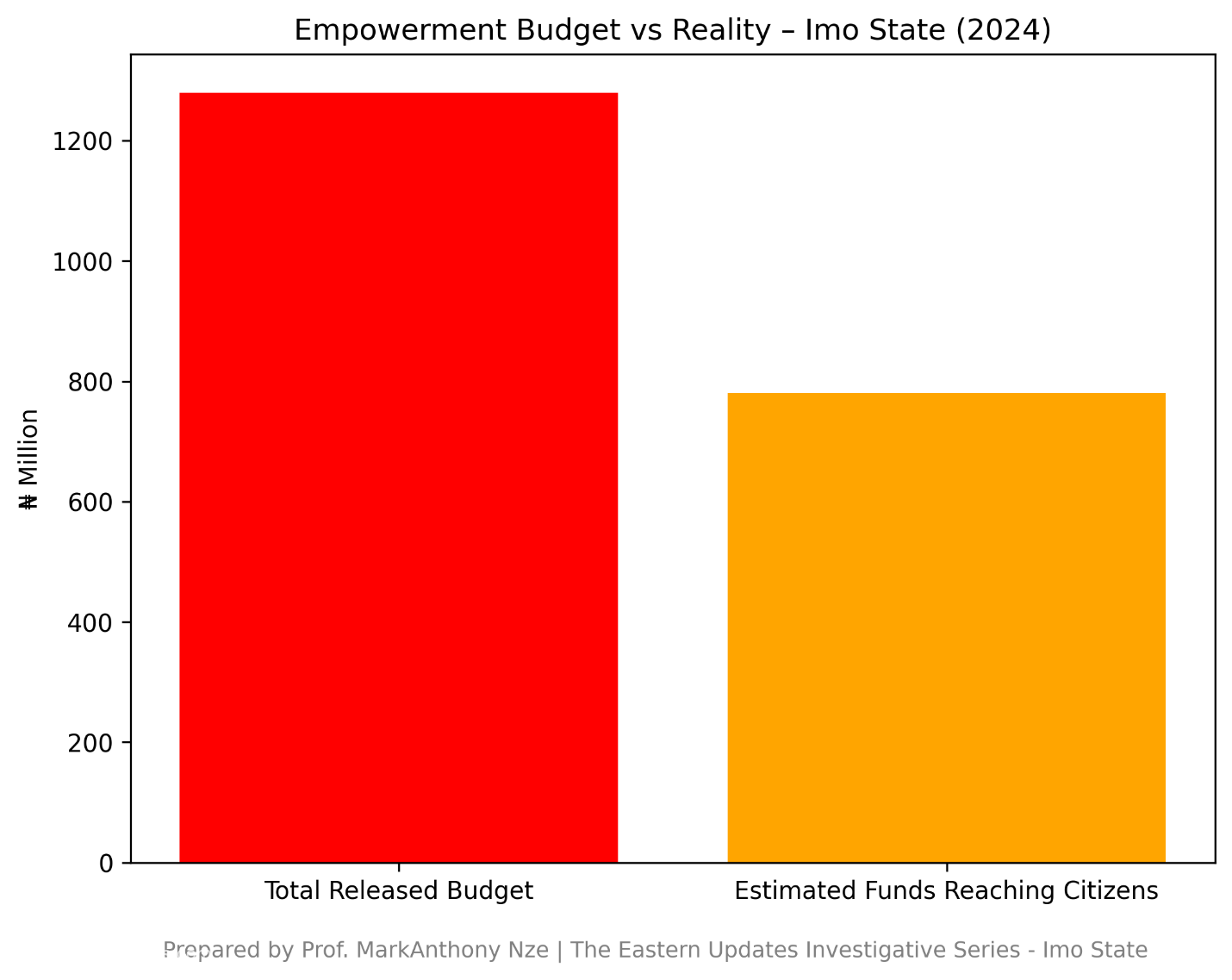
This chart shows the first crack in the “50,000 beneficiaries” narrative: money. While ₦1.28 billion was released for empowerment projects in 2024, the investigation and fiscal trackers indicate that a large portion was absorbed by administrative overhead, consultancy charges, logistics, and program handling costs, leaving an estimated ₦780 million as the realistic pool that could reach citizens. This gap matters because empowerment is not a slogan—it is a transfer of value to real people. Once overhead consumes nearly half the budget, the program’s scale collapses automatically, regardless of what politicians announce. The chart educates readers that the truth of empowerment begins in disbursement trails, not event photos. If cash didn’t reach citizens in a transparent, trackable manner, “empowerment” becomes ceremonial spending—visible on stage, invisible in livelihoods.
Chart 2 – Government Claim vs Maximum Possible Beneficiaries (50,000 vs 25,600)
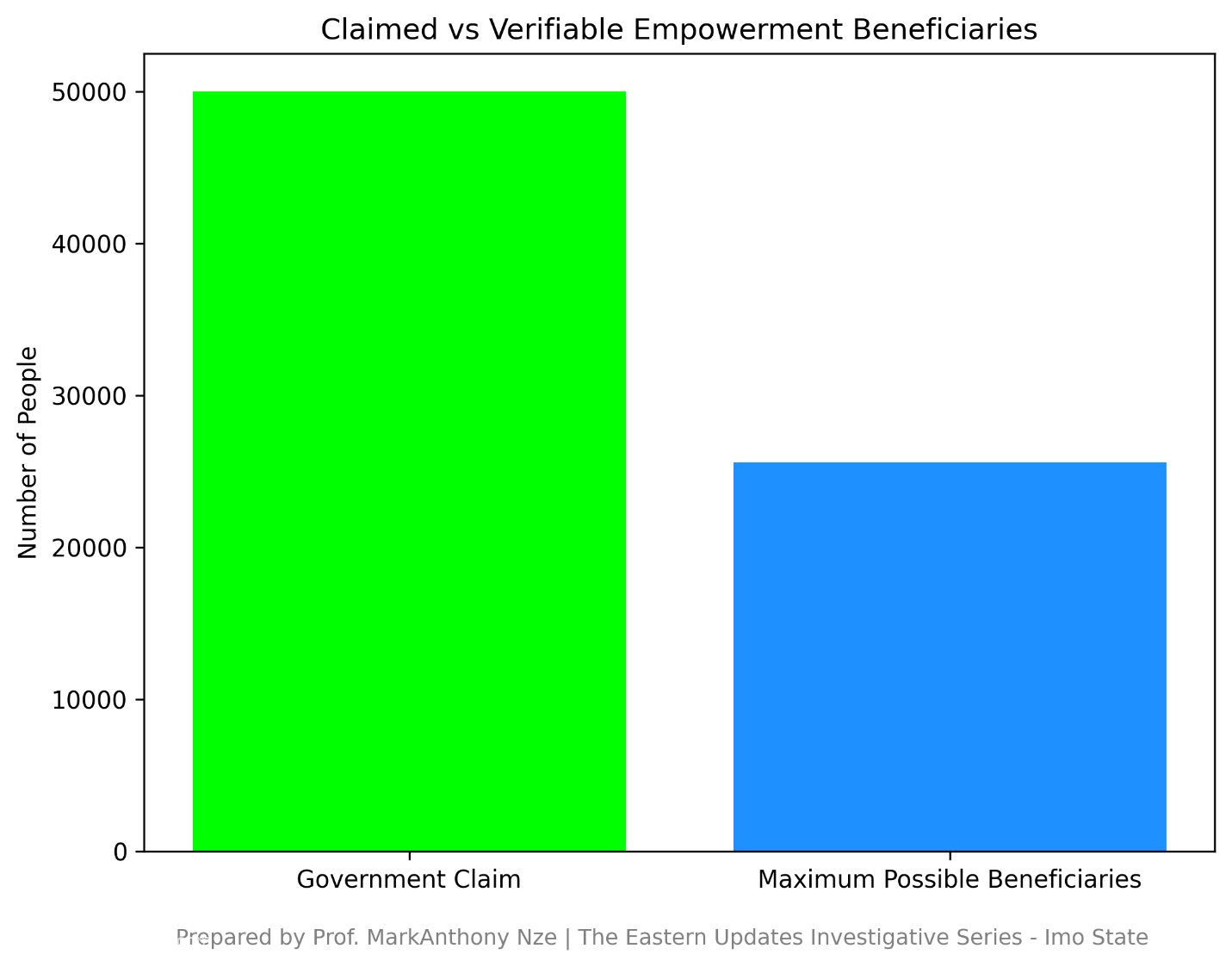
This chart converts rhetoric into arithmetic. Using the state’s released amount (₦1.28bn) and the lowest benchmark grant of ₦50,000 per person, the maximum possible beneficiaries is 25,600—even before deducting overheads. That means the governor’s claim of 50,000 is mathematically unattainable under the disclosed funding. In fact, once overheads are deducted, real beneficiaries would fall much lower. The chart teaches a critical accountability principle: beneficiary claims must align with unit-cost realities. You cannot empower 50,000 people with funds that can only cover half that number. This is the essence of “ghost beneficiaries”—people counted in speeches but absent in bank alerts. The chart turns the empowerment debate from emotion into proof: if the budget cannot fund the claim, the claim is fiction.
Chart 3 – Federal Verification vs State Narrative (CBN ₦312m, NDE 2,460 vs Claim 50,000)
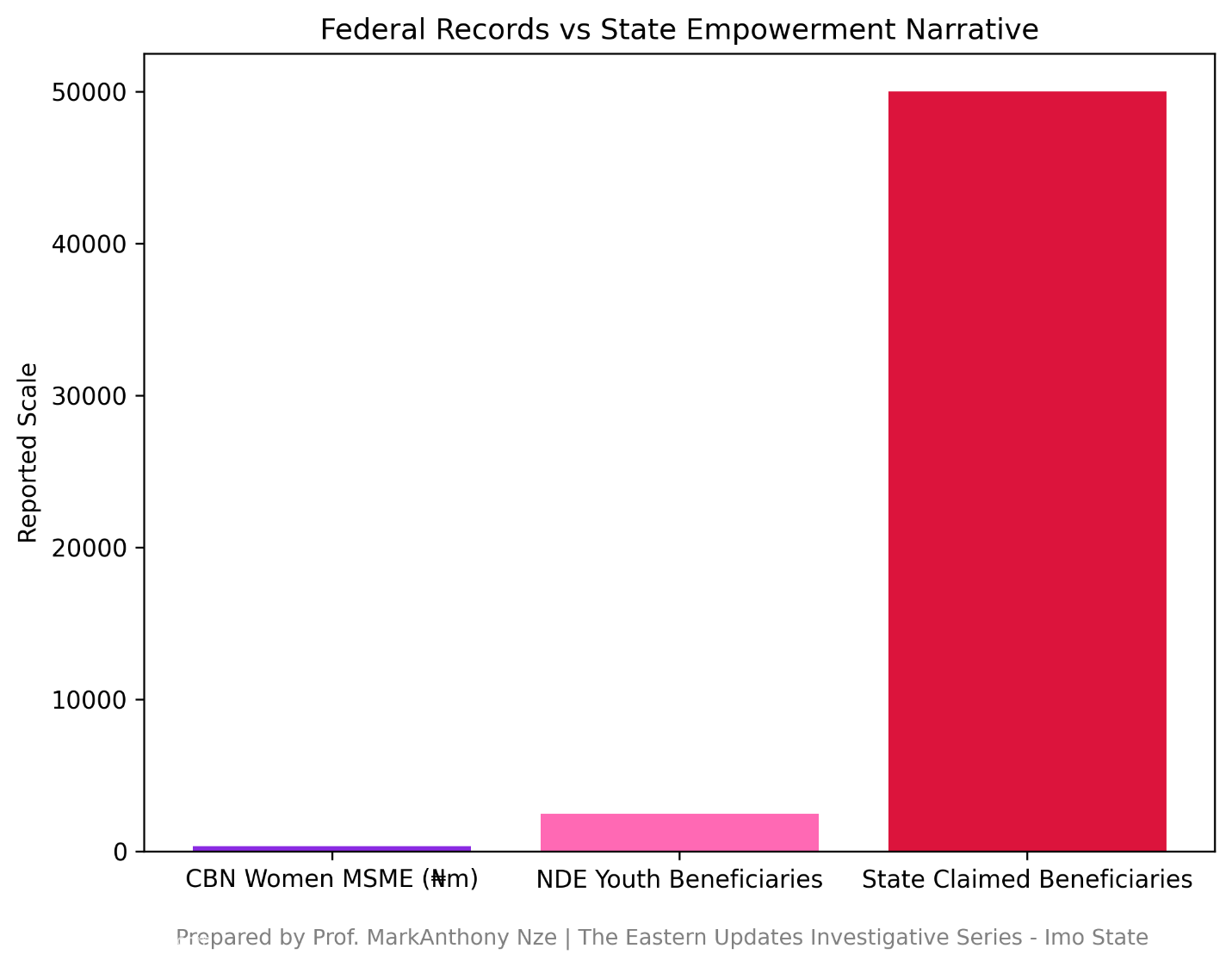
This chart places Imo’s claims beside federal verification signals—the strongest external check against state propaganda. The Central Bank’s MSME women-led disbursement record for Imo (₦312 million) and the National Directorate of Employment’s verified youth trainees (2,460 in the South-East program) show a footprint far smaller than the state’s headline figure. The point is not that the state did nothing; it is that the state’s numbers are not mirrored in credible external systems that track funds and participants. When a state claims mass empowerment, national datasets should show corresponding disbursement volume, training verification, or program scale. Here, the mismatch is extreme. This chart educates readers on how to audit political claims: compare them with independently compiled data. When the state shouts “50,000,” but federal records whisper “thin activity,” the truth is exposed.
Chart 4 – Labor Reality After ‘Empowerment’ (Female Unemployment 41%, Youth Underemployment 56%)
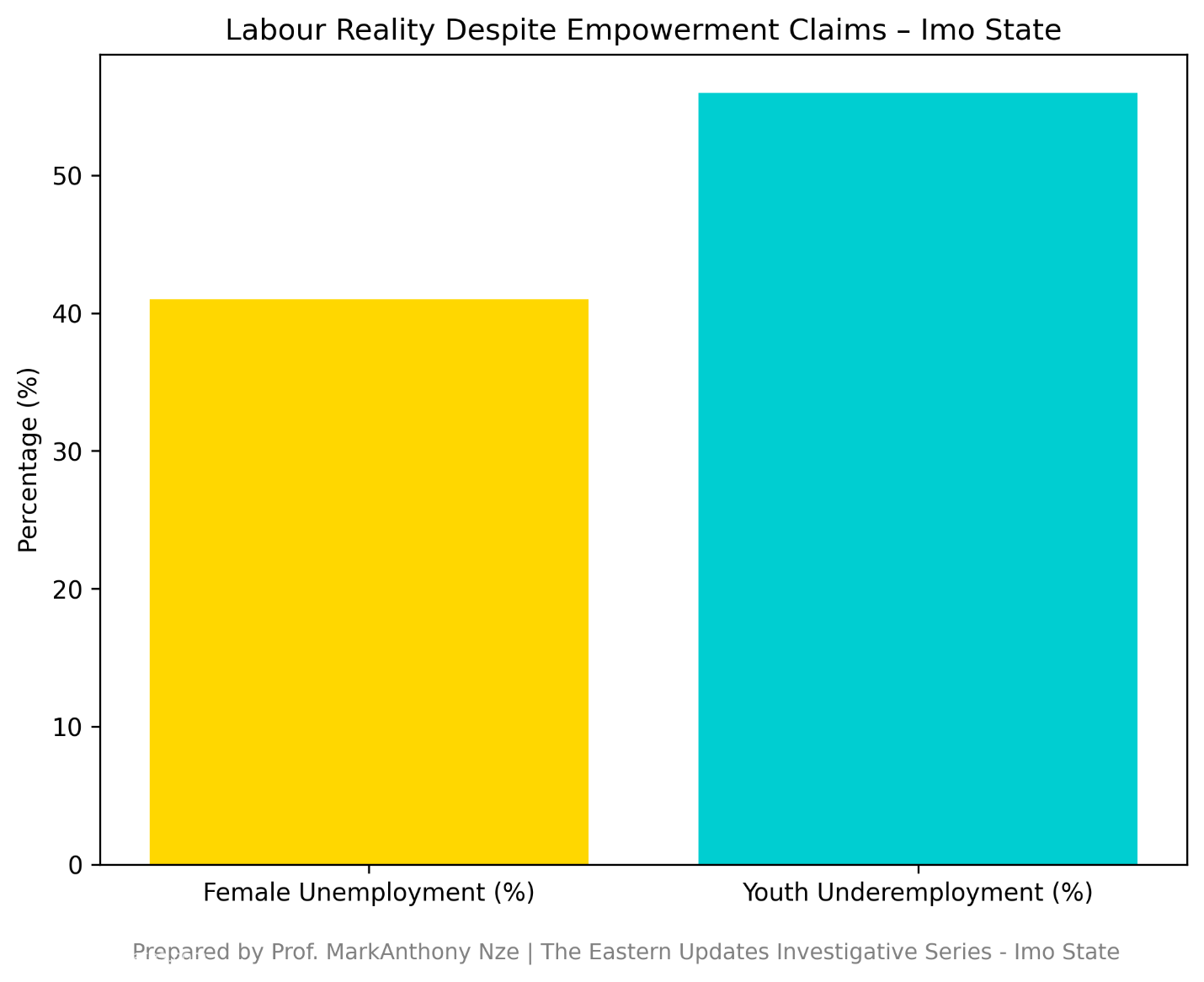
This chart measures outcomes, not announcements. If 50,000 women and youths were genuinely empowered with capital, placement, or sustained support, the labor indicators should respond—especially in vulnerable groups. Yet the report data shows female unemployment at 41% and youth underemployment at 56%, implying that economic conditions remain harsh and that any interventions were too small, too selective, or too shallow to shift the wider reality. The chart is important because it shows the difference between activity and impact. Workshops, certificates, and rallies may generate headlines, but they do not reduce unemployment unless they lead to jobs, enterprise growth, or long-term income stability. This visualization teaches the public to judge empowerment by what changes in people’s lives. When the labor picture remains bleak, “empowerment” becomes theater—short applause, and long hardship.
Verdict — The Ghost Economy of Power
Imo State’s “empowerment revolution” is a study in manufactured reality. The figures do not add up; the data does not exist; the beneficiaries cannot be found. The claim was not an achievement but a political fabrication — a numerical illusion constructed to mimic progress.
Empowerment is not attendance. It is not a certificate or a slogan. It is the lived experience of independence — the ability to sustain oneself through genuine access to capital and opportunity.
Until Imo’s leaders learn that truth, the state will continue to export disillusionment as policy and import applause as governance.
The evidence is unambiguous: Imo did not empower 50,000 women and youth — it empowered a myth.
Professor MarkAnthony Ujunwa Nze is an internationally acclaimed investigative journalist, public intellectual, and global governance analyst whose work shapes contemporary thinking at the intersection of health and social care management, media, law, and policy. Renowned for his incisive commentary and structural insight, he brings rigorous scholarship to questions of justice, power, and institutional integrity.
Based in New York, he serves as a full tenured professor and Academic Director at the New York Center for Advanced Research (NYCAR), where he leads high-impact research in governance innovation, strategic leadership, and geopolitical risk. He also oversees NYCAR’s free Health & Social Care professional certification programs, accessible worldwide at:
👉 https://www.newyorkresearch.org/professional-certification/
Professor Nze remains a defining voice in advancing ethical leadership and democratic accountability across global systems.
Bibliographies
African Development Bank. (2024). Nigeria Gender and Youth Economic Inclusion Report 2024. Abidjan: AfDB Human Capital and Employment Division.
BudgIT Foundation. (2025). State of States Report 2025 – Human Capital and SME Financing (Imo Chapter). Lagos: BudgIT Foundation.
Central Bank of Nigeria. (2024). MSME Development Fund: State-Level Disbursement Summary 2024. Abuja: CBN Development Finance Department.
Federal Ministry of Women Affairs. (2024). National Gender Empowerment and Entrepreneurship Baseline Study. Abuja: Policy, Planning & Statistics Department.
Imo Broadcasting Corporation (IBC TV). (2024, March 8). Governor Uzodinma: We Have Empowered Over 50,000 Women and Youths Across Imo. Owerri: IBC Archives.
Imo State Government. (2024, March 9). Press release: Governor Uzodinma’s Women’s Day Address – “Empowerment for Shared Prosperity.” Owerri: Ministry of Information.
Imo State Ministry of Women Affairs and Vulnerable Groups. (2024). Empowerment Programmes Annual Report 2024. Owerri: Women Development Centre.
Imo State Microfinance Agency. (2024). Loan and Grant Disbursement Register – January to December 2024. Owerri: ISMA Financial Operations Unit.
National Bureau of Statistics. (2024). Labour Force Survey Q4 2024 – Youth Employment and Gender Participation Indicators. Abuja: NBS.
National Directorate of Employment. (2024). Skills Acquisition and Entrepreneurship Training Statistics Report (South-East Zone). Abuja: NDE Research & Data Unit.
Nigeria Governors’ Forum. (2024). Subnational Human Capital and Empowerment Scorecard 2024. Abuja: NGF Secretariat.
Premium Times Nigeria. (2024, June 17). Fact Check: Imo’s Claim of Empowering 50,000 Women and Youths Lacks Evidence. Retrieved from https://www.premiumtimesng.com
Punch Newspapers. (2024, June 19). Imo Women Protest Unfulfilled Grant Promises. Retrieved from https://punchng.com
The Guardian Nigeria. (2024, June 21). Many Imo Women Still Await Empowerment Funds After State’s Announcement. Retrieved from https://guardian.ng
United Nations Development Programme (UNDP). (2024). Nigeria Subnational Human Development Report – Gender and Youth Economic Opportunities. New York: UNDP Regional Bureau for Africa.

