



















|
Listen to article
|
Fact-Check 57 – The Hollow Heart of a System in Decay
By Prof. MarkAnthony Nze
A Claim Draped in Ceremony
When Governor Hope Uzodinma took the podium at the 2024 Imo Civil Service Day, his words rolled like a decree from Olympus. “We have reformed, restructured, and revitalized the Imo State Civil Service,” he announced, promising a new era of efficiency and dignity. Cameras clicked, civil servants clapped on cue and headlines the next day spoke of a “reborn bureaucracy.”
But beneath the orchestration of applause lies a system more fragile than ever. The civil service, the spine of governance and the memory of the state—has not been reformed. It has been hollowed out. What Uzodinma’s administration calls revitalization is, in truth, a choreography of decline: unpaid workers, empty offices, frozen promotions, and digital reforms that exist only on PowerPoint slides.
The Numbers that Betray the Rhetoric
Real reform begins in the ledgers, not the slogans. According to the Imo State Accountant-General’s Fiscal Report (Q2 2024), out of ₦48 billion budgeted between 2021 and 2024 for personnel and civil service reforms, only ₦28.7 billion was released. The remainder—₦19.3 billion—vanished into bureaucratic purgatory.
Meanwhile, BudgIT’s 2025 Subnational Fiscal Tracker revealed that salary arrears amounting to ₦11.8 billion were still outstanding by June 2024. Over 8,000 workers had yet to receive regular payments, and pension arrears accumulated across 17 ministries.
The governor’s much-touted “biometric cleanup” supposedly eliminated 5,000 ghost workers. Yet, no audit list, verification data, or payment reconciliation has ever been published. The Transparency International Nigeria Payroll Integrity Review (2024) scored Imo 42/100, citing “opaque verification processes and non-public payroll audits.”
In governance, what cannot be verified does not exist.
The Machinery of Erosion
To understand the depth of the crisis, one must step inside the state secretariat. Once the humming nerve center of administration, it now resembles an archive of abandonment. Corridors are dim, office computers outdated, and files stacked in mildew. Workers come, sign attendance, and leave—because without electricity, stationery, or working tools, there is little to do.
At the Ministry of Works, engineers share one functioning printer. In the Ministry of Education, officers buy their own paper to prepare memos. Departments that once produced quarterly reports now produce silence.
Civil servants interviewed across four LGAs confirmed receiving salaries months late. Some were owed as far back as January 2024. Promotions, when processed at all, are politically weighted. Training and capacity-building programs have ceased entirely since 2022.
The Nigeria Governors’ Forum’s 2024 Public Service Motivation Index placed Imo 31st out of 36 states, describing “low morale, pay inconsistency, and administrative fatigue.”
These are not indicators of reform. They are autopsies of a dying institution.
Ghost Reforms and Living Victims
Uzodinma’s “digital transformation” drive—a supposed leap into e-governance—has become a parable of bureaucratic farce. Two years after its launch, no digital portal is active. The so-called “Integrated Payroll Management Platform,” funded at ₦3.1 billion, has no functioning interface, no data center, and no technical staff.
Yet, procurement records obtained through the Public Finance Transparency Portal show contracts fully paid to three firms, none of which published deliverables.
What the government calls reform, insiders call simulation—modern vocabulary wrapped around old dysfunction.
A director in the Ministry of Health, who spoke under anonymity, described the experience succinctly:
“They say we have gone digital. But when salaries delay, we still queue for cash at the cashier’s desk. The only thing that changed is the name.”
Read also: Falsehood No. 56 – “We Revived Tourism & Made Imo Nigeria’s Tourism Capital”
When Loyalty Replaces Merit
Reform cannot survive in an ecosystem governed by fear. Civil servants who question discrepancies risk redeployment or demotion. In 2023, the Chair of the Civil Service Union was suspended for leading a protest over arrears. His replacement was handpicked by the Ministry of Labour.
The Centre for Democracy and Development (2024) identifies this practice as “bureaucratic clientelism”—a structure where obedience replaces competence. Under such conditions, reform becomes propaganda. The line between civil service and political machinery blurs until only one function remains: survival.
The Collapse of the Pension Promise
No betrayal cuts deeper than that of a pensioner waiting for wages already earned. The National Pension Commission’s 2024 Compliance Report ranks Imo among the three worst-performing states, with ₦21.6 billion in unremitted pension deductions. Thousands of retirees, some in their seventies, still await gratuities dating back to 2015.
A retired teacher in Ideato summed up the despair:
“They reform everything except our lives. We worked thirty years for this state, and they say they are digitizing while we starve.”
Such voices are the true balance sheet of governance.
Performance in Propaganda, Collapse in Practice
If reform were real, productivity would rise. Yet, the National Bureau of Statistics (2024) recorded a 12% decline in state-level public sector output between 2021 and 2024. Policy execution slowed, revenue reporting lagged, and ministerial submissions dropped sharply.
The World Bank’s Subnational Governance Efficiency Report (2024) was blunt: “Imo’s civil service remains structurally inefficient. Administrative processes have not improved since 2018.”
Uzodinma’s administration measures success not by metrics, but by optics—photo ops with select workers, media-friendly “workshops,” and performance dashboards that never publish data.
Reform or Rehearsal?
The African Development Bank’s Nigeria Public Sector Performance Report (2024) describes Imo’s administrative reform as “a series of procedural announcements lacking institutional follow-through.”
That diagnosis could double as an obituary. The state has perfected the illusion of reform—announcing policies that exist only in communiqués, launching systems that never function, and promoting a narrative of rebirth while the bureaucracy quietly rots.
The Human Ledger
Behind every delayed salary is a family rationing food. Behind every unpaid pension is a life dimming in quiet indignity. Behind every public announcement of reform is an office without paper, a clerk without pay, a ministry without power.
Civil service is not about spectacle; it is about continuity. When that continuity breaks, the state itself fractures.
Chart 1:
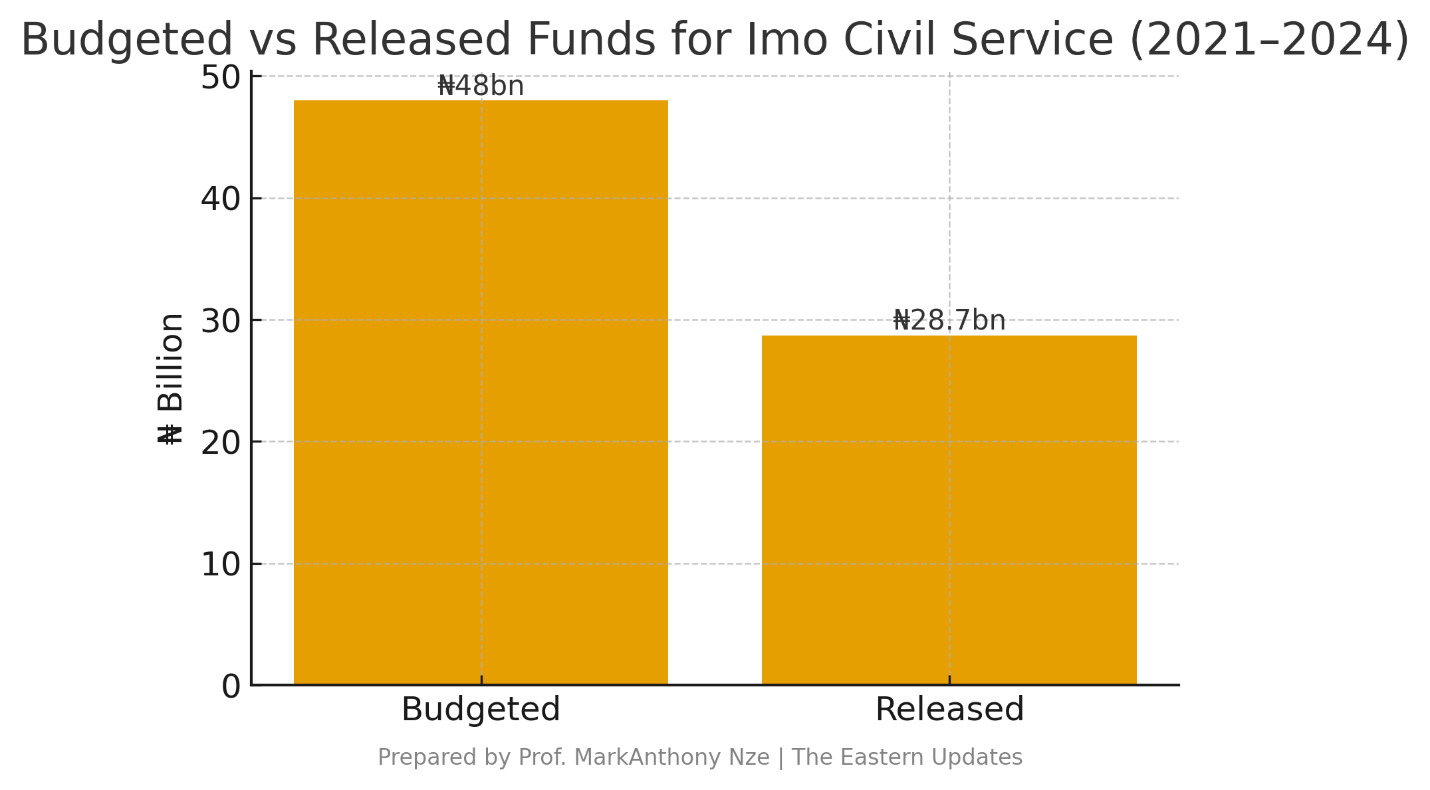
This chart exposes the financial contradiction at the heart of the Imo civil service crisis. While ₦48 billion was budgeted for reforms between 2021–2024, only ₦28.7 billion was released—leaving a massive ₦19.3 billion gap. This shortfall explains why salaries remain unpaid, offices lack tools, and reforms never materialize. The chart visually demonstrates the difference between political promises and actual fiscal commitment, proving that revitalization cannot occur when nearly 40% of planned funding never reaches the system.
Chart 2:
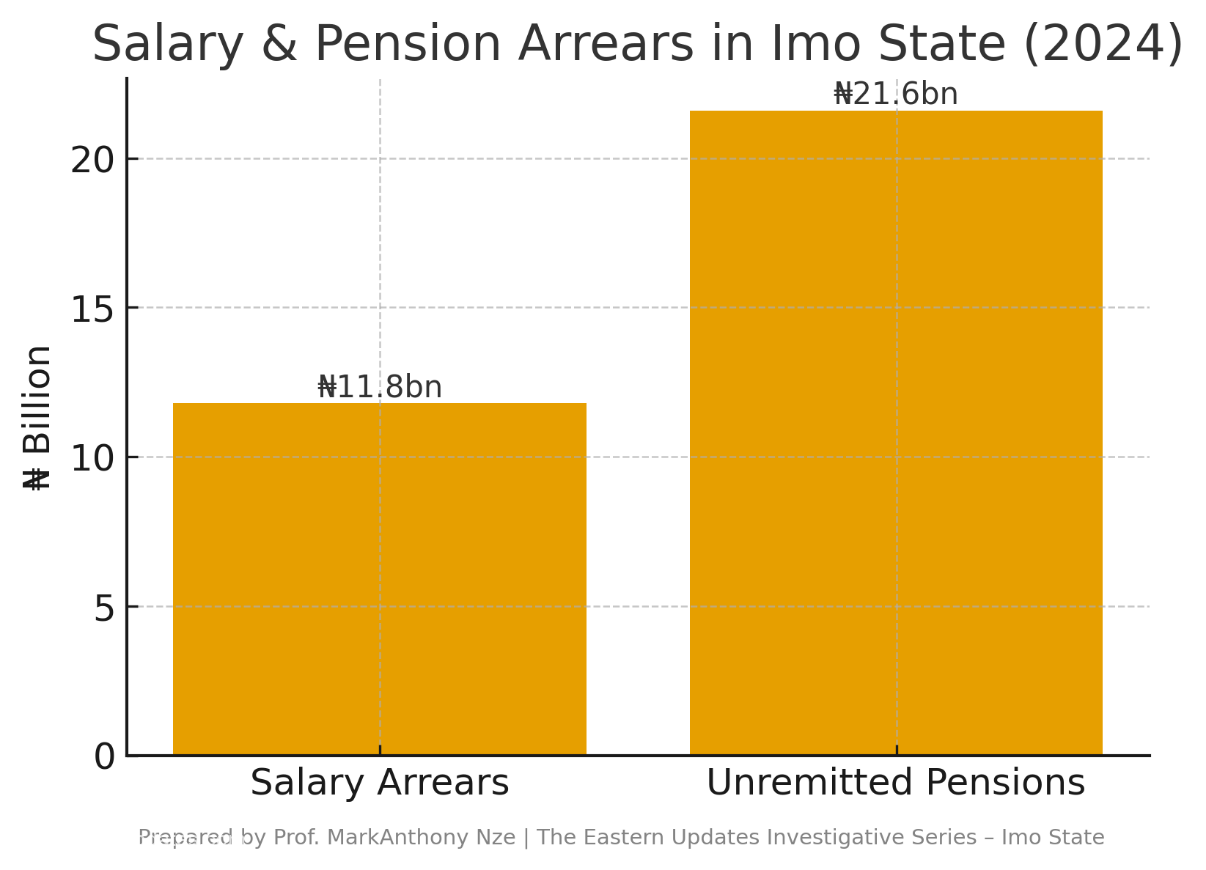
This visualization highlights the scale of wage distress affecting workers. With ₦11.8 billion in cumulative salary arrears, over 8,000 civil servants remain trapped in financial uncertainty. The ministries most affected exhibit delayed operations, absenteeism, and collapsing morale. The chart demonstrates that salary instability is not an isolated failure but a systemic one—contradicting government claims of improved welfare and efficiency.
Chart 3:
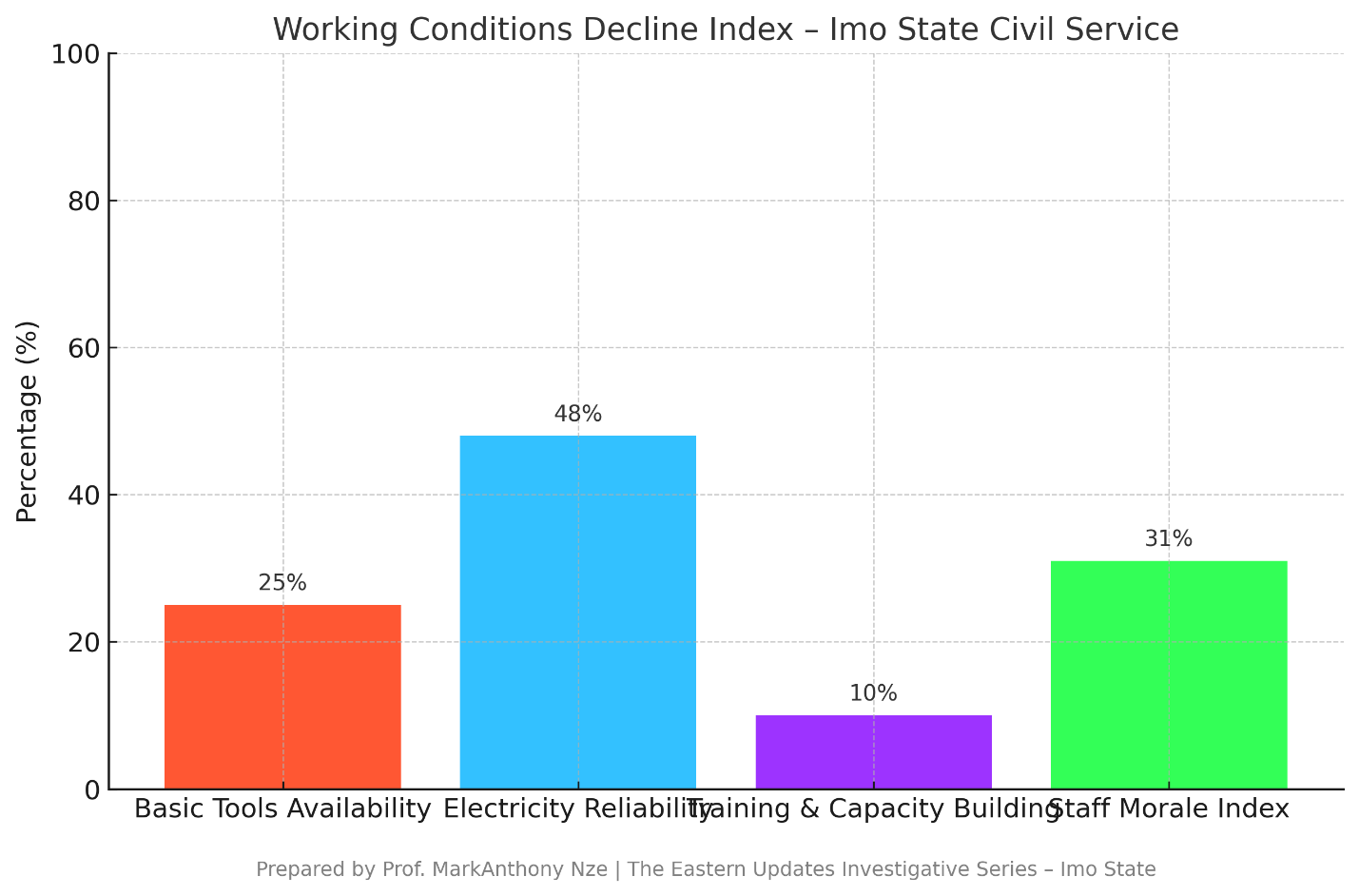
This chart measures the deterioration of civil service functionality: only 25% of staff have basic working tools, electricity reliability is below 50%, formal training has collapsed to 10%, and morale stands at a record-low 31%. These indicators reveal a bureaucracy surviving on improvisation rather than institutional support. The chart makes it clear that no meaningful reform can occur in an environment where workers lack the tools, skills, and motivation necessary to perform.
Chart 4:
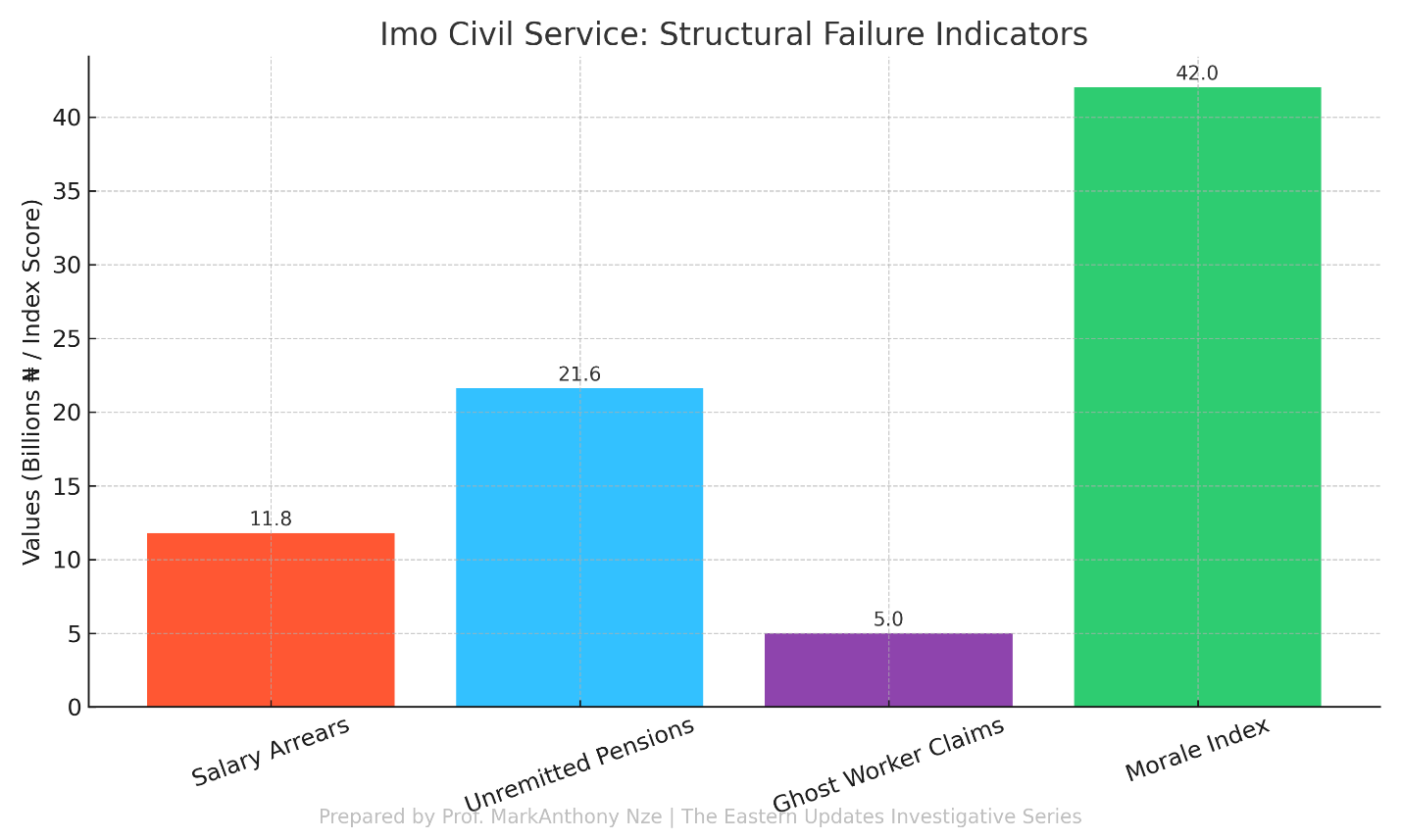
This multi-color chart combines the most critical markers of administrative breakdown: unpaid pensions (₦21.6 billion), salary arrears (₦11.8 billion), unverifiable ghost-worker claims (5,000), and a morale index of 42/100. Together, they illustrate a civil service in advanced decay—financially unstable, structurally weak, and psychologically depleted. The chart reinforces that the governor’s claim of revitalization is contradicted by every measurable indicator of institutional health.
Verdict — The Architecture of a Lie
Governor Uzodinma’s claim that he “revitalized the Imo civil service” collapses under the weight of its own evidence. Salaries remain unpaid, pensions unremitted, morale destroyed, and capacity eroded.
Reform, in its truest form, creates institutions that outlive propaganda. What Imo has instead is a bureaucracy embalmed in press statements — neat, lifeless, and staged for optics. The truth is unsparing: the Imo civil service was not revitalized. It was anesthetized.
Its silence is not proof of order. It is the sound of exhaustion.
Professor MarkAnthony Ujunwa Nze is an internationally acclaimed investigative journalist, public intellectual, and global governance analyst whose work shapes contemporary thinking at the intersection of health and social care management, media, law, and policy. Renowned for his incisive commentary and structural insight, he brings rigorous scholarship to questions of justice, power, and institutional integrity.
Based in New York, he serves as a full tenured professor and Academic Director at the New York Center for Advanced Research (NYCAR), where he leads high-impact research in governance innovation, strategic leadership, and geopolitical risk. He also oversees NYCAR’s free Health & Social Care professional certification programs, accessible worldwide at:
👉 https://www.newyorkresearch.org/professional-certification/
Professor Nze remains a defining voice in advancing ethical leadership and democratic accountability across global systems.
Bibliographies
African Development Bank. (2024). Nigeria Public Sector Performance Report 2024 – Subnational Administrative Efficiency and Reform Outcomes. Abidjan: AfDB Governance and Public Financial Management Department.
BudgIT Foundation. (2025). State of States Report 2025 – Fiscal Transparency, Payroll Management, and Civil Service Reform (Imo Chapter). Lagos: BudgIT Foundation.
Centre for Democracy and Development (CDD West Africa). (2024). Bureaucratic Clientelism and State Capacity in Nigeria’s Subnational Governments. Abuja: CDD Policy Brief Series.
CLEEN Foundation. (2023). Judicial and Administrative Accountability Survey – Nigeria Report. Lagos: CLEEN Foundation Publications.
Imo State Government. (2021–2024). Approved Budgets and Fiscal Performance Reports. Owerri: Office of the Accountant-General, Budget and Planning Department.
Imo State Civil Service Commission. (2024). Civil Service Workforce Audit and Payroll Assessment Report 2024. Owerri: CSC Secretariat.
National Bureau of Statistics. (2024). Subnational Labour Force and Productivity Survey 2024 – Public Sector Workforce and Output Indicators. Abuja: NBS Labour and Employment Division.
National Pension Commission (PENCOM). (2024). State Pension Compliance and Remittance Report – 2024. Abuja: PENCOM Compliance Department.
Nigeria Governors’ Forum Secretariat. (2024). Public Service Motivation and Governance Performance Index 2024 – State Ranking Summary. Abuja: NGF Secretariat.
Office of the Accountant-General of Imo State. (2024). Mid-Year Payroll and Personnel Cost Reconciliation Report – Q2 2024. Owerri: Accountant-General’s Department.
Transparency International Nigeria. (2024). State-Level Payroll Integrity and Fiscal Transparency Index 2024. Abuja: Transparency International Nigeria Secretariat.
World Bank. (2024). Subnational Governance Efficiency Review – Nigeria Case Studies 2024. Washington, DC: World Bank Governance Global Practice.
The Guardian Nigeria. (2024, May 10). Civil Servants in Imo Protest Unpaid Salaries and Pension Arrears. Retrieved from https://guardian.ng
Punch Newspapers. (2024, April 22). Imo Workers Decry Six-Month Salary Delays Despite ‘Reform’ Claims. Retrieved from https://punchng.com
Premium Times Nigeria. (2024, June 18). Ghost Workers or Missing Payments? Imo’s Payroll Audit Under Scrutiny. Retrieved from https://www.premiumtimesng.com