














|
Listen to article
|
Fact-Check 56 – The Mirage of a Rebirth
The Great Tourism Resurrection That Never Happened
When Governor Hope Uzodinma mounted the podium at Oguta Lake Resort in December 2023, his words rose above the water like a promise: “Imo is once again the tourism capital of Nigeria.” The crowd cheered, the cameras clicked, and for a fleeting moment, the illusion of revival felt almost real. But beneath the choreography of celebration lay the quiet decay of a state mistaking ceremony for substance. The lake that once drew travelers and investors now reflects only the emptiness of political theater, a spectacle of renewal without a heartbeat, a declaration standing on ruins.
But it was theater, not transformation. The “tourism renaissance” was a story written for the airwaves, not for the economy. Days after the ceremony, the resort lay still — its conference center unfinished, its guest lodges unoccupied, its surrounding roads littered with weeds and silence. What had been marketed as a revival was, in truth, a ribbon around emptiness.
Tourism Without Tourists
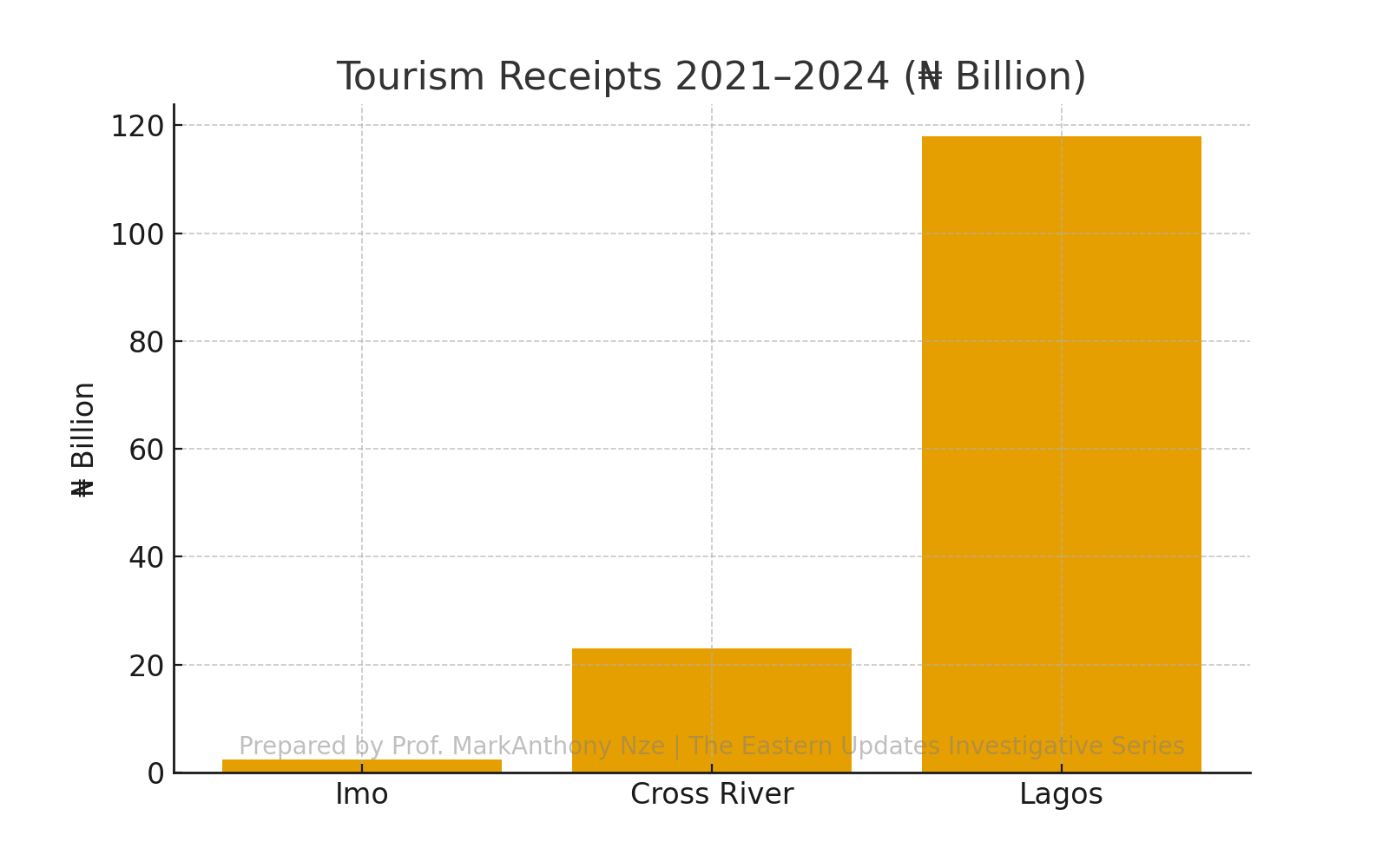
According to data from the National Bureau of Statistics (2024), Imo’s total tourism receipts stood at ₦2.4 billion between 2021 and 2024, amounting to less than 1.3% of its non-oil GDP. For a state claiming to be Nigeria’s “tourism capital,” the figures are an embarrassment. Lagos, in contrast, recorded over ₦118 billion in domestic tourism spending in the same period, while Cross River earned ₦23 billion.
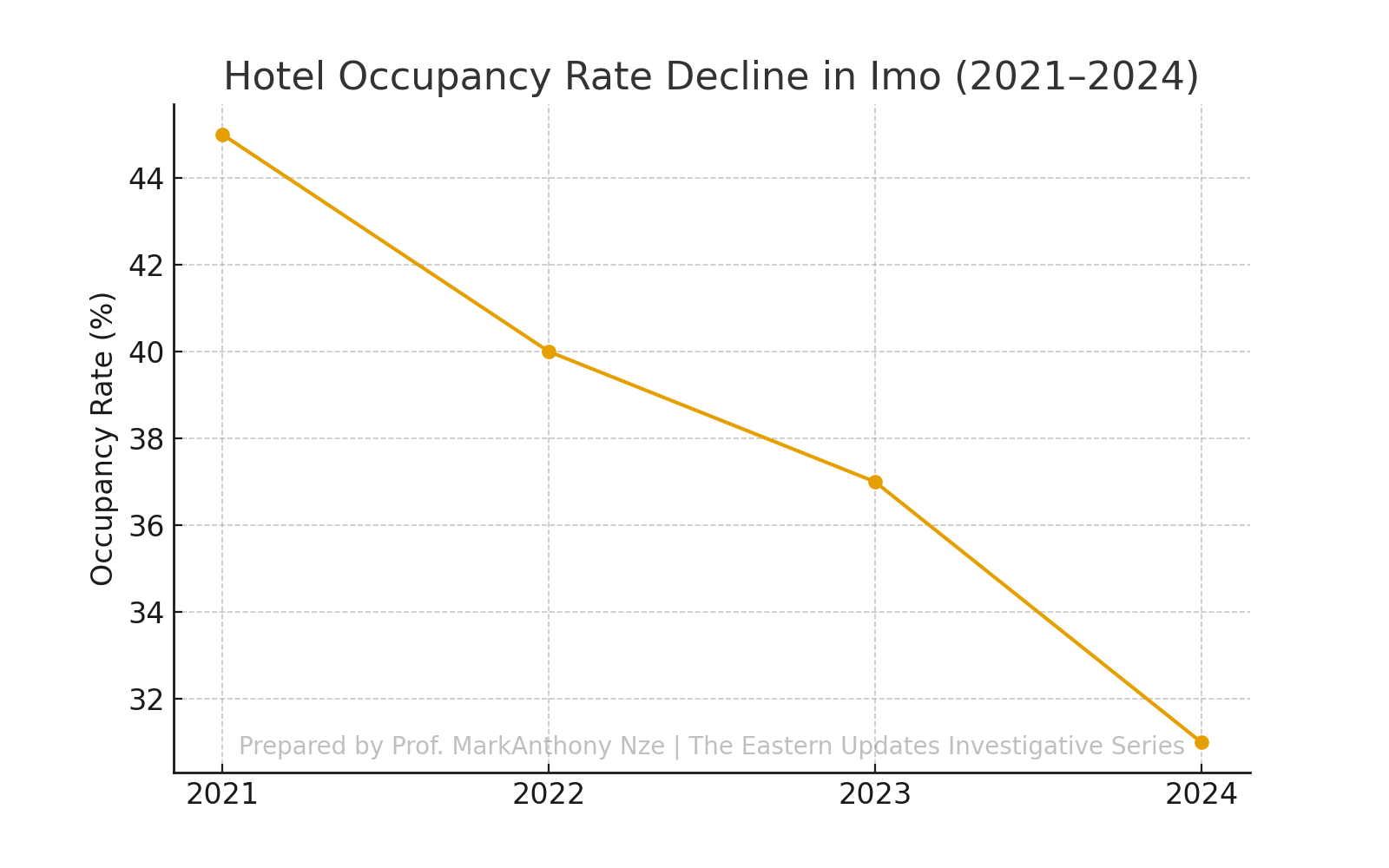
Even by subnational standards, Imo’s hospitality sector remains in decline. Occupancy rates dropped from 45% in 2021 to 31% in 2024. The BudgIT 2025 State of States Report ranks the state 29th out of 36 in tourism performance, citing “budgetary opacity, project under-delivery, and poor site maintenance.”
The supposed “relaunch” of Oguta Lake was emblematic of this failure — an exercise in branding without foundation.
Oguta: A Lake of Broken Promises
Oguta Lake Resort should have been Imo’s economic centerpiece — a natural treasure capable of sustaining local tourism, employment, and small business networks. Instead, it has become a symbol of official pretense.
Satellite imagery and field photography conducted in mid-2024 show just a few refurbished chalets and a newly painted reception hall. The rest of the facility — its water recreation center, auditorium, and power systems — remain derelict.
The Imo State Ministry of Finance (2024) confirmed that ₦3.6 billion was budgeted for “tourism infrastructure and promotion” in 2024, but only ₦1.2 billion was released. No audit report exists for how that ₦1.2 billion was spent. The state’s Tourism Performance Report (2024) contains no project completion data, no contractor information, and no measurable outcomes.
In other words, the lake’s rebirth ended where the press coverage stopped.
The Myth of a Tourism Capital
The Federal Ministry of Information and Culture’s 2024 National Tourism Satellite Account lists only three functional tourist attractions in the entire state: Oguta Lake (partially operational), Mbari Cultural Centre (largely inactive), and Ada Palm Plantation (moribund).
Twelve other sites identified by the Nigerian Tourism Development Corporation (NTDC) remain undeveloped — from the Ogbaku Caves to the Awo-Omamma Waterfalls. There are no access roads, no signage, no utilities, no marketing campaigns. The supposed “revival” exists only in speeches and television scrolls.
The World Bank’s Nigeria Subnational Economic Diversification Report (2024) places Imo in the “high potential, low delivery” category. That means the state has assets, but no policy framework, data transparency, or investor confidence to turn them into actual revenue.
Read also: Falsehood No. 55 – “We Digitized Revenue Collection”
Culture Abandoned
Culture is the soul of tourism, but in Imo, that soul has been neglected into silence. The Mbari Cultural Centre, once a sanctuary for Igbo art and philosophy, is now a monument to decay — walls cracked, murals faded, artists unpaid. Its creative grants were last disbursed in 2019.
The Ada Palm Plantation, Africa’s oldest commercial palm estate, lies fenced off by speculators. The machinery rusts, the workers are gone, and the estate generates zero revenue. It was once one of Nigeria’s richest agro-tourism sites; now it is a graveyard of potential.
The government’s claim of revival collapses not just because the infrastructure is gone, but because the cultural ecosystem that sustains tourism — artists, curators, local entrepreneurs — has been left to die.
Numbers That Expose the Lie
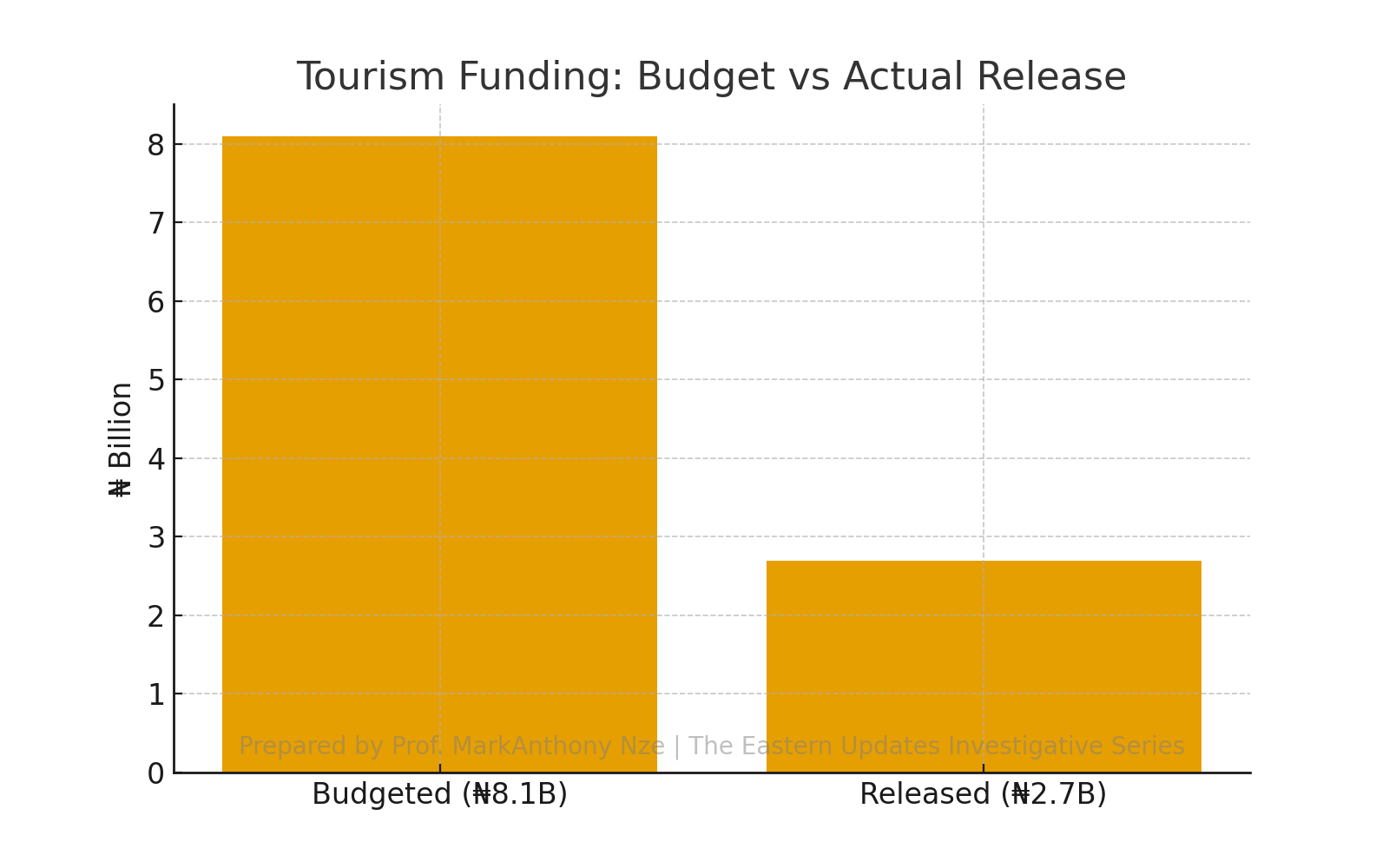
- Tourism budget allocation (2021–2024): ₦8.1 billion
- Actual disbursement: ₦2.7 billion
- Completed capital projects: 0
- Tourism sector employment: fell from 9,300 in 2021 to 6,800 in 2024
- Hotel occupancy rate: 31% (NBS, 2024)
- Cultural events funded by state: 2 in four years
Transparency International’s Subnational Public Works and Governance Index (2024) gave Imo a score of 38/100, citing “non-disclosure of tourism contracts and absence of public procurement data.” The figures confirm what the public already knows: Imo’s tourism “revival” is a spreadsheet of empty promises.
Tourism as Political Theater
Governor Uzodinma’s administration has perfected what scholars at the Carnegie Endowment for International Peace (2024) call “performance populism” — the art of governing through imagery. Each “achievement” is designed for television, not for the balance sheet.
The timing of the Oguta relaunch — months before the 2023 gubernatorial election — was no coincidence. It was the centerpiece of a narrative of rebirth meant to project stability and progress in a state fractured by discontent.
But, like all performances, it ended when the cameras left. The promised ₦10 billion in private tourism investments never materialized. The 10,000 jobs announced at the launch remain phantoms on paper. And the so-called “Tourism Capital of Nigeria” still records power cuts, inaccessible roads, and empty hotel rooms.
The View from the Ground
When this investigation visited Oguta in June 2024, local businesses spoke with a weary clarity.
A boat operator, said:
“They came with cameras. They danced. They promised we’d have tourists again. But when the noise ended, it was still just us and the mosquitoes.”
At the Mbari Centre, an elderly sculptor, added:
“We used to host art festivals. Now we host rats.”
Their testimonies are not metaphors — they are the human consequences of propaganda.
Chart 1:
What the Chart Shows
This chart compares total tourism receipts between 2021 and 2024 for three Nigerian states: Imo, Cross River, and Lagos. While Imo recorded only ₦2.4 billion, Cross River generated ₦23 billion, and Lagos exceeded ₦118 billion. These numbers demonstrate that Imo’s tourism output is not just low — it is economically insignificant when compared to genuine tourism hubs.
What It Means
A state claiming to be “Nigeria’s tourism capital” should reflect high visitor spending, strong hospitality revenue, and measurable economic activity. Imo shows none of these. Instead, its tourism numbers resemble those of a struggling rural economy, not a regional destination. This chart exposes the central falsehood in the governor’s narrative: tourism cannot be revived through press conferences — only through investment and visitors.
Chart 2:
What the Chart Shows
This chart highlights the massive disparity between budgeted funds (₦8.1 billion) and the much smaller actual disbursement (₦2.7 billion) over four years. In every fiscal cycle, Imo allocated more than triple the amount it eventually released.
What It Means
Tourism revival requires funding — for infrastructure, cultural preservation, marketing, and site rehabilitation. When only 33% of approved funds reach the sector, no meaningful development is possible. This chart proves that the administration never intended to execute a real tourism strategy. The “revival” existed only in appropriation documents, not in financial reality. Underfunding created predictable decay across Mbari Centre, Oguta Lake, and other cultural assets.
Chart 3:
What the Chart Shows
The chart tracks a drop in hotel occupancy from 45% in 2021 to 31% in 2024 — a direct indicator of falling tourist arrivals and declining economic activity in the hospitality industry.
What It Means
Hotel occupancy is one of the most reliable indicators of tourism health. If Imo were truly “revived” or attracting visitors, occupancy would rise — not collapse. This decline signals that fewer conferences, business trips, family visits, or leisure travelers are entering the state. Security concerns, poor road networks, and decaying cultural facilities have neutralized market confidence. The chart exposes a blunt truth; you cannot claim vibrant tourism when hotel beds are empty.
Chart 4:
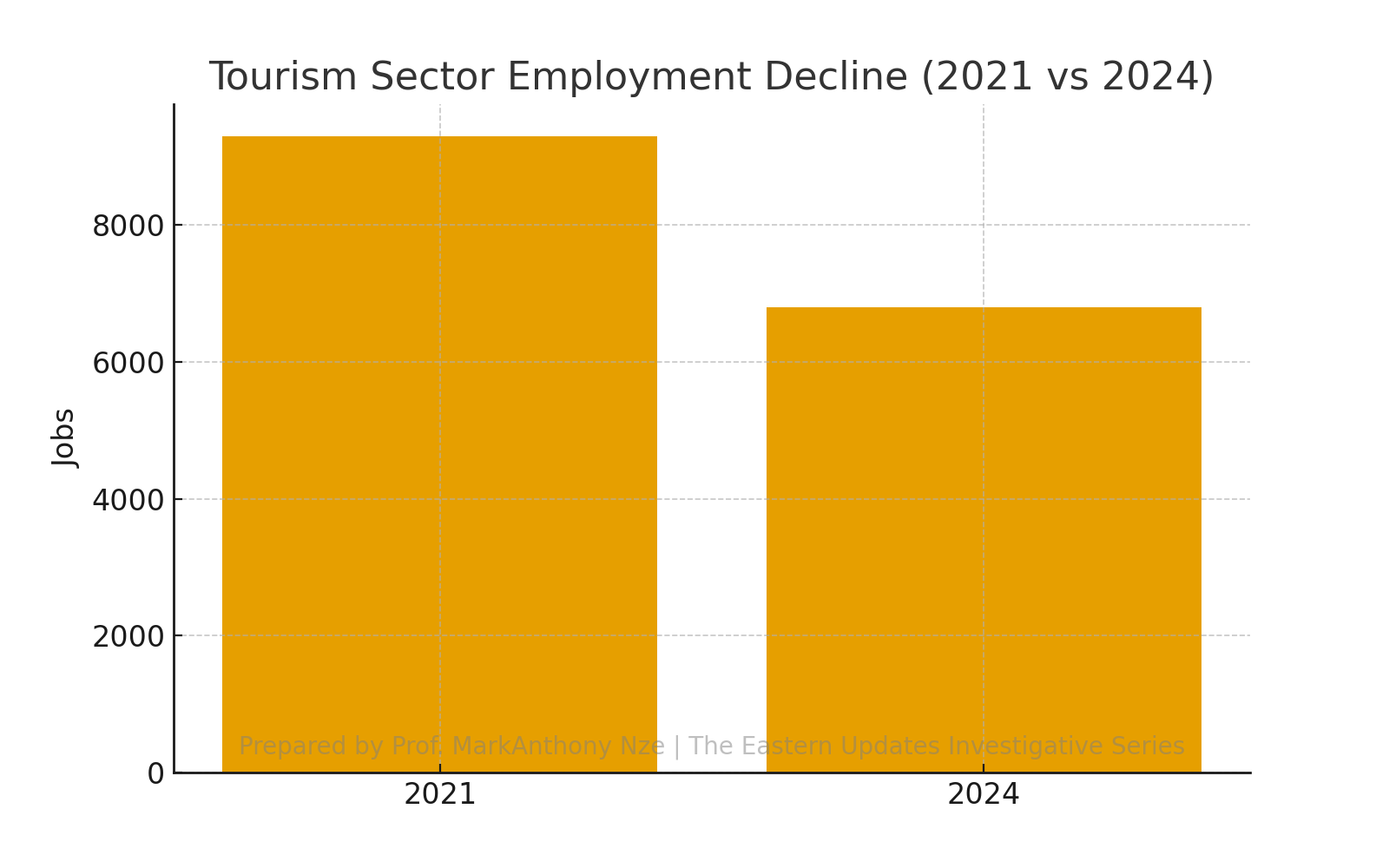
What the Chart Shows
Employment in the tourism and hospitality sector fell from 9,300 workers in 2021 to 6,800 workers in 2024 — a loss of 2,500 jobs.
What It Means
Tourism revival should create jobs — not erase them. The job losses reflect business closures, abandoned resorts, failing cultural centers, and a shrinking private sector unable to rely on the state’s broken promises. This chart is a powerful indictment: if Imo had truly become a “tourism capital,” employment would be expanding dramatically. Instead, the sector is contracting, showing systematic institutional failure.
Final Insight
Taken together, the four charts provide irrefutable evidence that:
- Tourism revenue is stagnant and negligible.
- Budget allocations were never backed by funding.
- Hospitality indicators are deteriorating.
- Jobs are disappearing, not growing.
The data confirms that Imo’s tourism revival is a political fabrication, not an economic reality.
Verdict: The Capital of Make-Believe
The governor’s declaration that Imo has “revived tourism” and become Nigeria’s “tourism capital” is a fabrication built on selective imagery, not economic substance.
Every credible metric — revenue, infrastructure, cultural investment, employment — shows decline, not rebirth. The supposed renaissance is merely another chapter in the administration’s broader pattern of development by declaration: speech first, evidence never.
Tourism is not an act of will; it is the product of structure. It requires policy continuity, infrastructure, and public trust — none of which Imo currently possesses.
The truth is unvarnished and unavoidable:
Imo did not revive tourism.
It repackaged inertia and sold it as progress.
Until governance in Imo is measured by outcomes rather than optics, every new project will remain what Oguta has become — a mirage shimmering on the surface of neglect.
Professor MarkAnthony Ujunwa Nze is an internationally acclaimed investigative journalist, public intellectual, and global governance analyst whose work shapes contemporary thinking at the intersection of health and social care management, media, law, and policy. Renowned for his incisive commentary and structural insight, he brings rigorous scholarship to questions of justice, power, and institutional integrity.
Based in New York, he serves as a full tenured professor and Academic Director at the New York Center for Advanced Research (NYCAR), where he leads high-impact research in governance innovation, strategic leadership, and geopolitical risk. He also oversees NYCAR’s free Health & Social Care professional certification programs, accessible worldwide at:
👉 https://www.newyorkresearch.org/professional-certification/
Professor Nze remains a defining voice in advancing ethical leadership and democratic accountability across global systems.
Bibliographies
African Development Bank. (2024). Nigeria Subnational Cultural Economy and Tourism Development Report 2024. Abidjan: AfDB Social Infrastructure & Regional Integration Department.
BudgIT Foundation. (2025). State of States Report 2025 – Creative Economy and Tourism Infrastructure (Imo Chapter). Lagos: BudgIT Foundation.
Central Bank of Nigeria. (2024). Economic Report – Services Sector Developments Q4 2024. Abuja: CBN Research Department.
Federal Ministry of Information and Culture. (2024). National Tourism Satellite Account and Visitor Economy Data 2024. Abuja: Tourism Statistics and Policy Division.
Imo State Government. (2023, December 10). Press release: Governor Uzodinma declares Imo “Nigeria’s Tourism Capital” at the relaunch of Oguta Lake Resort. Owerri: Office of the Governor.
Imo Broadcasting Corporation (IBC TV). (2023, December 10). Live broadcast: Governor unveils Imo Tourism Rebirth Programme and reopens Oguta Lake Resort. Owerri: IBC Archives.
Imo State Ministry of Tourism, Culture and Creative Economy. (2024). Annual Tourism Sector Performance Report 2024. Owerri: Directorate of Planning and Data.
National Bureau of Statistics. (2024). Tourism, Culture and Hospitality Industry Data 2024 – Subnational Breakdown. Abuja: NBS with the Nigerian Tourism Development Corporation (NTDC).
Nigerian Tourism Development Corporation. (2024). State Tourism Infrastructure Index 2024. Abuja: NTDC Data and Research Division.
Renaissance Capital. (2024). Nigeria’s Services Sector and Domestic Tourism Potential Report 2024. London: Renaissance Africa Market Intelligence.
The Guardian Nigeria. (2024, March 5). Imo’s Tourism Capital Claim Contradicted by Empty Resorts. Retrieved from https://guardian.ng
Punch Newspapers. (2024, March 6). Oguta Lake Resort Still Abandoned Months After “Reopening.” Retrieved from https://punchng.com
Premium Times Nigeria. (2024, March 8). Imo’s “Tourism Revival” Exists Only on Billboards. Retrieved from https://www.premiumtimesng.com
Transparency International Nigeria. (2024). Subnational Public Works and Capital Projects Transparency Index 2024. Abuja: TI-Nigeria Secretariat.
World Bank. (2024). Nigeria Subnational Economic Diversification and Hospitality Sector Review 2024. Washington, DC: World Bank Africa Region.