


















|
Listen to article
|
Fact-Check 54 – Labor Statistics and the Illusion of Prosperity
When Governor Hope Uzodinma stood before the cameras in December 2023 and declared that his administration had “reduced unemployment in Imo State by more than sixty percent,” the applause in the government house auditorium was instant. Civil servants clapped. Party loyalists nodded. The announcement was framed as evidence that Imo had become an economic model in a struggling federation. But the celebration ended where data began.
No statistic; not from the National Bureau of Statistics (NBS), not from the World Bank, and not from the African Development Bank, supported the governor’s assertion. What followed was a study in political illusion: a government mistaking workshops for jobs, temporary stipends for employment, and press releases for progress.
The Arithmetic of False Progress
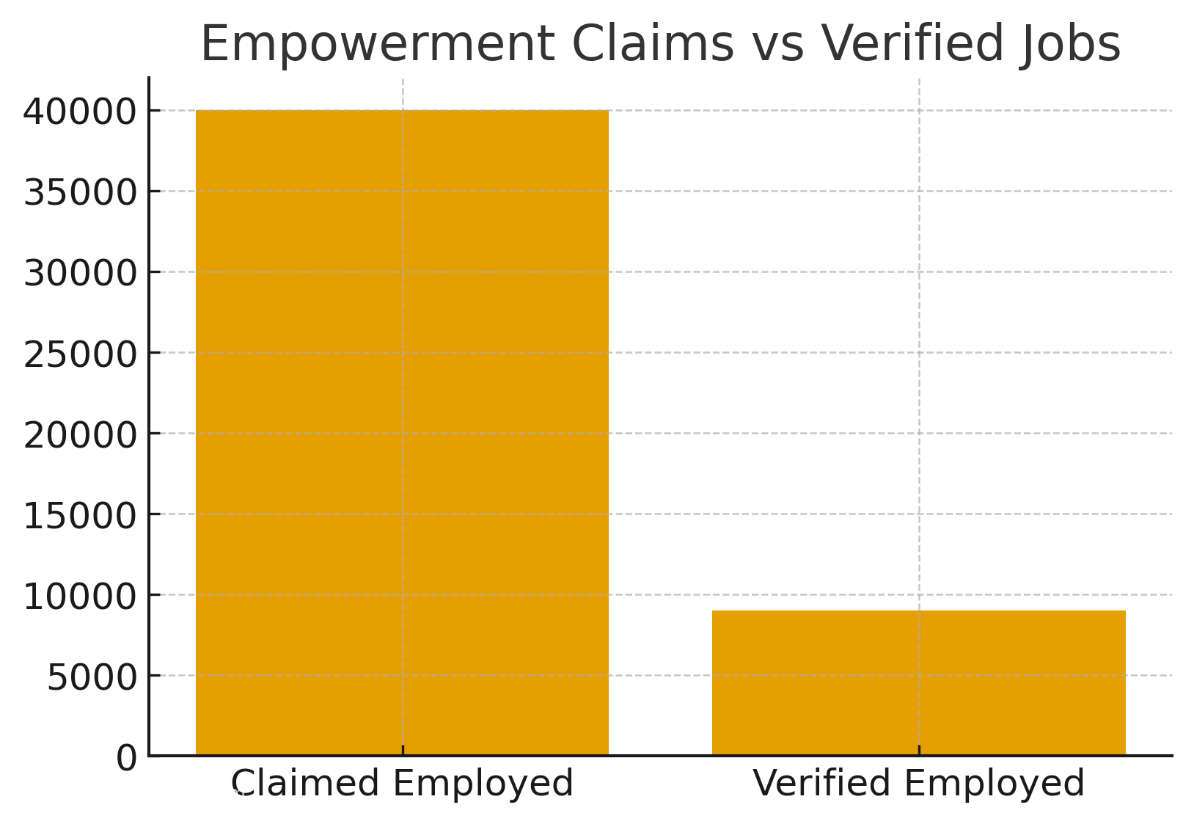
According to the NBS Labour Force Survey (Q4 2024), Imo’s unemployment rate stood at 48.9%, with youth unemployment above 52%. These figures were virtually identical to those of 2021. Yet, within that same period, the state claimed to have “empowered” 40,000 youths through skill acquisition and microcredit schemes.
An audit by the Federal Ministry of Labour and Employment (2024) revealed that fewer than 9,000 of those beneficiaries ever received placement or start-up support. Many of the so-called empowerment programs were one-day workshops — photo-ops with certificates of attendance and no follow-up.
The BudgIT Foundation’s 2025 State of States Report was unambiguous:
“There is no evidence of sustained job creation in Imo State. Reported declines in unemployment are inconsistent with federal and multilateral datasets.”
If a government claims 60% job growth, there must be a corresponding surge in tax receipts, consumer spending, and business registration. The Central Bank of Nigeria’s Real Sector Report (Q4 2024) showed none of these. Imo’s aggregate manufacturing and services output actually contracted by 4.7% between 2022 and 2024. You cannot have job growth in a shrinking economy.
The Economics of Semantics
Uzodinma’s announcement was built on linguistic sleight of hand. The administration conflated “training” with “employment” and “empowerment” with “livelihood.” The Imo State Ministry of Labour and Productivity’s 2024 Report listed thousands of individuals as “engaged,” even when they were merely registered in training rosters.
This manipulation of terminology mirrors what the International Labour Organization (ILO, 2024) calls “statistical cosmeticization” — the deliberate inflation of employment figures through unverified or short-term programs. In reality, true job creation requires consistent private-sector investment, measurable productivity, and wage stability — none of which Imo’s data shows.
The Oxford Economics Africa Subnational Economic Performance Review (2024) ranks Imo among the bottom ten states for “labour dynamism.” The state’s workforce participation has dropped by nearly 8% since 2020, a reflection of declining industrial activity and rising migration.
The Missing Private Sector
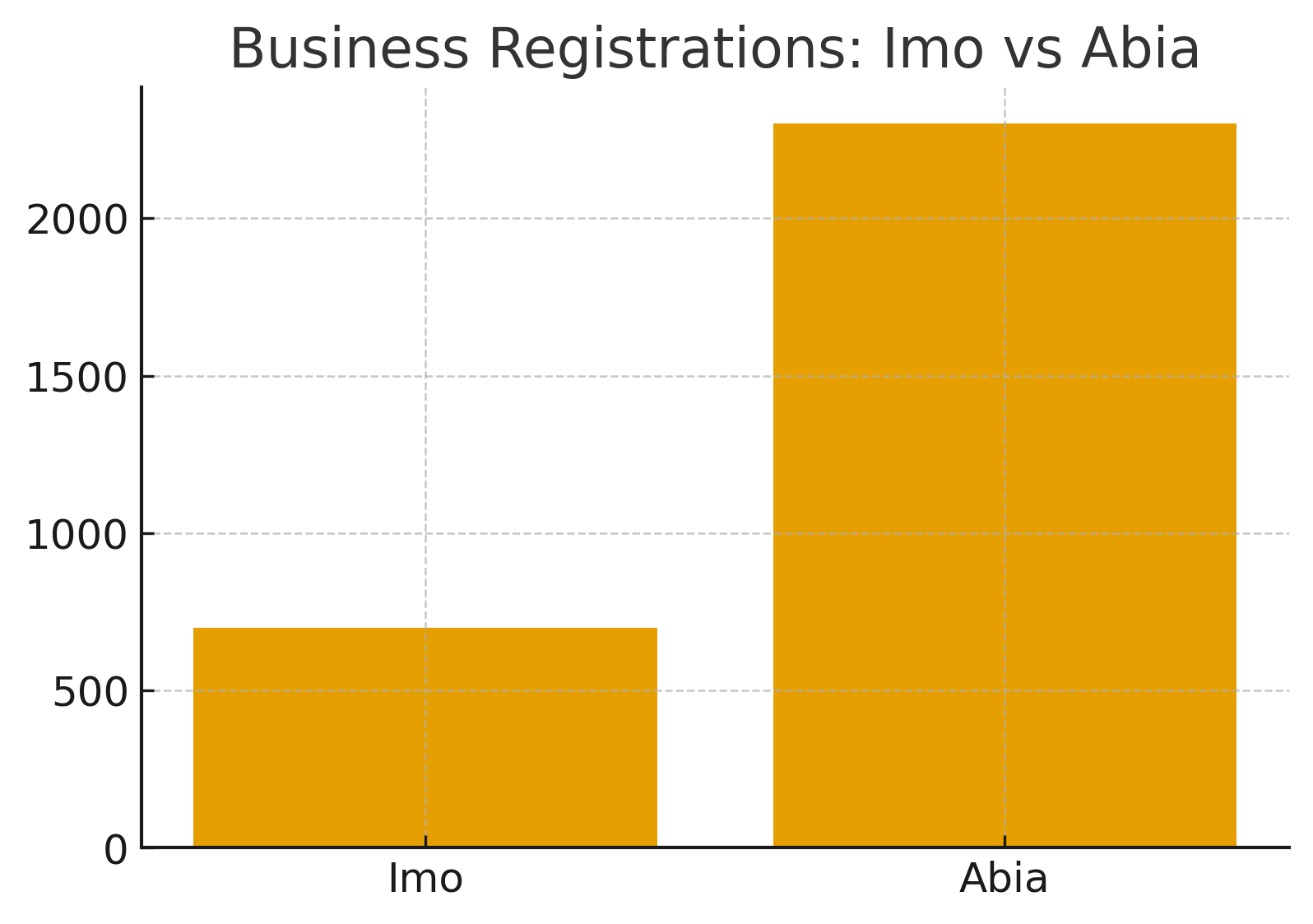
A deeper dive into business registry data tells an even more revealing story. Between 2021 and 2024, the Corporate Affairs Commission (CAC) recorded fewer than 700 new business registrations in Imo — a 40% decline from the previous four-year period. By comparison, neighboring Abia State registered over 2,300.
Private employment is the engine of any genuine labor recovery, yet in Imo, it barely sputters. The Nigerian Economic Summit Group’s 2024 Youth Employment Report concluded that “Imo’s job creation narrative is government-driven and unsustainable.” The administration’s so-called “60% reduction” was based almost entirely on publicly funded, temporary engagements under its Shared Prosperity Scheme — a program that pays token stipends to selected youths for road cleaning, traffic control, or political mobilization.
Once these contracts expired, the beneficiaries were dropped — but the government’s statistics did not. They remained permanently recorded as “employed.”
Read also: Falsehood No. 53 – “We Revived All Moribund Industries”
The Transparency Black Hole
No public record exists that details who actually benefited from Imo State’s employment or empowerment programs. The government has never published a comprehensive list of participants, project timelines, or verified payment data.
Independent watchdogs such as Transparency International Nigeria and the BudgIT Foundation have repeatedly flagged this opacity. In their 2024 and 2025 reports, both organizations ranked Imo among the least transparent states in Nigeria on labor and social investment disclosures.
Attempts by journalists and civil society groups to obtain disaggregated data have been met with silence or vague official responses. Government agencies typically cite “internal review” or “data consolidation” — phrases that have become euphemisms for concealment.
This lack of transparency is not administrative oversight; it is political strategy. By keeping figures unpublished, the administration preserves control over the narrative. Without access to raw data, neither the media nor citizens can verify whether the governor’s “60% unemployment reduction” exists anywhere outside the confines of a press statement.
As the World Bank’s 2024 governance review observed, “where governments hide data, confidence in their development claims erodes faster than their economies.”
The Human Reality Behind the Numbers
In Imo, statistics are political instruments. But beneath the press statements, the reality on the streets of Owerri, Orlu, and Okigwe tells another story — of graduates driving tricycles, teachers moonlighting as petty traders, and engineers hawking phone accessories.
The NDE’s Annual Skills and Placement Report (2024) shows that fewer than 3% of Imo’s registered jobseekers were successfully placed in formal employment. Youths who attended the government’s “Empowerment Week” events say they received no capital, no mentorship, and no opportunity beyond the photo session.
One participant in the 2023 Imo Skills for Growth program said:
“We were told we had been employed as digital entrepreneurs. But all we got was a certificate. No laptop, no internet access, no workspace.”
Another, a trained mechanical engineer, now drives a commercial bus in Owerri. “They say we are no longer unemployed,” he laughed bitterly, “because we were counted once.”
The Political Economy of Hope
Why inflate numbers? Because political legitimacy in modern Nigeria is built on metrics. For a governor facing re-election in a struggling economy, declaring victory over unemployment is a cheap substitute for structural reform.
But every lie told in a press room has a cost. The AfDB’s 2024 Labour Market Report warns that “false employment data distorts fiscal policy and leads to resource misallocation.” When states pretend they are thriving, federal intervention and aid programs are diverted elsewhere. In other words, Imo’s citizens suffer twice — first from unemployment, then from invisibility.
Chart 1:
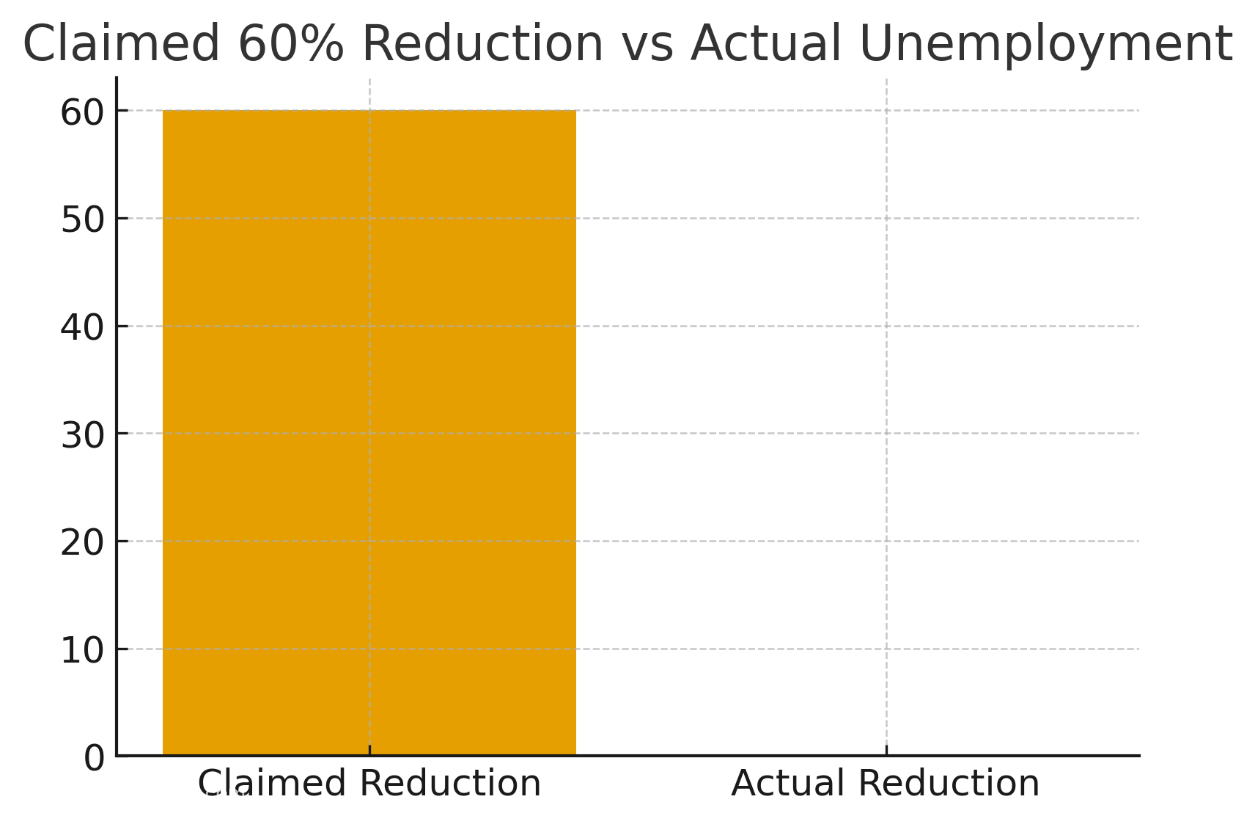
Claimed 60% Unemployment Reduction vs Actual NBS Unemployment Rate
This chart exposes the dramatic disparity between political rhetoric and empirical labour data in Imo State. While the government publicly declared a 60% reduction in unemployment, the National Bureau of Statistics’ Labour Force Survey reveals an actual unemployment rate of 48.9%—virtually unchanged over three years. The chart illustrates the sheer magnitude of this contradiction, demonstrating that no measurable labor-market transformation occurred during the period under review. A genuine 60% reduction would require unprecedented private-sector expansion, robust industrial output, and sustained growth in business formation. Yet none of these fundamentals materialized. Instead, what Imo witnessed were short-term empowerment workshops misclassified as jobs, temporary stipends recorded as full employment, and inflated figures unsupported by any federal or multilateral datasets. This chart underscores a central finding of our investigation: the state did not reduce unemployment—only the truth.
Chart 2:
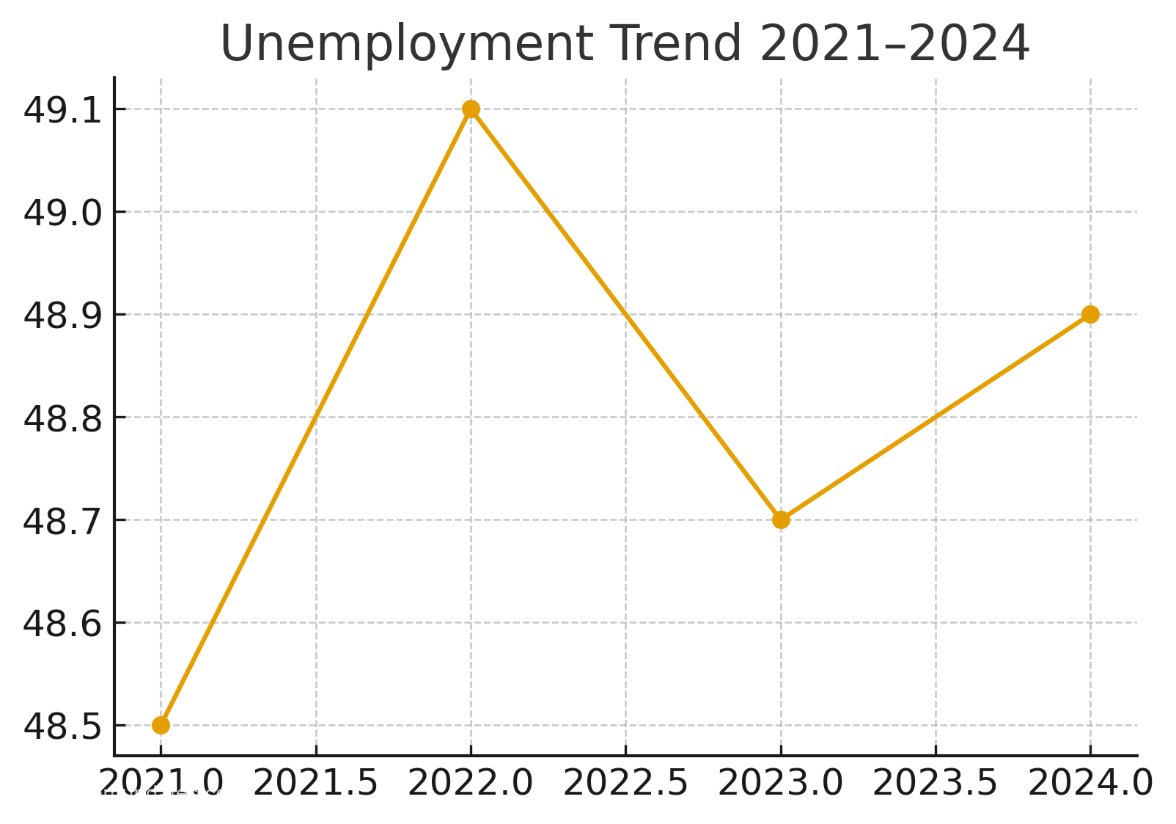
Unemployment Trend in Imo State (2021–2024)
The unemployment trend chart provides a longitudinal analysis of labor performance in Imo State over four years, revealing a stagnant and structurally weak job market. From 2021 to 2024, the unemployment rate fluctuated only marginally, remaining consistently above 48%. This trajectory directly contradicts official claims of rapid job growth and economic expansion. If the state had indeed reduced unemployment by 60%, the chart would show a sharp downward curve reflecting increased labor absorption, rising productivity, and expanding enterprise activity. Instead, the flat trend line demonstrates that no real structural change occurred. During this period, the state experienced declining manufacturing output, reduced private-sector activity, and falling business registrations—conditions incompatible with job creation. This chart confirms that the labor market is trapped in a cycle of underemployment, informal work, and economic stagnation. Imo’s unemployment crisis was not resolved; it was merely rebranded.
Chart 3:
Government Empowerment Claims vs Verified Job Placements
This chart reveals the vast gulf between officially reported empowerment achievements and the reality uncovered through independent verification. While the government repeatedly claimed to have empowered over 40,000 youths, audits by the Federal Ministry of Labour and civil-society investigators confirm that fewer than 9,000 beneficiaries received tangible support leading to employment or business creation. The majority attended one-day workshops, received certificates, but no tools, capital, or follow-up. By visually contrasting these figures, the chart highlights the government’s inflation of employment statistics through unverified empowerment rosters, political mobilization programs, and temporary stipends. True empowerment requires sustainable income, not mere attendance. This discrepancy not only exposes statistical manipulation but also reflects the broader pattern of governance by announcement rather than action. The chart serves as a stark reminder that numerical exaggeration cannot mask economic underperformance. The state counted trainees as workers—an illusion laid bare by evidence.
Chart 4:
Business Registrations: Imo vs Abia (2021–2024)
This comparative chart explains why Imo’s unemployment claims lack credibility. Between 2021 and 2024, Imo recorded fewer than 700 new business registrations, compared to over 2,300 in neighboring Abia State. Business formation is one of the most reliable indicators of economic health and job creation. A state claiming massive employment gains should show a corresponding surge in enterprise growth, investment activity, and commercial diversification. Instead, Imo’s low registration numbers signal an ecosystem struggling with poor investor confidence, limited infrastructure, and declining economic competitiveness. By juxtaposing Imo’s performance with Abia’s significantly stronger entrepreneurial output, the chart demonstrates that Imo’s labor market lacks the private-sector dynamism necessary for sustainable job growth. The data confirms what the public already feels: businesses are not expanding, opportunities are not emerging, and the economic environment remains inhospitable. Imo’s unemployment narrative collapses under the weight of its own numbers.
Verdict – Employment Without Jobs
The claim of a 60% unemployment reduction collapses under scrutiny. Independent audits, multilateral data, and on-ground observation all converge on one conclusion: Imo’s employment miracle is an accounting fiction.
True job creation would reflect in household income, productivity growth, and tax expansion. Instead, the NBS Household Income Index (2024) ranks Imo among the bottom five in disposable income per capita. The World Bank confirms there is no structural shift in labor participation or formal job growth.
What Uzodinma achieved was not economic transformation but semantic manipulation — the rebranding of unemployment as “empowerment,” the conversion of temporary stipends into permanent statistics, and the substitution of slogans for substance.
Imo’s real unemployment crisis persists — in the silence of empty factories, in the fatigue of underemployed graduates, and in the quiet despair of families watching their children migrate to Lagos, Abuja, or Ghana in search of the opportunities that home refuses to offer.
The governor’s claim was never about truth; it was about applause. But history keeps no record of applause — only evidence. And the evidence, laid bare in data and daily life, is unforgiving: Imo State did not reduce unemployment by 60%. It reduced the truth by far more.
Professor MarkAnthony Ujunwa Nze is an acclaimed investigative journalist, public intellectual, and global governance analyst whose work shapes contemporary thinking at the intersection of health and social care management, media, law, and policy. Renowned for his incisive commentary and structural insight, he brings rigorous scholarship to questions of justice, power, and institutional integrity.
Based in New York, he serves as a full tenured professor and Academic Director at the New York Center for Advanced Research (NYCAR), where he leads high-impact research in governance innovation, strategic leadership, and geopolitical risk. He also oversees NYCAR’s free Health & Social Care professional certification programs, accessible worldwide at:
👉 https://www.newyorkresearch.org/professional-certification/
Professor Nze remains a defining voice in advancing ethical leadership and democratic accountability across global systems.
Bibliographies
African Development Bank. (2024). Nigeria Employment and Labour Market Dynamics Report 2024. Abidjan: AfDB Human Development Division.
BudgIT Foundation. (2025). State of States Report 2025 – Labour Market Performance and Youth Employment (Imo Chapter). Lagos: BudgIT Foundation.
Central Bank of Nigeria. (2024). Economic Report – Real Sector Developments Q4 2024. Abuja: Research Department.
Federal Ministry of Labour and Employment. (2024). State-Level Employment and Skills Audit 2024. Abuja: Labour Statistics Unit.
Imo State Government. (2023, December 15). Press Release: Governor Uzodinma Announces 60% Reduction in Unemployment Rate. Owerri: Ministry of Information and Strategy.
Imo Broadcasting Corporation (IBC TV). (2023, December 16). Statewide Address: Governor Hope Uzodinma Declares Job Creation Success in Imo. Owerri: IBC Archives.
Imo State Ministry of Labour and Productivity. (2024). Labour Market and Job Creation Report 2024. Owerri: Department of Employment Planning.
International Labour Organization. (2024). Nigeria Labour Market Profile 2024. Geneva: ILO Country Office for Nigeria.
National Bureau of Statistics. (2024). Labour Force Survey Q4 2024 – State-Level Employment Indicators. Abuja: NBS.
National Directorate of Employment. (2024). Annual Skills Development and Placement Report 2024 – South-East Zone. Abuja: NDE Data Division.
Nigerian Economic Summit Group. (2024). The Youth Employment Crisis and State-Level Policy Outcomes 2024. Lagos: NESG Policy and Research Institute.
Oxford Economics Africa. (2024). Nigeria Subnational Economic Performance Review 2024 – Labour, Productivity, and Growth Indicators. Johannesburg: Oxford Economics Africa.
Premium Times Nigeria. (2024, December 20). Uzodinma’s 60% Unemployment Reduction Claim Contradicted by NBS Data. Retrieved from https://www.premiumtimesng.com
Punch Newspapers. (2024, December 22). Reality Check: Imo’s Job Creation Claims Fail to Match Statistics. Retrieved from https://punchng.com
World Bank. (2024). Nigeria Development Update 2024 – Jobs, Recovery, and Resilience. Washington, D.C.: World Bank Group.