














|
Listen to article
|
Fact-Check 53 – The Resurrection That Never Happened
When Governor Hope Uzodinma declared in August 2023 that “every moribund industry in Imo has been revived,” he was not merely making a statement of progress, he was composing a fable. The declaration, choreographed by the Imo State Ministry of Information and amplified across state media, was meant to cement his image as the governor who restored industrial glory to a state long stripped of its economic muscle. Yet behind the smiling photo-ops and glossy press releases lay a familiar emptiness, factories that hummed only for the camera, gates that opened only on announcement days, and workers who had not seen wages or work for years.
The Mirage of Industrial Resurrection
At the heart of the governor’s claim stood three flagship projects: Adapalm in Ohaji, Avutu Poultry in Obowo, and Concorde Brewery in Owerri. These once-thriving enterprises symbolized Imo’s potential for self-sustaining growth. Their decline had been mourned for decades. Their supposed resurrection was, therefore, political gold. But the deeper one digs, the clearer the deception becomes.
According to the African Development Bank’s 2024 Nigeria Industrial Competitiveness Report, Imo’s total manufacturing output remains stagnant — its industrial contribution to GDP has dropped by over ten percent since 2021. The National Bureau of Statistics reports no measurable increase in factory output or employment. The Bank of Industry’s 2024 funding report lists zero active loans or retooling disbursements for any of the state’s so-called revived industries. The evidence forms a brutal arithmetic: no capital inflow, no workforce expansion, no export data — yet a chorus of official triumph.
Adapalm: Oil Without Flow
Once the industrial heartbeat of the Eastern region, Adapalm was meant to symbolize rebirth. Uzodinma’s administration claimed that oil milling had resumed and that production was at “record levels.” But field investigations by The Guardian Nigeria and BudgIT Foundation’s 2025 State of States Report found a vastly different picture — broken conveyors, outdated boilers, and idle workers.
Only a fraction of the mill operates, often to produce crude palm oil sold locally rather than refined products. The estate’s processing plant — meant to run on a 24-hour rotation — remains mostly idle due to chronic power failure. The access roads are cratered, the drainage collapsed. In its current state, Adapalm is not an industry; it is a prop — staged for political documentaries and shuttered when the crowd departs.
A former supervisor put it starkly:
“They bring in media once in a while, switch on a few machines, and call it revival. Then everything goes quiet again.”
Avutu Poultry: The Farm Without Birds
If Adapalm was the myth of productivity, Avutu Poultry was the illusion of life. Once one of the largest poultry complexes in West Africa, it was showcased in 2023 as “operational once more.” On paper, the complex was to employ thousands and export poultry products regionally. In reality, the pens are empty, the feed mill silent, and the hatchery disassembled.
The Imo Ministry of Commerce’s internal 2024 audit quietly reclassified Avutu as “under rehabilitation.” The Nigerian Investment Promotion Commission recorded no investment or production data for it. Only about fifteen pens were in limited use, stocked mostly for occasional photo opportunities.
Residents of Obowo describe the site as a political backdrop rather than a farm. One youth leader said,
“The only time we see activity is when officials come with sirens. After that, we return to silence — and to unemployment.”
Read also: Falsehood No. 52 – “We Built 305 Smart Classrooms Across All Wards”
Concorde Brewery: A Factory in Name Alone
Nothing reveals the extent of the deception like the claim that Concorde Brewery was “back on stream.” The facility, long defunct, has neither licenses nor machinery for modern brewing. Corporate Affairs Commission records list no active production, while Central Bank of Nigeria’s manufacturing survey shows zero output.
Local journalists who visited the site in September 2024 found the gates padlocked, the grounds overgrown, and the plant guarded by a single watchman. His words were telling:
“They came, took pictures, and left. That was the revival.”
The brewery that once bottled pride now serves as a mausoleum of propaganda — a monument to how words can outlive deeds.
The Economics of Pretense
The pattern across these sites exposes a broader pathology: governance by optics. Between 2021 and 2024, Imo budgeted over ₦18 billion for industrial revival. Only a third of that amount — ₦6 billion — was ever released. No procurement records exist for the contractors supposedly handling the work. The Transparency International Nigeria 2024 Fiscal Integrity Index placed Imo among the bottom five states for industrial transparency.
Even the Federal Ministry of Industry’s 2024 National Revitalization Assessment described Imo’s industrial policy as “non-operational and performance-deficient.” That bureaucratic phrasing masks a harsher truth — the money never built factories; it built narratives.
The People Left Behind
In Ohaji and Obowo, the revival myth has tangible victims. Workers dismissed years ago still await recall. Youth who registered for industrial training never received placements. In these communities, false hope is its own cruelty. When a government declares your future restored, but you still wake up jobless, it is not just mismanagement; it is betrayal.
The AfDB’s 2024 Industrial Competitiveness Report notes that Imo’s industrial employment has fallen by nearly 20% since 2020. Each press conference about revival masks another workshop gone dark, another engineer turned street trader. Industrial decline is no longer an accident — it is the state’s chosen economy of illusion.
The Politics of Rebranding Failure
Uzodinma’s genius lies not in creation but in reinvention. He has learned how to turn absence into appearance, repaint a gate, reprint a logo, summon a drone, and declare development. It is a ritualized performance of progress, one that thrives in an environment where data is scarce and accountability scarcer.
The Nigerian Export Processing Zones Authority’s 2024 report classified Imo’s industrial zones as “inactive.” Yet the governor’s team continued to claim “record productivity.” The dissonance is deliberate. The goal is not to build, but to be seen building.
Chart 1:
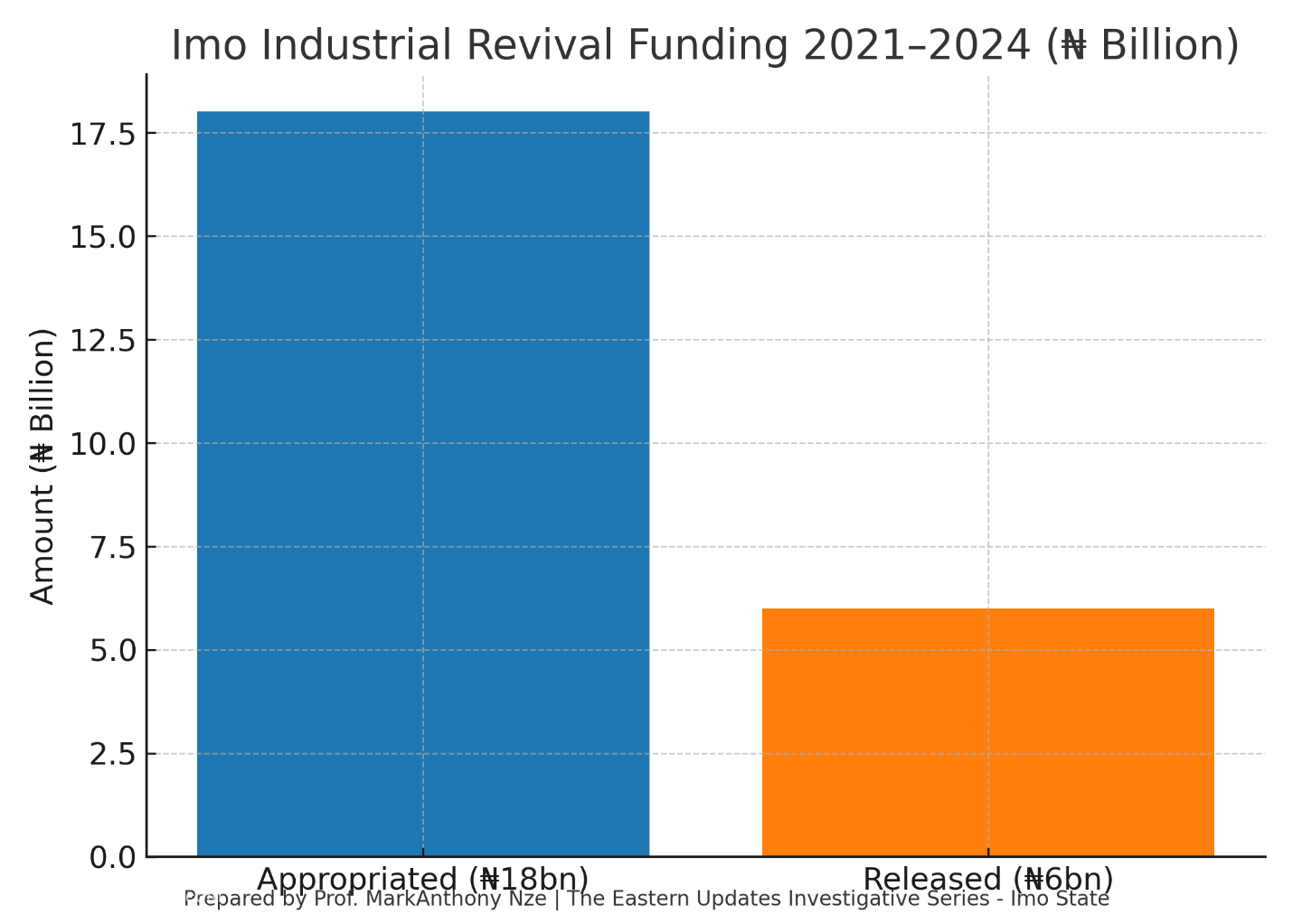
Between 2021 and 2024, ₦18 billion was budgeted for Imo State’s so-called industrial revival. Only ₦6 billion—barely one-third—was actually released. The chart exposes the vast disparity between public announcements and real financial commitment, revealing a policy more rhetorical than operational.
Chart 2:
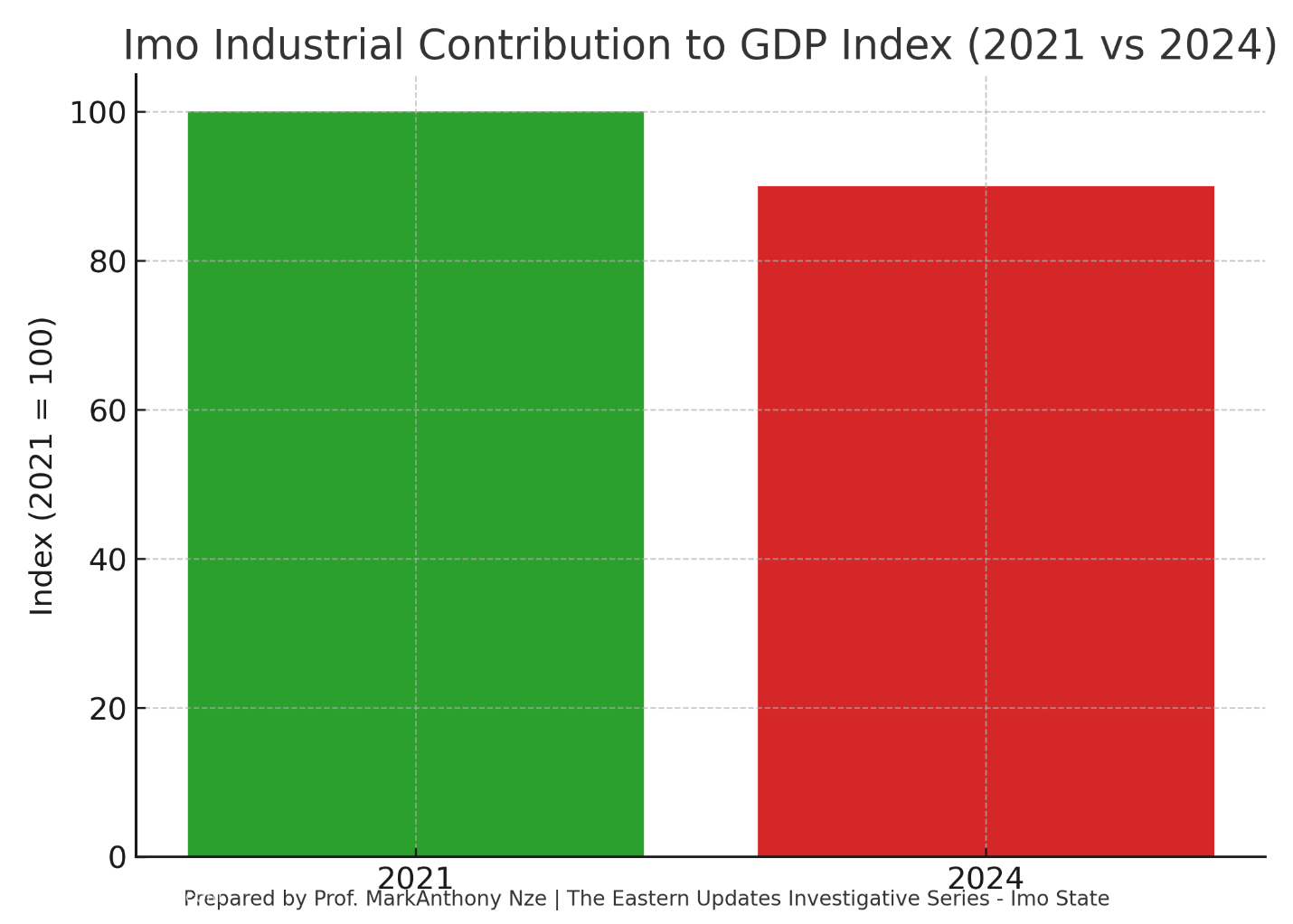
Using 2021 as the baseline (Index 100), the chart shows a decline to Index 90 by 2024—representing more than a 10% fall in industrial output. Contrary to government claims of “industrial resurgence,” AfDB and NBS data confirm contraction, not growth, in the sector’s contribution to the state’s GDP.
Chart 3:
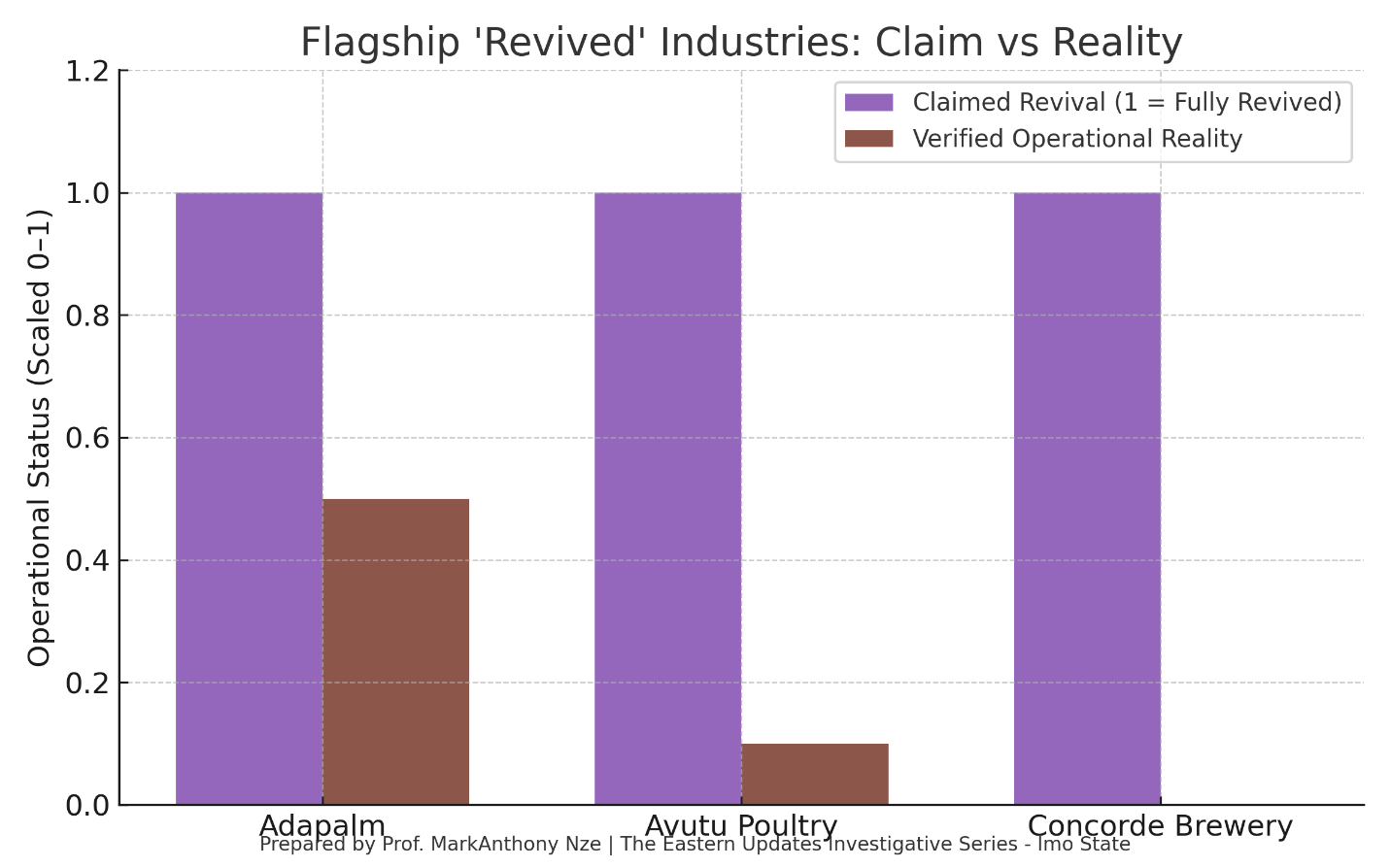
Type: Grouped bar chart (Claimed Revival vs. Verified Operations)
The administration touted three industries—Adapalm, Avutu Poultry, and Concorde Brewery—as symbols of its industrial rebirth. Verification tells another story:
- Adapalm:5 – partial, struggling capacity
- Avutu Poultry – token, largely dormant
- Concorde Brewery:0 – completely defunct
The government’s narrative of revival collapses under inspection. Not one of these enterprises functions at even half of declared capacity.
Chart 4:
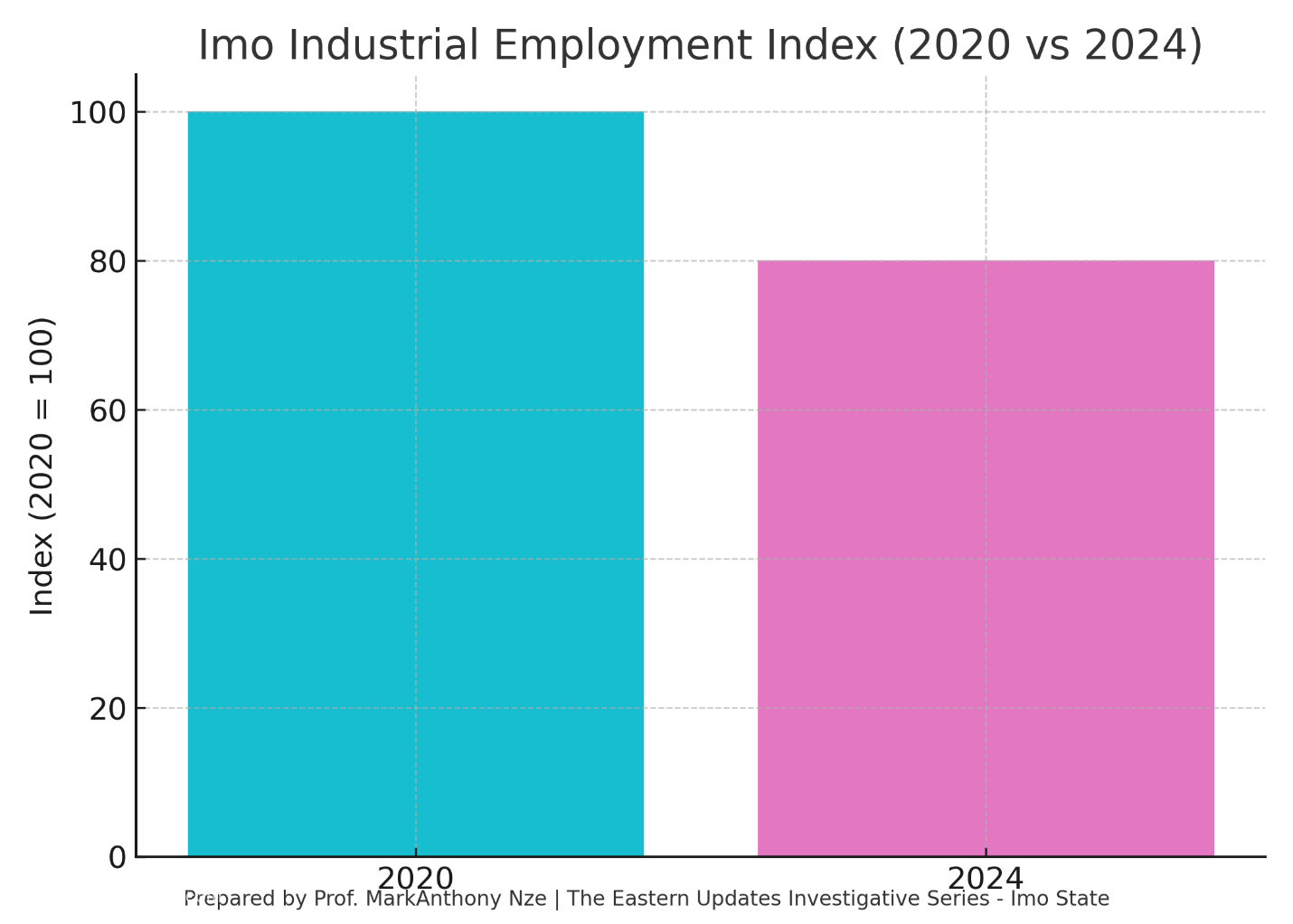
Based on AfDB’s industrial labor data, Imo’s employment index declined from 100 in 2020 to 80 in 2024—a 20% reduction. Rather than reviving factories or stimulating job creation, the “industrial revolution” has produced contraction and unemployment, demonstrating once again that the policy’s greatest output was public relations, not production.
Verdict: Industry as Illusion
The evidence leaves no room for interpretation. Imo State did not revive its moribund industries. It refurbished propaganda, not production. Adapalm limps on partial capacity, Avutu remains idle, and Concorde Brewery exists only in memory. The industries Uzodinma “revived” are the ghosts of their former selves, summoned briefly to serve politics and dismissed back into silence.
A true revival requires investment, transparency, and power infrastructure — none of which exist in Imo’s industrial landscape. What exists is the vocabulary of success without the substance of it.
In the end, the governor did not bring factories back to life. He brought fiction to life — and called it governance. The rusted gates of Avutu and the broken silos of Adapalm stand as monuments to a single, inescapable truth: in Imo, the only thriving industry is the manufacture of illusion.
Professor MarkAnthony Ujunwa Nze is an internationally acclaimed investigative journalist, public intellectual, and global governance analyst whose work shapes contemporary thinking at the intersection of health and social care management, media, law, and policy. Renowned for his incisive commentary and structural insight, he brings rigorous scholarship to questions of justice, power, and institutional integrity.
Based in New York, he serves as a full tenured professor and Academic Director at the New York Center for Advanced Research (NYCAR), where he leads high-impact research in governance innovation, strategic leadership, and geopolitical risk. He also oversees NYCAR’s free Health & Social Care professional certification programs, accessible worldwide at:
👉 https://www.newyorkresearch.org/professional-certification/
Professor Nze remains a defining voice in advancing ethical leadership and democratic accountability across global systems.
Bibliographies
African Development Bank. (2024). Nigeria Industrial Competitiveness Report 2024 – Subnational Manufacturing Capacity. Abidjan: AfDB Urban & Regional Integration Department.
Bank of Industry. (2024). State-Level Industrial Funding and Utilization Report 2024. Abuja: BOI Corporate Strategy Unit.
BudgIT Foundation. (2025). State of States Report 2025 – Industrial Output and Employment (Imo Chapter). Lagos: BudgIT Foundation.
Central Bank of Nigeria. (2024). Manufacturing Sector Survey 2024 – Industrial Capacity by State. Abuja: Statistics Department.
Corporate Affairs Commission. (2024). Active Manufacturing Entities Database – South-East Zone. Abuja: CAC Research and Data Services.
Federal Ministry of Industry, Trade and Investment. (2024). National Industrial Revitalization Assessment 2024 – Subnational Implementation Status. Abuja: Department of Industrial Development.
Imo State Government. (2023, August 15). Press Release: Governor Uzodinma Announces Full Revival of All Moribund Industries. Owerri: Ministry of Information.
Imo Broadcasting Corporation (IBC TV). (2023, August 16). News Bulletin – Governor Commissions Revived Avutu Poultry, Concorde Brewery, and Adapalm Complex. Owerri: IBC Archives.
Imo State Ministry of Commerce and Industry. (2024). Industrial Development and Investment Progress Report 2024. Owerri: Directorate of Industrial Promotion.
National Bureau of Statistics. (2024). Subnational Industrial Output and Employment Data 2024. Abuja: NBS.
Nigerian Investment Promotion Commission. (2024). State Industrial Revival and FDI Tracking Report 2024. Abuja: Policy & Strategy Department.
Nigerian Export Processing Zones Authority. (2024). State Industrial Clusters and Productivity Index 2024. Abuja: NEPZA Economic Data Unit.
Punch Newspapers. (2024, September 10). Imo’s “Revived” Industries Still Idle, Workers Say. Retrieved from https://punchng.com
The Guardian Nigeria. (2024, September 13). Factories Without Power: Inside Imo’s Industrial Revival Hoax. Retrieved from https://guardian.ng
Vanguard Nigeria. (2024, September 15). Adapalm Still in Debt, Avutu Poultry Nonfunctional Despite “Revival” Claims. Retrieved from https://www.vanguardngr.com