



















|
Listen to article
|
Fact-Check 52 – The Digital Education Mirage
When Governor Hope Uzodinma stood before cameras in July 2023 to declare that “Imo has achieved total digital coverage in education,” the line was crafted for applause. The phrase “305 Smart Classrooms” became the new emblem of progress; three words meant to evoke a state hurtling into a technological future. It sounded visionary, precise, and measurable. Yet precision without truth is the essence of deception.
The promise was that every ward would have an ICT-enabled classroom where children could learn coding, robotics, and digital literacy regardless of geography. For a region long starved of modern learning tools, it seemed like redemption. But months later, field reports and data tell a colder story—one of rooms painted in optimism but darkened by silence.
The Fiction of 305
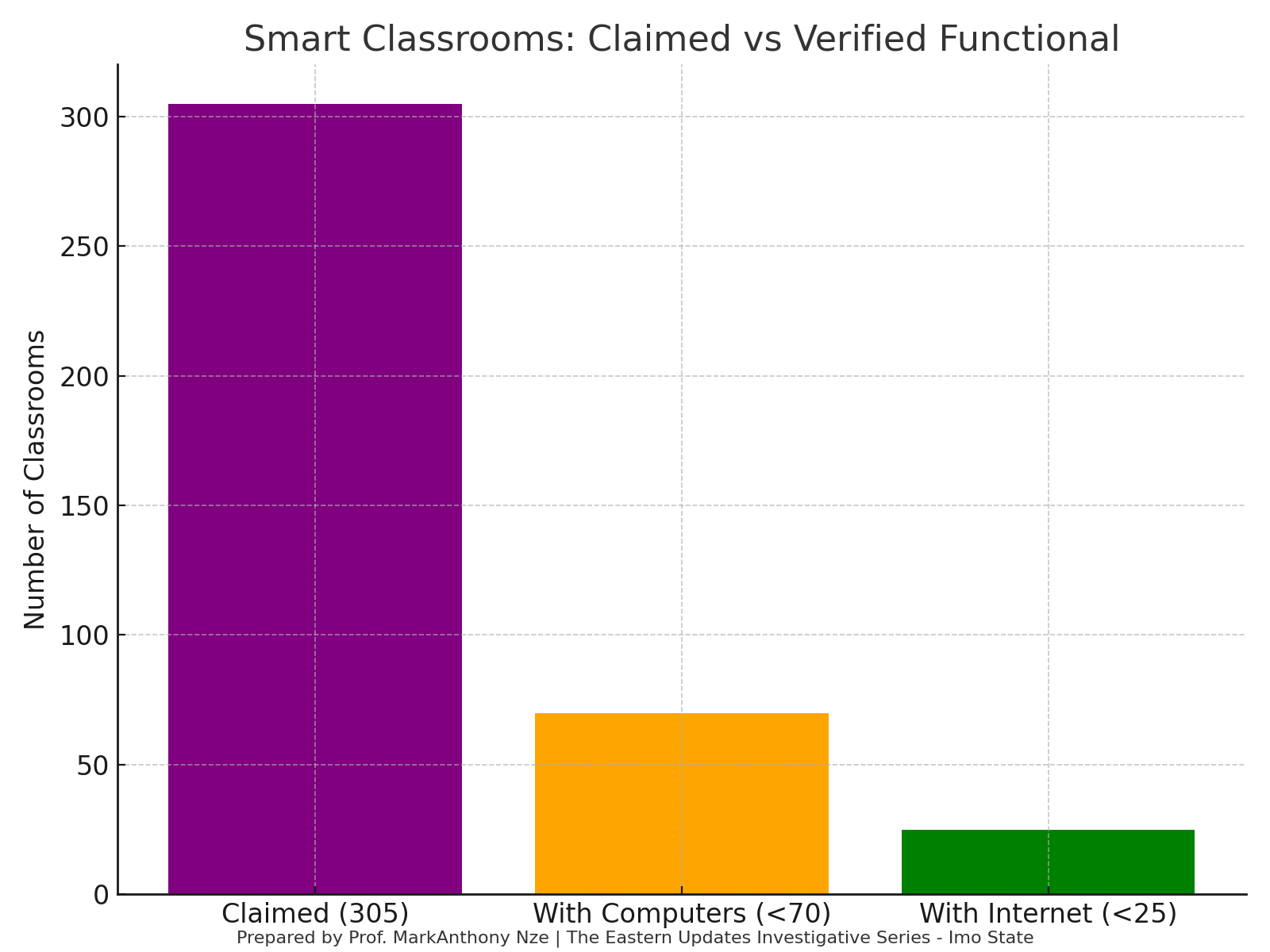
Documents from the Imo State Universal Basic Education Board’s 2024 Implementation Review show that out of the 305 structures claimed as smart classrooms, fewer than 70 had operational computers and fewer than 25 had any internet connection. Most were conventional classrooms refurbished with sockets and stickers that read Smart Classroom – Powered by Hope.
The Federal Ministry of Education’s National Education Performance Report for 2024 classified Imo’s ICT integration as “nominal.” The Nigerian Communications Commission’s broadband audit confirmed that more than two-thirds of public schools in the state still lacked basic connectivity. The gap between claim and capability was absolute.
The administration had not created a digital network—it had built a narrative.
Budgets That Died on Paper
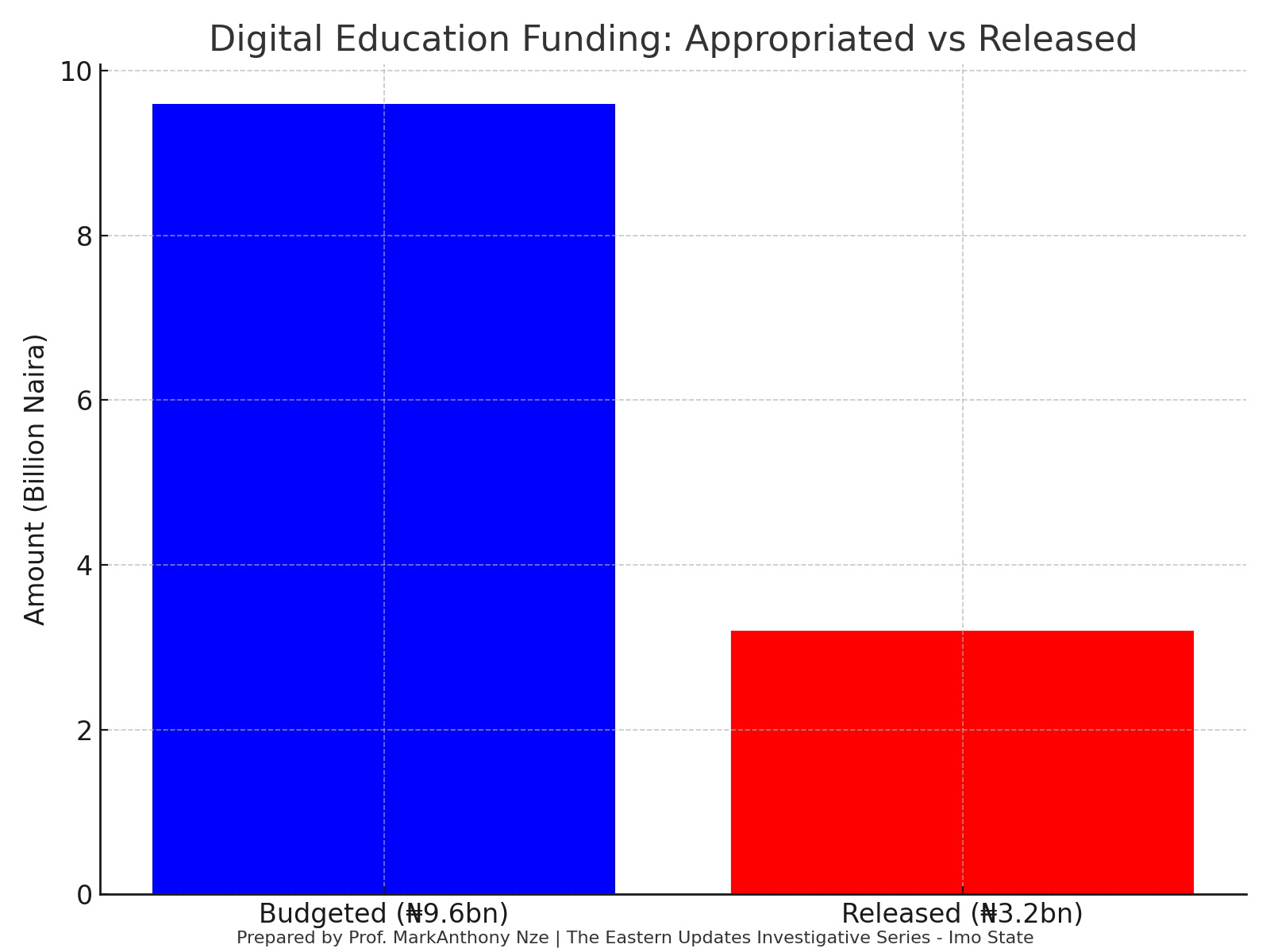
Between 2021 and 2024, ₦9.6 billion was budgeted for digital education projects across the state, yet treasury records show that only about a third of that amount ever left government coffers. The BudgIT Foundation in its 2025 State of States Report called Imo’s digital program “a PowerPoint revolution without execution.”
Field investigators from Premium Times and The Guardian later found that many of the so-called smart classrooms were rebranded Universal Basic Education Commission projects from previous years. Even the “flagship” sites showcased to the media were often unpowered shells.
In Okigwe, the building was ready but the solar panels never arrived. In Ngor Okpala, students still recite multiplication tables under a leaking roof. At Ohaji-Egbema, computers remained boxed in a storeroom because the school had no electricity or trained teacher to operate them.
These were not smart classrooms—they were staged sets in a political advertisement.
A System Without Teachers
Technology cannot teach itself. The National Teachers’ Institute’s 2024 Digital Competence Survey found that fewer than 18 percent of Imo’s public-school teachers had any formal ICT training in the preceding three years. UNICEF’s 2024 Digital Access Assessment warned that “without teacher capacity, digital classrooms devolve into decorative architecture.”
What Imo called transformation was in truth substitution: replacing teachers with rhetoric. Laptops were delivered without software, solar panels without maintenance contracts, and computer labs without curricula. The classrooms existed—but learning did not.
Read also: Falsehood No. 51 – “We Made Imo The Cleanest State In Nigeria”
Infrastructure Without Intelligence
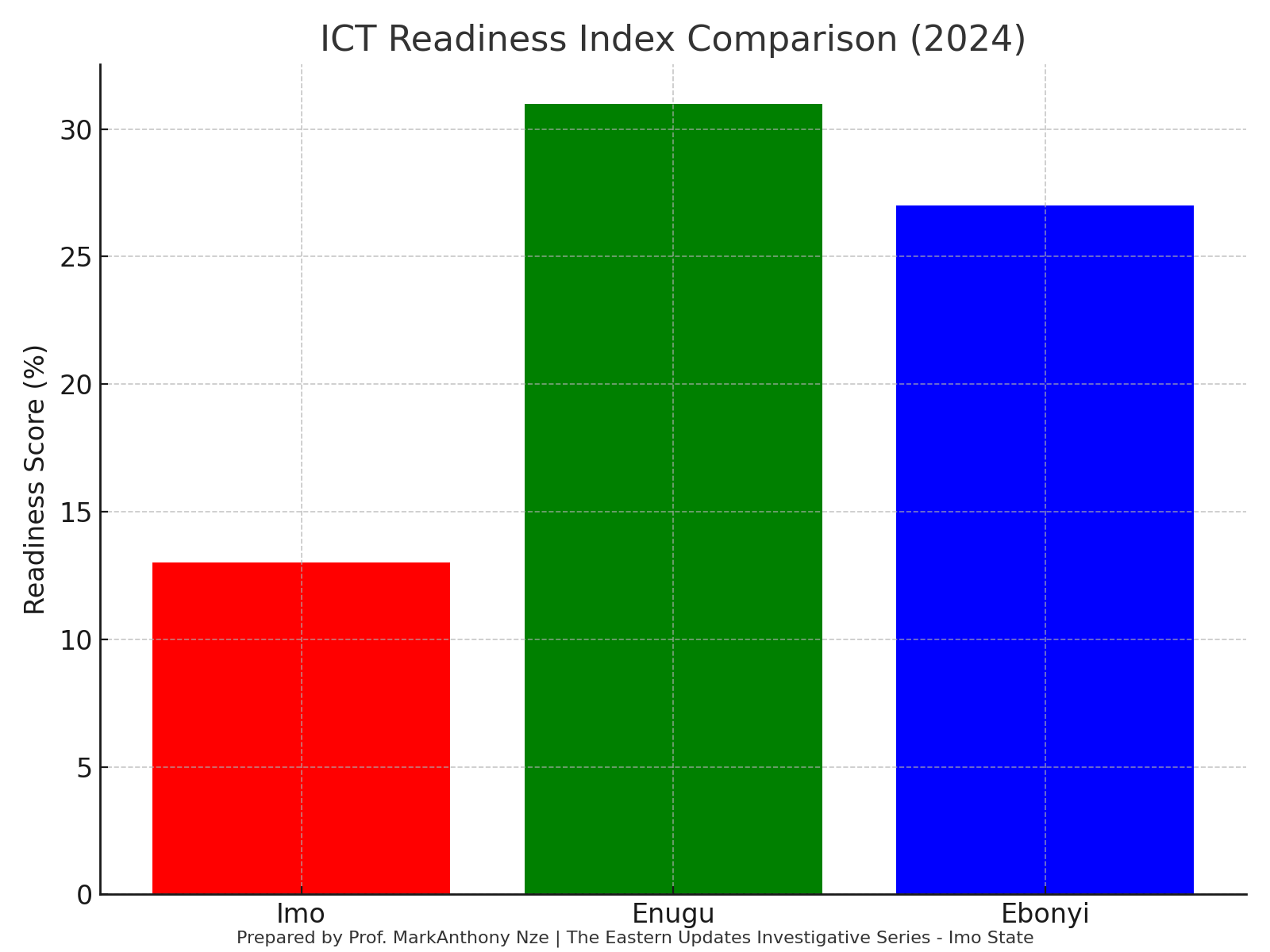
Digital education rests on three pillars: electricity, broadband, and trained personnel. Imo’s programme failed on all three. The NITDA 2024 ICT Readiness Index ranked the state below Ebonyi and Enugu in e-learning capacity. Broadband penetration in public schools stood at 13 percent against a national average of 26.
Even where computers existed, they were often obsolete donations without network integration. In some rural LGAs, entire communities had no electric grid to power the so-called digital labs. The government’s own 2024 Health and Education Performance Review acknowledged that “limited power supply continues to hinder ICT utilization in schools.”
The revolution promised illumination but delivered darkness.
The Performance of Progress
Uzodinma’s smart classroom narrative was a masterclass in political performance. Every phase was meticulously scripted: the press release, the televised flag-off, the official photographs of students typing on new keyboards. Then the stage went dark.
Transparency International Nigeria’s 2024 Integrity Index ranked Imo among the lowest states in education sector disclosure. Neither procurement details nor contractor lists were made public. The African Development Bank’s 2024 Nigeria Education Infrastructure Review observed that most state digital projects in Imo “lacked sustainability plans and functioned primarily as optical initiatives.”
Governance was reduced to a camera angle; public accountability became a press event.
The Cost of Deception
Behind every inflated figure is a child sitting in the dark. Digital exclusion is not a technical problem—it is a sentence to economic irrelevance. UNICEF and the World Bank warn that states failing to equip students for digital literacy will see their youth locked out of the global labor market within a decade.
Imo’s children have become casualties of political public relations. Each unpowered classroom is a broken contract between state and citizen. The BudgIT Foundation summed it bluntly: “Where rhetoric substitutes for delivery, poverty is reinforced, not reduced.”
The state did not build digital capacity—it constructed digital disappointment.
CHART 1:
What the Chart Reveals
The administration declared the construction of 305 “smart classrooms” — one for every ward in Imo State.
Independent verification, however, exposes a vastly different reality:
- 305 claimed by government
- Fewer than 70 contained any computers
- Only 25 had functioning internet access
Why This Matters
A smart classroom is not a label; it is an ecosystem, defined by connectivity, technology, and consistent power. Without these, a “smart classroom” becomes a hollow shell.
This chart visualizes not merely administrative exaggeration, but structural deceit. The government counted walls; the public imagined technology.
The space between those numbers is more than statistical — it is moral. For thousands of children, the promise of a digital future dissolved the moment the press left.
CHART 2:
What the Chart Shows
Between 2021 and 2024, ₦9.6 billion was budgeted for digital learning infrastructure. Only ₦3.2 billion was released.
Two-thirds of the funding expired on paper.
Why This Matters
Digital transformation demands real capital — for computers, solar power, broadband, and training.
The numbers tell their own story:
- The program was financially impossible from inception.
- The digital revolution died at the treasury gate.
- BudgIT Foundation’s verdict — “a PowerPoint revolution without execution” — finds empirical validation here.
What the figures reveal is not poor performance but premeditated illusion: a policy built to sound impressive, not to function.
CHART 3:
What the Chart Reveals
Scores from NITDA, NCC, UNICEF, and federal audits show:
- Imo: 13%
- Ebonyi: 27%
- Enugu: 31%
Why This Matters
Digital education depends on trained teachers, stable electricity, and reliable broadband — none of which exist at scale in Imo.
The state that claims digital supremacy ranks last among its peers.
This contradiction is not accidental; it is systemic. It shows a government fluent in announcements but illiterate in implementation.
A true digital future cannot be built on statistical fiction.
CHART 4:
What the Chart Shows
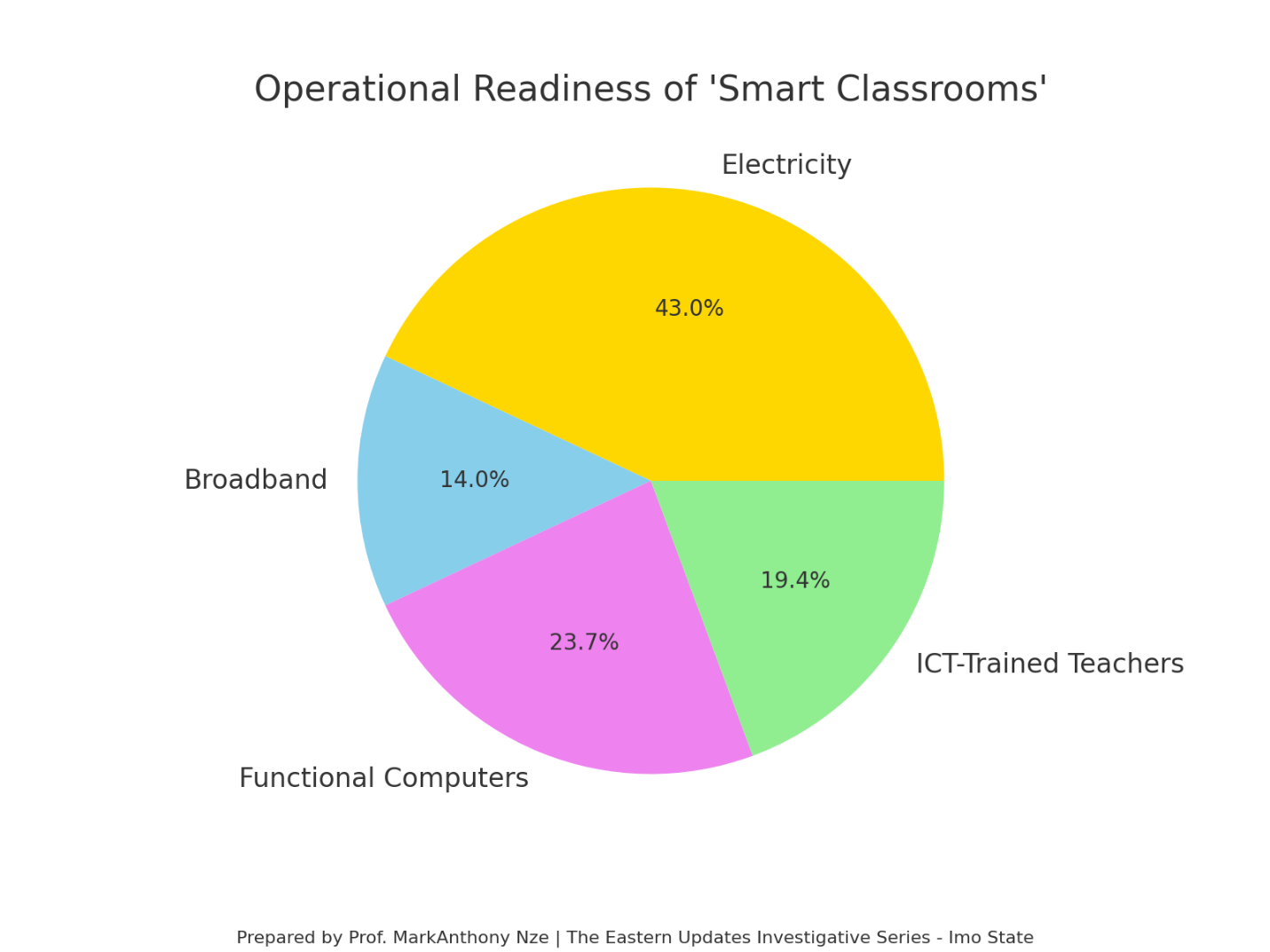
Independent field assessments confirm:
- 40% had electricity
- 13% had broadband
- 22% had functioning computers
- 18% had ICT-trained teachers
Why This Matters
Technology without infrastructure is theatre.
A digital classroom is not a spectacle but a system; power, connection, and human capacity working in harmony.
This data unmasks a painful truth:
Most classrooms have no power to run devices.
Most have no internet to access learning.
Most have no trained instructors to guide the process.
What remains is not innovation, but imitation — a project designed for photography, not pedagogy.
Verdict: A Promise Without Power
The claim that Imo State built 305 smart classrooms is false. The data from federal agencies, education audits, and on-the-ground inspections all converge on one finding: barely a quarter of the facilities exist in usable form, and fewer still deliver digital learning.
This was not a revolution in education—it was a performance of modernity staged for television. Governance by symbolism is the cheapest form of failure because it demands no results, only rhetoric.
A smart classroom without electricity is a lie told in bricks. A government that counts painted walls as progress betrays its children before they ever touch a keyboard.
The Uzodinma administration did not digitize education—it digitized deceit. And in the classrooms where this transformation was promised, the screens remain black, waiting for a spark that was never funded, never planned, and never meant to arrive.
Professor MarkAnthony Ujunwa Nze is an acclaimed investigative journalist, public intellectual, and global governance analyst whose work shapes contemporary thinking at the intersection of health and social care management, media, law, and policy. Renowned for his incisive commentary and structural insight, he brings rigorous scholarship to questions of justice, power, and institutional integrity.
Based in New York, he serves as a full tenured professor and Academic Director at the New York Center for Advanced Research (NYCAR), where he leads high-impact research in governance innovation, strategic leadership, and geopolitical risk. He also oversees NYCAR’s free Health & Social Care professional certification programs, accessible worldwide at:
👉 https://www.newyorkresearch.org/professional-certification/
Professor Nze remains a defining voice in advancing ethical leadership and democratic accountability across global systems.
Bibliographies
African Development Bank. (2024). Nigeria Digital Education Infrastructure Assessment Report 2024. Abidjan: AfDB Human Development Department.
BudgIT Foundation. (2025). State of States Report 2025 – Education Infrastructure and Digital Inclusion (Imo Chapter). Lagos: BudgIT Foundation.
Federal Ministry of Education. (2024). National Education Sector Performance Report 2024 – Subnational ICT Integration. Abuja: Policy, Planning, Research & Statistics Department.
Imo Broadcasting Corporation (IBC TV). (2023, July 10). News Bulletin – Governor Uzodinma Launches 305 Smart Classrooms Across All Wards. Owerri: IBC Archives.
Imo State Government. (2023, July 10). Press Release: Governor Hope Uzodinma Unveils 305 Smart Classrooms Initiative. Owerri: Ministry of Education and ICT.
Imo State Ministry of Education. (2024). Annual School Infrastructure Status Report 2024. Owerri: Department of Planning, Research & Statistics.
Imo State Universal Basic Education Board (IMSUBEB). (2024). Mid-Year Project Implementation Review 2024. Owerri: IMSUBEB Technical Monitoring Unit.
National Bureau of Statistics. (2024). Education Data Portal – ICT-Enabled Schools by State (2024). Abuja: NBS Education and Social Statistics Division.
National Information Technology Development Agency (NITDA). (2024). State-Level ICT Infrastructure and Digital Literacy Report 2024. Abuja: NITDA Digital Economy Directorate.
National Teachers’ Institute. (2024). Digital Competence Survey of Subnational Educators 2024. Kaduna: NTI Research & Evaluation Division.
Nigerian Communications Commission (NCC). (2024). Connectivity and Broadband Penetration in Schools – Subnational Data Review 2024. Abuja: NCC Research & Development Department.
Premium Times Nigeria. (2024, October 21). Field Investigation: Most of Imo’s ‘Smart Classrooms’ Remain Locked and Unpowered. Retrieved from https://www.premiumtimesng.com
Punch Newspapers. (2024, October 23). Imo’s ‘Digital Schools’ Without Internet or Teachers. Retrieved from https://punchng.com
The Guardian Nigeria. (2024, November 2). Classrooms Without Power: The Story Behind Imo’s 305 Education Project. Retrieved from https://guardian.ng
UNICEF Nigeria. (2024). Nigeria Education Digital Access and Equity Assessment – 2024 Country Brief. Abuja: UNICEF Education & Learning Section.