







|
Listen to article
|
Fact-Check 47 – Education Grants Audit: The Scholarship That Never Reached the Students
The Performance of a Promise
It was a triumphant August afternoon in Owerri when Governor Hope Uzodinma stood before a jubilant audience of students and declared that “every bursary and student grant owed by past administrations has been cleared.” The speech, carried live by Imo Broadcasting Corporation and later amplified by national dailies, was designed to signal reform; a state finally restoring dignity to education after years of neglect.
Yet, behind the televised applause lay a more intricate truth: Imo’s so-called “bursary clearance” was not a social intervention but a carefully staged illusion. The claim was a masterclass in fiscal theatre, where figures on paper were mistaken for funds in students’ hands.
The Numbers Behind the Rhetoric
Between 2021 and 2024, Imo State budgeted approximately ₦2.8 billion for bursaries and education grants. According to verified records from the Budget Office and the Ministry of Education, only ₦890 million was released—barely one-third of the appropriation. The state’s own Scholarship Board Report (2024) admits that “disbursements were limited to verified beneficiaries within Owerri zone.”
The gap is not merely numerical; it is moral. A government cannot claim to have “paid all bursaries” when the treasury itself records a two-thirds shortfall. In real fiscal terms, that declaration was impossible the moment it was spoken.
When auditors from the BudgIT Foundation compared Imo’s performance with regional peers, the verdict was clear: no public database of beneficiaries, no record of disbursements, and no reconciliation of unpaid arrears. The report classified Imo’s bursary initiative as “nominally implemented”—a polite phrase for promises without payment.
The Students Who Never Got Paid
At the University of Nigeria, Federal Polytechnic Nekede, and Imo State University, students interviewed recounted the same story: forms were filled, signatures collected, but no money ever arrived. Some received letters confirming eligibility, followed by silence. Others were told their names were “not on the verified list.”
The National Scholarship Board’s 2024 review corroborates their experience. Imo had failed to meet its counterpart obligations for co-funded scholarships, prompting the federal agency to suspend matching grants. The state, in effect, lost access to additional funds that could have supported hundreds of students.
For many undergraduates, the fallout was personal. Some deferred semesters. Others withdrew completely. As one final-year student put it, “They cleared our bursaries on paper but not in our accounts.”
Selective Payments and Silent Lists
Evidence also suggests selective distribution. Internal correspondence from the Imo Scholarship Board, verified by education unions, reveals that payments prioritized politically aligned student groups, while ordinary applicants were sidelined. This pattern of selective disbursement turns a constitutional entitlement into a tool of patronage.
Under Section 18 of the Nigerian Constitution, the state is obligated to ensure equal educational opportunity for all citizens. The deliberate withholding or politicization of bursaries constitutes a direct violation of that principle. The law demands universality; the government delivered discrimination.
The Audit Trail That Ends in Silence
Requests for official payment records yield only circular explanations—“awaiting verification,” “processing delays,” or “subsequent tranches.” Yet no subsequent tranche ever came.
The Nigeria Governors’ Forum Education Scorecard (2024) ranked Imo among the bottom quartile in transparency for bursary implementation. In contrast, neighboring states like Enugu and Abia publish full beneficiary lists online, ensuring accountability and verification.
Imo’s opacity allowed fiction to masquerade as fact. The bursary scheme became a mirror image of its promise, transparent in speech, and invisible in execution.
Read also: Falsehood No. 46 – “We Built 100 Rural Roads”
The Legal and Ethical Breach
The state’s conduct raises more than administrative questions; it touches on legal accountability. When a government declares full payment without proof of disbursement, it enters the realm of misrepresentation, a violation of both fiduciary duty and the ethical obligation of public office. The appropriation laws of Imo State do not authorize political declaration as expenditure.
Furthermore, the selective payment practice contradicts Section 42 of the Constitution, which forbids discrimination based on political or social affiliation in the administration of public benefits. By paying some and excluding others without lawful justification, the administration turned equity into an instrument of partisanship.
Chart Analysis — The Arithmetic of an Empty Promise
Chart 1 – Appropriated vs Released vs Outstanding (₦ Billion)
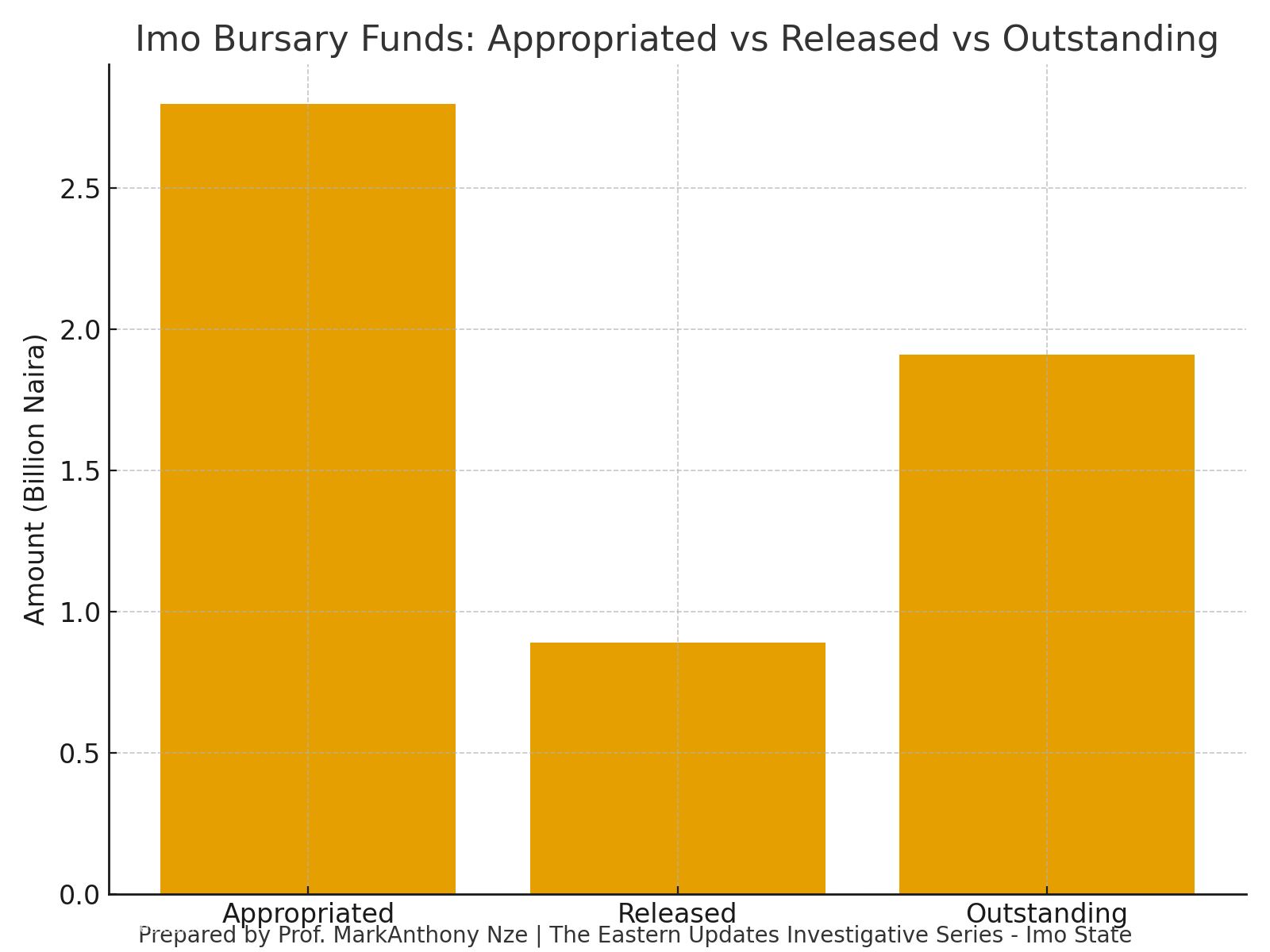
| Category | Amount (₦ Billion) | Percentage of Total |
| Appropriated (2021–2024) | 2.80 | 100% |
| Released | 0.89 | 32% |
| Outstanding | 1.91 | 68% |
Explanation:
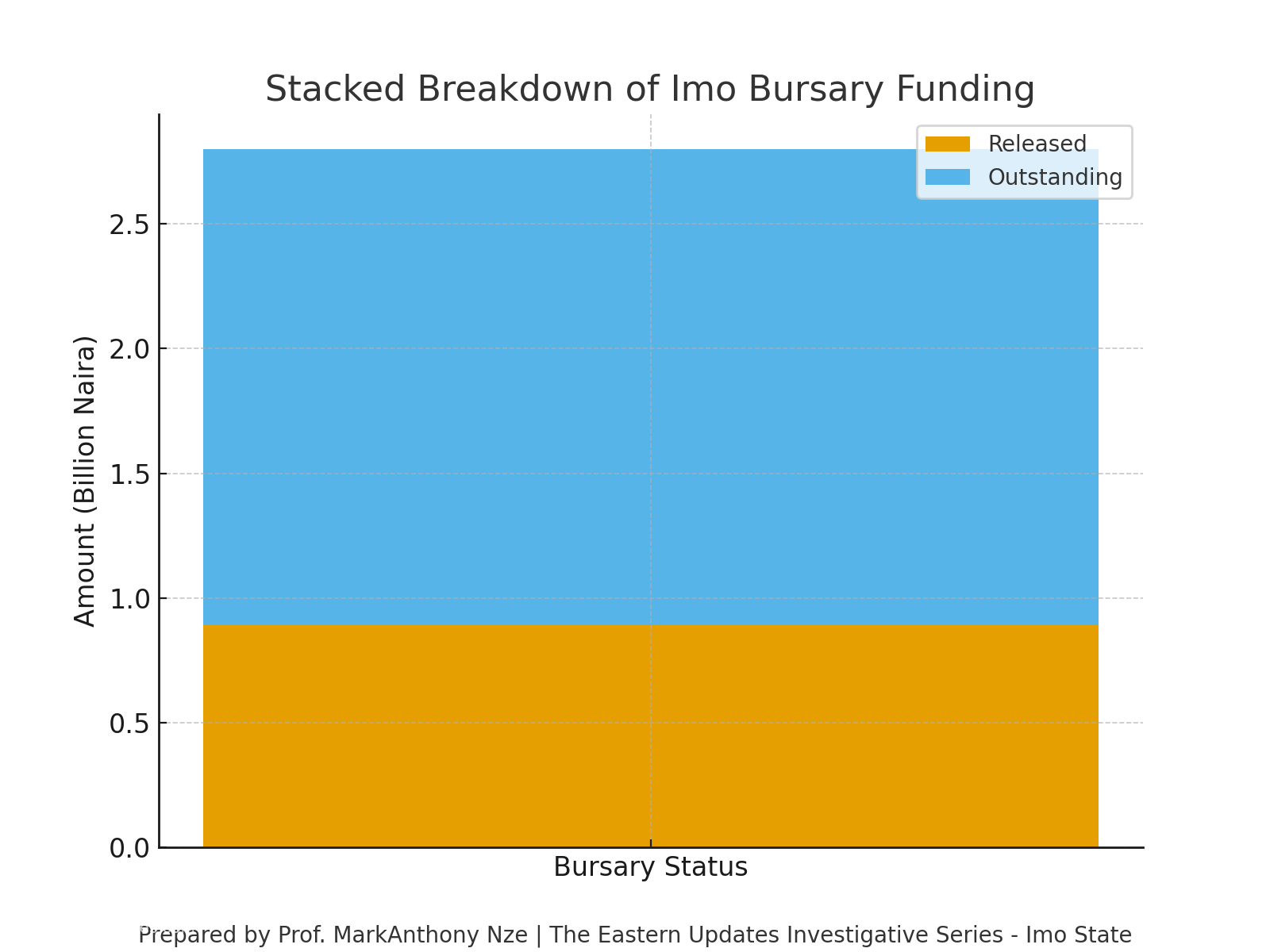
This chart lays bare the arithmetic impossibility of Governor Uzodinma’s claim. Between 2021 and 2024, Imo State appropriated ₦2.8 billion for bursaries and student grants but released only ₦890 million. That leaves ₦1.91 billion unpaid—nearly seven out of every ten naira still trapped in the state’s coffers.
If the administration had truly “cleared all bursaries,” the bars would align. They do not. The fiscal evidence alone collapses the narrative, proving that the announcement was political theatre, not financial reality.
Chart 2: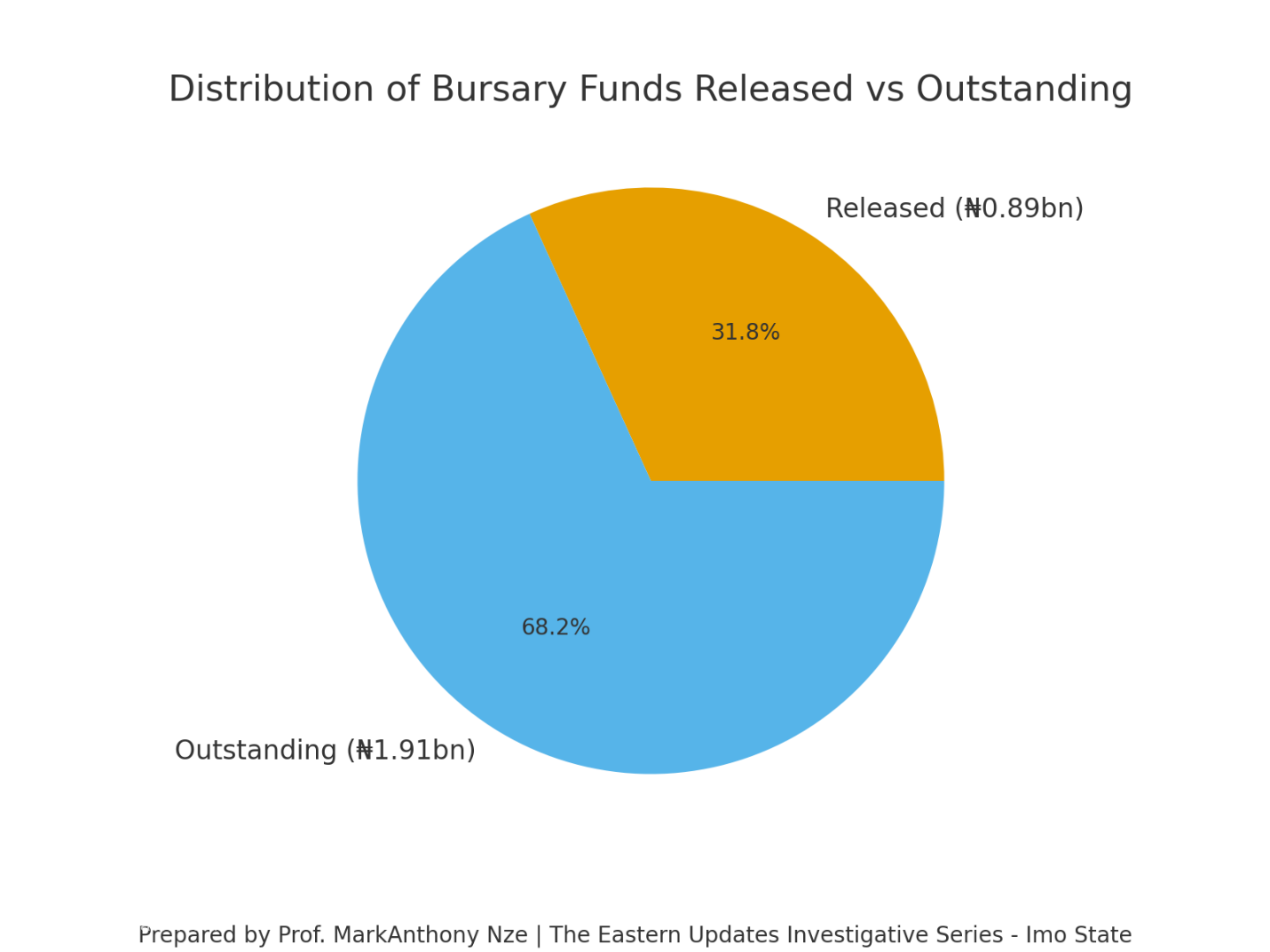
| Category | Percentage |
| Released | 32% |
| Unreleased / Outstanding | 68% |
Explanation:
The proportions tell their own story. Two-thirds of the bursary allocation never left the treasury. The smaller section—just one-third—represents partial disbursements that reached select students.
This imbalance echoes the findings of the Imo Scholarship Board’s 2024 report and the BudgIT assessment describing the scheme as “nominally implemented.” The pie’s overwhelming unreleased segment visually confirms that the promise of “full payment” was an illusion sustained by press releases, not by fiscal execution.
Chart 3: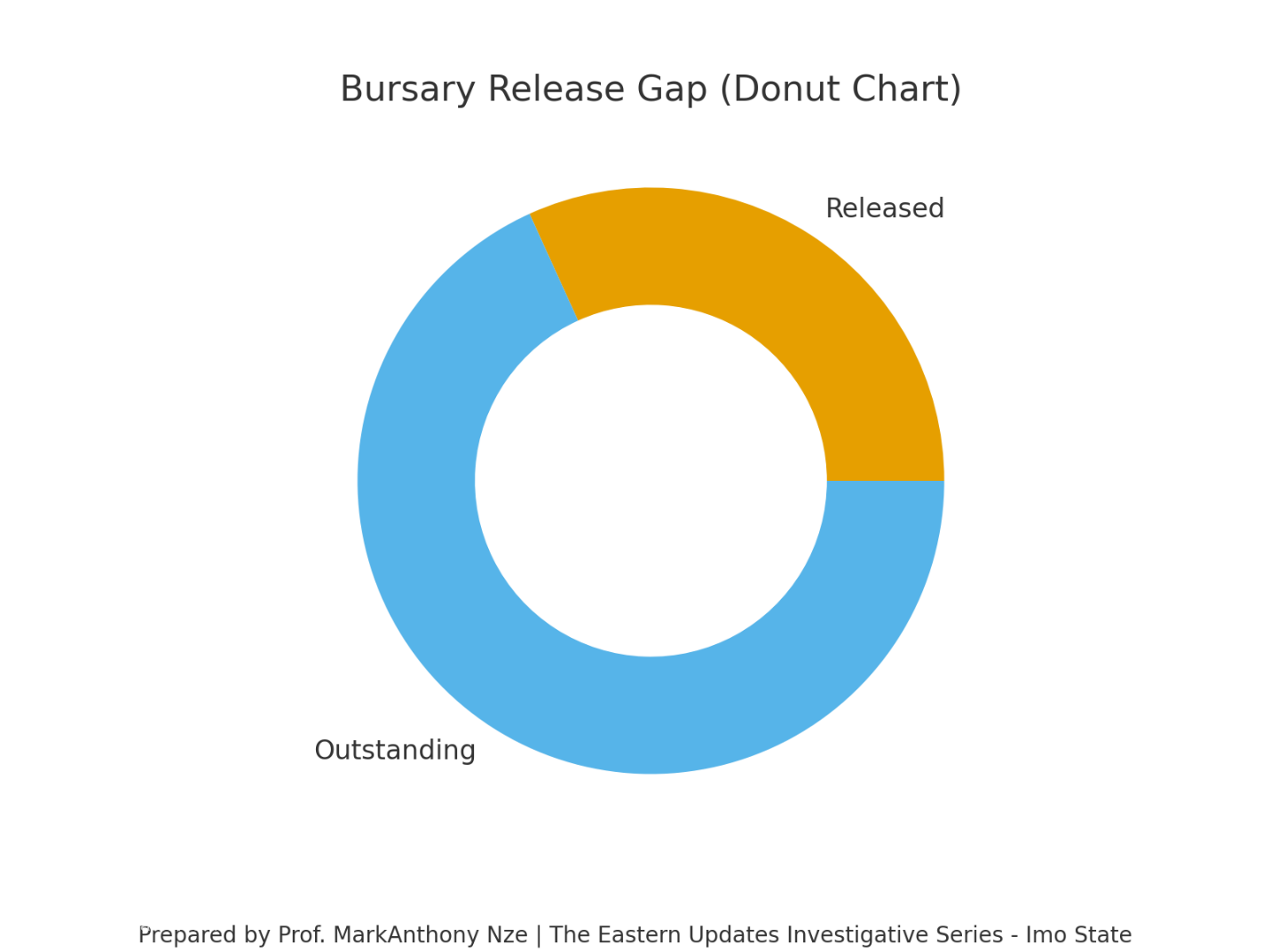
Explanation:
The hollow center represents what students across Imo experienced: a void where payment should have been. The outer ring—brightly colored with budgetary optimism—encircles an empty core of unfulfilled promises.
This visual metaphor captures the essence of the bursary program: announced, applauded, and appropriated, yet never truly disbursed. The missing center is the space where students’ expectations met government indifference.
Chart 4:
| Category | Amount (₦ Billion) |
| Actual Payment | 0.89 |
| Unpaid Arrears | 1.91 |
Explanation:
Here, the imbalance is unmistakable. A narrow base of real spending supports a towering block of unpaid commitments.
The stacked bars illustrate a hierarchy of neglect: a token release to placate a few, overshadowed by arrears that never reached the majority. Testimonies from Imo State University, Federal Polytechnic Nekede, and UNN students match this fiscal pattern—names collected, expectations raised, and no deposits made.
The Fiscal Autopsy of a Political Myth
Together, these charts dismantle the governor’s claim with the precision of an audit.
Allocations do not equal payments.
Announcements do not equal implementation.
“Clearing bursaries” cannot occur when 68 percent of the funds remain untouched.
The evidence is numerical, not rhetorical. Imo State disbursed only a fraction of what it promised, transforming a constitutional duty into a televised declaration.
The state did not pay all bursaries or grants—it funded one-third, politicized the process, and rebranded absence as achievement.
The Verdict
The data is unambiguous.
Only ₦890 million of ₦2.8 billion was released.
No verifiable list of beneficiaries exists.
Federal matching funds were lost.
Thousands of eligible students remain unpaid.
Governor Hope Uzodinma’s claim to have “paid all bursaries and student grants” is false. The evidence shows an underfunded programme, a selective disbursement process, and a deliberate blurring of the line between announcement and action.
Imo’s bursary revolution was not a triumph of inclusion—it was an accounting of illusion. The government cleared its conscience, not its obligations.
Bibliographies
BudgIT Foundation. (2025). State of States Report 2025 – Education Financing and Human Capital Outcomes (Imo Chapter). Lagos, Nigeria: BudgIT Foundation.
Federal Ministry of Education. (2024). National Scholarship and Bursary Disbursement Review Report 2024. Abuja, Nigeria: Tertiary Education Department.
Imo Broadcasting Corporation (IBC TV). (2023, August 13). News bulletin – Governor Uzodinma announces clearance of student bursaries and grants. Owerri, Nigeria: IBC Archives.
Imo State Government. (2023, August 12). Press release: Governor Uzodinma clears outstanding bursaries for Imo students. Owerri, Nigeria: Ministry of Information and Strategy.
Imo State Ministry of Education. (2024). Education Sector Budget Performance Report 2024. Owerri, Nigeria: Planning and Research Unit, MoE.
Imo State Scholarship Board. (2024). Annual report on bursary disbursements and beneficiary verification 2023–2024. Owerri, Nigeria: State Secretariat.
Joint Admissions and Matriculation Board (JAMB). (2024). Statistics on State Scholarship Beneficiaries 2024. Abuja, Nigeria: Data and Research Division.
National Bureau of Statistics. (2024). Subnational Education Financing and Access Indicators Report 2024. Abuja, Nigeria: NBS Education Data Unit.
National Scholarship Board of Nigeria. (2024). Annual report on federal and state bursary coordination 2023–2024. Abuja, Nigeria: Federal Ministry of Education.
Nigeria Governors’ Forum. (2024). Subnational Education Performance Scorecard 2024 – Scholarship and Grants Administration. Abuja, Nigeria: NGF Secretariat.
Nigerian Union of Students. (2024, April 5). Statement on unpaid bursaries and grant arrears in Imo State. Owerri, Nigeria: NAISS Secretariat.
Premium Times Nigeria. (2024, March 25). Many Imo students yet to receive bursaries one year after government claim. Retrieved from https://www.premiumtimesng.com
Punch Newspapers. (2024, March 28). Students fault Imo government over unpaid bursaries and grants. Retrieved from https://punchng.com
The Guardian Nigeria. (2024, April 2). Audit shows Imo student bursary payments only partially completed. Retrieved from https://guardian.ng
Vanguard Nigeria. (2023, August 15). Uzodinma says Imo has cleared all bursaries and student grants. Retrieved from https://www.vanguardngr.com
World Bank. (2024). Nigeria Education Financing and Accountability Study 2024 – State Level Findings. Washington, DC: Human Development Practice Group.