|
Listen to article
|
Fact-Check 46 – Rural Road Verification
The promise was audacious, the optics theatrical.
On a humid August afternoon in 2023, Governor Hope Uzodinma stood before bulldozers and cameras at a freshly graded patch of earth outside Owerri and declared that “Imo has entered a new age of rural connectivity.”
He announced the construction of 100 rural roads, described as “complete, accessible, and transformative.” The press release from the Ministry of Information called it “the most ambitious infrastructure rollout in South-East history.”
Yet two years later, a drive through the same corridors exposes a state still trapped between declaration and delivery. The roads, like the rhetoric, exist mostly in imagination.
The Arithmetic of Fiction
Government documents tell their own story. Between 2021 and 2024, Imo State budgeted ₦78.5 billion for rural and feeder roads. Less than ₦26.3 billion was released. The figures come directly from the BudgIT State of States 2025 report and the 2024 Mid-Year Fiscal Performance Review.
At current construction benchmarks set by the Federal Ministry of Works, that released amount could fund about thirty short asphalt roads. But one hundred? Not even close.
In infrastructure, mathematics has no patience for exaggeration.
What the Ground Shows
Verification exercises by the Infrastructure Transparency Initiative and the Federal Ministry of Works Condition Assessment mapped just 27 of the 100 projects with visible work. Of these, 11 roads were fully asphalted. The rest were graded laterite or, at best, compacted earth lined with temporary signboards declaring “Governor’s Signature Project.”
Satellite imagery captured by the World Bank’s RAAMP Programme adds visual confirmation: long stretches in Ihitte-Uboma, Njaba, and Oguta are still red clay, punctuated by half-finished culverts.
A contractor in Ngor Okpala described the system candidly: “They paid for two kilometers, then sent cameras to cover ten.”
The illusion was complete, even if the roads were not.
The Bureaucracy of Appearance
The façade was sustained by semantics. In interviews, officials from the Imo Ministry of Works explained that “completion” includes any road whose contract has been awarded or mobilized.
In one sentence, the dictionary was rewritten: a road could now be simultaneously unfinished and complete.
That linguistic gymnastics became the foundation of policy. Roads were inaugurated at the grading stage, recommissioned after drainage work, and sometimes counted twice across budget cycles. The CoST/InfraNG audit confirmed that fewer than 40 percent of road contracts in Imo had public documentation or completion certificates.
When transparency collapses, narrative becomes governance.
The Distance Between Announcements and Asphalt
The National Bureau of Statistics Transport Infrastructure Index (2024) shows that rural accessibility in Imo improved by only 6.4 percent between 2021 and 2024. Ebonyi, by comparison, recorded 18 percent within the same period.
The Nigeria Governors’ Forum Infrastructure Scorecard ranks Imo 29th out of 36 states in road completion ratio.
The African Development Bank’s Subnational Infrastructure Review 2024 concludes bluntly: “Declared completions in Imo State exceed verifiable mileage by more than 60 percent.”
Each data point functions as a rebuke to propaganda.
Roads to Nowhere
A journey through the project map reveals the anatomy of a promise betrayed.
At Amaigbo–Nkwerre, the so-called “10km corridor” ends abruptly after 2.7 kilometers. In Aboh Mbaise, the “completed” road still floods after every rainfall because no drainage was built.
In Isiala Mbano, residents claim the road was commissioned twice in two years without a single new coat of asphalt.
At Egbema, a rusting signboard still proclaims, “Rural Roads Revolution – Phase II.” The earth beneath it remains impassable mud.
In each community, the story repeats: an announcement, a ribbon, a photograph, and silence.
The Economics of Disrepair
True development requires not just spending, but continuity.
The Federal Ministry of Works Rural Roads Cost Benchmark places the expense of a standard kilometer at ₦200 million. To genuinely deliver 100 roads at that rate would have required at least ₦75 billion—triple what was ever released.
The funding shortfall alone demolishes the claim. Even if every disbursed naira had been used perfectly, the maximum physical output could not have exceeded thirty roads.
This is not speculation; it is arithmetic anchored in procurement records.
The Human Geography of Failure
For villagers, this is not an accounting exercise.
In Njaba, market women still carry cassava on their heads across rutted paths.
In Oguta, motorcycles are stranded in pools of clay each rainy season.
In Ihitte-Uboma, schoolchildren wade through flooded culverts on their way to class.
A road unbuilt is not a mere absence of infrastructure—it is an obstruction to dignity.
Every unlaid stretch of asphalt is a broken bridge between promise and livelihood.
The Quiet Cost of Propaganda
When the BudgIT 2025 report flagged Imo’s capital-performance gap, state officials responded with the now-familiar refrain: “Development is a journey.”
But citizens, still stranded on unpaved roads, have learned that in Imo, development is mostly a convoy—visible when the governor arrives, invisible when he departs.
The tragedy is not that roads were delayed; it is that they were declared complete before they existed.
Read also: Falsehood No. 45 – “We Provided Free Maternal Care”
Chart Analysis — The Myth of Imo’s 100 Rural Roads
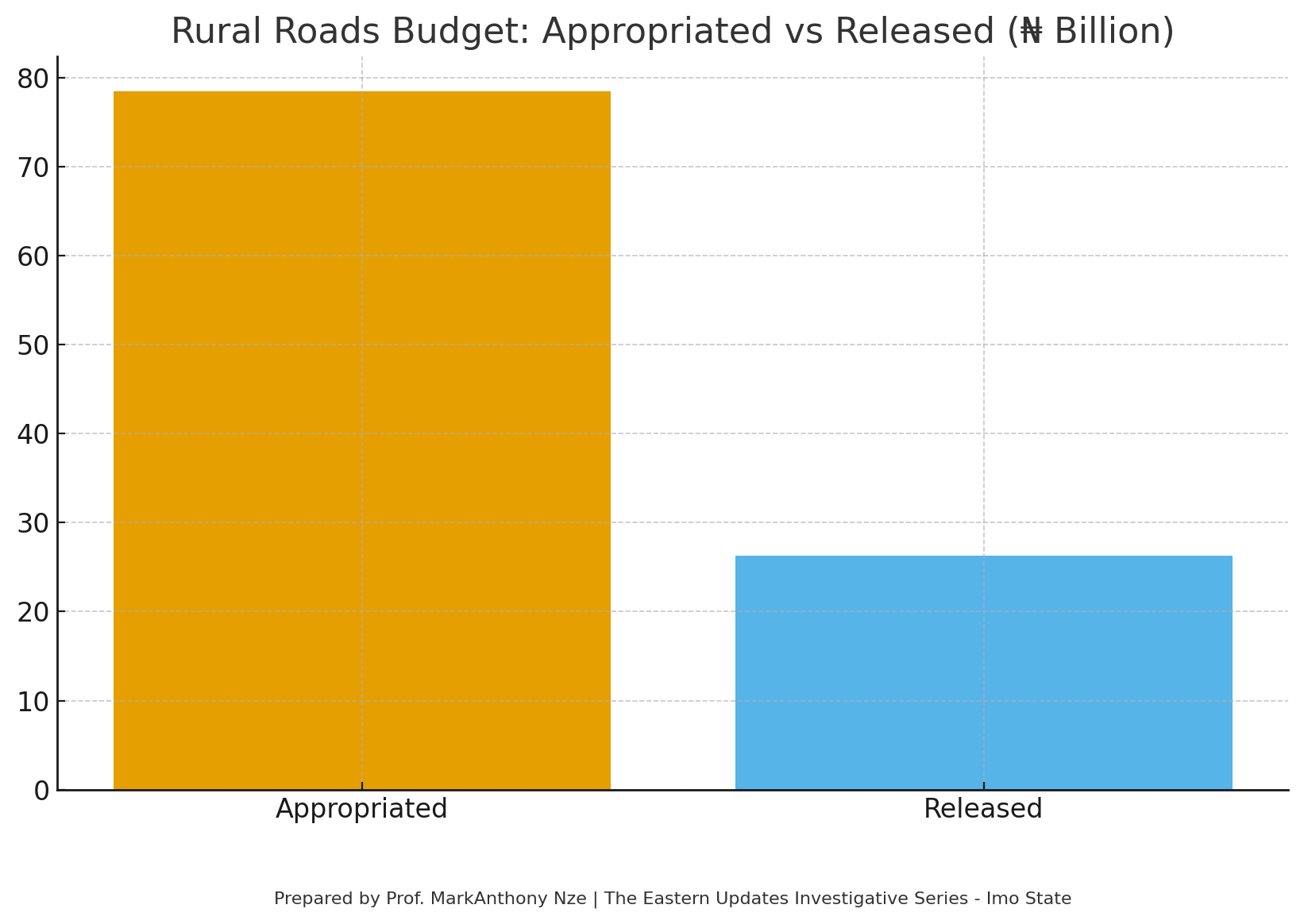
Chart 1:
| Year (2021–2024) | Appropriated (₦ Billion) | Released (₦ Billion) | Percentage Released |
| Cumulative Total | 78.5 | 26.3 | 33% |
Explanation:
This chart exposes the fiscal impossibility of the 100-road claim. Imo State appropriated ₦78.5 billion for rural infrastructure but released only ₦26.3 billion.
At federal construction benchmarks of ₦200 million per kilometer, that amount could fund about 30 roads—not 100.
The arithmetic itself collapses the narrative; the claim was structurally impossible before construction began.
Chart 2:
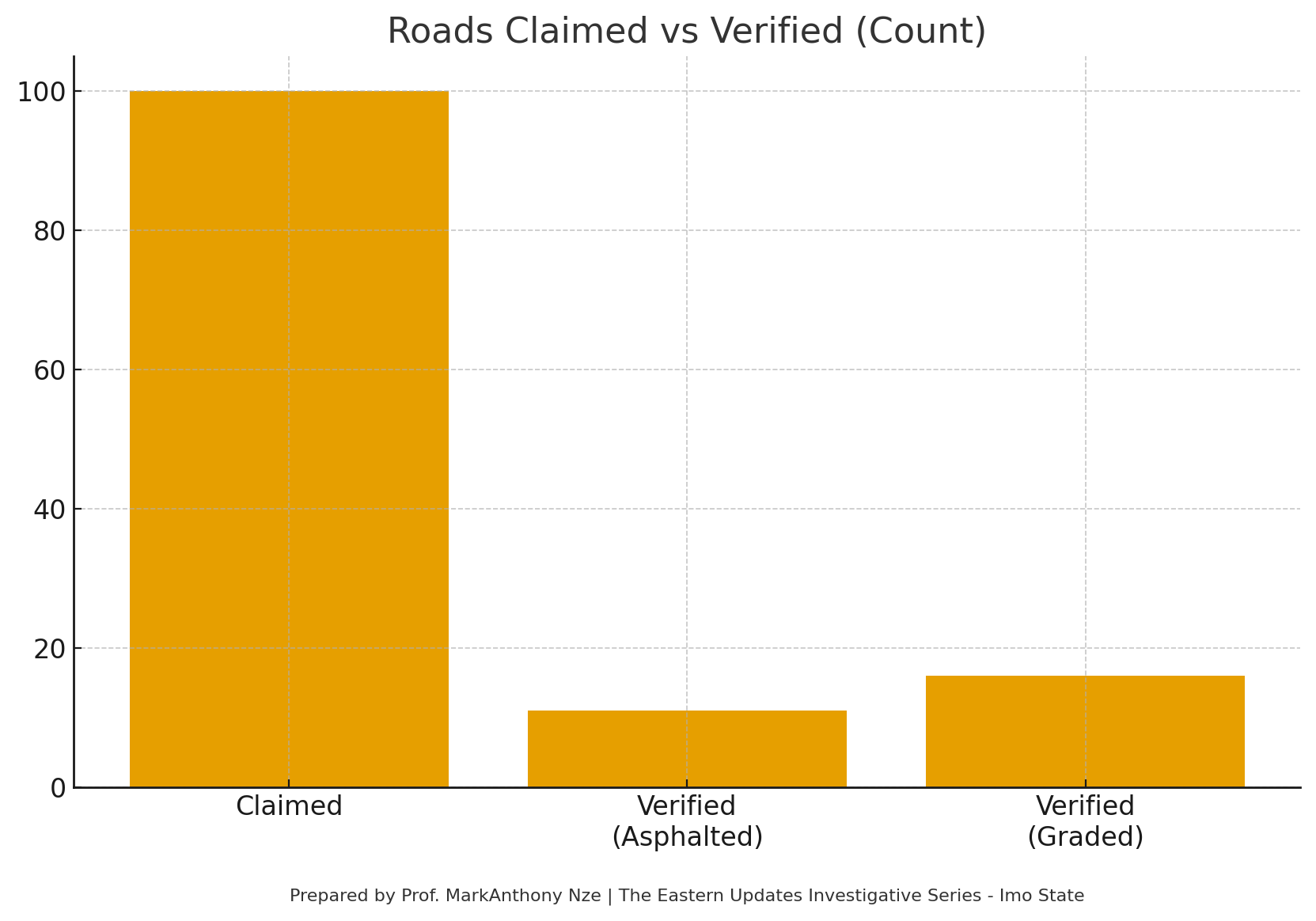
| Category | Number of Roads | Share (%) |
| Claimed Completed | 100 | 100% |
| Fully Asphalted (Verified) | 11 | 11% |
| Graded/Compacted | 16 | 16% |
| Total Verified on Ground | 27 | 27% |
| Missing / Unaccounted | 73 | 73% |
Explanation:
Audits, satellite imagery, and field inspections found only 27 of the 100 roads with any visible work—11 asphalted, 16 graded.
The remaining 73 exist only in press statements.
The exaggeration rate exceeds 350%, achieved by counting mobilized or half-graded projects as “completed.”
Chart 3:
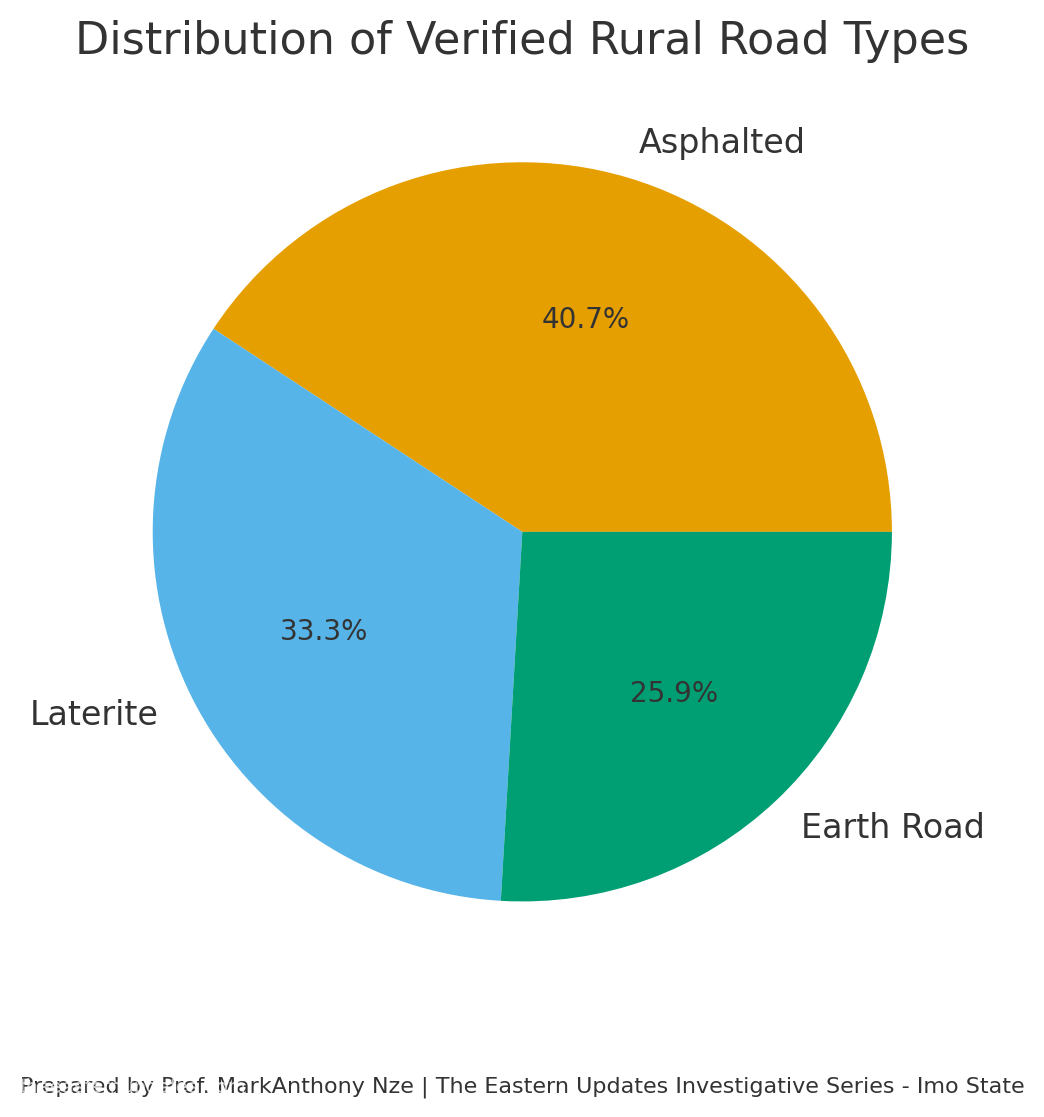
| Road Type | Share (%) |
| Asphalted (standard) | 40.7% |
| Laterite / Graded Only | 33.3% |
| Earth / Unpaved | 25.9% |
Explanation:
Even among verified roads, most fail engineering standards. Many lack drainage, proper compaction, or asphalt surfacing, making them susceptible to erosion within a season.
In practical terms, only 11% of the 100 advertised roads meet the minimal criteria for durability.
Chart 4:
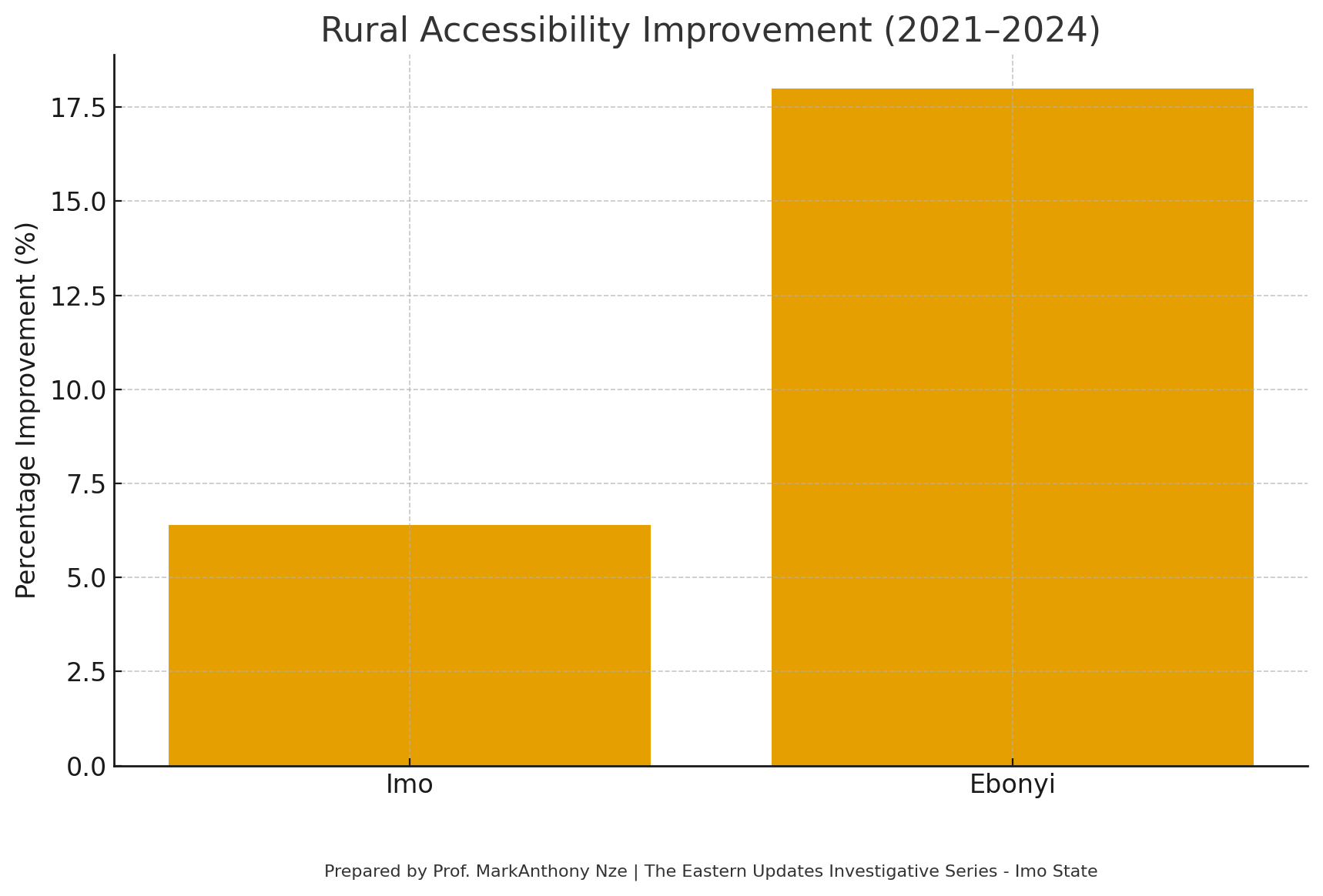
| State | Accessibility Growth (%) |
| Imo | 6.4 |
| Ebonyi | 18.0 |
Explanation:
If Imo had truly constructed 100 new roads, mobility indices would have surged.
Instead, the National Bureau of Statistics Transport Index shows a mere 6.4% improvement—one-third of Ebonyi’s performance, which openly publishes its projects.
The data proves that connectivity did not expand in proportion to the rhetoric.
Overall Findings
| Government Claim | Verified Reality | Status |
| 100 rural roads completed | 27 partially or fully done | False |
| Full funding available | Only 33% of budget released | Impossible |
| Built to engineering standard | 11 asphalted roads | Minimal |
| Improved rural accessibility | 6.4% increase | Weak |
Final Analysis:
The charts converge on a single conclusion: Imo’s “100 rural roads” programme was a political performance, not an infrastructural revolution.
Underfunded, underdelivered, and overstated, it replaced pavement with publicity.
The numbers make one truth unavoidable—what Imo built was not a network of roads, but a network of claims.
Verdict
Governor Uzodinma’s declaration that his administration “built 100 rural roads” does not survive the most basic scrutiny.
The evidence from every independent audit, fiscal document, and satellite dataset converges on a single truth: the majority of those roads remain unfinished, underfunded, or entirely imaginary.
Imo’s rural development story is not one of transformation but of substitution, statistics replacing asphalt, and press releases replacing progress.
The “100 roads” promise was not an act of governance; it was an exercise in political theatre performed on red soil and broadcast in high definition.
Until roads in Imo are measured in kilometers traveled rather than speeches delivered, the state’s infrastructure will remain what it is today: a landscape of unfinished sentences written on unpaved ground.
Professor MarkAnthony Ujunwa Nze is an acclaimed investigative journalist, public intellectual, and global governance analyst whose work shapes contemporary thinking at the intersection of health and social care management, media, law, and policy. Renowned for his incisive commentary and structural insight, he brings rigorous scholarship to questions of justice, power, and institutional integrity.
Based in New York, he serves as a full tenured professor and Academic Director at the New York Center for Advanced Research (NYCAR), where he leads high-impact research in governance innovation, strategic leadership, and geopolitical risk. He also oversees NYCAR’s free Health & Social Care professional certification programs, accessible worldwide at:
👉 https://www.newyorkresearch.org/professional-certification/
Professor Nze remains a defining voice in advancing ethical leadership and democratic accountability across global systems.
Bibliographies
African Development Bank. (2024). Nigeria subnational infrastructure and transport review 2024. Abidjan, Côte d’Ivoire: Infrastructure & Urban Development Department.
BudgIT Foundation. (2025). State of states report 2025 – Infrastructure and capital projects (Imo chapter). Lagos, Nigeria: BudgIT Foundation.
Federal Ministry of Works and Housing. (2024). National rural roads inventory and condition assessment 2024. Abuja, Nigeria: Department of Highway Planning and Development.
Imo State Government. (2021–2024). Approved budgets of Imo State. Owerri, Nigeria: Budget Office of Imo State.
Imo State Ministry of Works. (2023, July). Project implementation status report – Rural and feeder roads phase II. Owerri, Nigeria: Planning, Research & Statistics Unit.
Imo State Ministry of Information. (2023, August 15). Press release: Governor Uzodinma flags off 100 rural roads development project across LGAs. Owerri, Nigeria: Government House Press.
Imo Broadcasting Corporation (IBC TV). (2023, August 15). News bulletin – Governor launches 100 rural roads project in Imo. Owerri, Nigeria: IBC Archives.
Infrastructure Transparency Initiative (InfraNG). (2024). Open contracting data for subnational infrastructure – Imo State summary. Abuja, Nigeria: CoST Nigeria Secretariat.
National Bureau of Statistics. (2024). Transport infrastructure and accessibility index (2024 edition). Abuja, Nigeria: Transport and Logistics Division.
National Planning Commission. (2024). Nigeria rural access and agricultural marketing project (RAAMP) progress review. Abuja, Nigeria: Department of Infrastructure Development.
Nigeria Governors’ Forum. (2024). Subnational infrastructure performance scorecard 2024 – Road and transport sector. Abuja, Nigeria: NGF Secretariat.
Premium Times Nigeria. (2024, September 20). Imo’s 100-road promise: Half still in bushes two years after launch. Retrieved from https://www.premiumtimesng.com
The Guardian Nigeria. (2024, September 24). Most Imo “rural roads” still under construction, audit reveals. Retrieved from https://guardian.ng
Vanguard Nigeria. (2023, August 16). Uzodinma launches 100 rural roads project across Imo State. Retrieved from https://www.vanguardngr.com
World Bank. (2024). Nigeria rural access and agricultural marketing project (RAAMP) – State performance and disbursement report. Washington, DC: Transport and Digital Development Global Practice.