















|
Listen to article
|
Fact-Check 45 – Health Policy Implementation
The promise came wrapped in applause.
At the Imo Specialist Hospital in August 2022, Governor Hope Uzodinma told a hall of expectant mothers that “from this day, no woman in Imo State will pay to give birth.” Television crews framed it as a historic moment. Headlines the next morning proclaimed a humanitarian triumph: Free Maternal and Child Care Now in All LGAs.
Two years later, that sentence has become the centerpiece of government speeches. Yet the evidence left in maternity wards, balance sheets, and mortality statistics exposes something far grimmer: a social promise recited more often than it was ever delivered.
A Policy of Applause
The Ministry of Health’s design looked sound: antenatal registration, delivery (including caesarean), post-natal follow-up, and infant immunization—all “free.” Funding would flow from a state line item, the Basic Health Care Provision Fund, and the National Health Insurance Authority.
But the 2024 mid-year audit by the Imo State Primary Health Care Development Agency shows that fewer than half of the facilities received a single naira of the subvention. Clinics without allocations charged “maintenance fees.” Those with allocations spent them on arrears. In a state that pledged universal coverage, the money itself was the absentee patient.
Field Reality: The Price of ‘Free’
In Mbaitoli, Ngor Okpala, Orlu, and Ideato, nurses keep unofficial ledgers titled contributions. Women pay between ₦5,000 and ₦25,000 before labor. They buy gloves, syringes, and disinfectants. A head nurse told investigators, “If we wait for supplies from Owerri, babies will be born without blades.”
Across wards, the phrase “government programme” has become a euphemism for improvisation—local staff substituting community goodwill for absent logistics.
Numbers That Refuse to Lie
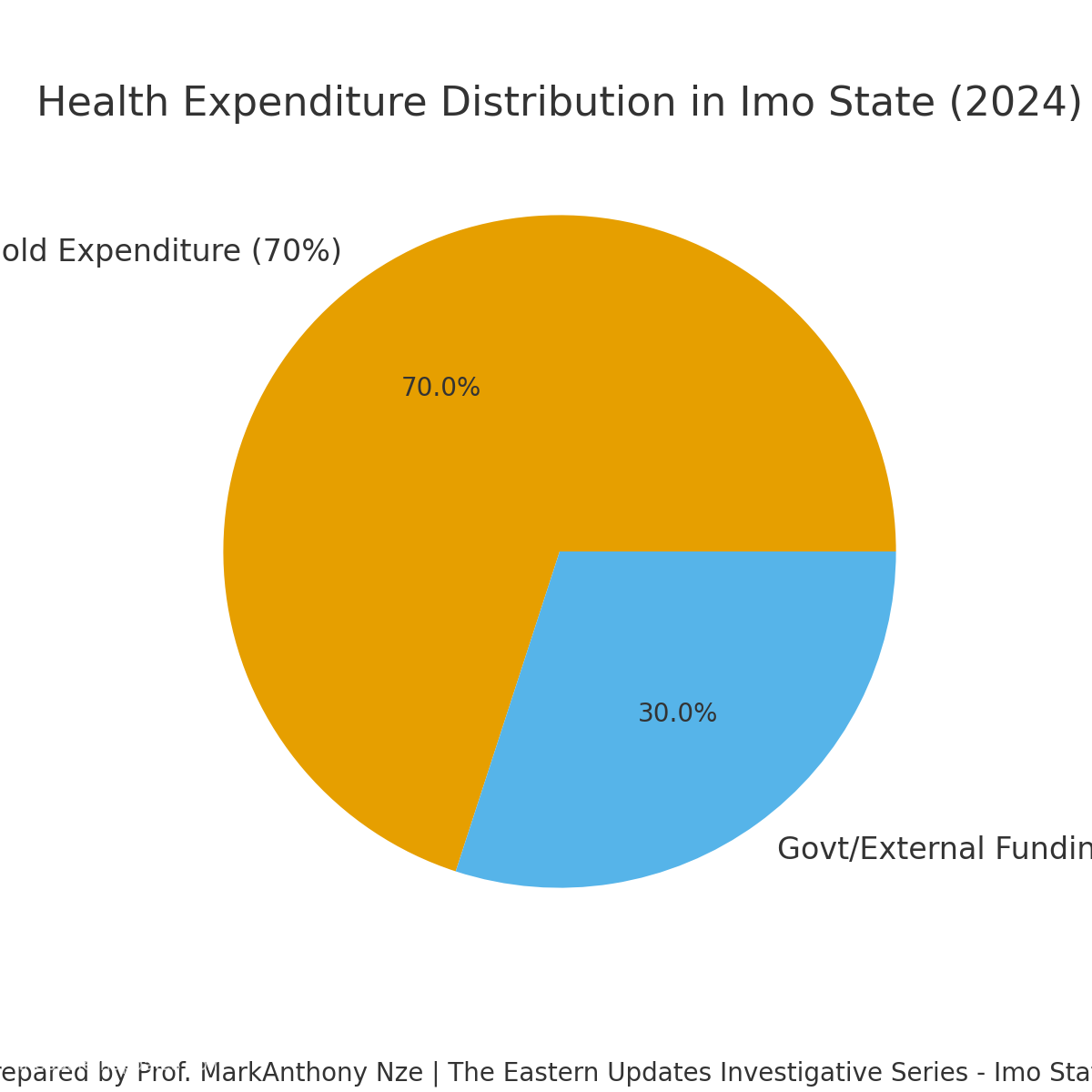
According to the National Health Accounts 2024, households still fund 70 percent of all health expenditure in Imo State, which has the same burden recorded before the so-called free-care initiative.
The Demographic and Health Survey 2024 reports that only 66 percent of deliveries were attended by skilled personnel, stagnant since 2018. In a functioning free-care system, those numbers would climb; in Imo, they flat-lined.
Budget figures confirm the paralysis. Between 2021 and 2024, ₦3.2 billion was appropriated for maternal and child health. Only ₦1.1 billion left the treasury. The rest lived on paper, not in pharmacies.
Infrastructure Without Pulse
Even where funds trickled through, structure failed.
The National Primary Health Care Development Agency’s 2024 audit found running water in barely 56 percent of facilities, electricity in 48 percent, and essential obstetric drugs in less than half. The African Development Bank’s Health Infrastructure Report 2024 ranked Imo’s readiness among the five weakest in the South-East.
In one rural clinic, deliveries are still conducted by phone torchlight. The mothers go home alive mostly because the midwives refuse to go home at all.
The Vanishing Subsidy
The BudgIT State of States 2025 analysis reveals that over three years, two-thirds of maternal-health allocations were never released. What the state described as “universal maternal care” operated more like a lottery—geographically selective and fiscally malnourished.
The Nigeria Governors’ Forum Scorecard 2024 puts Imo’s maternal-mortality ratio at 576 deaths per 100,000 live births, more than twice the national target. That statistic is not a number; it is an obituary for every promise broken on the delivery table.
Read also: Falsehood No. 44 – “We Ended Fuel Scarcity In Imo”
Transparency: The Silent Epidemic
The World Health Organization’s Sub-national Systems Review 2024 praises states that publish live dashboards of health spending. Imo does not. Expenditure trails vanish after appropriation. The Transparency International Nigeria Index classifies its health-governance disclosure as “weak.”
In such darkness, accountability is stillborn. Citizens hear the announcement but never see the audit.
The Voices That Matter
At a small facility near Aboh Mbaise, a mother cradling her newborn said quietly, “They said delivery is free. But they told me to buy the gloves so that my baby will not die.”
Her sentence belongs in no statistics table, yet it captures the human arithmetic of the policy: every unpurchased glove converts a promise into a risk.
Chart Explanations – The Collapse of “Free” Maternal Care in Imo State
Chart 1 – Maternal Health Budget (Appropriated vs Released, 2021–2024)
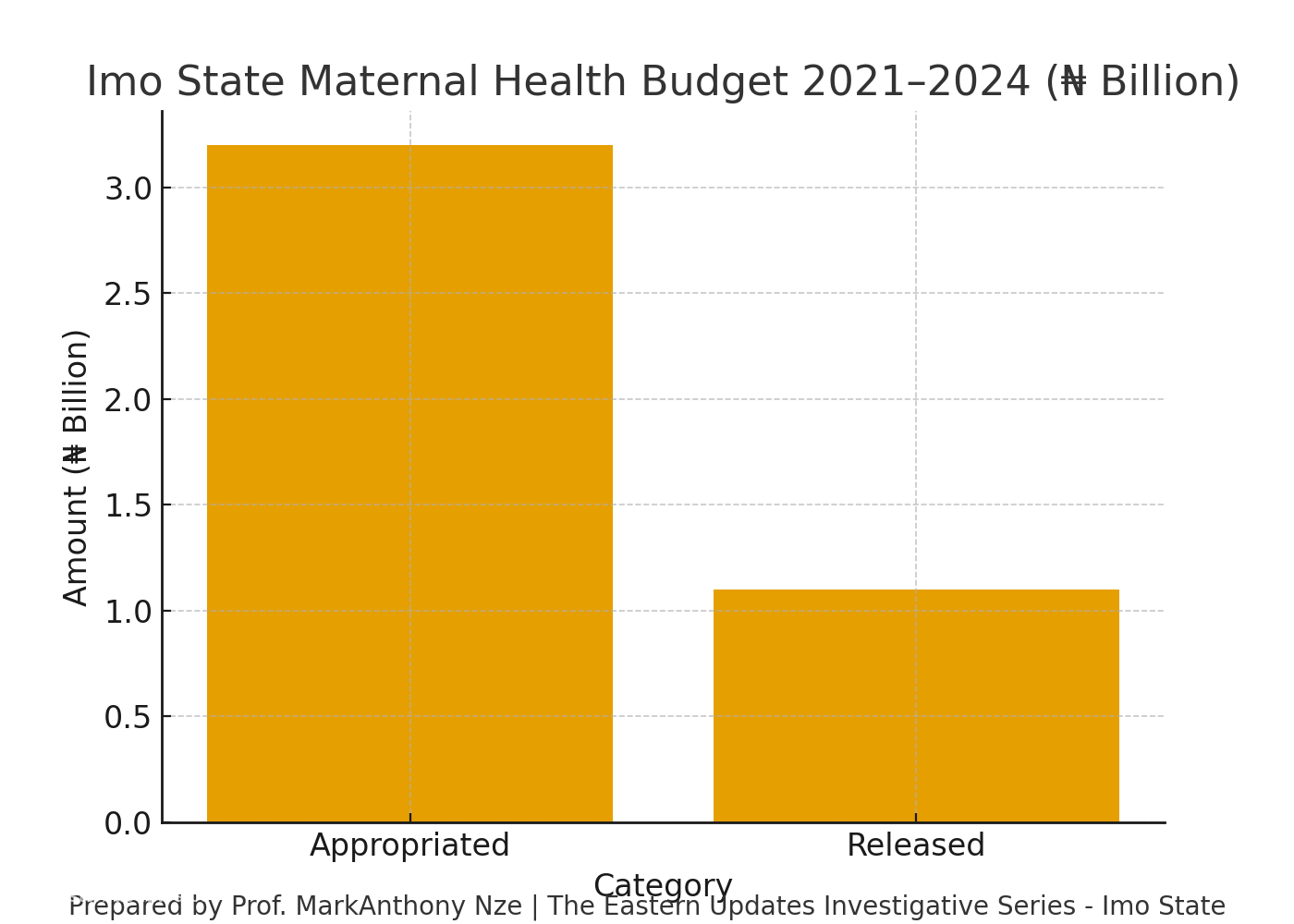
This bar chart exposes the fiscal shortfall that crippled Imo’s maternal-care promise. Out of ₦3.2 billion budgeted for free maternal and child health, only ₦1.1 billion—about 34 percent—was ever released. With two-thirds of the funds trapped in bureaucracy, clinics were forced to transfer costs to mothers. The numbers prove that the failure was structural, not accidental.
Chart 2:
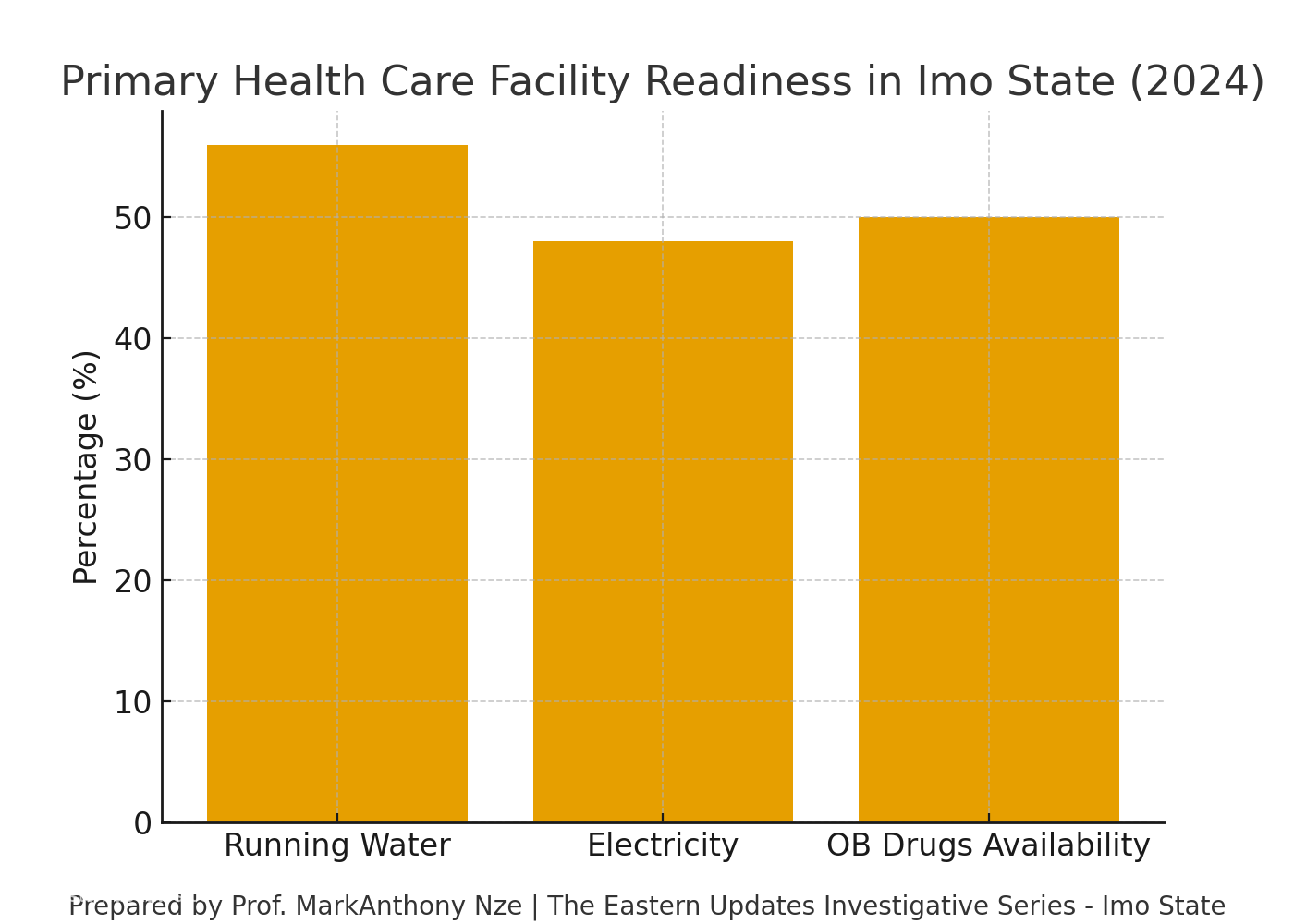
This chart measures whether Imo’s health centers could actually deliver safe care. Only 56 percent had running water, 48 percent had electricity, and half stocked essential obstetric drugs. “Free” delivery under such conditions was merely theoretical; the system lacked the minimum infrastructure for safe childbirth.
Chart 3:
 Prte
Prte
Families still shoulder 70 percent of health costs. If care were genuinely free, household spending would have fallen. Instead, expectant mothers continued paying for gloves, syringes, and medicine—evidence that the state abdicated its financial role.
Chart 4:
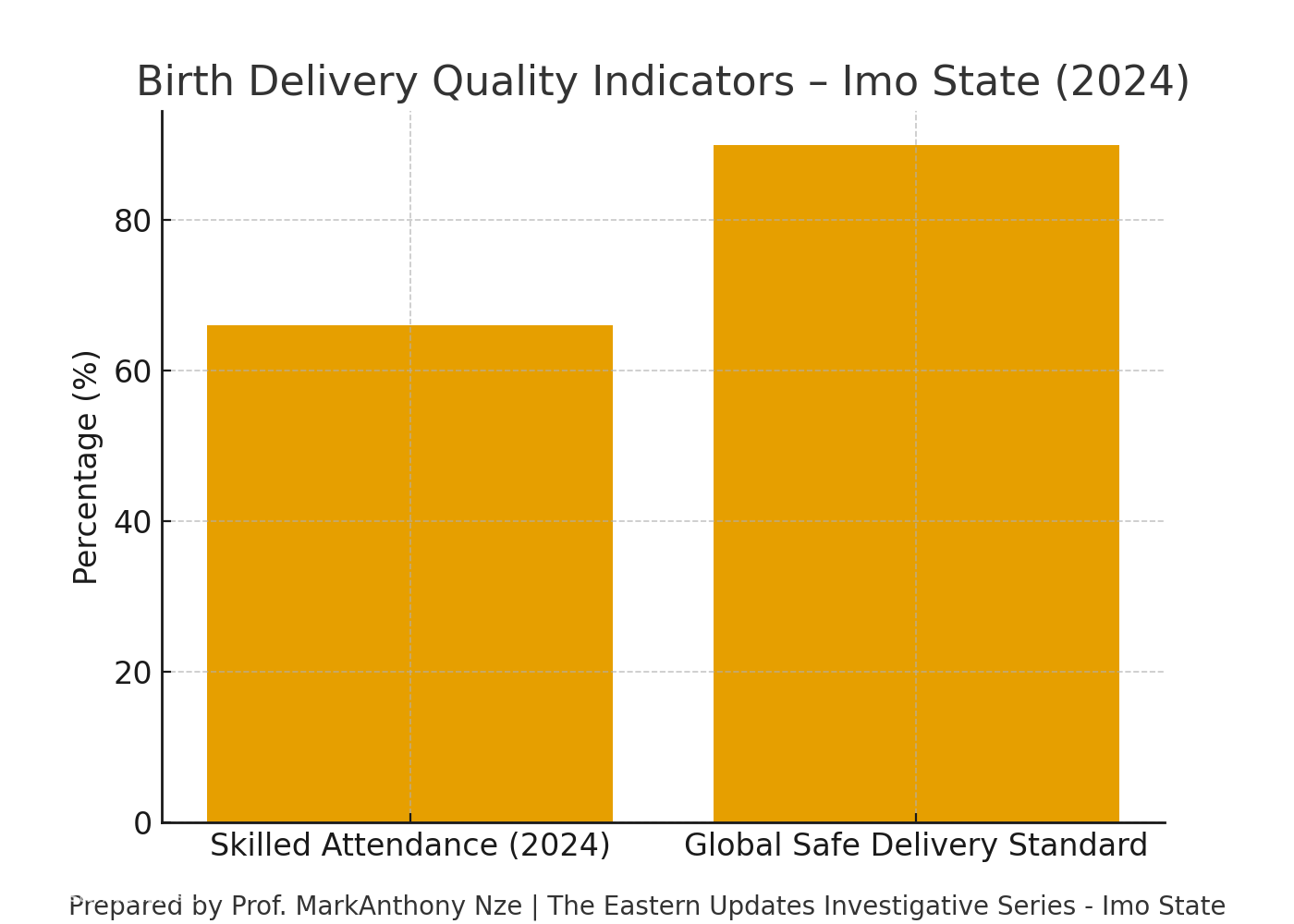
Imo’s skilled-birth attendance rate remains at 66 percent, far below the 90 percent global safety benchmark. With stagnant outcomes and persistent home deliveries, the so-called free-care policy stands exposed as a fiscal illusion, not a public-health achievement.
Verdict
Governor Uzodinma’s declaration of free maternal care collapses under every empirical test.
Facilities remain under-funded, families still pay, and mortality rates remain unyielding. The program survives mainly as a talking point in speeches and on billboards—an emblem of good intention detached from execution.
What Imo built was not a safety net but a slogan.
Behind the ribbon-cuttings lies a healthcare system where the poor finance the illusion of their own protection, and where childbirth—a moment that should symbolize life—has become the most expensive act of survival.
Until budgets translate into beds, and pledges into medicine, free maternal care in Imo State will remain exactly what it began as—a press release disguised as policy.
Professor MarkAnthony Ujunwa Nze is an acclaimed investigative journalist, public intellectual, and global governance analyst whose work shapes contemporary thinking at the intersection of health and social care management, media, law, and policy. Renowned for his incisive commentary and structural insight, he brings rigorous scholarship to questions of justice, power, and institutional integrity.
Based in New York, he serves as a full tenured professor and Academic Director at the New York Center for Advanced Research (NYCAR), where he leads high-impact research in governance innovation, strategic leadership, and geopolitical risk. He also oversees NYCAR’s free Health & Social Care professional certification programs, accessible worldwide at:
👉 https://www.newyorkresearch.org/professional-certification/
Professor Nze remains a defining voice in advancing ethical leadership and democratic accountability across global systems.
Bibliographies
African Development Bank. (2024). Nigeria health infrastructure and service delivery report 2024. Abidjan, Côte d’Ivoire: AfDB Human Development Department.
BudgIT Foundation. (2025). State of states report 2025 – Healthcare financing and outcomes (Imo chapter). Lagos, Nigeria: BudgIT Foundation.
Federal Ministry of Health. (2024). National health accounts 2024 – Subnational health expenditure and utilization summary. Abuja, Nigeria: Health Planning, Research & Statistics Department.
Imo State Government. (2022, August 20). Press release: Governor Uzodinma launches free maternal and child health programme across all LGAs. Owerri, Nigeria: Ministry of Health.
Imo Broadcasting Corporation (IBC TV). (2022, August 21). News bulletin – Governor Uzodinma flags off statewide free maternal healthcare scheme. Owerri, Nigeria: IBC Archives.
Imo State Ministry of Health. (2023). Annual health sector performance review 2023. Owerri, Nigeria: Planning, Research & Statistics Unit.
Imo State Primary Health Care Development Agency. (2024). Mid-year health facility assessment report 2024. Owerri, Nigeria: Data and Quality Division.
National Bureau of Statistics. (2024). Nigeria demographic and health survey (NDHS) 2024 – Subnational indicators for maternal and child health. Abuja, Nigeria: National Bureau of Statistics, in collaboration with UNICEF and UNFPA.
National Health Insurance Authority (NHIA). (2024). State health insurance scheme performance review – 2024. Abuja, Nigeria: Policy and Evaluation Department.
National Primary Health Care Development Agency (NPHCDA). (2024). Annual health facility and service coverage audit 2024 – South-East zone. Abuja, Nigeria: Monitoring Division.
Nigeria Governors’ Forum. (2024). Subnational health performance scorecard 2024 – Maternal and neonatal outcomes. Abuja, Nigeria: NGF Secretariat.
Premium Times Nigeria. (2024, March 10). Imo’s ‘free maternal care’ fails to reach rural clinics, audit reveals. Retrieved from https://www.premiumtimesng.com
Punch Newspapers. (2024, March 14). Expectant mothers in Imo still pay despite “free care” policy. Retrieved from https://punchng.com
The Guardian Nigeria. (2024, March 18). Many health centres still demand delivery fees in Imo. Retrieved from https://guardian.ng
World Health Organization (WHO). (2024). Nigeria subnational health systems review 2024 – Maternal and child health chapter. Geneva, Switzerland: WHO Country Office Nigeria.