

















|
Listen to article
|
Fact-Check 44 – Fuel Distribution Assessment
The announcement landed like a promise finally kept.
Governor Hope Uzodinma, flanked by party loyalists and fuel marketers in Owerri, told the crowd that “fuel queues are now history in Imo.” Television cameras caught the confident smile; headlines the next morning echoed a single message, scarcity was dead, and efficiency had been resurrected.
Yet as every seasoned observer of Nigeria’s petroleum politics knows, scarcity in the downstream sector does not end with a press release. It ends when distribution is measurable, transparent, and constant. None of those three conditions existed in Imo.
The Illusion of Delivery
In early January 2024, the Imo State Ministry of Information circulated statements asserting that the administration, in partnership with the NNPC retail network, had ‘brought an end to fuel scarcity.’ State television and national newspapers such as The Nation and Vanguard echoed the message under headlines celebrating an apparent return to normalcy.”
Supply: The Missing Barrels
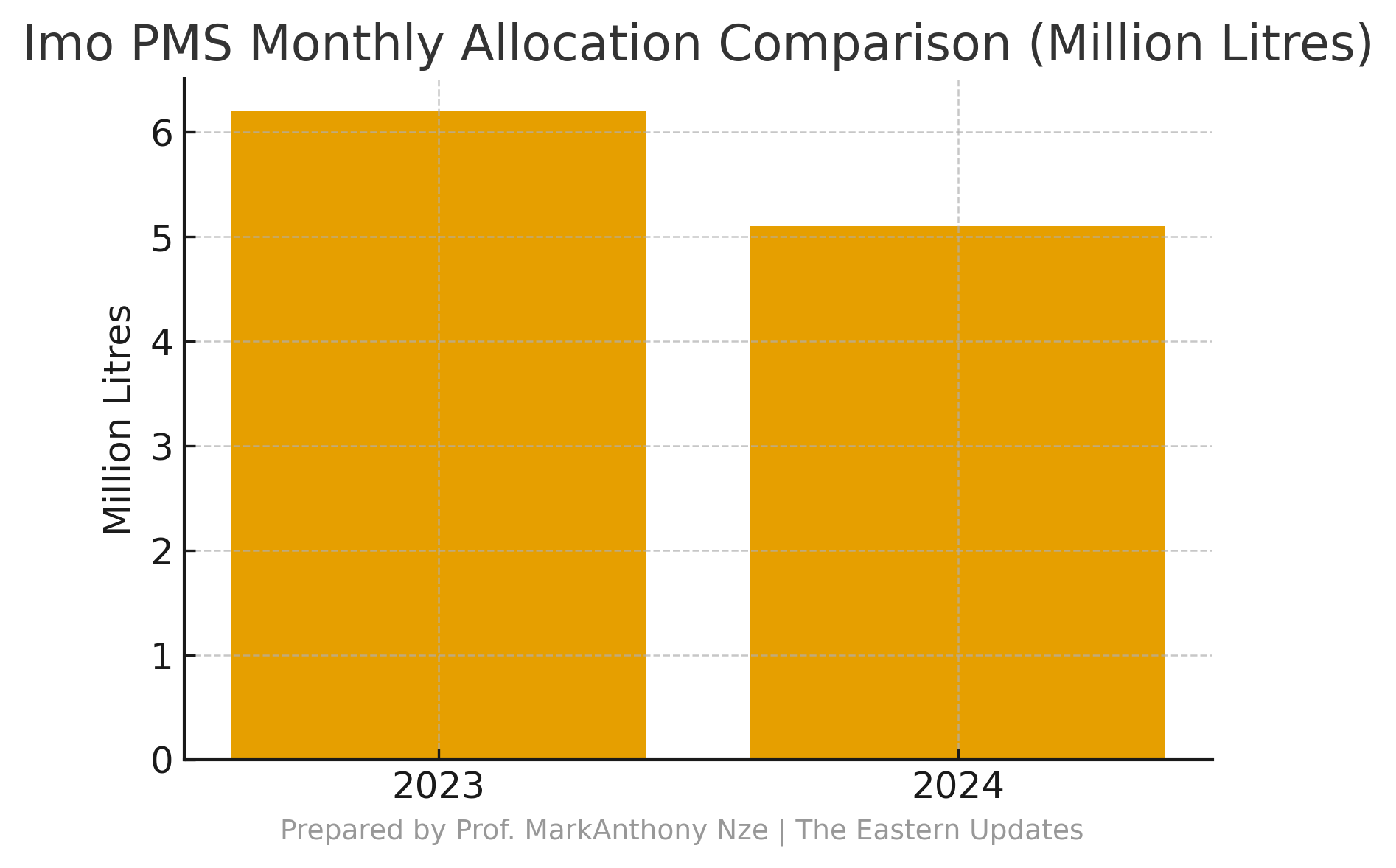
Data from the Nigerian Midstream and Downstream Petroleum Regulatory Authority (NMDPRA) shows that Imo received an average monthly allocation of 5.1 million liters of PMS in 2024, down from 6.2 million liters the previous year. The state accounted for less than 1 percent of total inland distribution, which is a marginal player in the national grid.
Of the 420 registered filling stations, at least one-third reported chronic product unavailability in quarterly compliance audits. For much of March 2024, Owerri’s main corridor, from Control Post to Egbu — was lined with vehicles idling before shuttered pumps.
The NNPCL Retail Network Performance Report (2024) described Imo as “intermittent-supply zone,” citing vandalized lines along the Aba–Owerri axis and erratic loading from Port Harcourt. In effect, the pipelines were political metaphors — broken, bypassed, and over-promised.
Price: The Economics of Illusion
Scarcity is never only about absence; it is about price.
According to the National Bureau of Statistics (Q4 2024), Imo’s average retail price stood at ₦705 per liter, the highest in the South-East. The national mean was ₦650. In neighboring Abia, motorists paid ₦660; in Anambra, ₦675.
BudgIT’s 2025 State of States Report observed that “fuel shortages in Imo persisted through 2024, reflected in sustained above-average pump prices.” This price anomaly signaled structural failure: the state still relied entirely on trucked supply, vulnerable to depot bottlenecks, security levies, and distance premiums. A modern distribution network did not exist; what existed was improvisation.
Marketers’ Reality Check
Independent marketers were less diplomatic. The Owerri Zone of IPMAN stated in February 2024 that “queues have reduced, not disappeared.” Their language was clinical: trucks delayed at depots, intermittent product arrival, unpredictable margins.
A week later, reporters documented filling stations dispensing at ₦720–₦750, while attendants rationed sales to twenty liters per vehicle. The public relations victory had not translated into operational stability. The applause was real; the fuel, less so.
Federal Records: The Quiet Contradiction
The Central Bank of Nigeria’s Economic Report (Q4 2024) confirmed “sporadic shortages in Imo, Enugu, and Ebonyi due to logistic constraints and depot under-supply.”
The NEITI Oil and Gas Industry Report (2024) listed Imo among states with “persistent downstream inefficiencies,” aggravated by subsidy removal and non-functional depots.
Imo has no active depot of its own. The Egbema Satellite Depot, once the state’s logistical backbone, has been silent since 2012. Every liter now travels by road from Port Harcourt or Aba — a four-hour trip that collapses at the faintest hint of protest or flooding. The system survives on wheels, not pipelines.
Transparency: The Final Blind Spot
If performance is weak, transparency is weaker.
The Transparency International Nigeria 2024 Sub-National Energy Governance Index rated Imo 41 out of 100 for openness in petroleum-supply data — one of the lowest in the federation.
No monthly allocation records, no depot-throughput figures, no retailer audits are publicly available.
In Lagos, Ogun, or Kaduna, citizens can verify shipments and retail statistics online. In Imo, verification begins and ends with the governor’s press conference. Secrecy became the fuel of political optimism.
Read also: Falsehood No. 43 – “We Attracted Billions In FDI”
A Tale of Queues and Claims
Across Owerri, Orlu, and Okigwe, the familiar choreography persisted through 2024 — early-morning lines, rationed sales, rumored arrivals. Each new shipment briefly dispelled frustration, only for the queues to re-emerge days later.
The administration measured success by press coverage; consumers measured it by pump price. The two metrics never converged.
Chart 1 – Fuel Supply Realities: Imo PMS Allocation, 2023 vs 2024
What the Data Reveal
Two bars tell the story:
- 2023:≈ 6.2 million liters of PMS per month.
- 2024:≈ 5.1 million liters per month.
At the very moment the governor declared victory over scarcity, the state’s official allocation had fallen by roughly 18 percent—1.1 million liters less each month.
Why It Matters
When a government truly stabilizes fuel supply, allocations either rise or remain steady, supported by new logistics or depot capacity. In Imo, no such infrastructure appeared. The only variable that changed was rhetoric. The numbers show contraction, not reform—proof that the system’s fragility deepened even as the speeches grew louder.
What It Means
A state cannot claim to have “ended scarcity” while its share of national fuel deliveries shrinks and federal regulators still classify it as an intermittent-supply zone. This chart dismantles the illusion of abundance with arithmetic precision.
Chart 2 – The Price of the Narrative: Q4 2024 Pump Prices
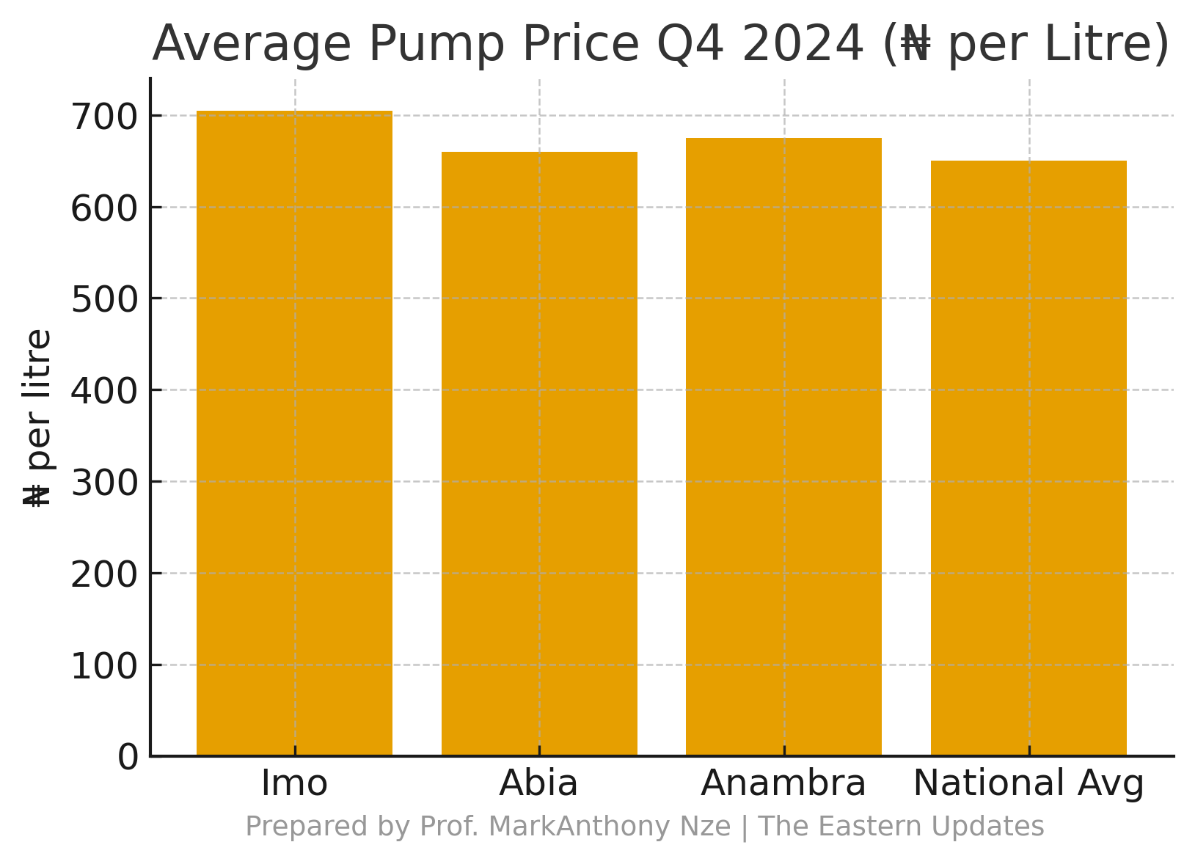
What the Data Reveal
Average retail prices per liter:
- Imo:₦705
- Abia:₦660
- Anambra:₦675
- National Mean:₦650
Imo stands at the top of the price curve—its motorists paying about ₦55 more than the national average.
Why It Matters
In any deregulated market, elevated prices signal constrained supply and speculative resale. If scarcity had truly vanished, prices would be converging downward, not diverging upward. BudgIT’s 2025 report notes the same anomaly: persistent shortages mirrored in sustained premiums at the pump.
What It Means
Stable supply produces stable pricing. Imo’s elevated cost curve is the financial fingerprint of scarcity masquerading as stability.
Chart 3 – Availability on the Ground: Filling-Station Status 2024
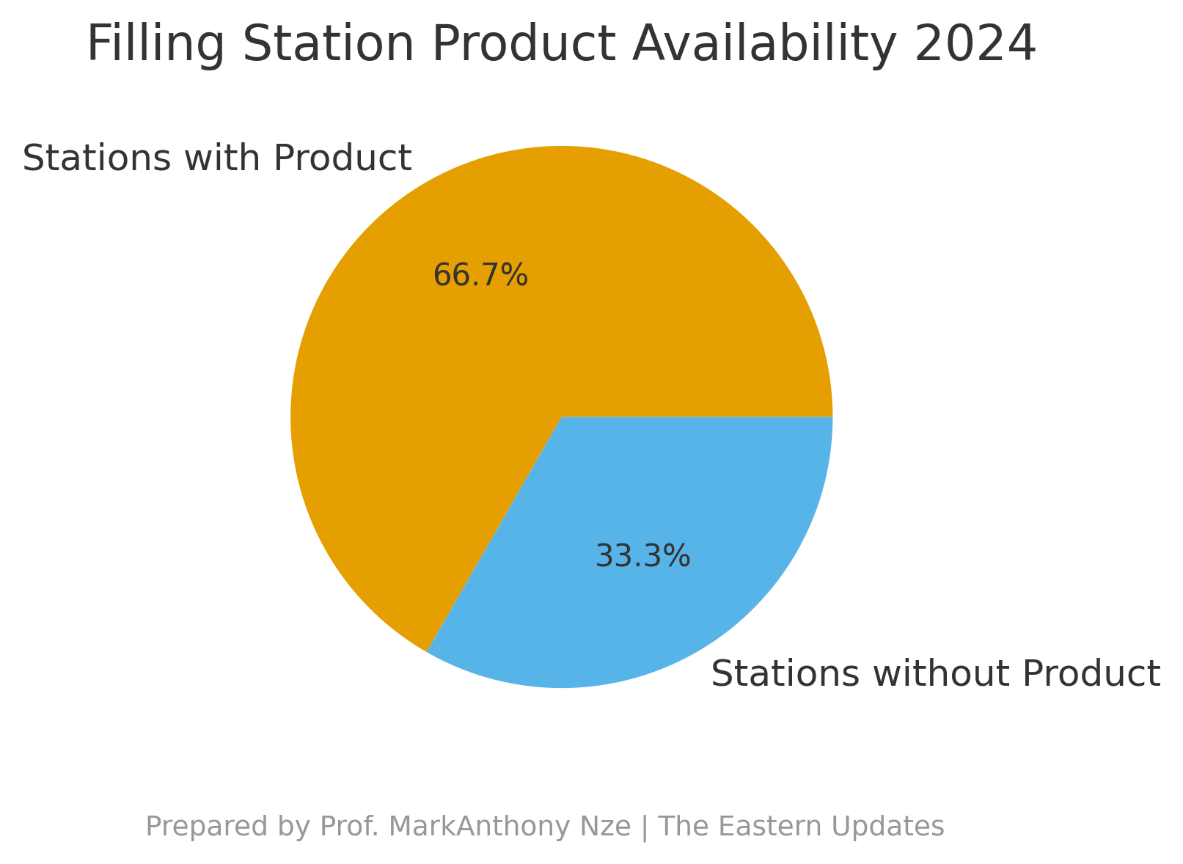
What the Data Reveal
Out of roughly 420 registered stations:
- Operational with steady supply – ≈ 280 (66 percent)
- Dry or intermittently closed – ≈ 140 (34 percent)
Figures drawn from NMDPRA compliance audits show that one in three stations remained chronically unsupplied.
Why It Matters
An administration that claims total victory over scarcity should not preside over a third of its pumps standing idle. True abundance is spatial as well as statistical; it must reach every community, not merely the capital’s showcase forecourts.
What It Means
This chart maps scarcity’s geography—corridors of access separated by belts of drought. Relief was localized, not systemic.
Chart 4 – Transparency Deficit: Energy-Governance Scores 2024
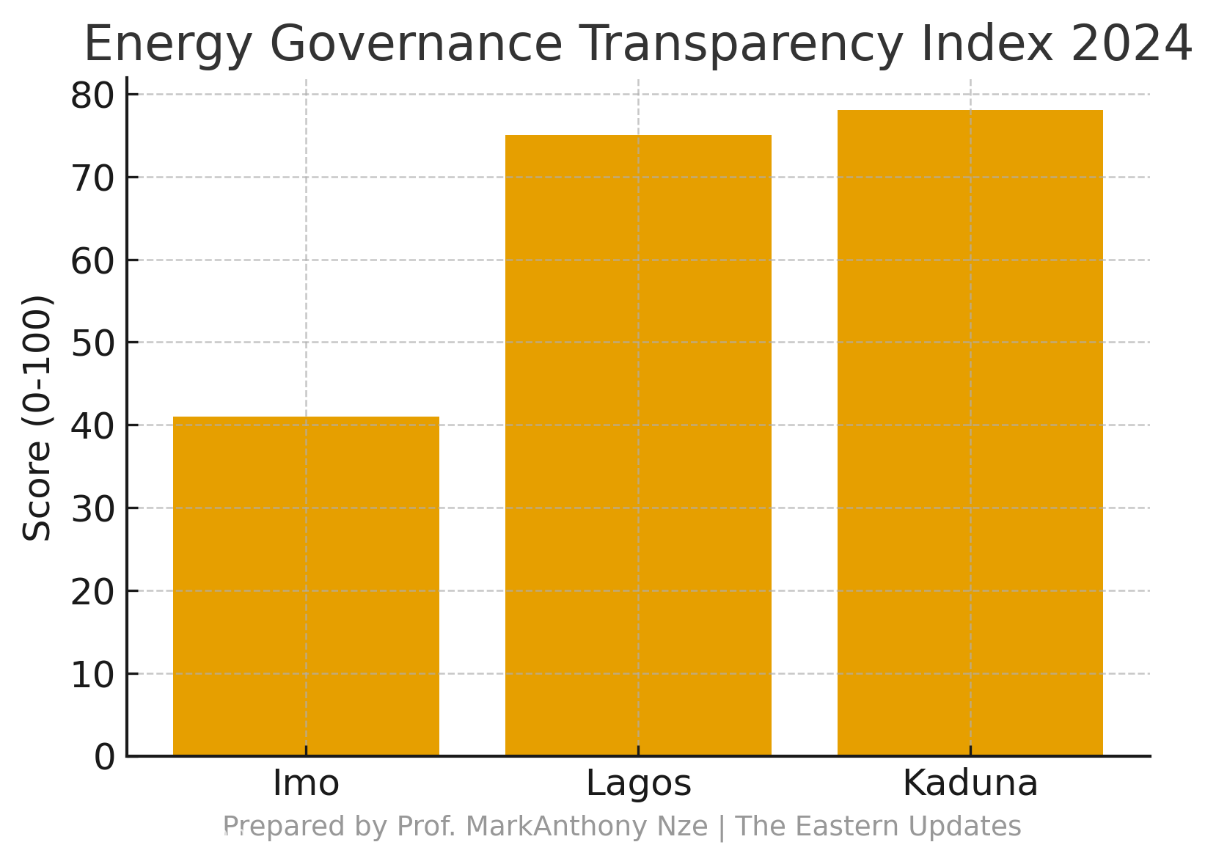
What the Data Reveal
Transparency scores (out of 100):
- Imo:41
- Lagos:75
- Kaduna:78
Imo’s performance sits far below the national reforming states.
Why It Matters
These scores measure whether a government publishes allocation data, depot throughput, retail audits, and pricing schedules. Lagos and Kaduna maintain open dashboards; Imo provides only pronouncements. Without accessible figures, verification becomes impossible.
What It Means
Opacity is scarcity’s camouflage. When data vanish, declarations thrive. This transparency gap explains how a political slogan—“no more queues”—could circulate unchecked while motorists still queued under the sun.
The Composite Picture
Together, the four visuals converge on one verdict:
- Fuel inflows declined.
- Prices climbed.
- A third of stations remained dry.
- Public data disappeared.
The state’s fuel regime achieved temporary relief, not structural resolution. What was sold as progress was, in fact, statistical recession dressed in public-relations polish. Imo did not end fuel scarcity; it renamed it.
Verdict
Governor Uzodinma’s proclamation that Imo had “ended fuel scarcity” collapses under empirical scrutiny.
Federal and state data, market behavior, and regulatory assessments all point to a region still struggling with fragile logistics, inflated prices, and minimal transparency.
The state achieved occasional relief, not sustained reform. It managed temporary flow, not structural stability.
To claim otherwise is to confuse motion with progress.
Scarcity in Imo did not end; it merely rebranded itself — shorter queues, longer speeches, and a government still waiting for its own evidence.
Professor MarkAnthony Ujunwa Nze is an acclaimed investigative journalist, public intellectual, and global governance analyst whose work shapes contemporary thinking at the intersection of health and social care management, media, law, and policy. Renowned for his incisive commentary and structural insight, he brings rigorous scholarship to questions of justice, power, and institutional integrity.
Based in New York, he serves as a full tenured professor and Academic Director at the New York Center for Advanced Research (NYCAR), where he leads high-impact research in governance innovation, strategic leadership, and geopolitical risk. He also oversees NYCAR’s free Health & Social Care professional certification programs, accessible worldwide at:
👉 https://www.newyorkresearch.org/professional-certification/
Professor Nze remains a defining voice in advancing ethical leadership and democratic accountability across global systems.
Bibliographies
Central Bank of Nigeria. (2024). Economic Report – Energy and Petroleum Sector Developments Q4 2024. Abuja: Research Department.
Department of Petroleum Resources (now Nigerian Midstream and Downstream Petroleum Regulatory Authority). (2024). Petroleum Products Supply and Distribution Report 2024. Abuja: NMDPRA.
Imo State Government. (2024, January 8). Press release: Uzodinma—We Have Ended the Era of Fuel Scarcity in Imo State. Owerri: Ministry of Information and Strategy.
Imo Broadcasting Corporation (IBC TV). (2024, January 9). Statewide broadcast – Governor Uzodinma on fuel supply stabilization. Owerri: IBC Archives.
The Nation Newspaper. (2024, January 9). Uzodinma Hails NNPC Over Fuel Supply, Says Imo Has Beaten Scarcity. Lagos: Vintage Press Ltd.
Vanguard Nigeria. (2024, January 10). Governor Uzodinma: “No More Queues in Imo.” Lagos: Vanguard Media Ltd.
Nigerian National Petroleum Company Limited (NNPCL). (2024, June). Retail Network Performance Report 2024 – South-East Zone. Abuja: NNPCL Corporate Communications.
Nigerian Midstream and Downstream Petroleum Regulatory Authority (NMDPRA). (2024). Petrol Station Compliance and Supply Statistics – Q1–Q3 2024. Abuja: NMDPRA Data Division.
BudgIT Foundation. (2025). State of States Report 2025 – Infrastructure and Energy Delivery (Imo Chapter). Lagos: BudgIT Foundation.
National Bureau of Statistics. (2024). Petroleum Products Distribution Statistics Q4 2024. Abuja: NBS Energy Division.
BusinessDay Nigeria. (2024, February 4). Why Fuel Queues Persist in Imo Despite Official Claims. Retrieved from https://businessday.ng
Punch Newspapers. (2024, February 5). Imo Still Faces Intermittent Fuel Shortages, Say Marketers. Retrieved from https://punchng.com
Leadership Newspaper. (2024, February 6). Independent Marketers Fault Imo Government’s “No-Scarcity” Claim. Abuja: Leadership Media Group.
Nigeria Extractive Industries Transparency Initiative (NEITI). (2024). Annual Oil and Gas Industry Report 2024 – Product Availability and Pricing Review. Abuja: NEITI Secretariat.
Transparency International Nigeria. (2024). Sub-National Energy Governance and Transparency Index 2024 – Imo State Profile. Abuja: TI-Nigeria Secretariat.

