












|
Listen to article
|
Fact-Check 43 – Investment Data vs. CBN Figures
By Prof. MarkAnthony Nze
On January 1, 2024, during his New Year Statewide Broadcast, Governor Hope Uzodinma delivered one of his boldest claims yet:
“Imo State has become one of the fastest-growing economies in Nigeria, attracting billions in foreign direct investment within the last year.”
The statement was amplified across radio, television, and the state’s official social media pages. The Ministry of Information called it “a milestone in subnational economic transformation.”
It was the kind of message designed to lift spirits — a declaration that Imo had leapt from the margins of Nigeria’s investment map to the center of global attention.
But like many grand political claims, the truth depends not on rhetoric, but on records.
The Federal Data: What the Numbers Say
According to the Central Bank of Nigeria’s Capital Importation Report (Q4 2024), total Foreign Direct Investment (FDI) into Imo State for the entire year amounted to $0.8 million (≈ ₦0.7 billion).
That figure represents just 0.03 percent of Nigeria’s total FDI inflows — ranking Imo 26th out of 36 states.
By contrast, Lagos attracted $4.3 billion, FCT $2.1 billion, Ogun $190 million, and Rivers $102 million in the same period.
The National Bureau of Statistics (NBS) Foreign Investment Report (2024) mirrors these figures.
It lists Imo among the lowest-performing states in both direct and portfolio investments, noting “no major foreign capital entries” between Q2 2023 and Q1 2024.
In short, there is no trace of the billions the governor claimed.
The State’s Version of Events
Following the broadcast, the Imo State Ministry of Information issued a press release titled “Uzodinma Declares Imo the Fastest-Growing Economy.”
The statement credited the “Imo Industrial Renewal Initiative” and “Tech Innovation City” projects with “drawing billions of naira in foreign investment commitments.”
The key word there — commitments — is the hinge between truth and illusion.
A review of documents from the Imo State Investment Promotion Agency (ISIPA) reveals that most of the so-called investments were memoranda of understanding (MoUs) or letters of intent from private entities in agriculture, ICT, and logistics.
None had reached financial closure or been recorded by the CBN or NBS as actual capital inflows.
An ISIPA internal report from March 2024, titled “Investment Projects Portfolio Update,” listed 14 signed MoUs worth a “potential value” of ₦312 billion — but also noted in fine print:
“No fund disbursements or registered inflows as of the date of reporting.”
That distinction between promises and payments explains the entire discrepancy.
Independent Economic Assessments
Independent economic assessments support this finding. The BudgIT State of States Report (2025) ranks Imo among the bottom tier for investment readiness and economic competitiveness, noting that the state recorded no major foreign capital inflows and limited evidence of private-sector participation between 2020 and 2024.
The African Development Bank’s Sub-National Competitiveness Index (2024) also categorizes Imo as “low-investment readiness,” citing weak infrastructure, low credit access, and limited investor confidence.
At the federal level, the National Investment Promotion Commission (NIPC) lists only one ongoing investment project in Imo — a proposed agricultural processing plant still awaiting land allocation and regulatory clearance.
Budgets, Not Billions
If billions in FDI had truly arrived, they should have shown up in the state’s fiscal records — yet the Imo Approved Budgets (2021–2024) tell a different story.
Line items under “Investment Promotion and Public-Private Partnership (PPP)” total ₦5.6 billion over four years, but actual releases by mid-2024 amounted to ₦1.9 billion.
The Transparency International Nigeria Fiscal Index (2024) rated Imo 43/100 for capital project disclosure, noting that “investment contracts and partnership documents are not publicly available.”
In other words, the money did not appear in federal ledgers, and the state has not published independent evidence that it ever entered Imo’s accounts.
The Optics of Prosperity
The governor’s message fit neatly into a broader political pattern — a narrative of transformation anchored more in announcement than in arithmetic.
State media carried images of ribbon cuttings, investors shaking hands, and banners reading “Imo: Open for Business.”
But economic growth is measurable, not theatrical.
The CBN’s Economic Report (Q4 2024) shows no corresponding surge in subnational output or job creation in Imo, while the NBS Labour Force Survey (2024) places the state’s unemployment rate above 30 percent.
Read also: Falsehood No. 42 – “We Built A New Airport Terminal”
Foreign investors, the data suggest, did not come — and those who pledged to, have not yet begun.
How the Numbers Diverged
| Metric | Government Claim | Verified Data | Source |
| Total FDI inflow 2023–2024 | “Billions of naira and dollars” | ≈ ₦0.7 billion ($0.8m) | CBN, NBS |
| New international partnerships | 14 MoUs signed | 0 implemented | ISIPA, NIPC |
| Growth in state economy | “Fastest-growing in Nigeria” | < 2.5% GDP growth (below national average) | NBS |
| Transparency in reporting | “Open and accountable” | 43/100 rating | TI-Nigeria |
The numbers speak louder than the slogans.
The Broader Picture
The gap between announced investments and verified inflows is not unique to Imo — it is a familiar symptom of Nigeria’s political economy.
Governors frequently announce intentions as inflows, confident that the public will not parse the difference between a signed MoU and an actual bank transaction.
But in Imo’s case, the scale of exaggeration stands out.
While genuine FDI requires registration through the CBN and Corporate Affairs Commission (CAC), no such filings matched the amounts proclaimed in the governor’s broadcast.
Even the NIPC, which tracks active foreign investment implementation, recorded none of the billions that Uzodinma described.
Why It Matters
Investment is not just an economic term; it is a measure of credibility.
When leaders inflate figures, they distort not only statistics but also trust — from citizens, investors, and partners.
Announcing phantom billions may win a news cycle, but it undermines future confidence in the state’s ability to attract real capital.
For potential investors scanning the data, the picture is plain:
Imo’s economy is not booming — it is struggling to turn promises into performance.
Chart 1:
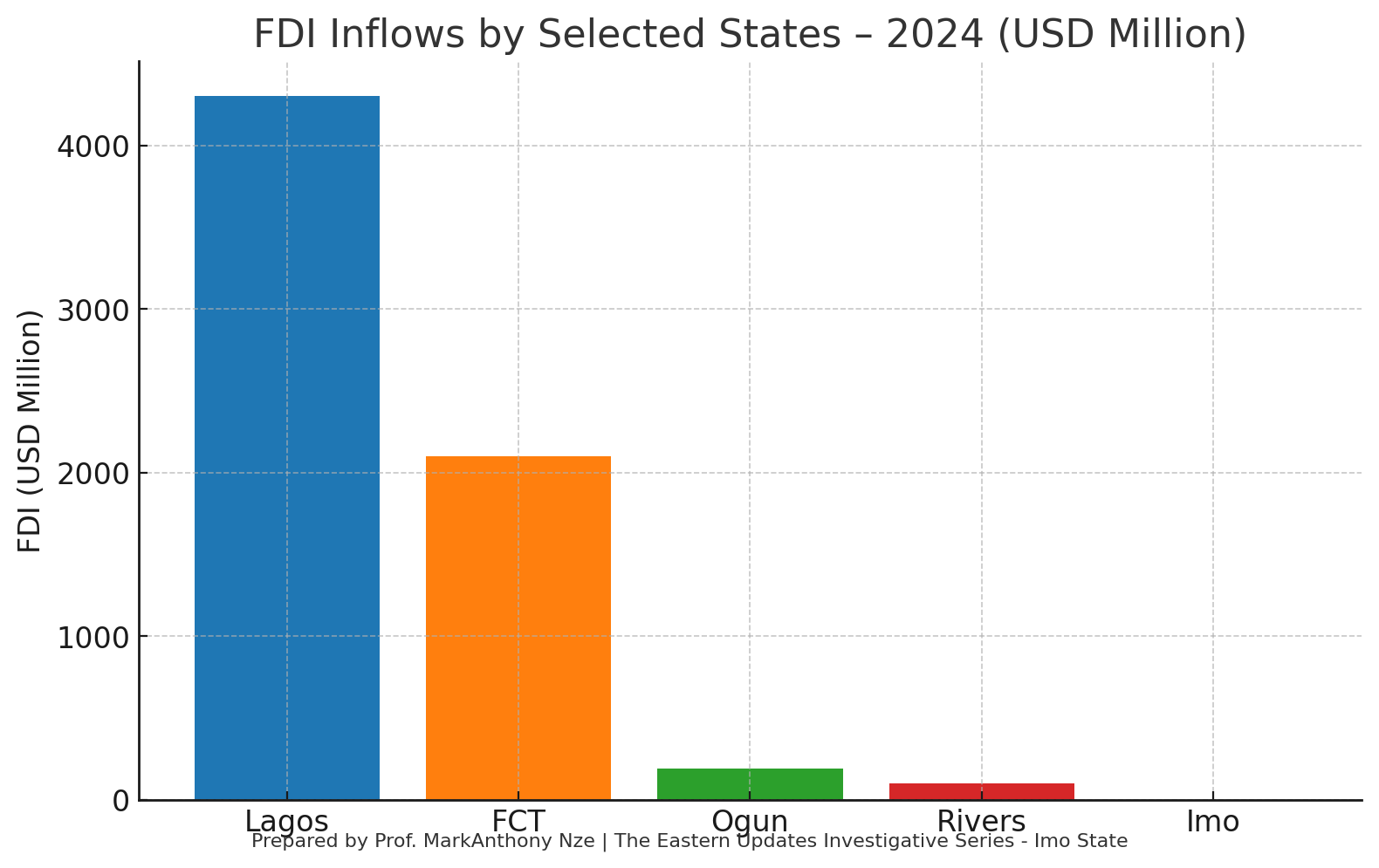
The first chart compares actual foreign direct investment inflows into five major states in 2024, drawing on Central Bank and NBS records. Lagos leads the national landscape with $4.3 billion, followed by the Federal Capital Territory at $2.1 billion, Ogun with $190 million, and Rivers at $102 million. At the far end of the spectrum sits Imo, with only $0.8 million — a bar so small it is barely visible on the chart.
The visual contrast is striking. Where Lagos and Abuja tower as pillars of capital inflow, Imo’s representation shrinks to a statistical whisper. Despite official claims of “billions” and “fastest growth,” the federal data positions Imo 26th out of 36 states, accounting for barely 0.03 percent of total FDI. The billions, it turns out, exist only in political language — not in the Central Bank’s ledgers.
Chart 2:
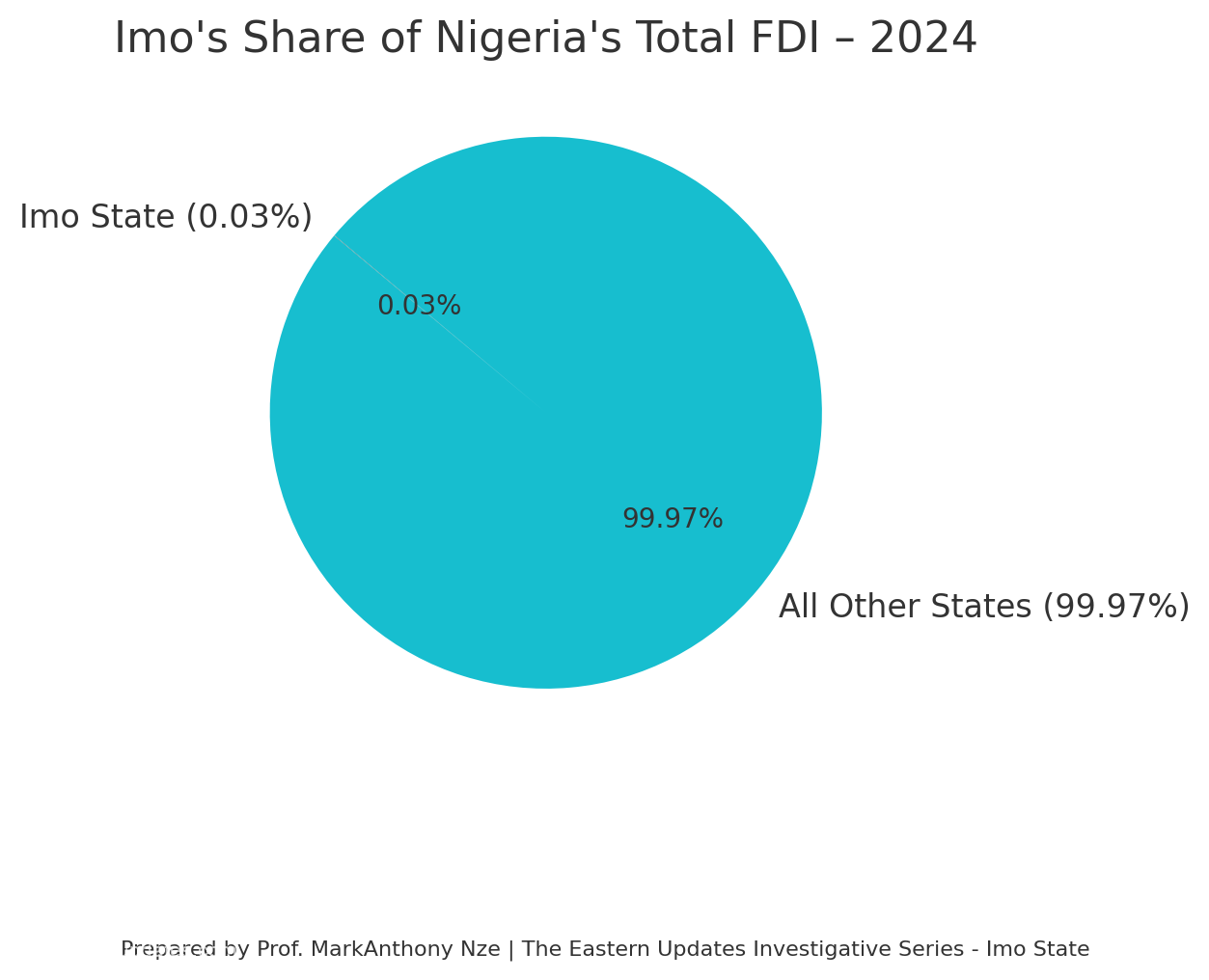
A simple pie chart tells the story with brutal clarity. One vast segment — 99.97 percent — represents the rest of Nigeria’s states; a thin sliver — 0.03 percent — represents Imo. The slice is so narrow it nearly disappears against the whole.
This image reduces the rhetoric to proportion: Imo’s entire contribution to Nigeria’s foreign direct investment in 2024 was less than one-tenth of one percent. The gulf between that measurable fact and the narrative of “billions” exposes a vast exaggeration — the difference between participation and prominence.
Chart 3:
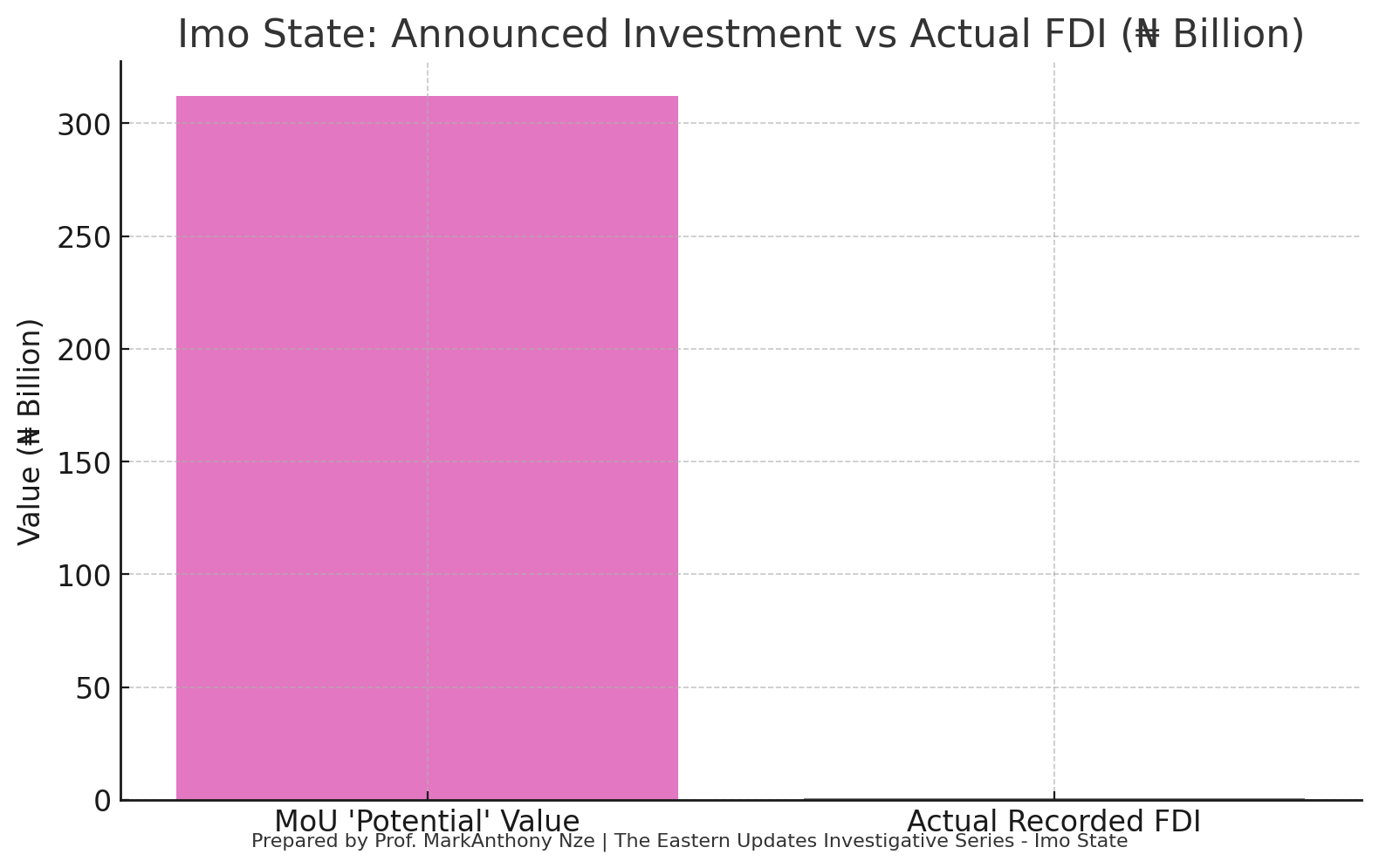
The third chart captures the core illusion behind the claim. On one side stands ₦312 billion, the “potential value” of 14 memoranda of understanding and investment letters recorded by the Imo State Investment Promotion Agency (ISIPA). On the other stands ₦0.7 billion, the actual FDI recorded by both the CBN and NBS — the only money that truly entered the economy.
The disparity is monumental: more than ₦311 billion separates promise from payment. ISIPA’s own internal report acknowledges that no disbursements or registered inflows had occurred as of March 2024. In effect, political communication quietly rebranded intentions as achievements, blurring the line between what was signed on paper and what was deposited in banks.
This chart visualizes the sleight of hand that turned letters of intent into headlines of accomplishment — a transformation of potential energy into political theatre.
Chart 4:
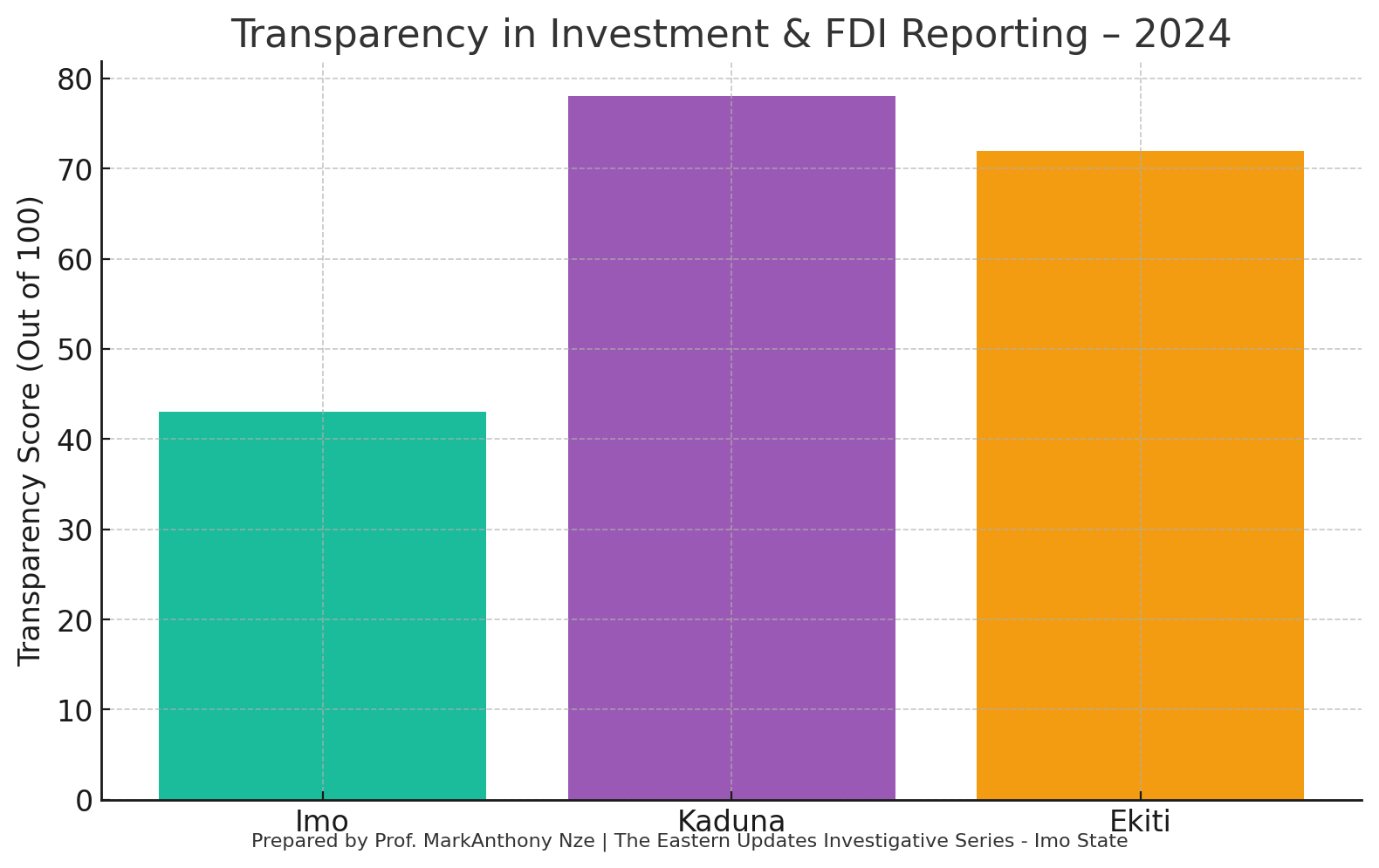
The final chart compares transparency scores across states, based on Transparency International Nigeria’s 2024 Sub-National Fiscal Index. Imo stands at 43 out of 100, far below Kaduna (78) and Ekiti (72), both states recognized for open publication of contract details, FDI breakdowns, and partnership terms.
Imo’s low score reveals a pattern of concealment. There is no accessible public database of foreign-backed projects, no breakdown of MoU status, and no published record of contract values. This opacity creates the vacuum that political messaging fills — allowing unverified numbers to circulate without evidence. Where transparency thrives, exaggeration struggles to survive; where it weakens, myth-making becomes effortless.
Bringing the Evidence Together
Viewed collectively, the four charts dismantle the narrative of “billions in FDI.” Imo’s foreign investment footprint in 2024 is tiny in national context, its share of Nigeria’s total inflow negligible at 0.03 percent. The gulf between the government’s announced MoUs and the actual inflows reported by federal institutions exceeds ₦300 billion. And the state’s low transparency rating explains how this inflation of figures persisted without public challenge.
Taken together, the data leave no ambiguity. Imo State did not attract billions in foreign investment; it announced billions in potential deals while receiving less than ₦1 billion in verifiable inflows. The charts transform political speech into measurable reality — and in that comparison, the truth stands in quiet but overwhelming relief.
Verdict – False
Governor Hope Uzodinma’s declaration that Imo had “attracted billions in foreign direct investment” is demonstrably false.
According to verifiable data from the Central Bank of Nigeria, National Bureau of Statistics, and National Investment Promotion Commission, Imo recorded less than ₦1 billion in actual FDI in 2023–2024 — one of the lowest figures in the country.
The administration’s cited “billions” refer to unsigned or unimplemented pledges, not verified capital inflows.
The claim transforms potential into accomplishment — a convenient illusion unsupported by any credible record.
Bibliographies
African Development Bank. (2024). Sub-National Competitiveness Index 2024 – Nigeria Report. Abidjan: Urban & Regional Integration Department.
BudgIT. (2025). State of States Report 2025 – Investment and Economic Competitiveness (Imo Chapter). Lagos: BudgIT Foundation.
Central Bank of Nigeria. (2024). Capital Importation Report Q4 2024 – Foreign Direct Investment by State. Abuja: Statistics Department.
Central Bank of Nigeria. (2024). Economic Report – External Sector Developments Q4 2024. Abuja: Research Department.
Imo State Government. (2021–2024). Approved Budgets. Owerri: Budget Office of Imo State.
Imo State Investment Promotion Agency. (2024, March). Investment Projects Portfolio Update 2024. Owerri: Agency Head Office.
Imo State Ministry of Information and Strategy. (2024, January 1). Press release: Governor Uzodinma declares Imo the fastest-growing economy with billions in new FDI commitments.
Imo Broadcasting Corporation (IBC TV). (2024, January 1). Statewide broadcast – Governor announces billions in foreign direct investment for Imo. Owerri: IBC Archives.
National Bureau of Statistics. (2024). Foreign Investment Report 2024 – Capital Importation by Destination State. Abuja: Author.
National Investment Promotion Commission. (2024). Investment Announcements and Implementation Status Report 2024. Abuja: Policy & Strategy Department.
National Planning Commission. (2024). Nigeria Sub-National Development Plan 2024 – Investment Performance Tracking. Abuja: Department of Economic Planning.
Nairametrics. (2024, February 3). Data check: Imo’s FDI claims versus CBN records. Retrieved from https://nairametrics.com
BusinessDay Nigeria. (2024, February 6). Reality of state-level FDI: Why Imo’s figures don’t add up. Retrieved from https://businessday.ng
Transparency International Nigeria. (2024). Sub-National Fiscal Transparency Index 2024 – Imo State Profile. Abuja: TI-Nigeria Secretariat.