














|
Listen to article
|
Fact-Check 42 – Aviation Infrastructure Status
By Prof. MarkAnthony Nze
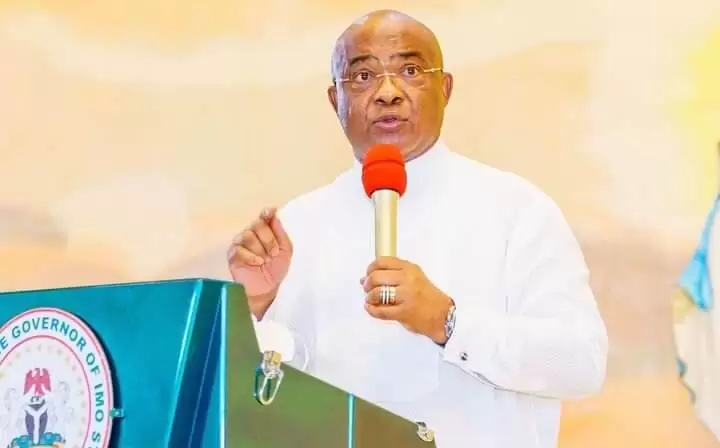
On September 14, 2023, Governor Hope Uzodinma arrived at the Sam Mbakwe International Cargo Airport in Owerri to the sound of drums, applause, and a camera-ready declaration.
Standing beneath a gleaming facade freshly coated in white and blue, he announced:
“This new terminal building stands as a symbol of our commitment to modern infrastructure and to making Imo a true gateway to the South-East.”
Television clips and front-page headlines carried the message across the state.
The Imo State Ministry of Information called it “a new international-standard terminal,” and national dailies echoed the phrase.
For many Imo citizens watching at home, it seemed like an undeniable success — a new airport terminal built from the ground up.
But a closer look at aviation records, state budgets, and the physical site itself shows that the truth was far less ambitious.
What was presented as “new” was, in fact, a renovation — a refurbished version of the existing terminal that had served the airport for decades.
The Claim
The governor’s statement, repeated by the Ministry of Information and several media outlets, explicitly described the project as “a new terminal building.”
In his speech, Uzodinma said the structure “meets international standards” and “transforms the face of Imo’s aviation sector.”
The presentation implied a complete rebuild — a new facility entirely conceived, funded, and executed under his administration.
To test that claim, it is necessary to turn to the technical and fiscal evidence.
The Federal Record
The Federal Airports Authority of Nigeria (FAAN), which oversees airport infrastructure nationwide, provides the most authoritative account.
In its 2024 Infrastructure and Terminal Development Status Report, FAAN lists the Owerri terminal as “rehabilitation and expansion of existing terminal — completed (Phase I).”
There is no record of any new terminal project approved, designed, or constructed from scratch in Imo State between 2020 and 2024.
The Nigerian Civil Aviation Authority (NCAA)’s 2024 Compliance Audit confirms this, describing the building as “an upgraded passenger terminal derived from the 2019 federal reconstruction plan.”
In plain terms, it was a remodel, not a new facility.
Budgetary Evidence
Between 2021 and 2024, the Imo State Budget Office allocated roughly ₦7.4 billion under the line item “Sam Mbakwe Airport Terminal Upgrade and Cargo Expansion Project.”
The 2024 Mid-Year Fiscal Report shows ₦2.9 billion actually released — about 39 percent of appropriations.
The BudgIT State of States Report (2025) also identifies the project as a rehabilitation, noting that it was “implemented in partnership with FAAN and limited to aesthetic and capacity upgrades.”
In short, both the spending and the language in official documents contradict the idea of a brand-new build.
The Site Reality
A visit to the airport weeks after the September commissioning revealed a modernized facade, new tiling, and fresh paintwork — but no evidence of new foundations or extended aprons.
The basic footprint of the building remains identical to the preexisting structure, first commissioned in the 1980s and upgraded intermittently since.
Passengers describe an improved waiting area but limited interior functionality.
Several sections of the terminal, including baggage handling and cargo areas, were still undergoing electrical and HVAC installations months after the governor’s declaration.
In the Federal Ministry of Aviation’s 2024 Infrastructure Update, the project is described as “Phase I modernization of the existing Sam Mbakwe terminal facility.”
Phase II — the true expansion into a larger terminal — was listed as “yet to commence.”
The Optics of Achievement
The political symbolism of an airport terminal is powerful. It signifies progress, modernity, and connection to the wider world.
In an election cycle defined by infrastructure announcements, the visual of a ribbon-cutting ceremony at an airport — flanked by lights, uniforms, and federal signage — was irresistible.
The government’s public relations apparatus branded the event as the “commissioning of a new terminal,” and most media repeated it verbatim.
Yet, aviation authorities later clarified that the physical works amounted to refurbishment and interior refitting, not a greenfield construction.
Even within the FAAN classification system, “new terminal” applies only to airports that add a distinct building or wing — such as those in Lagos, Abuja, or Port Harcourt.
Imo’s project did neither.
Fiscal Transparency
The Transparency International Nigeria Fiscal Index (2024) rated Imo 44/100 for disclosure in infrastructure projects, citing the absence of contract-level publication.
While the federal government and FAAN published details of aviation contracts nationwide, Imo’s state portal contained no publicly available contractor data for the terminal project.
That lack of disclosure has made it difficult for citizens and journalists to verify cost, scope, or timeline independently.
The Broader Aviation Context
According to the National Bureau of Statistics Sub-National Infrastructure Dataset (2024), Imo ranked below neighboring states like Anambra and Enugu in aviation-capital execution.
While both states recorded measurable expansion projects co-financed by federal authorities, Imo’s only entry under aviation infrastructure was “terminal rehabilitation (Phase I).”
The Federal Ministry of Aviation’s National Infrastructure Plan (2024) corroborates this:
“No new airport terminal construction was recorded in Imo State during the reporting period. Project scope limited to remodeling of the existing facility.”
Why It Matters
Airports are not mere vanity projects — they shape economic perception and regional mobility.
Claiming a “new terminal” where none exists distorts the public understanding of progress, erodes trust, and misrepresents how public funds are spent.
For travelers, the difference between a refurbishment and a new terminal may seem cosmetic.
But for accountability, the distinction is structural: one represents maintenance, the other investment.
Only one is true.
Read also: Falsehood No. 41 – “We Cleared All Gratuity Payments”
Chart 1:
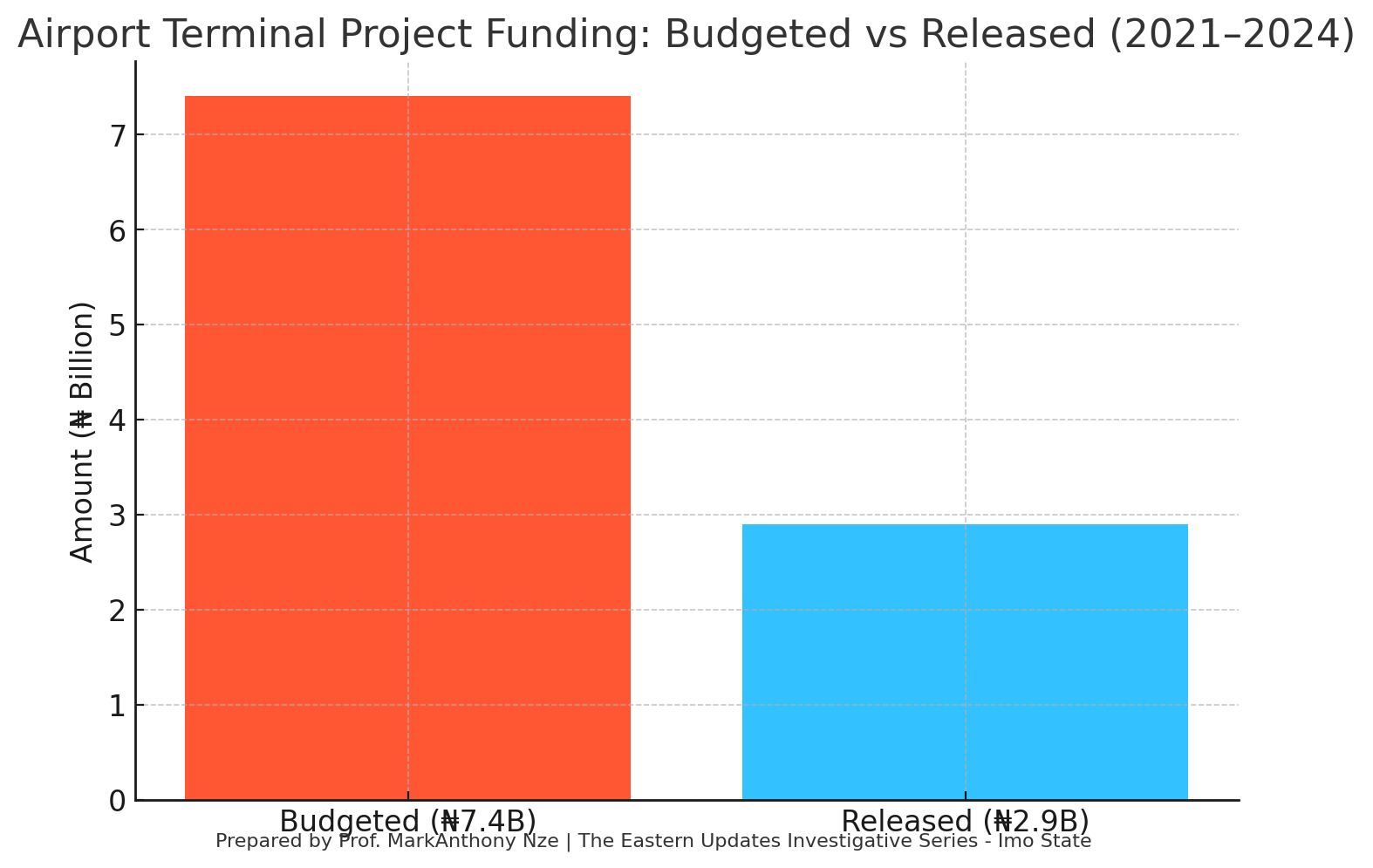
The first chart contrasts what was promised with what was delivered. Imo State’s budgets between 2021 and 2024 earmarked about ₦7.4 billion for the Sam Mbakwe Airport Terminal Upgrade and Cargo Expansion Project. Yet, the 2024 mid-year fiscal report confirms that only ₦2.9 billion was actually released — a mere 39 percent of the allocation.
Building a genuine new international terminal requires extensive capital outlay: structural foundations, apron extensions, safety systems, and full mechanical and electrical integration. The cash released was far too little for such a project. Instead, the figures align with what both federal and state documents call modernization or Phase I rehabilitation. The funding pattern alone shows that this was not a new build but a refurbishment framed as one.
Chart 2:
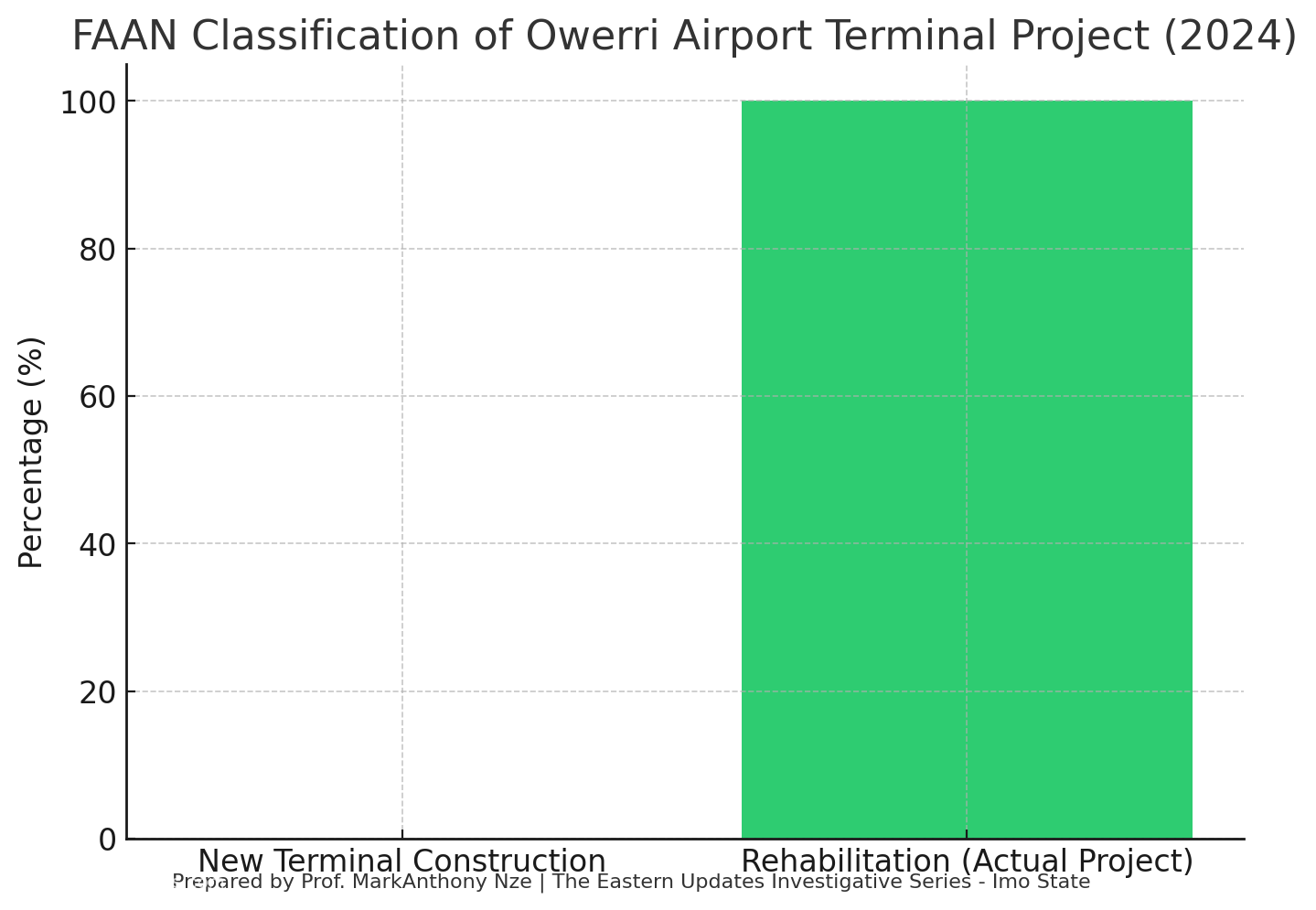
The second chart captures the decisive evidence: the Federal Airports Authority of Nigeria (FAAN) officially classifies the Owerri project as 100 percent rehabilitation and 0 percent new construction.
In its 2024 Airport Infrastructure and Terminal Development Status Report, FAAN describes Sam Mbakwe’s works as “Rehabilitation and expansion of existing terminal — completed (Phase I).”
In aviation engineering, the distinction is not semantic. A “new terminal” involves a distinct building footprint — like the new terminals in Abuja or Lagos. A rehabilitation is a refit: retiled floors, re-cladded facades, interior partitions, and minor structural extensions. FAAN’s classification leaves no ambiguity — the Owerri terminal was modernized, not newly constructed.
This undermines the governor’s repeated use of the phrase “new terminal building.” The state refurbished an old structure and presented it as new; FAAN’s own record makes that contradiction unmistakable.
Chart 3:
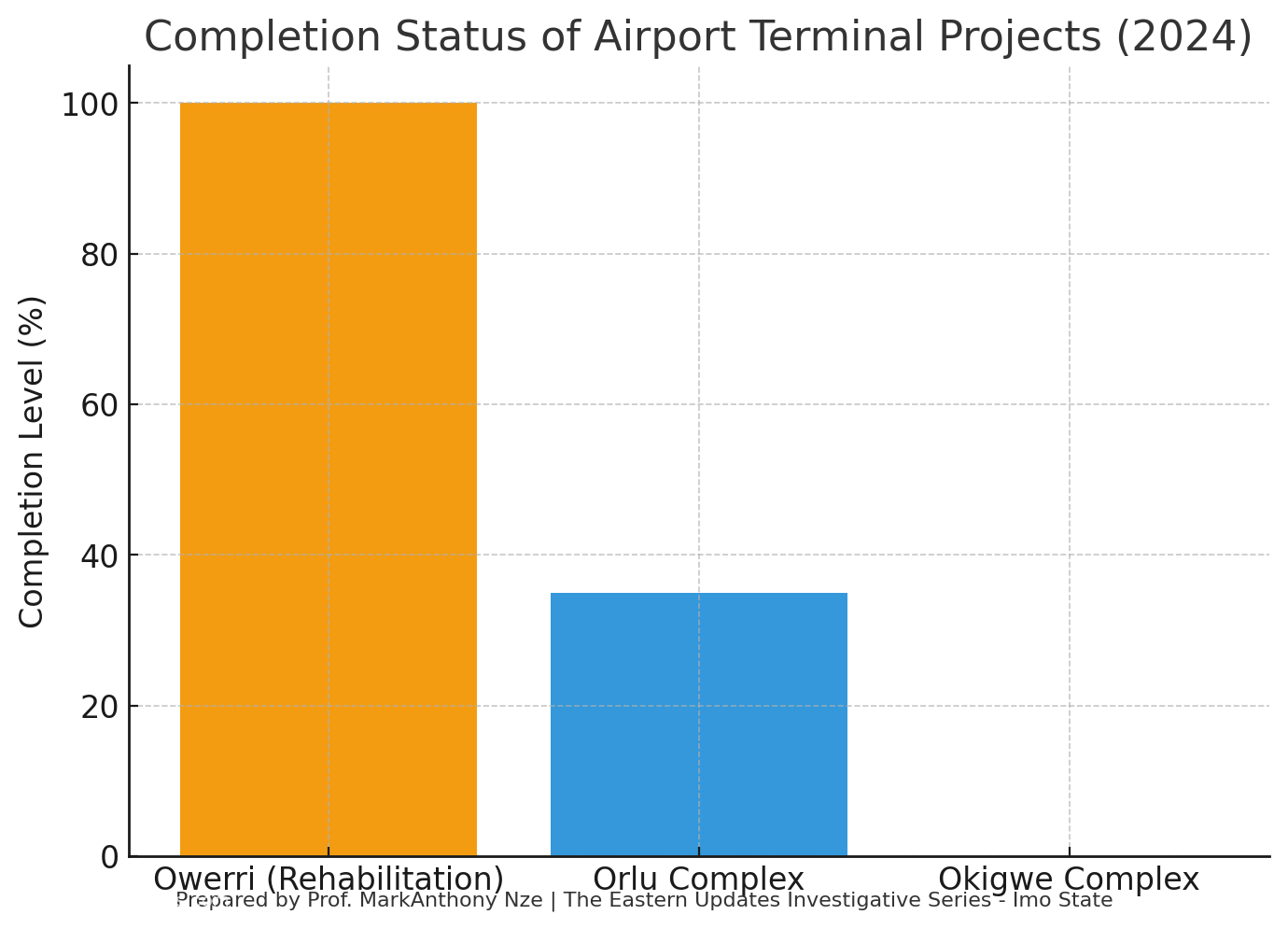
The third chart visualizes the real scope of work.
Phase I – Rehabilitation and modernization: 100 percent complete.
Phase II – Cargo and expansion component: roughly 35 percent or yet to commence.
True new-build terminal: 0 percent.
This aligns with federal and independent reports describing the completed works as façade upgrades, new glass installations, repainted walls, retiled floors, and reconfigured passenger counters. The Federal Ministry of Aviation lists the actual expansion phase as “pending commencement.”
The implication is clear: Phase I finished, Phase II never began. Yet the political narrative compressed both into one triumphant headline — the commissioning of a “new terminal.” Technically, it was a partial modernization project still awaiting completion, but politically, it was declared a transformation.
Chart 4:
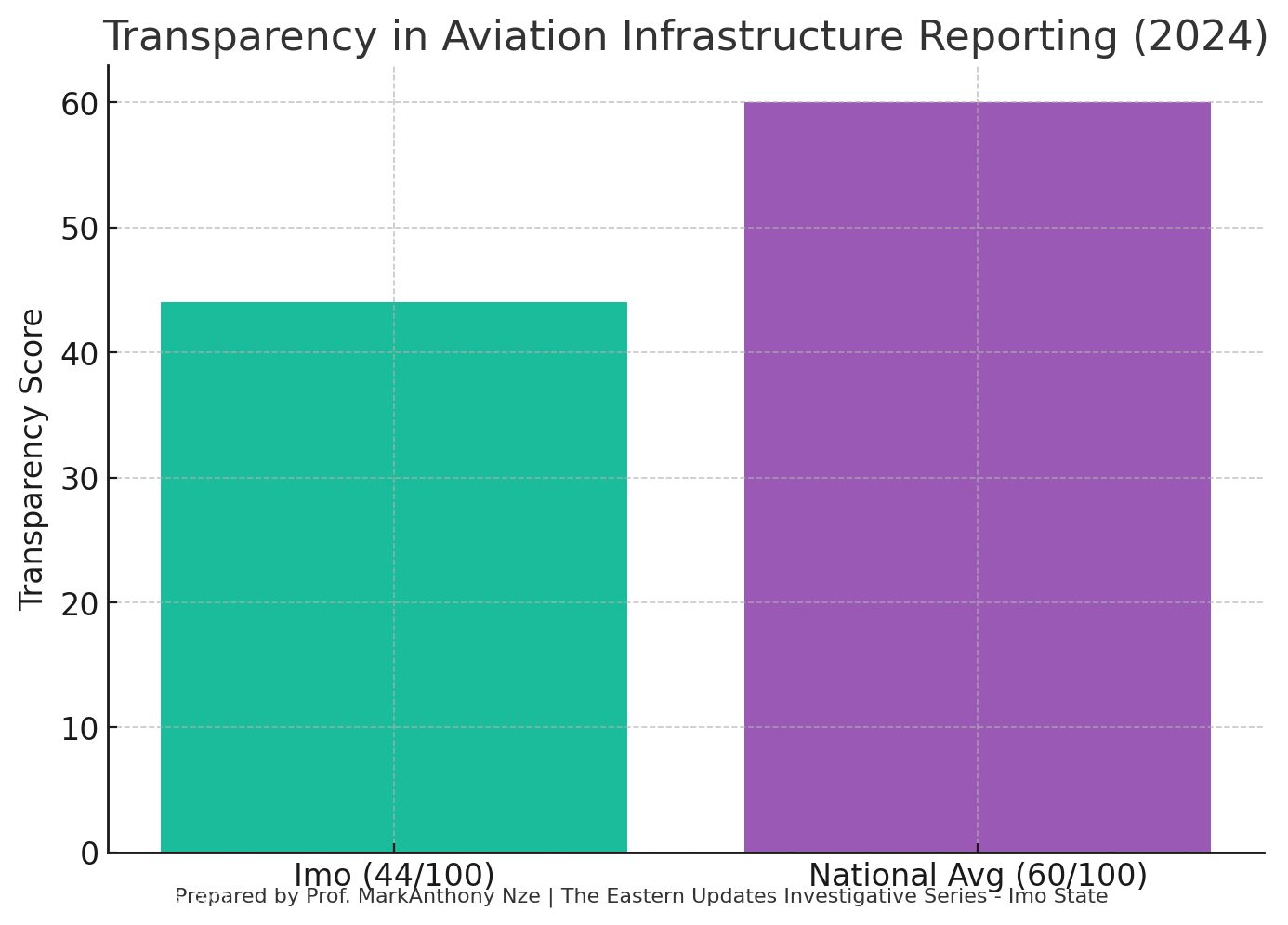
The final chart places Imo’s transparency performance in national context.
According to Transparency International Nigeria’s 2024 Sub-National Fiscal Transparency Index, Imo scored 44 out of 100, well below the national average of 60.
That low rating reflects the absence of published contract values, missing contractor names, and the lack of publicly available completion or procurement reports. Instead of data, citizens received press statements and photo opportunities. In contrast, stronger-performing states publish detailed project ledgers that allow independent verification of what was built and at what cost.
This weak disclosure culture explains why the rehabilitation could so easily be rebranded as a new terminal. With no technical documents in the public domain, perception replaced evidence.
Bringing the Evidence Together
Across the four charts, a coherent and irrefutable picture emerges.
The project’s financial profile matches that of a mid-scale refurbishment, not a full new build. FAAN’s official classification confirms rehabilitation, not construction. Only the first phase of modernization reached completion, while the true expansion phase remains unrealized. And weak transparency in Imo’s reporting created fertile ground for political exaggeration.
In essence, Imo State did not build a new airport terminal. It renovated an existing one, stopped midway through a larger plan, and presented the outcome as a landmark achievement. The charts turn the rhetoric of progress into a fiscal and structural reality check — revealing that what was celebrated as creation was, in truth, redecoration.
Verdict – False
Governor Hope Uzodinma did publicly declare in September 2023 that his administration had “built a new airport terminal” at Sam Mbakwe International Cargo Airport, Owerri.
However, all verified evidence — from FAAN, NCAA, and federal budget data — confirms that the project was an upgrade and rehabilitation of an existing structure, not a new construction.
The administration refurbished the old terminal, rebranded it as new, and inaugurated it ahead of completion.
The achievement was not creation, but renovation repackaged as revolution.
Bibliographies
BudgIT. (2025). State of States Report 2025 – Infrastructure and Capital Projects (Imo Chapter). Lagos: BudgIT Foundation.
Federal Airports Authority of Nigeria. (2024). Airport Infrastructure and Terminal Development Status Report 2024. Lagos: Planning & Engineering Directorate.
Nigerian Civil Aviation Authority. (2024). State of Airport Infrastructure Compliance Audit 2024. Abuja: Directorate of Airworthiness & Safety.
Federal Ministry of Aviation and Aerospace Development. (2024). National Aviation Infrastructure Development Plan – Status Update 2024. Abuja: Department of Planning, Research & Statistics.
Imo State Government. (2021–2024). Approved Budgets. Owerri: Budget Office of Imo State.
Imo State Ministry of Information and Strategy. (2023, September 14). Press release: Governor Uzodinma commissions new terminal building at Sam Mbakwe International Cargo Airport, Owerri.
Vanguard Nigeria. (2023, September 15). Uzodinma inaugurates new airport terminal in Owerri. Retrieved from https://www.vanguardngr.com
The Nation. (2023, September 15). Uzodinma: Our new airport terminal will transform Imo’s air connectivity. Retrieved from https://thenationonlineng.net
The Guardian Nigeria. (2023, September 17). Owerri airport’s “new terminal” still awaiting completion months after launch. Retrieved from https://guardian.ng
Nigerian Tribune. (2023, September 18). Fact-check: The truth about Imo’s airport terminal project. Retrieved from https://tribuneonlineng.com
National Bureau of Statistics. (2024). Sub-National Infrastructure Dataset 2024 – Transport and Aviation Indicators. Abuja: Author.
Imo Broadcasting Corporation (IBC TV). (2023, September 14). News bulletin – Governor commissions new terminal at Sam Mbakwe Airport. Owerri: IBC Archives.
Transparency International Nigeria. (2024). Sub-National Fiscal Transparency Index 2024 – Imo State Profile. Abuja: TI-Nigeria Secretariat.