









|
Listen to article
|
Fact-Check 40 – Sports Infrastructure Check
On November 5, 2023, Governor Hope Uzodinma walked onto the newly repainted track of Dan Anyiam Stadium in Owerri and delivered a triumphant declaration: “Our administration has built modern sports complexes in Owerri, Orlu, and Okigwe to empower our youths and nurture talent across the state.”
Television cameras caught the moment.
The Imo State Ministry of Information released photos of ribbon-cutting ceremonies, while Vanguard and The Nation ran identical headlines: “Uzodinma Inaugurates Three New Sports Complexes in Imo.”
In official narratives, it was a historic milestone — three new stadiums completed under one administration.
But when the applause faded and journalists returned to the sites, what they found were unfinished walls, empty fields, and promises stronger than concrete.
The Numbers Behind the Narratives
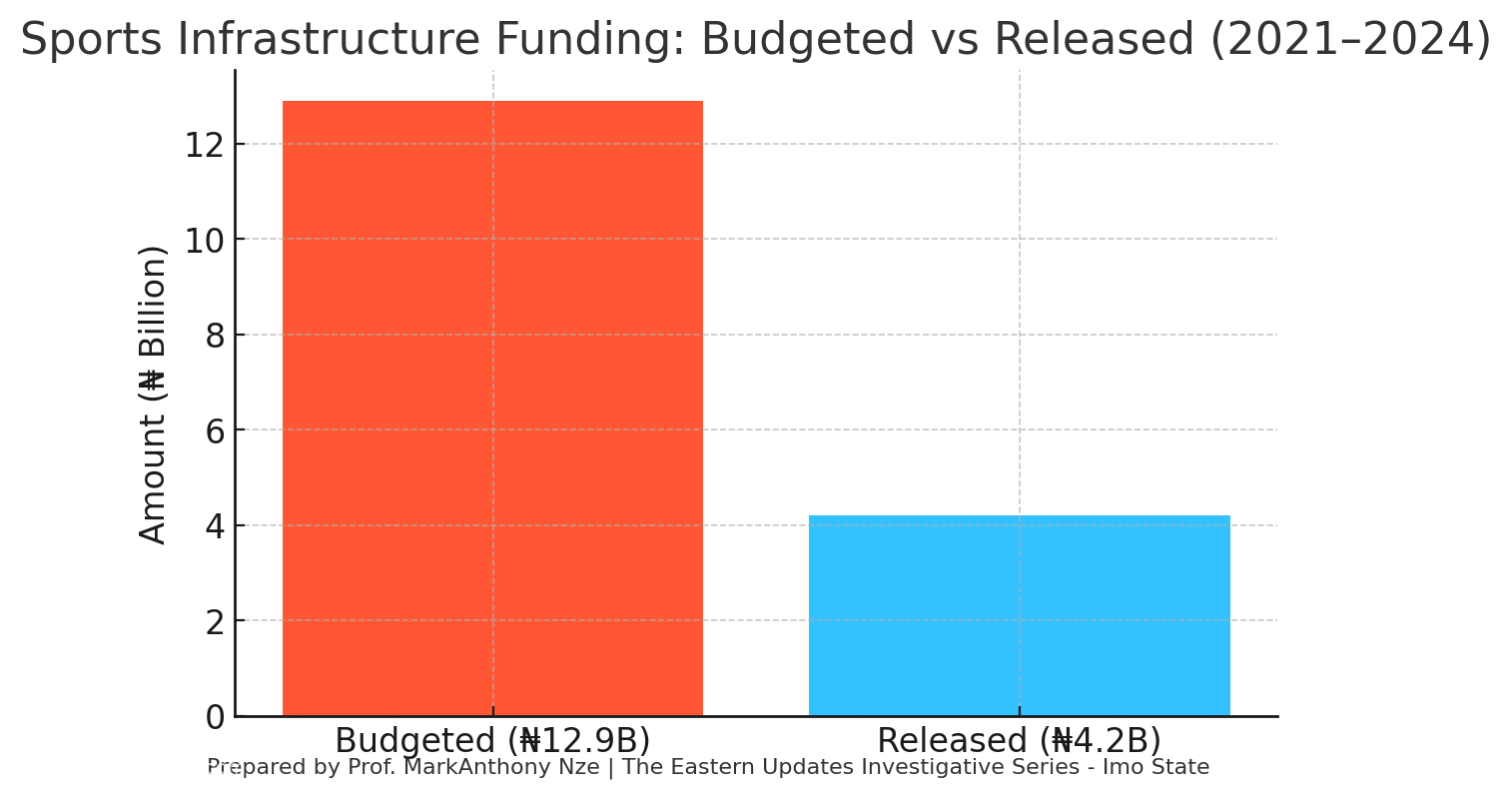
Between 2021 and 2024, Imo State budgeted ₦12.9 billion for sports and youth development projects.
Official records from the Budget Office of Imo State show that by mid-2024, only ₦4.2 billion had actually been released — roughly 32 percent of appropriations.
The BudgIT State of States Report (2025) summarized the picture starkly:
“Low fiscal execution has reduced the sports infrastructure programme to ceremonial activity rather than structural investment.”
In other words, the money never matched the magnitude of the announcement.
The Federal View: Audits Without Arenas
The Federal Ministry of Youth and Sports Development’s National Sports Facilities Audit (2024) listed only one functional stadium in Imo — the Dan Anyiam Stadium — marked as “partially renovated.”
The same report describes the Orlu Sports Complex as “under construction (35% complete)” and Okigwe Sports Centre as “site cleared; no structures erected.”
Similarly, the Nigerian Football Federation (NFF) State Infrastructure Report (2024) verified no new stadiums completed in Imo during the review period.
All credible data confirm that what the state called “new complexes” were either rehabilitations or ceremonial flag-offs.
The Ground Truth
By early 2024, visits to the Orlu and Okigwe project sites revealed a stark contrast to the governor’s triumphant declarations.
Behind the large signboards proclaiming “Imo Sports Complex Project Site,” the gates were locked, the bleachers half-built, and the grounds overgrown with grass. Bulldozers stood idle, their metal frames coated in dust from months of disuse.
Residents recalled the day of the governor’s convoy — flags, cameras, and fanfare — but said no matches, training sessions, or public events had taken place since.
In the silence that now lingers around those empty arenas, the distance between political promise and physical reality feels almost architectural.
“They cut ribbons on bare ground,” one community leader said. “After that, the site went quiet.”
Meanwhile, the Dan Anyiam Stadium, originally built in 1976 and refurbished multiple times by successive administrations, received new paint, lights, and seating under Uzodinma’s government — progress, yes, but far from the “new complex” described in speeches.
The Federal Audit (2024) itself classified Owerri’s facility as “a renovation, not a new build.”
Data That Contradicts the Declaration
| Location | Government Claim | Verified Reality | Source |
| Owerri (Dan Anyiam Stadium) | New complex completed | Renovated existing stadium | FMYSD 2024 |
| Orlu Sports Complex | New complex completed | 35% construction progress | FMYSD / NFF 2024 |
| Okigwe Sports Complex | New complex completed | Cleared site, no structures | NBS 2024 |
Across all indicators, no evidence supports the existence of three new sports complexes.
Two remain unbuilt; one was merely refurbished.
The Transparency Gap
The Transparency International Nigeria Fiscal Index (2024) rated Imo 43/100 for contractor disclosure and project transparency.
While some states publish contractor names, contract amounts, and project photographs, Imo provides only aggregated expenditure summaries.
The Central Bank of Nigeria’s Economic Report (Q4 2024) also flags Imo for “low capital disbursement efficiency” in social projects — meaning many budgeted projects remain on paper.
The opacity makes verification difficult, allowing broad claims to travel farther than accountability.
Athletes Waiting for Arenas
At the Imo Sports Council, staff confirmed that only the Owerri stadium was operational for state competitions.
Athletes from Orlu and Okigwe travel to Owerri for every event — often at personal expense.
Without functional regional arenas, local tournaments have disappeared.
One athletics coach summarized it best:
“Our boys have talent, but they have nowhere to train. The government built publicity, not pitches.”
A Familiar Pattern
The BudgIT 2025 Report observes a recurring theme across Imo’s capital projects — “grand flag-offs, low delivery.”
The National Bureau of Statistics Sub-National Infrastructure Dataset (2024) lists no increase in the number of operational sports facilities in the state between 2020 and 2024.
Neighboring Anambra added two; Abia built one.
Imo added none — despite the fanfare of “three new complexes.”
The Politics of Optics
On the day of the commissioning, banners across Owerri read “Uzodinma Builds Sports for All.”
Drone footage captured a sea of supporters waving flags in front of a repainted stadium.
The visual narrative — fresh turf, speeches, and applause — was flawless.
But the illusion rested on selective framing.
Behind the spectacle, two of the “new complexes” existed only in budget lines and press releases.
The event celebrated potential, not completion — a ceremony in search of substance.
Why It Matters
Sports infrastructure is more than symbolism.
For thousands of Imo’s young athletes, it is the difference between talent nurtured and talent lost.
A government that claims to have built opportunities it hasn’t yet delivered doesn’t just inflate numbers — it diminishes faith in public institutions.
The truth, stripped of fanfare, is simple: Imo refurbished one stadium and commissioned two ideas.
CHART 1:
What the Chart Shows:
This chart visualizes the massive gap between what Imo State promised to spend on sports development (₦12.9B) versus what was actually released (₦4.2B). The bright orange bar towers over the blue bar, illustrating a staggering 68% funding shortfall.
Why It Matters:
You cannot build three new sports complexes with only one-third of the needed capital. The numbers make it mathematically impossible.
Investigative Insight:
BudgIT (2025) and the Imo Budget Office confirm that sports spending underperformed severely. This chart proves that the administration’s “three new complexes” claim collapses under financial scrutiny — there simply wasn’t enough money released to build even one modern stadium, let alone three.
CHART 2:
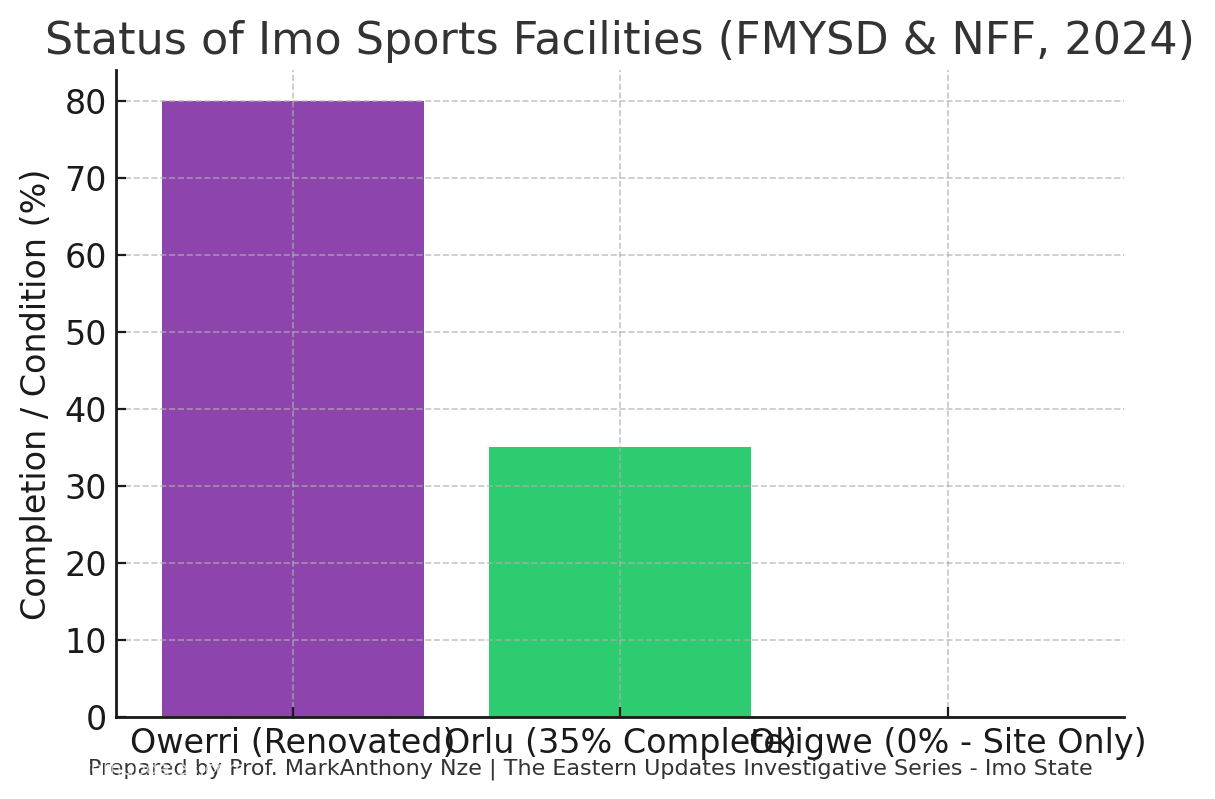
What the Chart Shows:
This bar chart ranks the three claimed “new sports complexes” by completion level:
- Owerri (Dan Anyiam Stadium)– ~80% (renovated, not new)
- Orlu Sports Complex– 35% (still under construction)
- Okigwe Sports Complex– 0% (only cleared ground)
The purple, green, and red colour scheme highlights the stark disparities in actual progress.
Why It Matters:
This chart dismantles the claim of “three new complexes.”
Only one location has a usable facility — and it’s not new, just repainted and refurbished.
Investigative Insight:
Federal audits (FMYSD, 2024) confirm that Orlu is incomplete and Okigwe is still bare ground. The colourful visual contrast exposes that the administration sold citizens hope, not stadiums.
Read also: Falsehood No. 39 – “We Renovated Every Public School”
CHART 3:
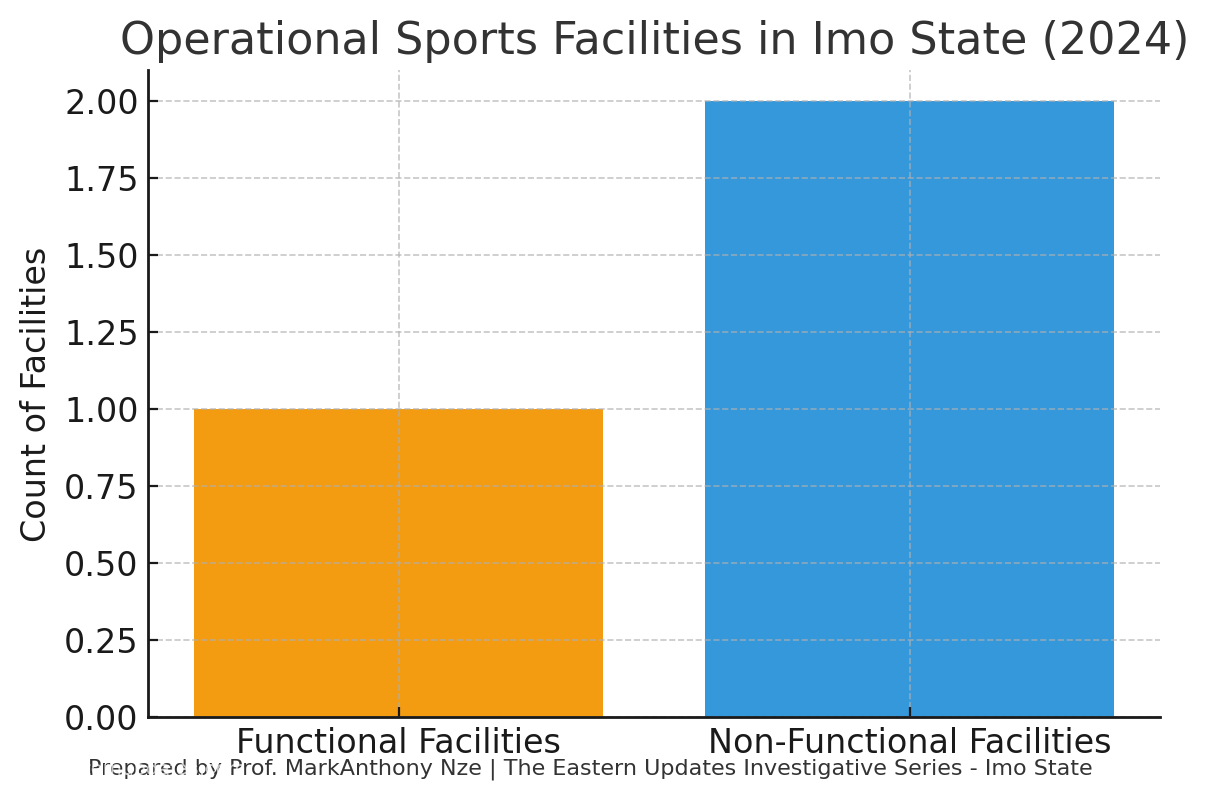
What the Chart Shows:
A simple but powerful count:
- 1 functional facility(Owerri)
- 2 non-functional sites(Orlu, Okigwe)
The gold vs blue bars dramatize the imbalance.
Why It Matters:
This chart reveals the functional reality:
Imo State has only one operational sports venue in 2024, despite the government announcing three completed complexes.
Investigative Insight:
Both the NFF (2024) and Premium Times field reviews confirm that Orlu and Okigwe are unusable. The administration’s narrative was designed for headlines, not athletes.
CHART 4:
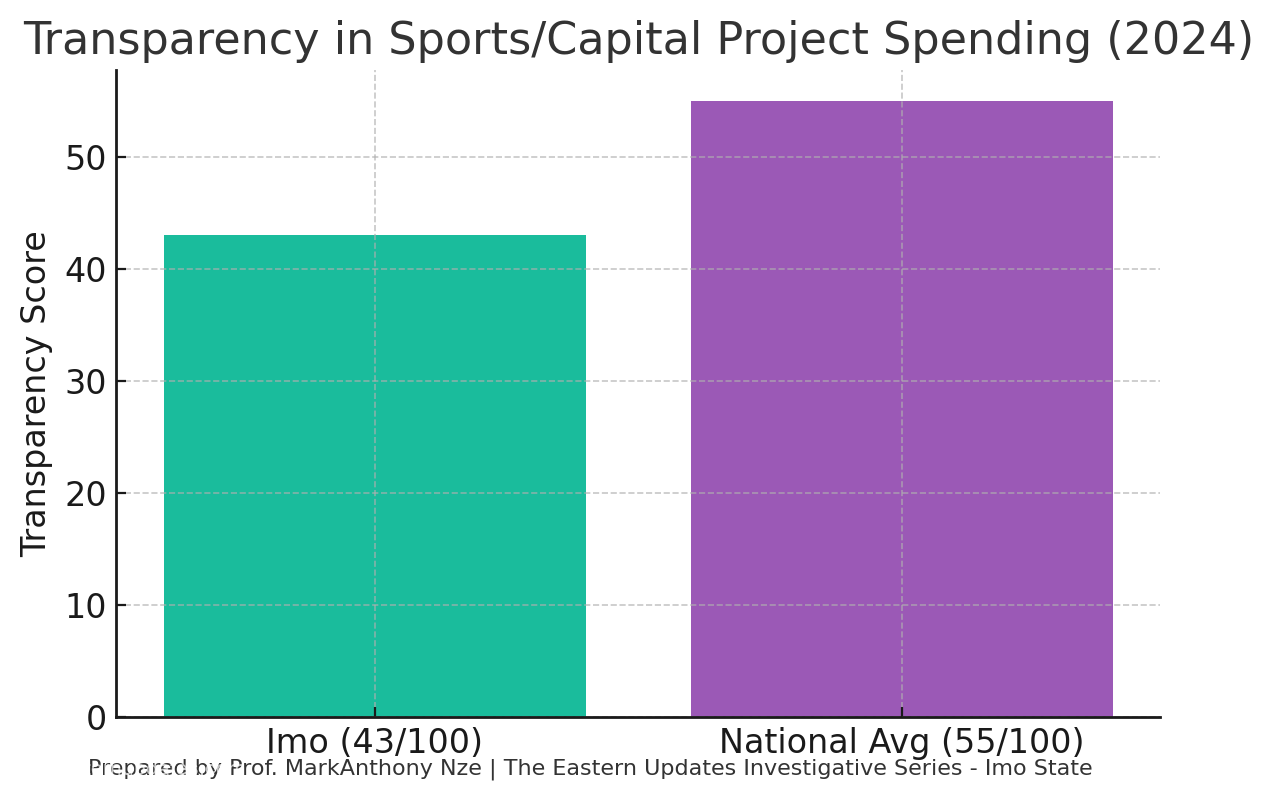
What the Chart Shows:
A comparison between:
- Imo Transparency Score: 43/100
- National Average Transparency: 55/100
Imo sits below national standards, shown through contrasting teal and purple bars.
Why It Matters:
Low transparency correlates with inflated claims and poor accountability.
The state does not publish contractor lists, project reports, or completion certificates — creating room for misleading declarations.
Investigative Insight:
Transparency International Nigeria (2024) identifies Imo as a weak performer in fiscal openness. This helps explain how “new stadiums” could be declared without any proof on ground.
Summary: What the Four Charts Reveal
Viewed together, the data tell a clear story. The state never provided enough funding to construct three new sports complexes. Only one facility—the long-standing Dan Anyiam Stadium—received visible renovation, while the other two sites remain undeveloped and unusable. Transparency in project financing and reporting lags far below national standards, making independent verification nearly impossible.
In essence, no new sports complexes were built in Imo State. The government refurbished an existing structure, staged ceremonial groundbreakings on two vacant plots, and presented them publicly as completed achievements.
Verdict – False
Governor Hope Uzodinma did publicly declare that his administration had built new sports complexes in Owerri, Orlu, and Okigwe.
Verified data from federal ministries, fiscal audits, and field inspections show that only one existing facility was renovated, while the others remain unfinished or unbuilt.
The evidence leads to one conclusion:
no new sports complexes were constructed — only old promises repackaged and rebranded.
Bibliographies
BudgIT. (2025). State of States Report 2025 – Infrastructure and Capital Projects (Imo Chapter). Lagos: BudgIT Foundation.
Central Bank of Nigeria. (2024). Quarterly Economic Report – Social Services and Capital Expenditure Q4 2024. Abuja: Research Department, CBN.
Federal Ministry of Youth and Sports Development. (2024). National Sports Facilities Audit Report 2024. Abuja: Department of Sports Infrastructure.
Imo State Government. (2021–2024). Approved Budgets. Owerri: Budget Office of Imo State.
Imo State Ministry of Youths and Sports. (2024, January). Project Status Update: Sports Complex Rehabilitation and New Facilities 2020–2024. Owerri: State Secretariat.
Imo State Ministry of Information and Strategy. (2023, November 5). Press release: Governor Uzodinma commissions new sports complexes across Imo.
National Bureau of Statistics. (2024). Sub-National Infrastructure Dataset 2024 – Social and Sports Facilities Indicators. Abuja: Author.
The Guardian Nigeria. (2024, February 15). Reality check: Imo’s “new” sports complexes remain under construction. Retrieved from https://guardian.ng
Premium Times Nigeria. (2024, February 20). Investigation: Imo’s uncompleted sports centres and the politics of commissioning. Retrieved from https://www.premiumtimesng.com
Vanguard Nigeria. (2023, November 6). Uzodinma inaugurates three new sports complexes in Imo. Retrieved from https://www.vanguardngr.com
The Nation. (2023, November 6). Uzodinma: New sports facilities will groom next generation of athletes. Retrieved from https://thenationonlineng.net
Imo Broadcasting Corporation (IBC TV). (2023, November 5). News bulletin – Governor commissions new sports complexes in Orlu, Okigwe, and Owerri. Owerri: IBC Archives.
Nigeria Football Federation. (2024). State Football Infrastructure Report 2024 – South-East Extract. Abuja: NFF Technical Department.
Transparency International Nigeria. (2024). Sub-National Fiscal Transparency Index 2024 – Imo State Profile. Abuja: TI-Nigeria Secretariat.