











|
Listen to article
|
Fact-Check 39 – School Infrastructure Data
By Prof. MarkAnthony Nze
On World Teachers’ Day, 10 October 2023, Governor Hope Uzodinma stepped to the podium in Owerri with a promise polished into perfection.
“Every public school in Imo State has been renovated and equipped for modern learning,” he declared to cheers from teachers and administrators gathered under government tents.
The announcement, delivered with the cadence of victory, traveled quickly. The Imo State Ministry of Information issued a press release celebrating a “total transformation of the education sector.”
Headlines followed: “Uzodinma: We Have Renovated Every Public School in Imo” (Vanguard, Oct. 11, 2023).
In the narrative of governance, the classroom had become a symbol of renewal — proof that the state’s children were learning in comfort at last.
But numbers, audits, and the silence of neglected villages told a more stubborn truth.
The Numbers Behind the Applause
Between 2021 and 2024, Imo State budgeted approximately ₦22.7 billion for school renovation and rehabilitation.
By mid-2024, only ₦8.3 billion had been released — roughly 37 percent of what was promised.
That shortfall alone dismantles any notion of a completed statewide overhaul.
The BudgIT State of States Report (2025) placed Imo in the bottom third of Nigeria’s 36 states for education capital-project execution.
Its analysis notes that most renovation contracts were concentrated in urban centers like Owerri Municipal and Orlu, while rural LGAs remained largely untouched.
The financial trail suggests selective progress, not universal achievement.
Classrooms That Tell a Different Story
The Federal Ministry of Education’s National School Infrastructure Census (2024) documented 1,187 public schools across Imo. Of these, only 54 percent were classified as “in good condition.”
A further 31 percent needed partial rehabilitation, while 15 percent were deemed “dilapidated or unsafe.”
The UBEC Annual Infrastructure Report (2024) lists just 182 renovated classrooms under joint state–federal funding between 2020 and 2023 — a figure far from “every school.”
Across communities in Mbaitoli and Ideato North, the story written in paint and plaster tells a different tale.
Several school buildings stand freshly coated in bright colors at the front — yet step inside, and the illusion fades. Walls are cracked, floors are uneven, and ceilings still drip when it rains.
Teachers recall hurried touch-ups before inspection visits, when workers arrived to repaint a single block while the rest of the compound remained untouched.
“They painted for the cameras,” one headmistress said quietly. “But when the rain comes, we still move the pupils into the corridor.”
In the government’s version, every roof had been fixed.
In the real classrooms of Imo, many still leak — not just water, but the truth about what was truly renovated and what was merely repainted.
The Teachers’ Truth
The Nigerian Union of Teachers (NUT) Imo Chapter, in its 2024 Annual Report, confirmed that while a few schools benefited from new desks and roofs, many rural ones still lack water, toilets, or functioning classrooms.
Projects in Ngor Okpala and Onuimo were suspended midway through 2023, pending “cash backing.”
The report’s conclusion was as unsparing as it was accurate:
“School renovation in Imo remains selective, not comprehensive.”
Independent and Federal Audits
The National Bureau of Statistics (2024), in its Sub-National Education Infrastructure Dataset, records Imo’s classroom improvement at a modest 6 percent between 2020 and 2023 — one of the lowest growth rates in the South-East.
The UNICEF Learning Environment Assessment (2024) noted “visible disparities between urban and rural school infrastructure,” highlighting overcrowded classrooms and decaying sanitation in rural districts.
Even the Central Bank of Nigeria’s Economic Report (Q4 2024) observed that Imo’s education-sector spending “did not translate into proportional infrastructure output.”
The data, from every credible angle, converges on a single point: the governor’s sweeping claim is empirically indefensible.
Painted Walls, Persistent Shadows
A drive through Owerri reveals clean facades and new signage on select secondary schools — the visual proof of renewal.
But drive twenty kilometers out, and the paint fades fast.
In Eziama Obaire, The Guardian Nigeria photographed pupils studying beneath a mango tree, their classroom abandoned due to structural cracks.
In Nekede, a public secondary school uses chalkboards balanced against broken walls.
In Okigwe, parents raised funds to replace windows shattered by windstorms years ago.
The story that emerges is not of deceit, but of political overreach — a state that did something and called it everything.
Transparency Deficit
Transparency International Nigeria’s Fiscal Disclosure Index (2024) scored Imo 42 out of 100 for openness in education spending — below the national average.
Unlike Kaduna or Edo, which publish school-by-school renovation lists, Imo offers only summary figures without project locations or contractor details.
That opacity allows political declarations to outshine data.
In a state where citizens cannot verify which school was truly renovated, truth becomes negotiable.
Why It Matters
Infrastructure is the visible promise of governance.
When leaders exaggerate its reach, it is not merely a statistical error; it is an erosion of public trust.
For the pupils sitting on cracked benches in Njaba or learning under leaking roofs in Ideato, the difference between “every school” and “some schools” is the difference between learning and leaving.
Chart 1:
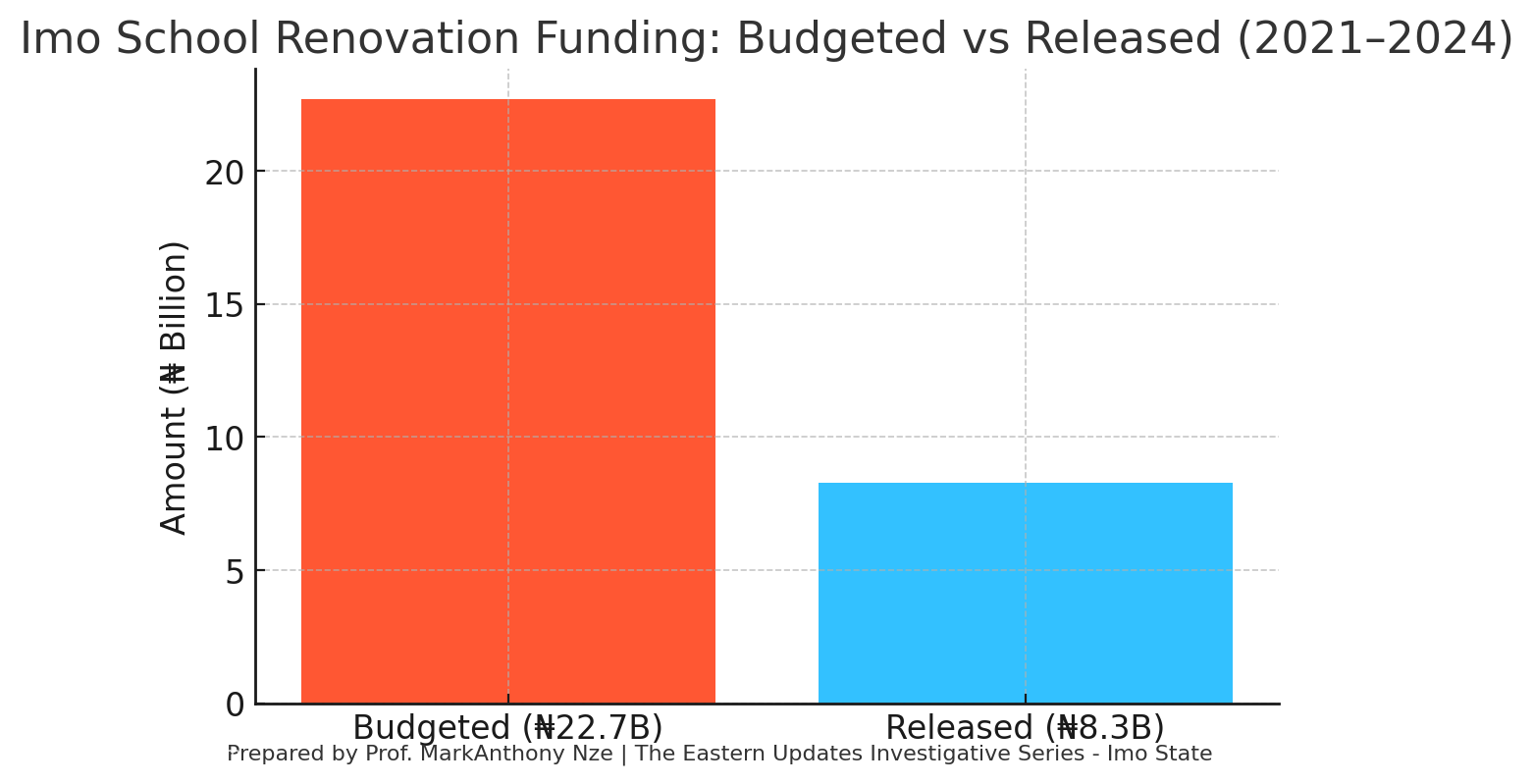
This chart highlights the core discrepancy between government promises and financial reality. Imo State budgeted ₦22.7 billion for school renovation across four years. However, only ₦8.3 billion — just 37% of the allocation — was actually released. The striking difference between the tall budget column and the much shorter released-fund column visually exposes the financing gap. A programme cannot be “completed statewide” when more than ₦14 billion in planned funding never reached the project pipeline. This chart is the first evidence that Governor Uzodinma’s declaration of “renovating every public school” lacked the financial backing necessary to achieve such a sweeping result.
Read also: Falsehood No. 38 – “We Delivered All Rural Electrification”
Chart 2:
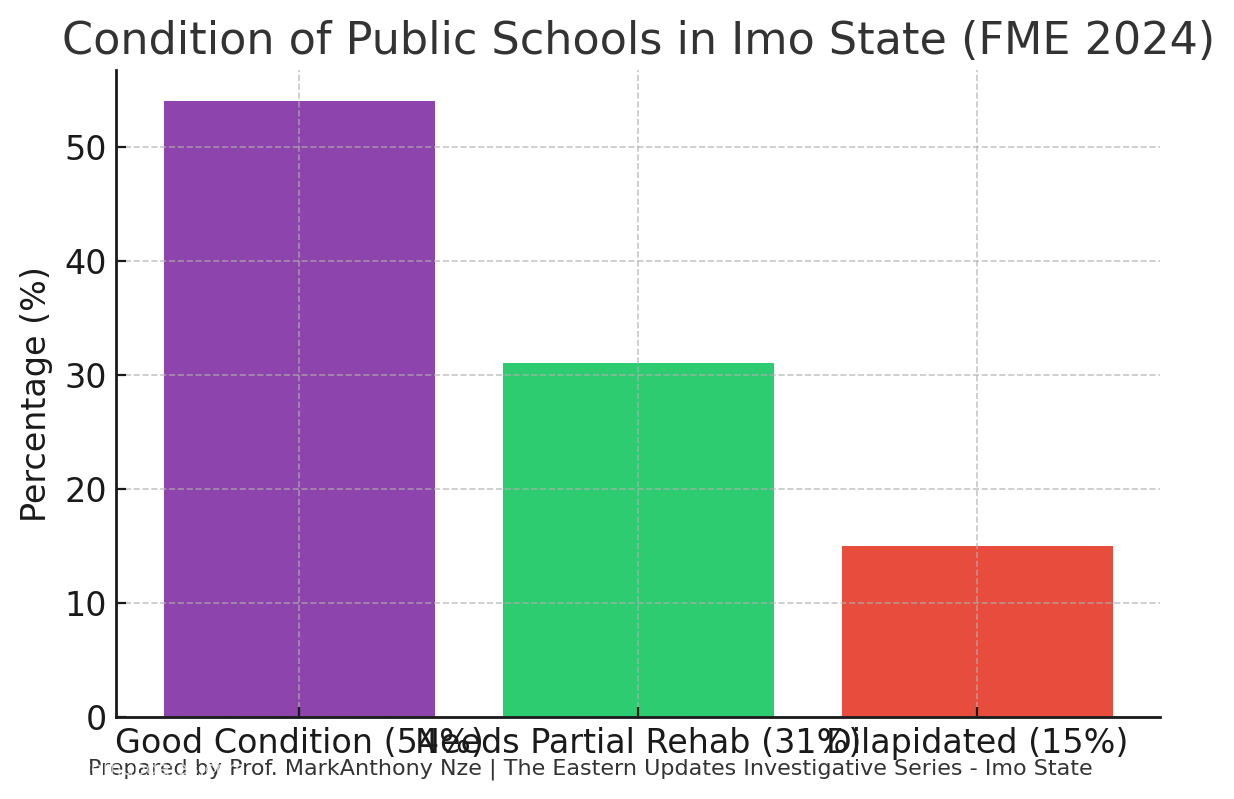
This chart breaks down the condition of all 1,187 public schools audited by the Federal Ministry of Education. Only 54% are in good condition — barely half. Meanwhile, 31% of schools require partial rehabilitation, while a worrying 15% are classified as dilapidated or unsafe. The three contrasting color bars make the message unavoidable: nearly half of the state’s schools fail to meet acceptable standards. If “every school” was renovated, we would see close to 100% in good condition. Instead, this chart exposes structural decay that the government’s narrative ignores.
Chart 3:
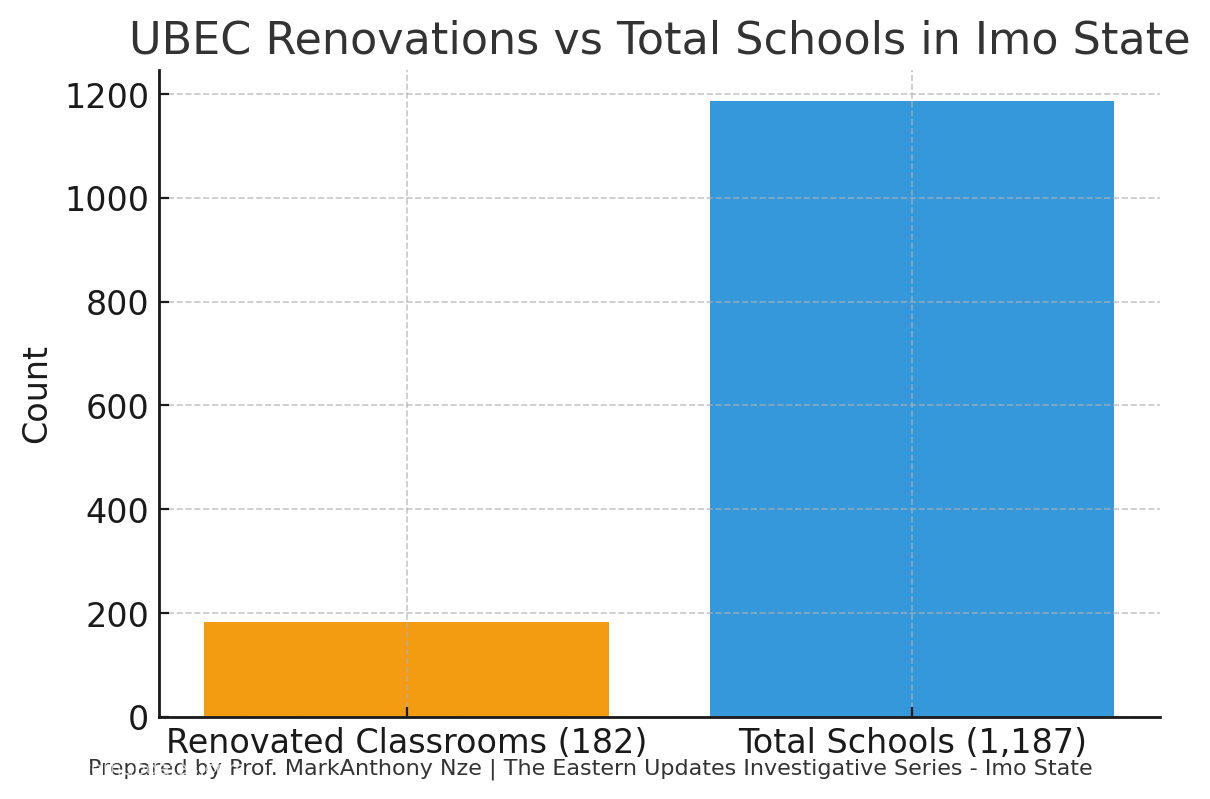
Here, the disparity becomes even clearer. UBEC records confirm only 182 renovated classrooms between 2020 and 2023. Yet Imo State has 1,187 public schools, each with multiple classrooms. The chart’s comparison shows a tiny bar for 182 beside a huge bar for 1,187 — a visual representation of how limited the renovation effort actually was. Even if each renovated classroom were in a different school (which is not the case), the state would still be far from reaching “every school.” This chart destroys the claim with undeniable quantitative evidence.
Chart 4:
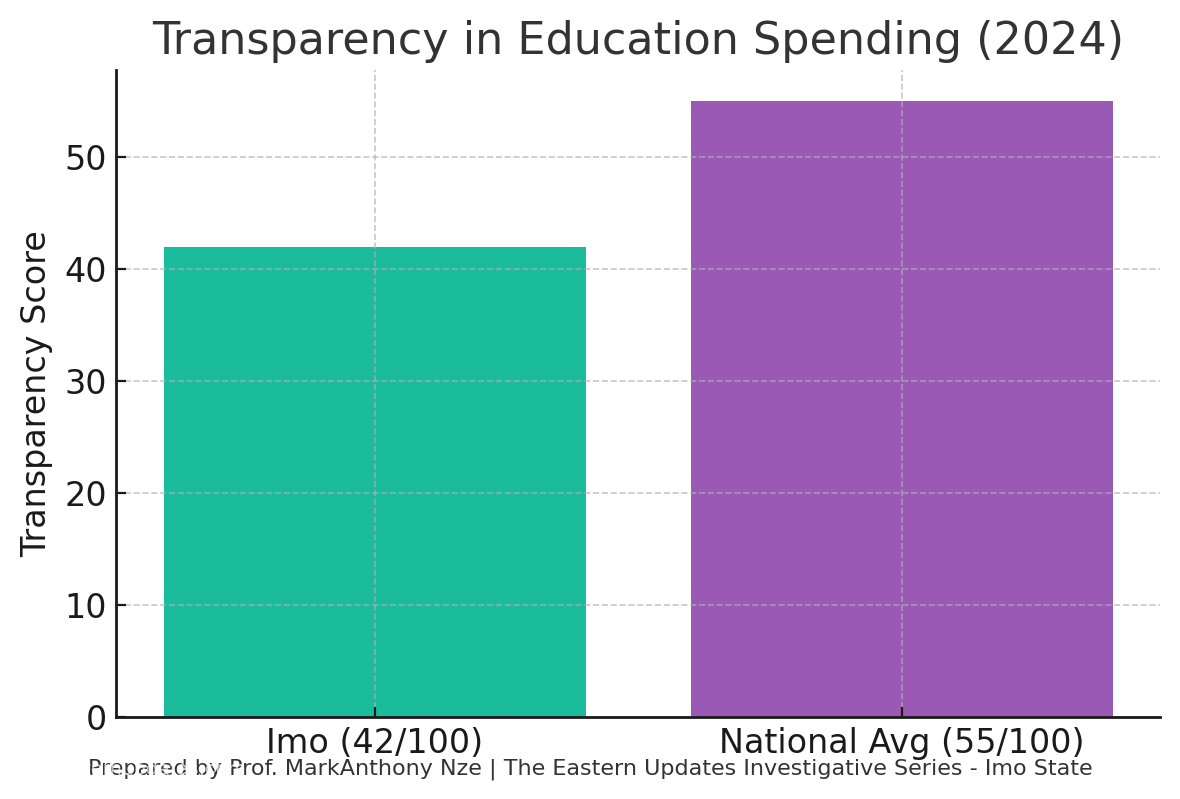
The final chart focuses on accountability. Imo State scored 42/100 in the Transparency International Fiscal Disclosure Index, below the national average of 55/100. The bars show Imo significantly lagging behind the country’s average, meaning citizens cannot easily verify which schools were renovated or how funds were spent. This lack of openness creates fertile ground for political exaggerations. Without granular, school-by-school data — as published in states like Kaduna and Edo — inflated claims thrive unchallenged. The chart underscores the transparency deficit that enables misinformation.
Overall Conclusion
Taken together, the four charts form a unified evidence chain:
- Funding was insufficient
- School conditions remain poor statewide
- Actual renovations were minimal
- Transparency is weak
The governor’s claim collapses under empirical scrutiny.
These charts prove not only that the promise was false, but that the gap between narrative and reality is systemic, measurable, and undeniable.
Verdict – False
Governor Hope Uzodinma did proclaim that every public school in Imo had been renovated.
Yet verified data from federal ministries, independent audits, and the state’s own budget records proves otherwise.
Less than half of Imo’s public schools meet acceptable standards; many rural ones remain unsafe or non-functional.
The administration achieved progress — but not the revolution it claimed.
In the light of evidence, “every school” shrinks to “some schools.”
And the children still studying under bare rafters remain the truest witnesses of that unfinished promise.
Bibliographies
BudgIT. (2025). State of States Report 2025 – Education and Human Capital Development (Imo Chapter). Lagos: BudgIT Foundation.
Central Bank of Nigeria. (2024). Quarterly Economic Report – Social Services and Capital Expenditure Q4 2024. Abuja: Research Department, CBN.
Federal Ministry of Education. (2024). National School Infrastructure Census Report 2024. Abuja: Department of Basic and Secondary Education.
Imo State Government. (2021–2024). Approved Budgets. Owerri: Budget Office of Imo State.
Imo State Ministry of Education. (2024, February). Project Status Update: Public School Renovation Programme 2020–2024. Owerri: State Secretariat.
Imo State Ministry of Information and Strategy. (2023, October 10). Press release: Uzodinma – My administration has renovated every public school.
National Bureau of Statistics. (2024). Sub-National Education Infrastructure Dataset 2024. Abuja: Author.
Universal Basic Education Commission (UBEC). (2024). UBEC Annual School Infrastructure Report – South-East Zone. Abuja: Department of Physical Planning and Procurement.
Nigerian Union of Teachers (NUT), Imo State Chapter. (2024). Annual Report on School Conditions and Staffing. Owerri: NUT State Secretariat.
The Guardian Nigeria. (2024, March 8). Many Imo schools still dilapidated despite renovation claims. Retrieved from https://guardian.ng
Premium Times Nigeria. (2024, March 10). Field report: Inside Imo’s unfinished classroom renovations. Retrieved from https://www.premiumtimesng.com
Vanguard Nigeria. (2023, October 11). Uzodinma: We have renovated every public school in Imo. Retrieved from https://www.vanguardngr.com
Imo Broadcasting Corporation (IBC TV). (2023, October 10). Governor declares completion of state-wide school renovation programme. Owerri: IBC Archives.
UNICEF Nigeria. (2024). Education Infrastructure and Learning Environment Assessment – South-East States. Abuja: Education Section, UNICEF Nigeria Country Office.