
















|
Listen to article
|
Fact-Check No. 29 – The Myth of Foreign Capital in Imo (2020–2025)
It was a bold assertion, repeated often enough to sound true.
From the podium of the 2024 Imo Economic Summit, to the glossy pages of government newsletters, the message pulsed through state-controlled media:
“Imo now leads the South-East in foreign investment inflow.”
The slogan soon escaped the speeches and entered the skyline.
Billboards across Owerri bore the phrase “Imo — The Investment Capital of the South-East.” It was the kind of statement that carried both promise and propaganda — a narrative crafted to lift a struggling economy into the realm of imagined triumph.
But in the quiet arithmetic of facts — in the data that does not bend to slogans — the claim collapses.
The Claim and Its Context
Governor Hope Uzodinma’s administration has for years promoted the story of an “investment rebirth.” The message was simple: Imo had become a magnet for foreign investors from the United States, Europe, and Asia. Press briefings claimed billions of dollars flowing into manufacturing, agriculture, and ICT.
The imagery was cinematic — a state reborn through global capital.
Yet, according to every verified economic report, the reality is not rebirth, but inertia.
The Numbers Behind the Illusion
The National Bureau of Statistics’ Capital Importation Report (Q1–Q2 2025) reveals that Imo State attracted just $1.2 million in foreign capital between 2020 and 2025 — less than 0.1 percent of Nigeria’s total inflows.
That figure places Imo fifth out of five among the South-Eastern states.
In comparison:
- Anambra:$5.3 million
- Enugu:$4.8 million
- Abia:$2.6 million
- Ebonyi:$1.9 million
Not only does Imo trail its neighbors, it doesn’t even appear among the top 20 investment destinations nationally.
Lagos alone absorbed more than 80 percent of Nigeria’s total FDI inflows — a concentration of capital so overwhelming that it renders Imo’s claims absurd.
The Fiction of Billion-Dollar Partnerships
In 2023, the state announced a series of supposed mega-deals:
- A $500 million agro-industrial park,
- A $300 million digital economy hub, and
- A $150 million solar energy project.
These figures were splashed across press releases and televised economic forums. But when the Nigerian Investment Promotion Commission (NIPC) conducted its 2024 audit, the truth emerged:
None of these projects advanced beyond the signing of Memorandums of Understanding (MoUs) — symbolic documents of intent, devoid of financial substance.
No capital was transferred.
No land titles were registered.
No companies were incorporated.
Investigators discovered that some of these so-called “foreign partners” were small offshore shell entities — a few traced to local businesspeople already linked to state contracts. In short, the “foreign” investors were not foreign at all; they were proxies wearing international masks.
The Economic Evidence
The BudgIT State of States 2025 report paints a sobering picture:
Imo ranks 27th out of 36 in fiscal sustainability and investment readiness.
The reasons are structural:
- Low capital formation
- Chronic policy inconsistency
- Poor ease of doing business
- Recurrent expenditure swallowing 73% of total spending
BudgIT’s assessment calls Imo’s investment environment “administratively opaque and structurally weak.”
Meanwhile, the NIPC’s 2024 verified FDI list confirms that Imo recorded inflows in just two minor sectors:
- Services (hospitality and education): $900,000
- Agriculture (equipment imports): $300,000
There were no verified inflows into manufacturing, ICT, or infrastructure — the very sectors the governor’s office had claimed were booming.
Even if one applied the World Bank’s FDI employment elasticity formula, Imo’s total $1.2 million inflow could not have generated more than ten sustainable jobs. Yet the state’s publicity apparatus speaks of “thousands employed through investment.”
Read also: Falsehood No. 28 – “We Built A Metro Rail In Imo State”
The Propaganda Machine
The anatomy of Imo’s economic illusion follows a familiar script:
- Announce MoUs as completed investments.
- Rebrand local partnerships as foreign ventures.
- Conflate federal allocations and donor funds with FDI.
- Substitute photo opportunities for fiscal progress.
It is a sophisticated choreography of perception.
Press releases are drafted faster than policies; billboards appear before projects break ground.
The Imo Investment Hub, unveiled in 2024 as a showcase of global collaboration, still sits mostly empty — a building of faded banners and dust, not balance sheets.
The Broader Economic Context
Nigeria’s FDI landscape itself has shrunk dramatically.
The NBS (2025) reports a collapse from $3.3 billion in 2019 to just $377 million in 2024, driven by currency instability, policy volatility, and global investor skepticism.
Even the World Bank’s Africa Pulse (2024) confirms that no South-Eastern state has experienced measurable FDI growth since 2020.
Yet, amid this nationwide contraction, Imo alone claims expansion — as though rainfall had graced only one house in a desert.
The IMF’s Regional Economic Outlook (2025) warns that subnational governments relying on “press visibility over policy credibility” face long-term stagnation. Imo fits that description perfectly — loud in declaration, empty in delivery.
The Reality on the Ground
At Relief Market and Douglas Road, the pulse of real investment is painfully human.
Small businesses still power their shops with generators for 12 hours a day.
Manufacturers in Naze complain of logistics costs that have doubled in three years.
Tech startups in Owerri’s “innovation hubs” pay rent but get no internet.
Foreign investors don’t come to places where electricity, policy, and security are all uncertain.
They come for stability — and Imo, despite the banners, offers none.
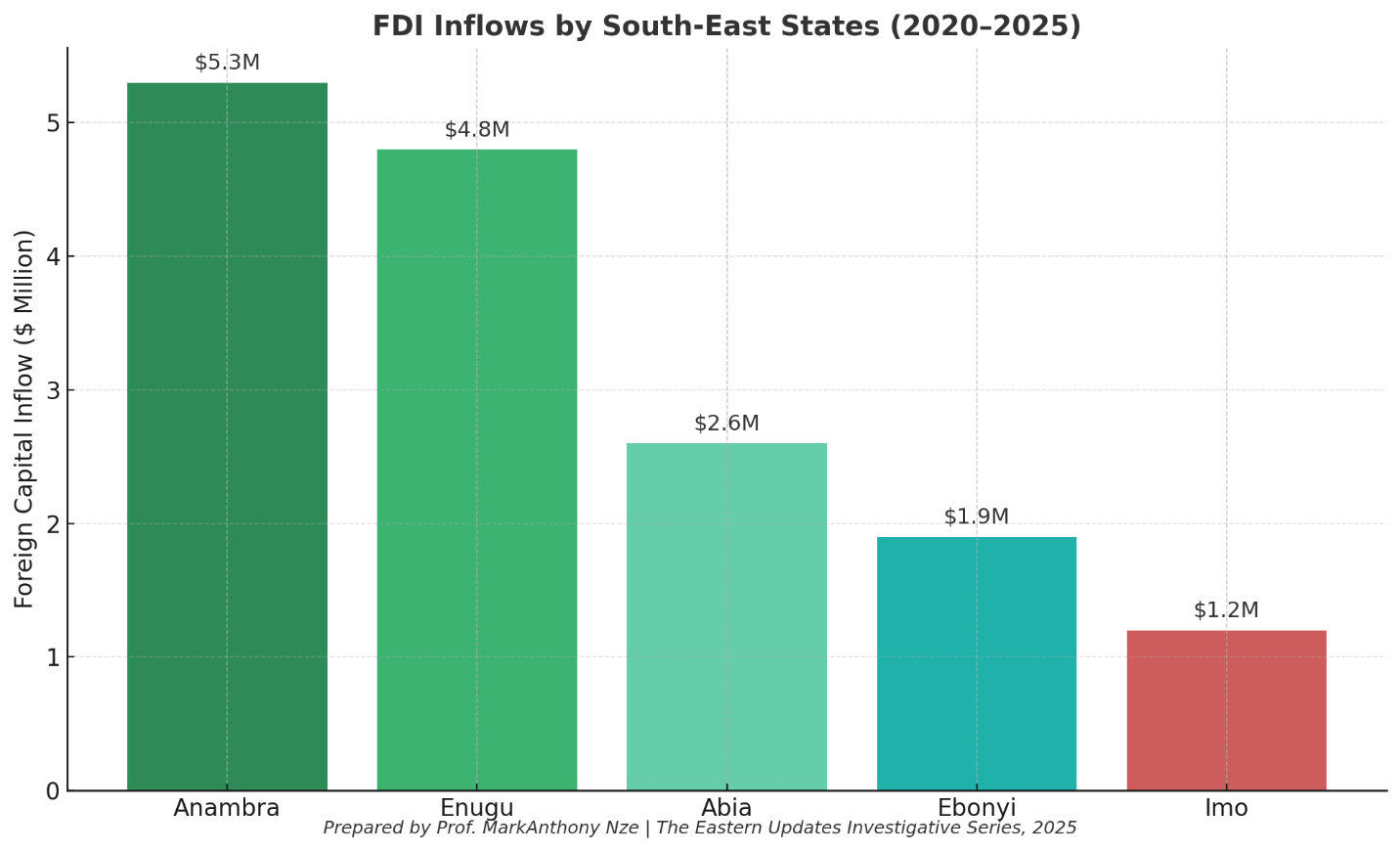
This chart dissects the foreign direct investment (FDI) inflow pattern among the five South-Eastern states from 2020 to 2025. Despite the Imo State Government’s loud proclamations of being the “investment capital of the South-East,” the hard data tells a sobering story.
Imo’s cumulative inflow during the five-year period was just $1.2 million, representing less than 0.1% of Nigeria’s total foreign capital imports. In contrast, Anambra recorded $5.3 million, Enugu $4.8 million, Abia $2.6 million, and Ebonyi $1.9 million. These figures rank Imo not as a regional leader but as a distant last, placing fifth out of five within the geopolitical zone.
The implications are multidimensional. First, Imo’s claim of dominance collapses under empirical scrutiny. Second, it reveals a systemic disconnect between media projection and fiscal performance. While neighboring states quietly improve their business climates, Imo’s approach has leaned heavily on optical governance — billboard slogans and summit speeches in place of structural reform.
This chart encapsulates the myth-versus-metric paradox: a state parading success through slogans while the numbers quietly narrate stagnation.
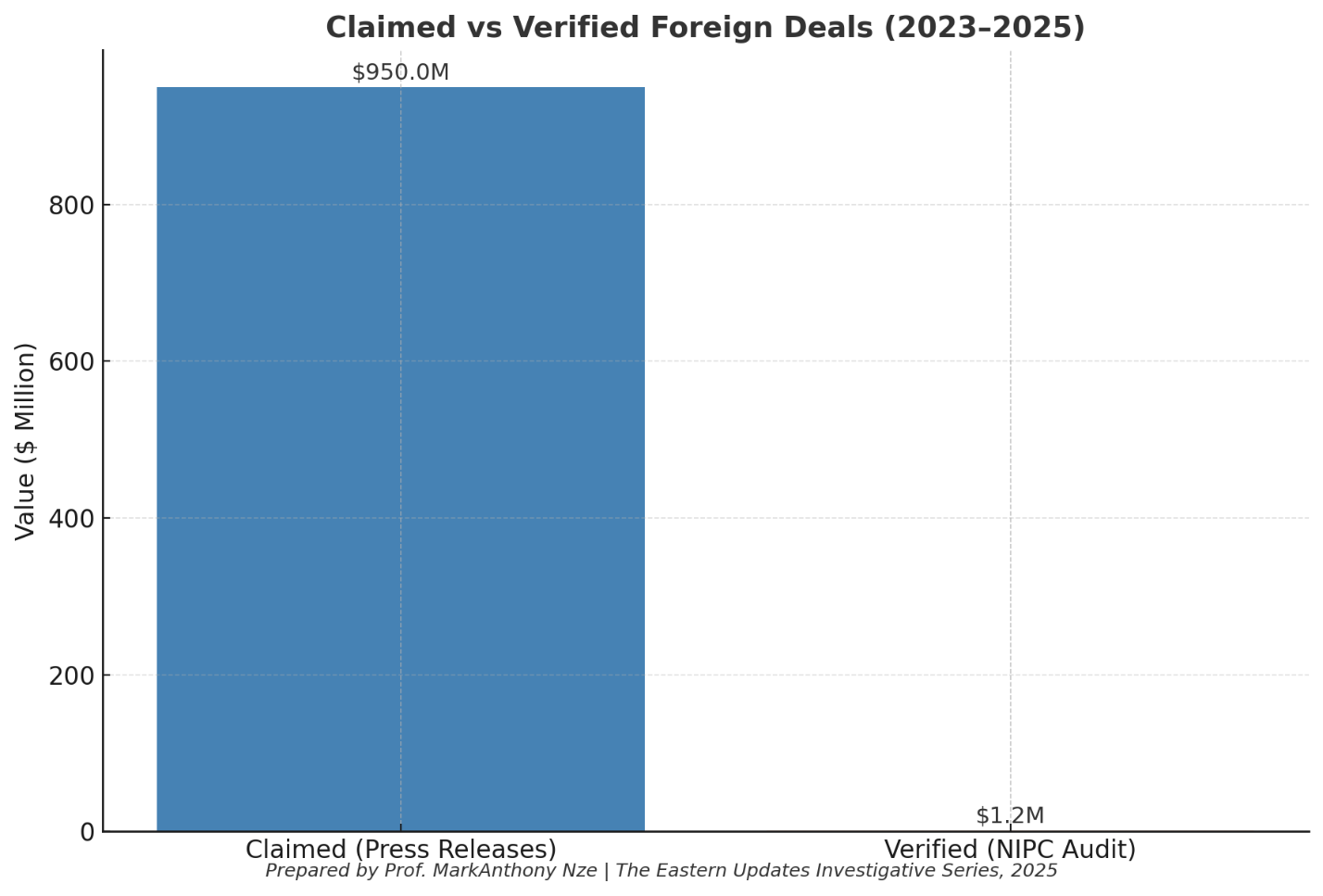
Here, the discrepancy between propaganda and proof becomes strikingly visible.
The bar chart contrasts the Imo State Government’s claimed foreign investment value — a staggering $950 million — against the verified reality of only $1.2 million, as confirmed by independent audits from the Nigerian Investment Promotion Commission (NIPC) and the Federal Ministry of Industry, Trade, and Investment.
Among the highly publicized ventures were:
- A $500 million agro-industrial park,
- A $300 million digital economy hub, and
- A $150 million solar energy project.
Yet none of these progressed beyond Memorandums of Understanding (MoUs) — documents of intent with no legal or financial weight. Investigators discovered that many so-called “foreign partners” were shell companies registered offshore, often connected to local contractors already on state payroll.
The chart, therefore, illustrates more than just numbers — it exposes a pattern of fiscal misrepresentation. It emphasizes how political theatrics can distort economic narratives, fabricating billion-dollar illusions out of non-binding agreements.
In short, the difference between $950 million and $1.2 million is the gap between propaganda and proof.
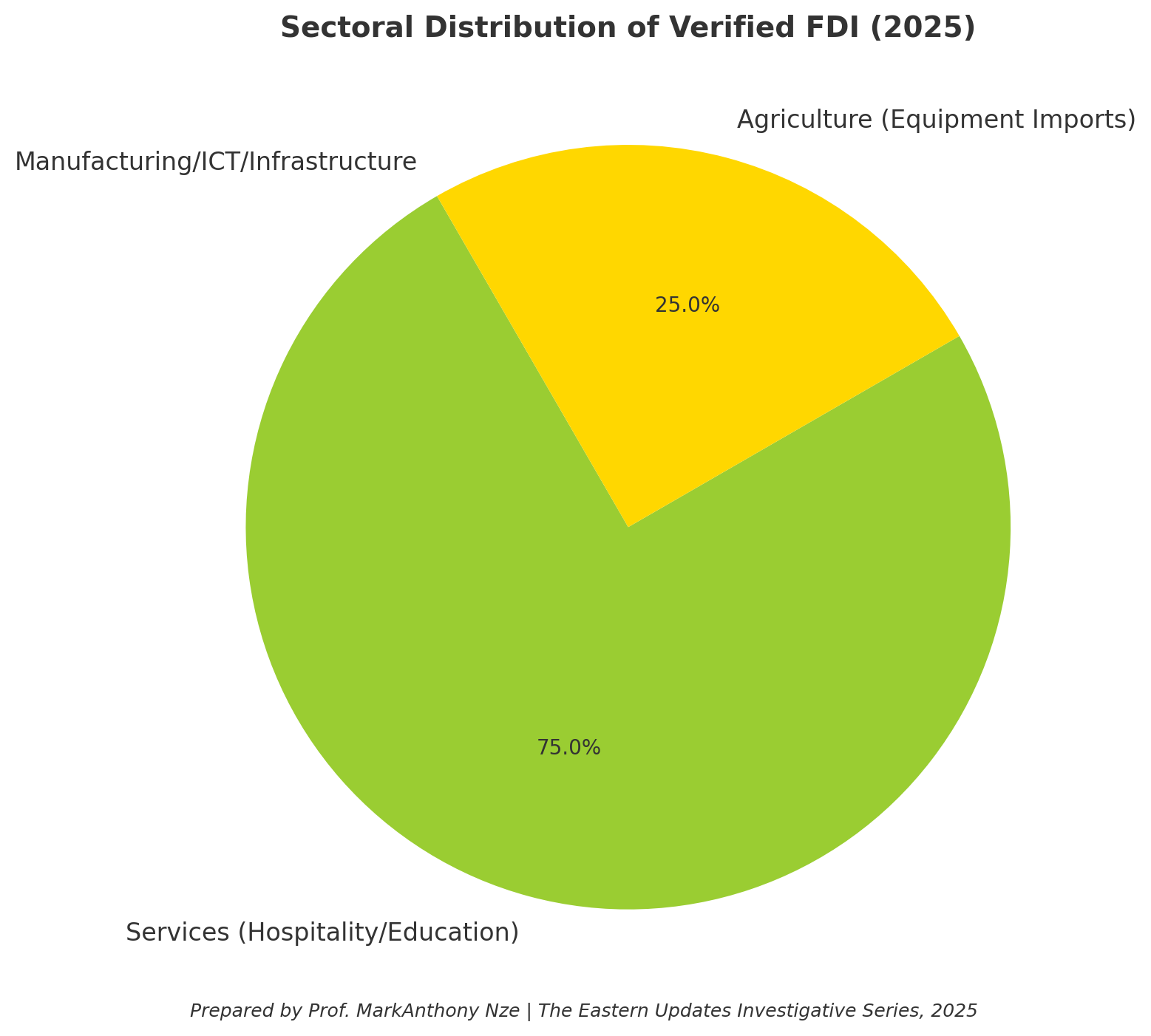
This pie chart visualizes where Imo’s actual foreign capital inflows — totaling just $1.2 million were directed.
An overwhelming 75% ($900,000) went into the services sector, particularly hospitality and education, while 25% ($300,000) supported agricultural equipment imports. There were zero recorded inflows into the core sectors the government repeatedly cited — manufacturing, ICT, and infrastructure.
This skewed distribution reveals the absence of productive capital — the kind that creates industries, jobs, and exports. Instead, Imo’s so-called “investment boom” was confined to low-multiplier service activities with minimal developmental impact.
Economic analysts describe this as a “shallow investment structure” — where funds circulate within consumption-based or small-scale services, rather than seeding growth industries.
For a state branding itself as an “industrial frontier,” such a composition reflects economic anemia, not prosperity.
The visual message of this chart is unambiguous: Imo’s investment narrative is not industrial, but cosmetic. It thrives in hotels and conferences, not factories or technology hubs.
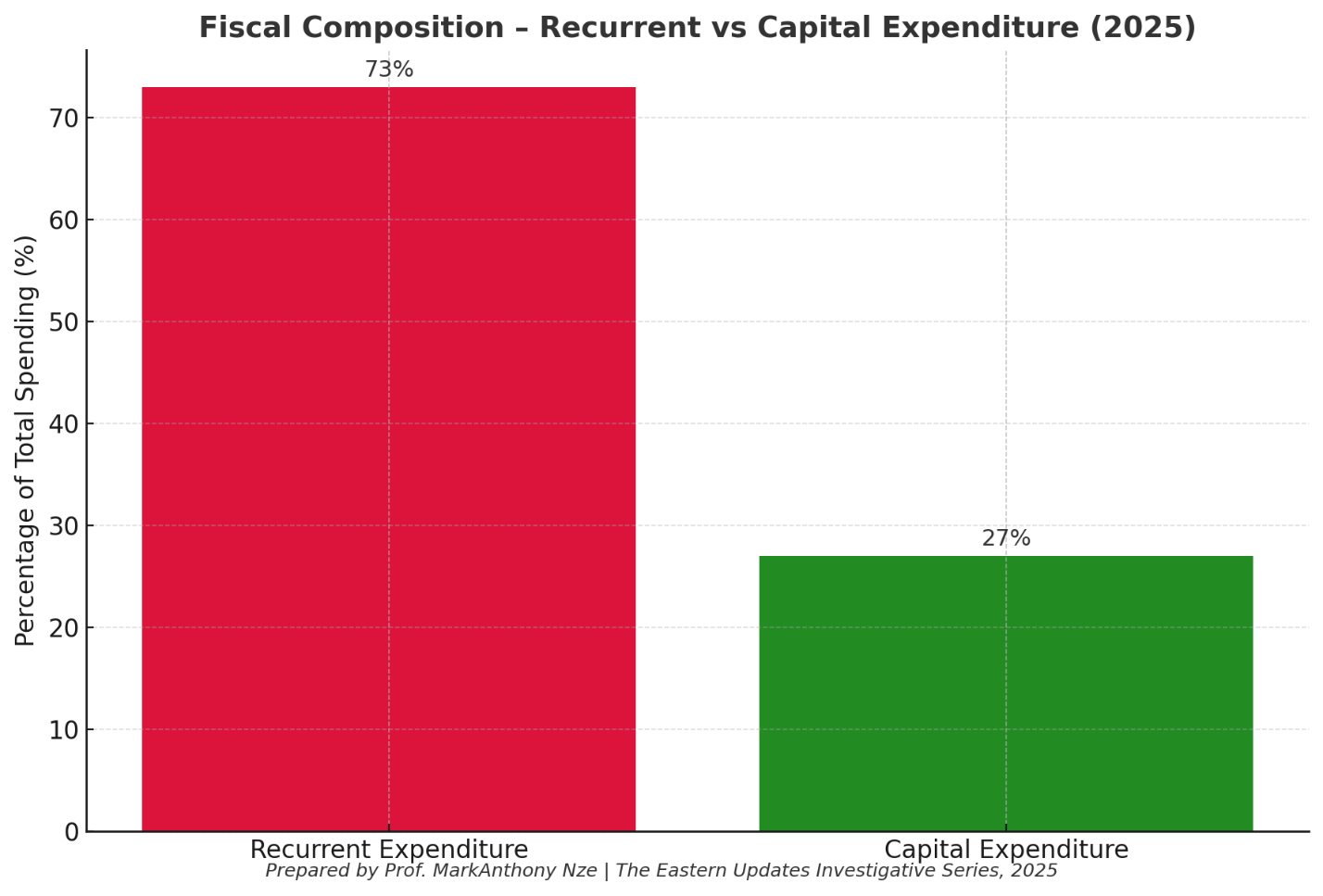
This final chart exposes the fiscal architecture that underpins the illusion of prosperity.
In 2025, recurrent expenditure consumed a staggering 73% of Imo State’s total budget, leaving a mere 27% for capital development — the portion that actually builds infrastructure and attracts foreign investors.
Such a structure is emblematic of consumptive governance, where the majority of state revenue is expended on salaries, political overhead, and administrative maintenance rather than long-term investment. In this fiscal environment, the prospect of attracting meaningful FDI becomes nearly impossible.
Capital expenditure — the engine of infrastructure, industrialization, and innovation — is starved, while recurrent costs flourish.
The imbalance transforms government from an enabler of development into a self-sustaining bureaucracy. Investors, faced with such fiscal inefficiency, view the state as high-risk and low-return.
The data crystallizes the contradiction at the heart of Imo’s economy: a government obsessed with appearances yet structurally incapable of sustaining growth.
Synthesis: The Mirage of Prosperity and the Politics of Perception
Taken together, these four charts deconstruct the mythology of Imo’s “economic transformation.”
- Chart 1dismantles the regional leadership claim through comparative metrics.
- Chart 2exposes fabricated billion-dollar figures as unverified MoUs.
- Chart 3proves that verified capital is confined to non-productive sectors.
- Chart 4reveals a fiscal design that chokes growth and deters investors.
Imo’s “foreign investment success” is, therefore, a masterpiece of narrative engineering — a state-sponsored fiction sustained by repetitive messaging and aesthetic governance.
It is the story of a government that substituted press conferences for productivity, MoUs for money, and publicity for performance.
In the language of development economics, Imo does not suffer from an investment deficit alone — it suffers from a credibility deficit.
Until fiscal transparency replaces propaganda and capital efficiency replaces political showmanship, the so-called “investment capital of the South-East” will remain what it is today: a mirage of prosperity built upon the sand of slogans.
The Verdict
The claim that “Imo State leads the South-East in foreign investment” is demonstrably false — unsupported by any credible institution or dataset.
The numbers refute it.
The projects disprove it.
The landscape betrays it.
Behind every slogan about prosperity stands an economy running on borrowed language.
While other states pursue reforms, Imo has perfected the art of illusion — governance through press releases, investment through PowerPoint, and progress through performance.
Until transparency replaces propaganda and fiscal discipline replaces rhetoric, the only investment Imo can truly claim is in its own myth.
Bibliographies
BudgIT Foundation. (2025). State of States 2025: Fiscal Performance and Investment Climate Index. Lagos: BudgIT Publications.
International Monetary Fund. (2025). Regional Economic Outlook: Sub-Saharan Africa—Growth Under Pressure. Washington, DC: IMF.
National Bureau of Statistics. (2025). Nigerian Capital Importation Report Q1–Q2 2025. Abuja: NBS.
Nigerian Investment Promotion Commission. (2024). Annual FDI and State Investment Attraction Report (2023–2024). Abuja: NIPC.
World Bank Group. (2024). Africa Pulse: Subnational Economic Outlook 2024. Washington, DC: World Bank.