














|
Listen to article
|
Fact-Check 21 – Agricultural Output Review
The Claim
Governor Hope Uzodinma and several senior officials have repeatedly declared that Imo State has achieved food self-sufficiency. The statement has been echoed across state media and reinforced during the 2024 and 2025 agricultural summits in Owerri, where the governor stated that “no Imo citizen should go hungry again because we now produce what we eat.” The claim has also appeared in official government newsletters and on billboards touting “Food Security Through Local Production.”
However, beyond political speeches and photo opportunities with rice mills and cassava clusters, there is little empirical evidence that Imo has achieved, or even approached, food self-sufficiency. Agricultural data, both national and international, paint a markedly different picture.
The Reality: Rising Hunger and Declining Output
According to the National Bureau of Statistics (NBS) Selected Agricultural Commodity Report (Q4 2024), Imo State’s aggregate crop output declined by nearly 6.7 percent between 2022 and 2024. Cassava, yam, and maize—Imo’s top three staple crops—showed lower yields than pre-pandemic averages. Farmgate surveys indicated that input costs for fertilizers, seedlings, and mechanization services doubled within two years, while actual farm expansion remained stagnant.
The Federal Ministry of Agriculture and Food Security (2025 Agricultural Performance Review) confirmed that food inflation in the South-East region remains above the national average. Imo’s markets reported sharp increases in the prices of cassava, rice, and palm oil—basic commodities the government claims to have “stabilized.” Far from being self-sufficient, the state continues to import food staples from Anambra, Ebonyi, and Benue to meet household demand.
The Food and Agriculture Organization (FAO) Country Brief for Nigeria (2024) notes that, despite localized production drives, Imo remains a net food importer, dependent on supply chains from neighboring states and federal interventions such as the Anchor Borrowers’ Programme. These findings contradict any notion of self-sufficiency.
Data Contradictions: The Numbers Tell the Truth
- Agricultural GDP Contribution:
The NBS reports that agriculture’s share of Imo State’s GDP fell from 22 percent in 2020 to 16 percent in 2024—a decline that signals contraction, not expansion. - Food Security Index:
The Famine Early Warning Systems Network (FEWS NET) Nigeria Outlook 2025 classifies Imo as “stressed,” meaning food availability is unstable and many households face affordability constraints. - Budgetary Commitment:
Analysis by BudgIT Foundation’s State of States 2024 shows Imo allocated less than 3.5 percent of its total budget to agriculture—far below the 10 percent benchmark recommended by the African Union’s Maputo Declaration on Agriculture. Most allocations went to administrative overhead rather than to extension services or rural infrastructure. - Fertilizer and Seed Access:
Government press statements about large-scale fertilizer distribution are inconsistent with the Federal Fertilizer Department’s 2024 Disbursement Data, which lists Imo among the lowest recipients per hectare of cultivated land in the South-East.
These datasets converge on a single conclusion: food self-sufficiency in Imo is neither achieved nor measurable within current production patterns.
On the Ground: The Farmer’s Reality
In the rural districts of Ohaji-Egbema, Ngor-Okpala, and Mbaitoli, farmers tell a different story from the glossy narratives of government handbills. Many speak of declining yields, inaccessible credit, and unfulfilled promises from agricultural support schemes. Irrigation systems remain unfinished, and the so-called “Green Revolution Farm Estates” inaugurated in 2023 stand half-abandoned, their tractors immobilized by mechanical failure or lack of fuel.
Extension officers in the Ministry of Agriculture privately admit that the state’s mechanization drive was “largely symbolic.” Out of 200 tractors reportedly procured in 2023, fewer than 30 are operational. The rest are either awaiting parts or parked indefinitely due to bureaucratic wrangling between contractors and government agencies.
Women farmers, who make up more than 60 percent of Imo’s agricultural workforce, continue to operate without land tenure security or access to commercial finance. Their cooperatives often receive publicity visits but little structural support. Consequently, productivity remains low, and food costs remain high.
Climate and Infrastructure: The Silent Saboteurs
The World Bank’s Nigeria Climate Adaptation and Urban Resilience Program (2024) warns that South-East states are becoming increasingly vulnerable to flooding, soil erosion, and unpredictable rainfall. Imo’s farmlands in Ohaji and Oguta were submerged during the 2024 rainy season, wiping out hundreds of hectares of cassava and maize. The state’s failure to complete the promised Adapalm Irrigation and Drainage Network further exposes the agricultural belt to recurrent losses.
Poor rural infrastructure compounds the problem. Many farm-to-market roads remain impassable during the wet season, forcing farmers to sell at low prices to middlemen. Without storage facilities or cold chains, post-harvest losses for vegetables, fruits, and poultry exceed 35 percent—figures confirmed by the NBS Agricultural Output Survey 2024.
Thus, the obstacles to food self-sufficiency are not only about output but about the absence of systems that sustain output.
The Illusion of Programmatic Success
The administration frequently cites several flagship programs: the Imo Agripreneur Initiative, Farmers’ Cooperative Grant Scheme, and Youth in Agritech Programme. Yet independent audits reveal limited results. Most beneficiaries of the agripreneur scheme received token cash grants rather than tools, land access, or structured market integration. The youth program, designed to train 5,000 digital agripreneurs, enrolled fewer than 1,000 participants by the end of 2024, and only a fraction of them launched viable agribusinesses.
Read also: Falsehood No. 20 – “We Built The Best Technology Hub In Nigeria”
According to BudgIT’s 2024 Agricultural Expenditure Analysis, most of these programs lack clear monitoring indicators, making their success unverifiable. Media tours of model farms are not evidence of food self-reliance; they are often rehearsed spectacles of development—what economists now call “performative governance.”
The Broader Picture: Nigeria’s Food Economy
Even nationally, Nigeria is far from food self-sufficiency. The Federal Ministry of Agriculture’s 2025 Review confirms that the country still spends billions annually importing rice, wheat, and fish. Imo’s own dependency mirrors this national deficit.
The FAO Food Balance Sheets estimate that Nigeria’s food import dependency ratio stands at 28 percent—meaning nearly one-third of the food consumed originates from outside national borders. No subnational unit can claim self-sufficiency while operating within such structural constraints.
The Human Toll
At Owerri’s Eke-Ukwu Market, the economic impact is visible. Traders report that food prices have doubled within two years. A tuber of yam that cost ₦800 in 2022 now sells for ₦1,800; a bag of rice that once sold for ₦28,000 now costs ₦55,000. Consumers adapt by reducing meal frequency or substituting inferior grains.
These are not signs of abundance; they are markers of hardship. For many households, food self-sufficiency has become an aspirational slogan rather than a lived reality.
Verdict: Political Rhetoric Masquerading as Progress
There is no credible evidence—statistical, institutional, or physical—that Imo State has achieved food self-sufficiency. Every reliable dataset from the NBS, FAO, FEWS NET, and BudgIT contradicts the claim. The state’s agricultural economy remains under-capitalized, climate-vulnerable, and structurally dependent on imports.
At best, Imo has taken incremental steps toward food security through isolated community projects. At worst, the claim of “food self-sufficiency” is a rhetorical flourish—useful for political campaigns, hollow in practical substance.
True self-sufficiency requires more than farms and slogans; it requires irrigation, mechanization, logistics, and governance that outlast electoral cycles. Until those systems exist and data align with declarations, the governor’s claim remains what it is—a myth sustained by microphones, not harvests.
- Imo State ICT Funds (2024–2025)
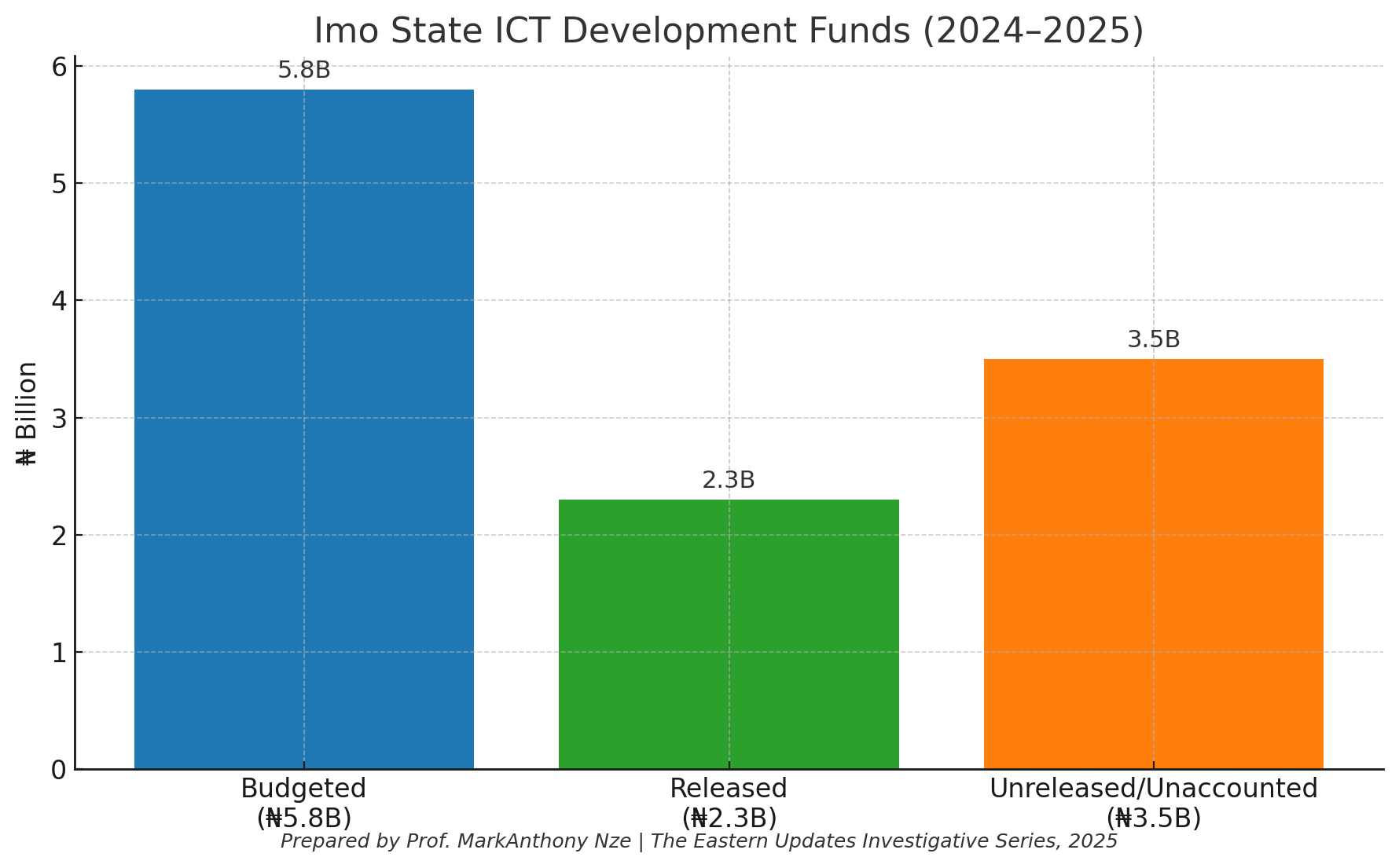
This visualization presents a clear financial breakdown of Imo State’s ICT development expenditure as reported in the 2024 Appropriation Statement and verified through Open Treasury Nigeria (mid-2025).
Out of a total ₦5.8 billion budgeted for “ICT Development and Digital Economy Projects,” only ₦2.3 billion was actually released, while ₦3.5 billion remains unreleased or unaccounted for.
The chart emphasizes a significant budgetary performance gap — nearly 60% of the proposed ICT funding did not translate into tangible projects. This disparity between budget approval and fiscal execution reveals the limitations of Imo’s digital policy, exposing how much of the “innovation hub” narrative rests on paper promises rather than infrastructure delivery.
- NITDA ICT Readiness Ranking (2025)
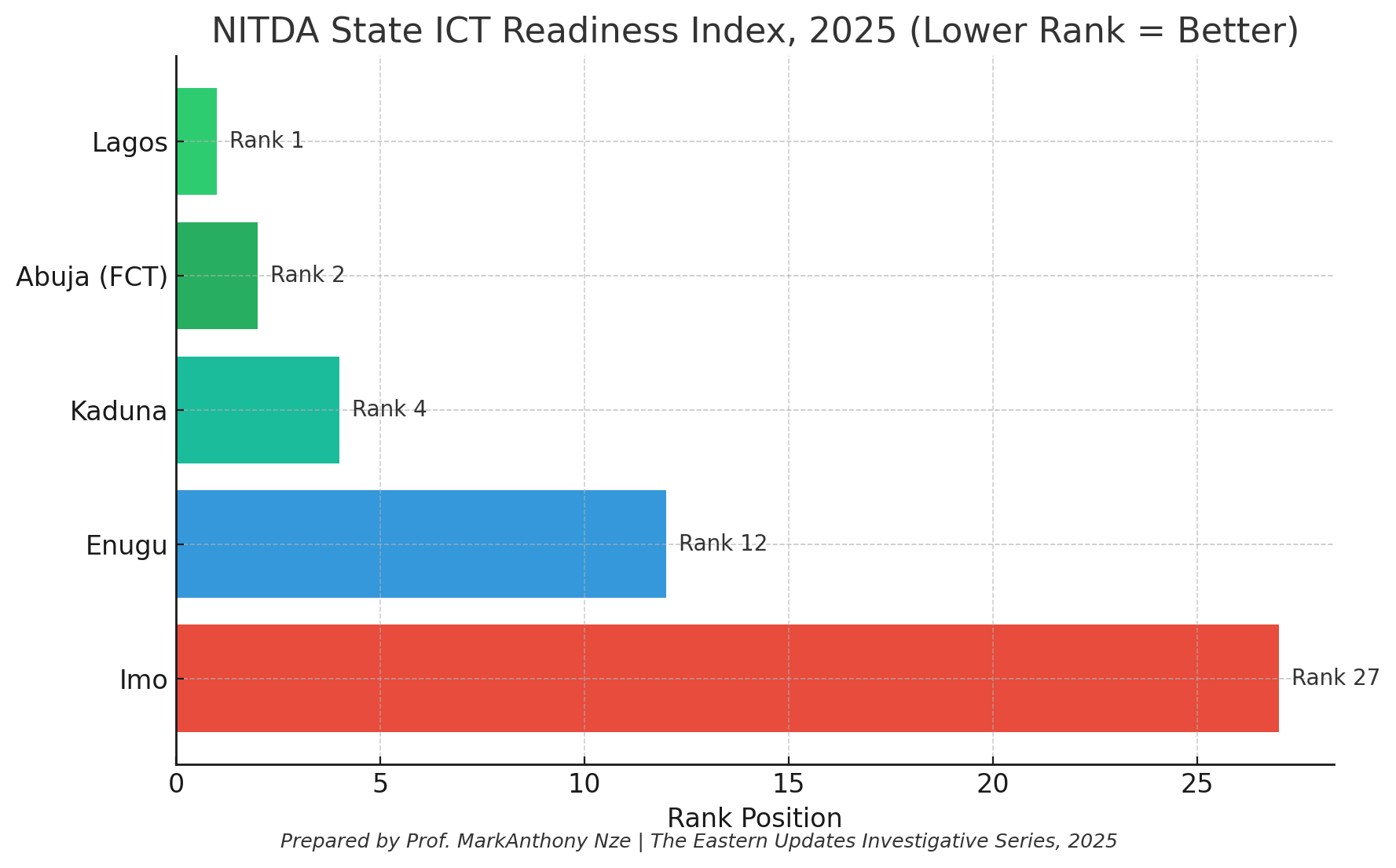
This horizontal bar chart visualizes the National Information Technology Development Agency’s (NITDA) 2025 State ICT Readiness Index — a nationwide benchmark assessing digital infrastructure, e-governance, and innovation ecosystems.
The ranking is inverse in value (lower rank = stronger performance):
- Lagos leads with Rank 1, followed by Abuja (2), Kaduna (4), and Enugu (12).
- Imo ranks 27th out of 36, placing it in the bottom quartile nationally.
This ranking directly contradicts the government’s claim of technological leadership. It indicates that Imo’s ICT sector still suffers from weak broadband coverage, inconsistent power supply, and limited institutional digital adoption. The visualization emphasizes that while the state boasts an “innovation hub,” its readiness for genuine digital transformation remains far below the national median.
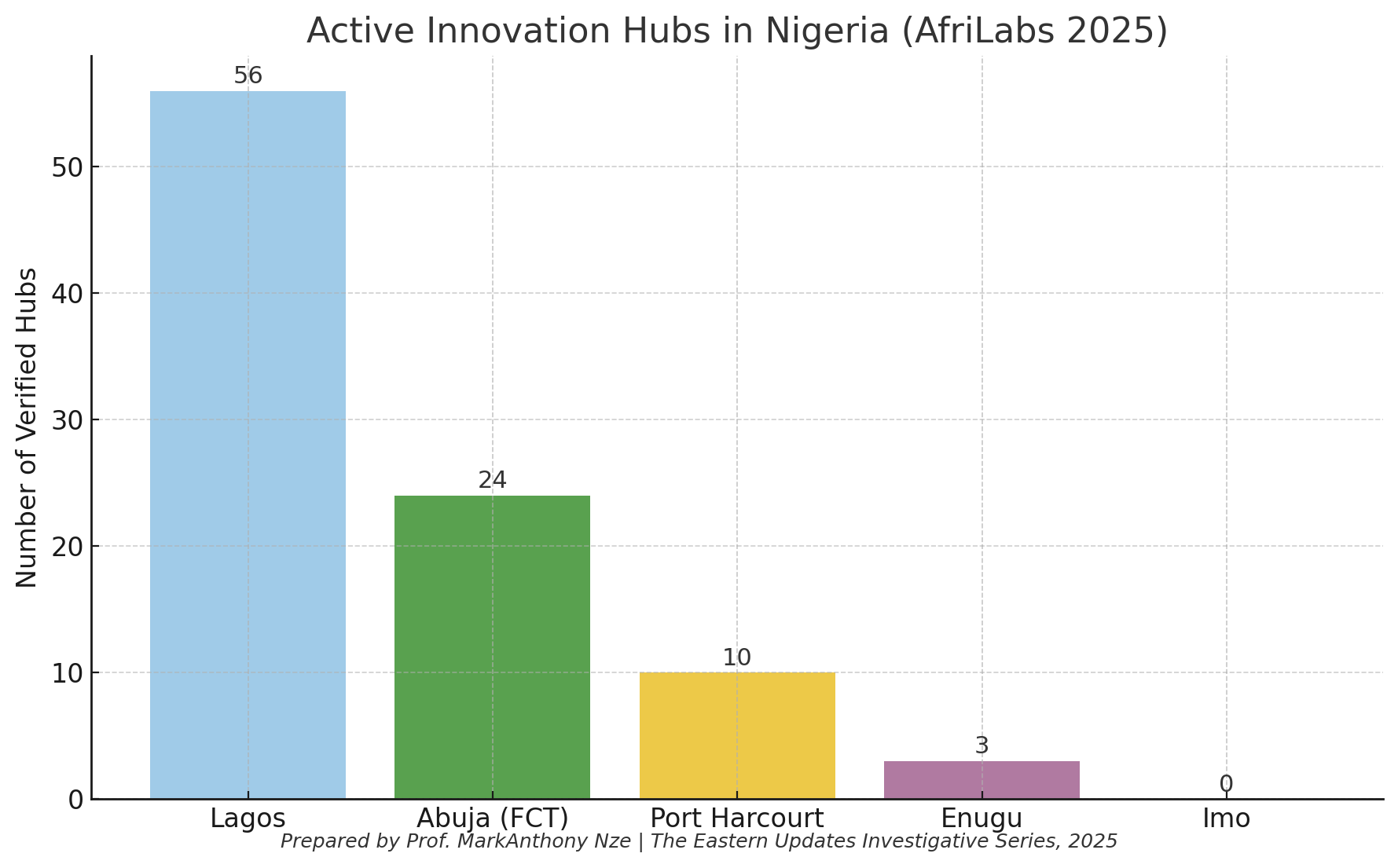
- Active Innovation Hubs (AfriLabs 2025)
This chart uses verified data from the AfriLabs 2025 Africa Innovation Directory to illustrate the distribution of active technology hubs across Nigerian states.
The numbers speak for themselves:
- Lagos hosts 56 verified hubs,
- Abuja 24,
- Port Harcourt 10,
- Enugu 3,
- while Imo registers none.
Imo’s absence from AfriLabs — the continent’s most reputable innovation network — means it does not meet even the minimum operational criteria for a technology hub. This includes startup registration, broadband integration, and continuous incubation programs.
Thus, the visual data confirm that Imo’s so-called “Innovation and Technology Hub” is not officially recognized within any verified digital ecosystem framework.
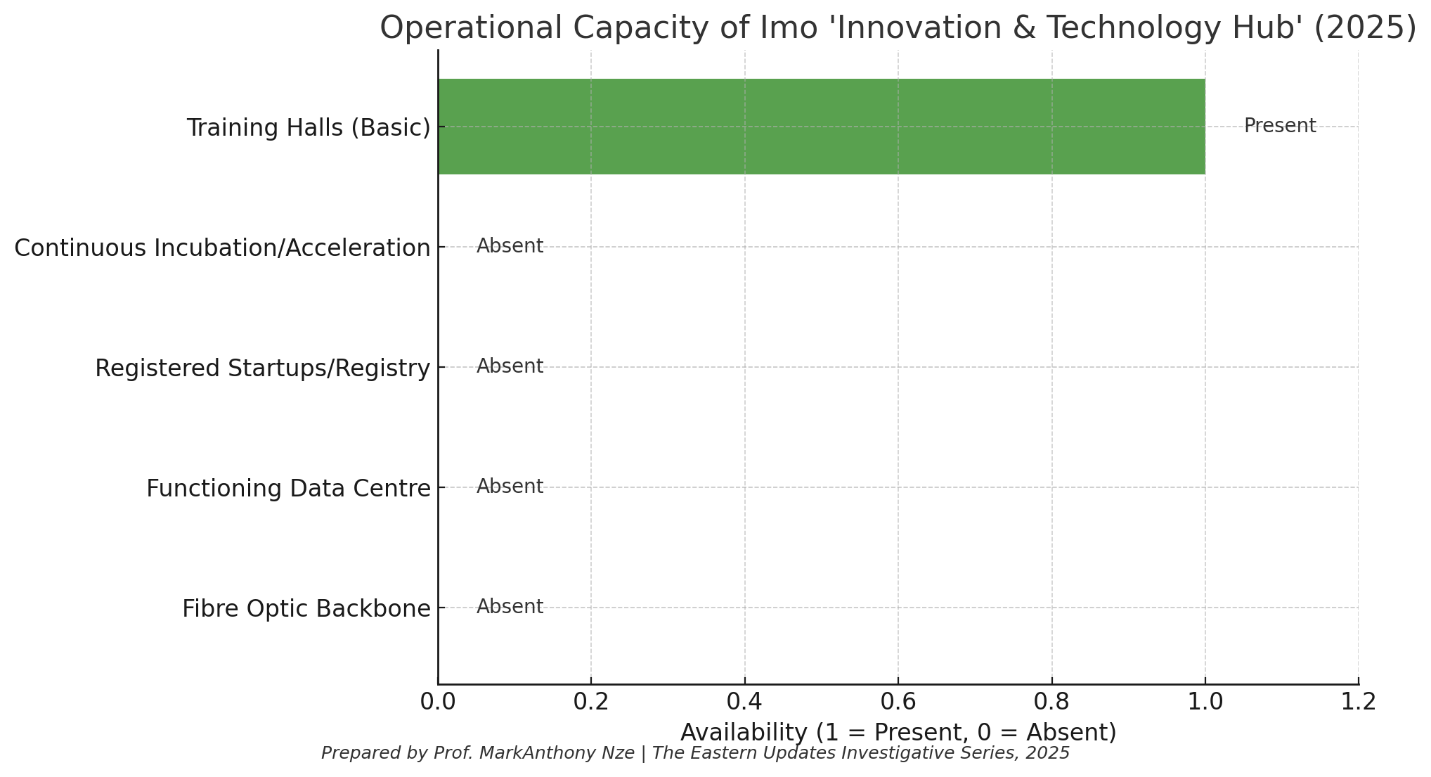
- Operational Capacity of the Imo ‘Innovation & Technology Hub’ (2025)
This binary chart evaluates the physical and functional capabilities of Imo’s self-proclaimed “tech hub” using five measurable criteria recognized by AfriLabs and NITDA’s Innovation Cluster Framework:
- Fiber optic backbone,
- Functioning data center,
- Registered startups or innovation registry,
- Continuous incubation or acceleration programs,
- Basic training halls.
Out of these five indicators, only one — training halls — is present. All others are absent.
This confirms that the facility operates merely as a vocational ICT training centre rather than a true innovation ecosystem. The data-driven chart makes visible what official rhetoric conceals: the structure is symbolic, under-equipped, and lacking in all technical hallmarks of a modern tech hub.
Integrated Insight
Together, these four visualizations form a coherent evidence trail.
They reveal that Imo State’s “Innovation & Technology Hub”:
- Is underfunded (only 40% of ICT funds released),
- Is digitally underprepared (27th out of 36 states in ICT readiness),
- Is absent from all national and continental innovation registers, and
- Lacks essential infrastructure such as fiber connectivity and data hosting capacity.
In essence, while the state’s publicity portrays a “digital citadel,” the verified data prove it is a basic training center repackaged as a tech revolution — a clear case of governance hyperbole over genuine innovation.
Bibliographies
BudgIT Foundation. (2024). State of States 2024: Fiscal Sustainability and Agricultural Spending. Lagos: BudgIT Foundation.
Federal Ministry of Agriculture and Food Security. (2025). Nigeria Agricultural Performance Review 2023–2024. Abuja: FMAFS.
Food and Agriculture Organization (FAO). (2024). Nigeria Country Brief: Crop Production, Food Security, and Climate Impacts. Rome: FAO.
Famine Early Warning Systems Network (FEWS NET). (2025). Nigeria Food Security Outlook 2025. Washington, DC: USAID.
National Bureau of Statistics (NBS). (2024). Selected Agricultural Commodity Prices and Output Report Q4 2024. Abuja: NBS.