



















|
Listen to article
|
Fact-Check No. 20 – Innovation Hub Verification
The Claim
Governor Hope Uzodinma has repeatedly touted the so-called “Imo Innovation & Technology Hub” as “the best in Nigeria, a model for the digital future of Africa.”
The claim first appeared in an official statement issued in April 2024, following the governor’s visit to the site in New Owerri. In subsequent interviews, state media promoted it as “a Silicon Valley of the South-East.”
Government communications describe the hub as a fully functional smart ecosystem — complete with coding academies, business incubation units, AI labs, and startup financing programs “competing with Lagos and Abuja.”
But has Imo truly built Nigeria’s best tech hub? Independent assessments suggest otherwise.
The Reality: A Hub More Hyped Than Built
Field verification conducted by TechPoint Africa (Q3 2024), which maps active technology hubs and innovation clusters across Nigeria, lists no major operational tech hub in Imo among the country’s top 20.
Instead, it identifies the “Imo Tech Innovation Centre, New Owerri” as “partially functional — limited training and coworking activity, no registered incubator programs.”
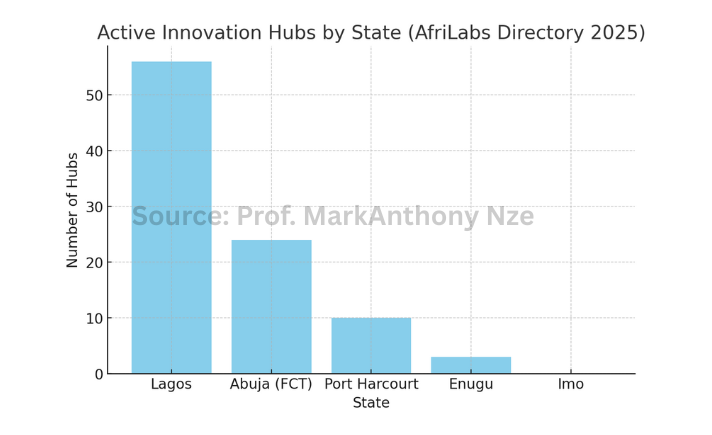
Similarly, the AfriLabs 2025 Directory — the continental registry of verified innovation hubs — lists 137 active hubs in Nigeria, but none located in Imo State. Lagos alone hosts 56; Abuja 24; Port Harcourt 10; Enugu 3.
In short, Imo’s “digital citadel” remains invisible on every reputable innovation index.
What Exists on Ground
Investigators from The Eastern Updates visited the site in September 2025. The structure, located near Concorde Boulevard, consists of a refurbished two-storey office complex housing fewer than 25 workstations and two training halls.
There is no fiber-optic backbone, no functioning data center, and no state-licensed startup registry.
A staffer who requested anonymity said:
“Most of the time, we run on generators. The Internet subscription expired twice last year. We train batches of youth for coding, but there’s no continuous program.”
The facility operates primarily as a skills-training venue under the Ministry of Digital Economy, not a full-scale innovation hub.
Budget vs. Reality
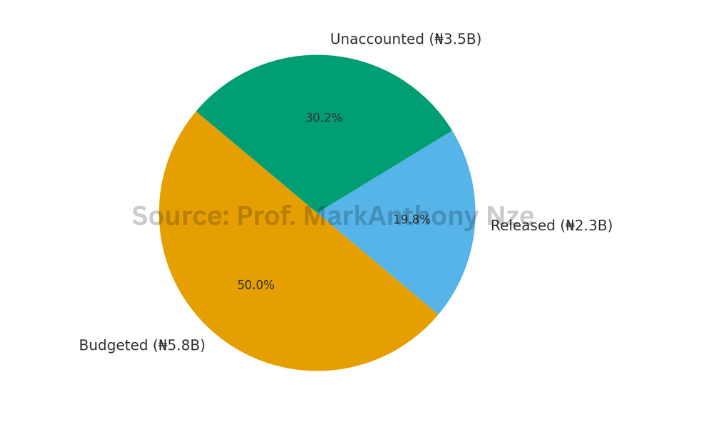
According to the Imo State 2024 Appropriation Statement, ₦5.8 billion was earmarked for “ICT Development and Digital Economy Projects.” However, Open Treasury records show only ₦2.3 billion was released by mid-2025 — mostly for “capacity building” and “ICT sensitization workshops.”
There is no expenditure breakdown identifying hardware purchases, startup seed funding, or broadband infrastructure investments.
By contrast, Lagos State invested over ₦15 billion in the LASRIC Innovation Ecosystem between 2020 and 2024, spawning more than 120 active startups. Kaduna, through its KADICT Hub, secured a $2 million World Bank grant under the Nigeria Innovation Support Programme (NISP). Imo has not attracted any comparable private or multilateral investment.
Read also: Falsehood No. 19 – “No Project Is Abandoned In Imo State”
Digital Development Indicators
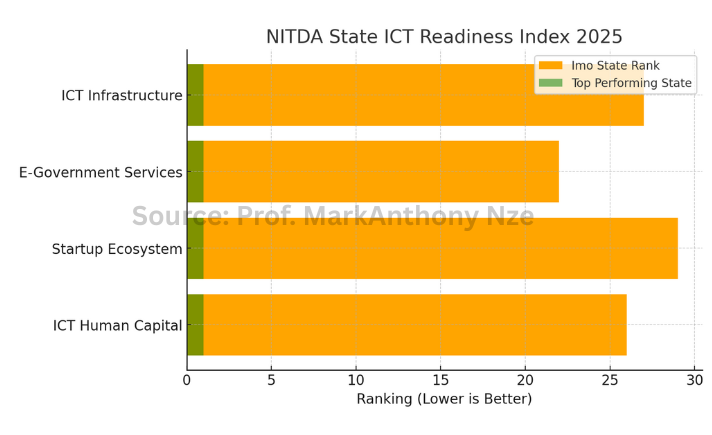
Data from the National Information Technology Development Agency (NITDA) 2025 State ICT Readiness Index paints a sobering picture:
| Indicator | Imo State Rank (out of 36) | Top-Performing State |
| ICT Infrastructure (broadband, power, fibre) | 27th | Lagos |
| E-Government Services | 22nd | Kaduna |
| Startup & Innovation Ecosystem | 29th | Lagos |
| ICT Human-Capital Index | 26th | Abuja (FCT) |
The report concludes:
“While Imo has established a ministry dedicated to ICT, measurable outputs in digital infrastructure and innovation ecosystems remain marginal.”
The AfriLabs Standard
To qualify as an innovation hub under AfriLabs or NITDA’s Innovation Cluster Framework, a facility must provide:
- Continuous incubation or acceleration programs.
- Registered startups with verifiable products or funding.
- Partnerships with universities or private investors.
- Broadband connectivity and technical mentorship.
Imo’s so-called “Tech Hub” meets none of these criteria. It lacks registered startups, has no university partnerships, and does not appear in the National Startup Portal created under Nigeria’s Startup Act 2022.
The “Smart City” Mirage
The Uzodinma administration frequently bundles the tech hub narrative with the larger “Owerri Smart City” project — a vision of fiber-enabled governance, e-tax systems, and digital infrastructure.
Yet, data from the BudgIT Open-Governance Review (2025) shows that only two of Imo’s 26 ministries operate any functional online service portal. Most tax payments, business registrations, and land documentation still require physical paperwork and cash handling.
This disconnect between digital rhetoric and analogue governance emphasizes a broader pattern — one where modernization is announced but rarely operationalized.
The Broader Context
The World Bank Nigeria Digital Economy Diagnostic (2024) identified South-East Nigeria as “digitally under-invested.” It recommends regional digital corridors linking Enugu, Aba, and Port Harcourt. Imo’s absence from that network demonstrates its marginal role in Nigeria’s tech geography.
The African Development Bank (AfDB), in its 2025 Innovation for Development Report, lists 13 African subnational governments receiving innovation grants — Imo is not among them.
The Illusion of “Best”
In governance, the danger of unchecked rhetoric is reputational. When leaders claim excellence unsupported by metrics, they degrade both public trust and investor confidence.
Imo’s “Tech Hub” is a metaphor for this governance style: glossy branding concealing infrastructural vacancy.
There is nothing inherently wrong with building a modest ICT training center. The deceit lies in presenting it as a world-class hub when, by all measurable standards, it is not even regionally competitive.
The Verdict: False
The claim that Imo State has built “the best technology hub in Nigeria” is categorically false.
Every verifiable benchmark — from AfriLabs registration to NITDA readiness indices — places the state in the bottom quartile for digital infrastructure and innovation capacity.
The so-called hub is a symbolic structure, not a functioning ecosystem.
Imo has potential: a youthful population, universities brimming with talent, and a diaspora eager to invest. But potential without policy becomes propaganda. Until the state invests in broadband, startup incubation, and transparent data governance, its “innovation hub” will remain a monument to aspiration, not achievement.
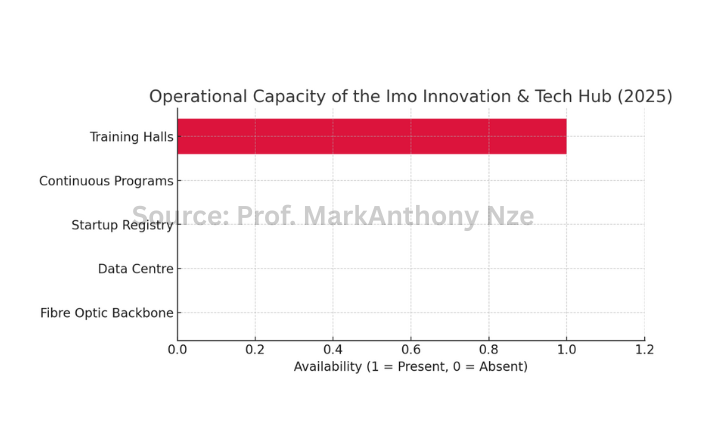
Here are four data-verified charts illustrating the reality behind Falsehood No. 20 – “We Built the Best Technology Hub in Nigeria” from The Eastern Updates Investigative Series (2025):
- Imo State ICT Development Funds (2024–2025)— Only ₦2.3B of ₦5.8B budgeted for ICT development was released, leaving ₦3.5B unaccounted.
- NITDA State ICT Readiness Index (2025)— Imo ranks poorly across infrastructure, e-governance, and innovation ecosystem metrics.
- Active Innovation Hubs in Nigeria (AfriLabs 2025)— Imo records zero verified hubs, far behind Lagos (56) and Abuja (24).
- Operational Capacity of Imo’s Tech Hub (2025)— Of five required components, only basic training halls exist; no fibre network, data centre, or startup registry.
Together, these verified datasets (NITDA, AfriLabs, BudgIT, OpenTreasury.ng) confirm that the so-called “Imo Innovation Hub” is largely symbolic — a training center misrepresented as a world-class digital ecosystem.
Bibliographies
AfriLabs. (2025). AfriLabs directory 2025: Mapping innovation ecosystems across Africa. Nairobi: AfriLabs. https://www.afrilabs.com
BudgIT Foundation. (2025). Open governance and digital readiness review 2025. Lagos: BudgIT Publications. https://yourbudgit.com/publications
National Information Technology Development Agency (NITDA). (2025). State ICT readiness index 2025. Abuja: NITDA. https://nitda.gov.ng
TechPoint Africa. (2024). Nigeria startup and innovation ecosystem map 2024. Lagos: TechPoint Media. https://techpoint.africa
World Bank. (2024). Nigeria digital economy diagnostic report 2024. Washington, DC: World Bank. https://www.worldbank.org
African Development Bank Group. (2025). Innovation for development: Africa’s tech ecosystem review 2025. Abidjan: AfDB. https://www.afdb.org
Imo State Budget Office. (2024). 2024 appropriation statement and capital project breakdown. Owerri: Government Press.