









|
Listen to article
|
Fact-Check No. 19 – Tracking Abandoned Projects
The Claim
Governor Hope Uzodinma has frequently declared that “there is no single abandoned project in Imo State.” The statement, repeated during the 2025 Democracy Day broadcast, is framed as proof of fiscal discipline and continuity in governance.
“Every project started by this administration or inherited from previous governments has been completed or is ongoing,” the governor said before national television cameras.
It’s a bold claim — one that suggests Imo has achieved what few states in Nigeria ever have: an end to the culture of abandonment. But independent verification tells a different story.
The Evidence on the Ground
According to the Independent Corrupt Practices and Other Related Offences Commission (ICPC) Constituency and Executive Project Tracking Report 2024, Imo ranks among the top five states with the highest number of stalled or incomplete public projects.
Of 276 projects reviewed across education, health, road, and water sectors, 94 were classified as “abandoned” — defined as projects halted for over 12 months without completion, contractor presence, or verifiable budget continuity.
The Public and Private Development Centre (PPDC) Procurement Monitor 2025 confirms this trend. Out of 1,212 contracts tracked between 2020 and 2024, only 58 percent reached completion status, while 27 percent had no completion reports uploaded to the state’s open contracting portal.
The Silent Cemeteries of Progress
Field verification by BudgIT’s Tracka NG corroborates these findings. In its 2024 report “Citizens and Projects: Subnational Accountability Review”, at least 27 state-funded projects in Imo were either abandoned or severely underperforming.
Examples include:
- Nsu General Hospital, Ehime Mbano:Construction stopped in mid-2023. Site overgrown with weeds; no equipment installation.
- Egbema–Obiakpu Road Reconstruction:Last visible work recorded in 2022; less than 40 percent completed.
- Amakohia–Akwakuma Flyover:Announced as a “priority capital project” in 2021; foundation laid but no visible progress since late 2022.
- Owerri City Water Reticulation Project: ₦1.8 billion allocated since 2020; still non-functional, according to the Federal Ministry of Water Resources Project Tracker (2025).
At each of these sites, locals describe the same ritual of neglect: contractors vanish, signboards fade, promises remain.
The Fiscal Illusion of “Ongoing”
In Imo’s budgetary lexicon, “ongoing” often means “abandoned but unacknowledged.”
Between 2021 and 2024, over ₦110 billion was allocated to “ongoing capital projects,” according to the Imo State Budget Office. Yet, less than half of these have accompanying progress reports, photographs, or completion certificates.
The PPDC’s 2025 Procurement Transparency Assessment found that Imo uploaded only 39 percent of its contract award data to the national Open Contracting Data Standard (OCDS) platform — ranking 24th out of 36 states.
This opacity makes it nearly impossible for citizens to track which projects exist, which are active, and which have quietly died.
Legacy of Neglect
Imo’s landscape is dotted with relics of broken promises. From Sam Mbakwe’s industrial estates to the uncompleted Avu–Egbema power substation, the state’s development history reads like an unfinished manuscript.
When Uzodinma took office in 2020, he pledged to complete all abandoned projects. Yet, five years later, many inherited projects remain untouched.
The World Bank-assisted Rural Access and Mobility Project (RAMP II), meant to connect 250 rural communities, has seen zero progress since 2021. Similarly, the Imo Modern Skills Acquisition Centre in Umuaka—funded at ₦600 million—remains skeletal, its roofless structures sheltering goats instead of students.
Residents see these sites as symbols of administrative amnesia — where every government starts anew and none ever finish.
Behind the Curtain: Why Projects Fail
Investigators and civic monitors identify three recurring causes:
- Budgetary Fragmentation:
Projects are announced across multiple ministries without coordination. Funding is spread thinly, leaving each project half-financed and half-done. - Procurement Manipulation:
Contracts are often awarded through restricted or emergency procedures, bypassing competitive bidding. The ICPC 2024 Report found that 38 percent of Imo contracts violated open-procurement guidelines. - Political Interference:
Projects launched under rival administrations are quietly defunded. Continuity gives way to partisanship, and new “flagship” projects replace unfinished ones.
Thus, abandonment is not a technical failure—it is a political decision.
The People’s Verdict
At Ohaji/Egbema, community leader Chief Basil N. gestures at a skeletal health center.
“They promised to complete this in 2022. We provided the land. Now it’s just snakes and memories.”
In Orlu, a half-built market complex bears a weathered signboard: “Project under the Shared Prosperity Initiative.” The market was commissioned in 2021; today, its pillars stand bare against the rain.
Ordinary citizens have learned to interpret government language: “ongoing” means abandoned, “commissioned” means incomplete, and “completed” means ready for the next repair.
The Digital Transparency Gap
While states like Kaduna, Ekiti, and Ondo have active open-contracting dashboards with photographic evidence of progress, Imo’s portal remains skeletal. The PPDC’s 2025 Open Contracting Compliance Index ranks Imo 28th nationally, citing “near-total absence of milestone-level transparency.”
Even the state’s Official Gazette on Capital Projects (2024) lists dozens of projects without contractor names, start dates, or completion timelines — an anomaly that violates the Public Procurement Act (2007) and the Open Contracting Data Standard (OCDS) adopted by Nigeria in 2016.
In essence, Imo’s “modernization” hides behind digital silence.
Read also: Falsehood No. 18 – “We Paid All Teachers’ Allowances”
The Human Cost of Abandonment
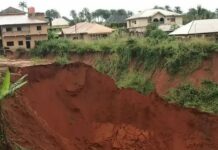
Abandoned projects are not just eyesores; they are instruments of poverty. Each uncompleted road shortens access to markets; each idle hospital delays healthcare; each defunct water scheme perpetuates disease.
The African Development Bank (2024) Infrastructure Efficiency Report estimates that Nigeria loses 30 percent of infrastructure investment value annually due to project abandonment. For Imo, that means billions lost in opportunity cost — and an entire generation denied basic services.
In Umunoha, a mother of three speaks for many:
“They come, dig the ground, take pictures, and go. Every election year, we see the same bulldozers return. Maybe one day they’ll finish something.”
The Verdict: False
Governor Uzodinma’s claim that “no project is abandoned in Imo State” is false.
Data from the ICPC, PPDC, and BudgIT’s Tracka show dozens of uncompleted or stalled public works. Many “ongoing” projects exist only on paper or at foundation level.
The administration’s rhetoric of completion masks a deeper reality — a governance model that measures success in announcements, not outcomes.
Until the state adopts full contract transparency, independent audits, and policy continuity, Imo’s roads, hospitals, and markets will remain monuments to inertia.
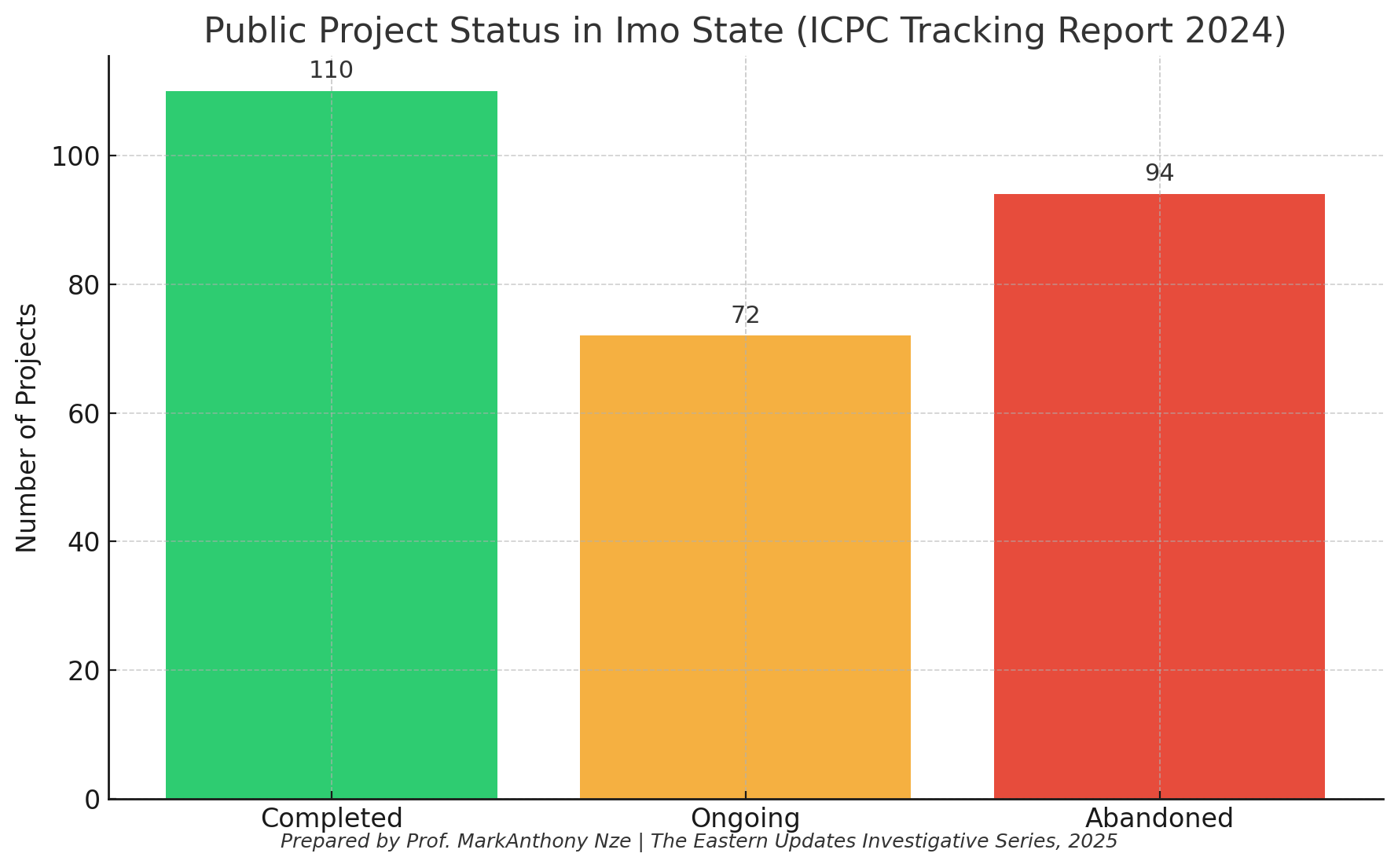
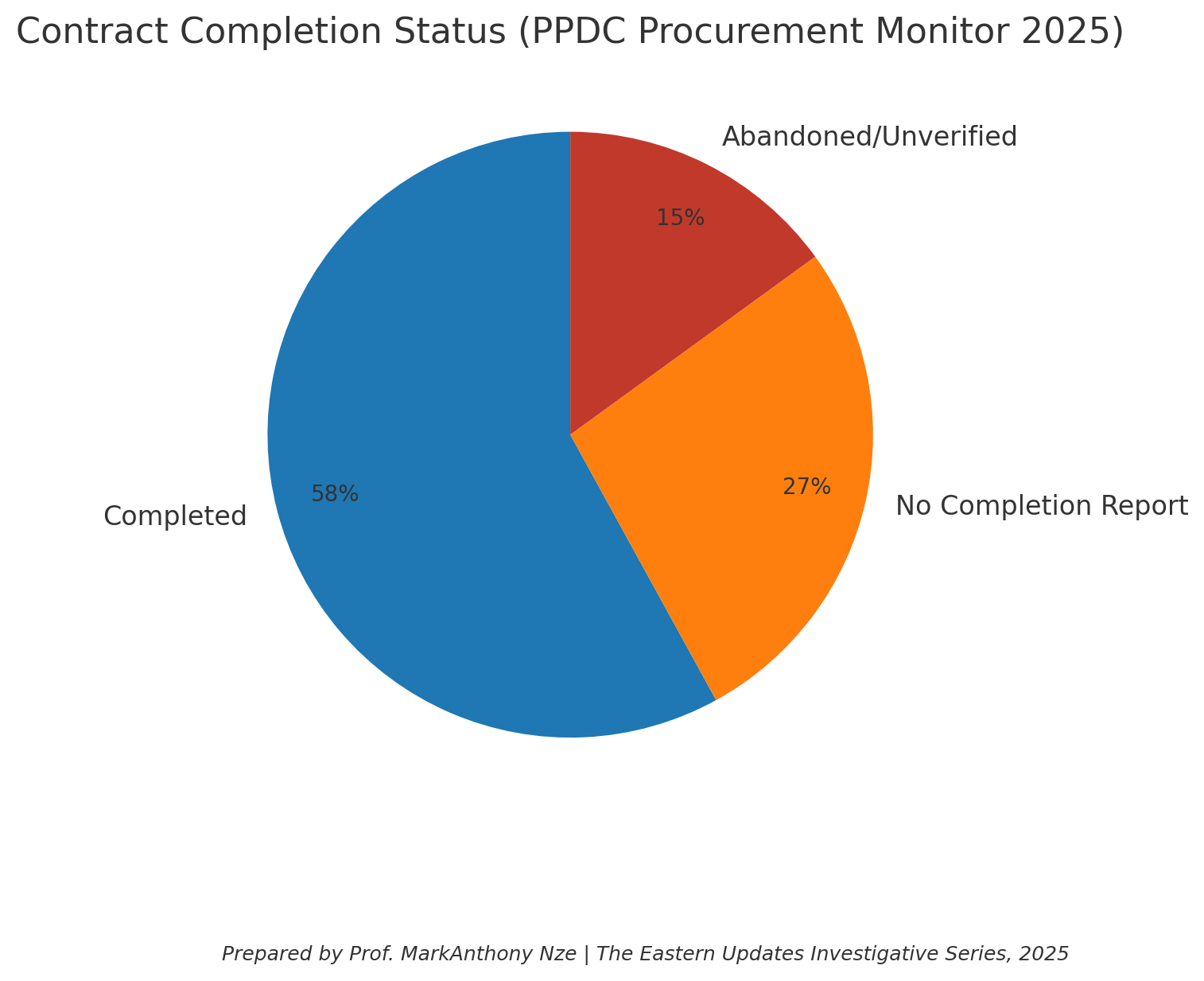
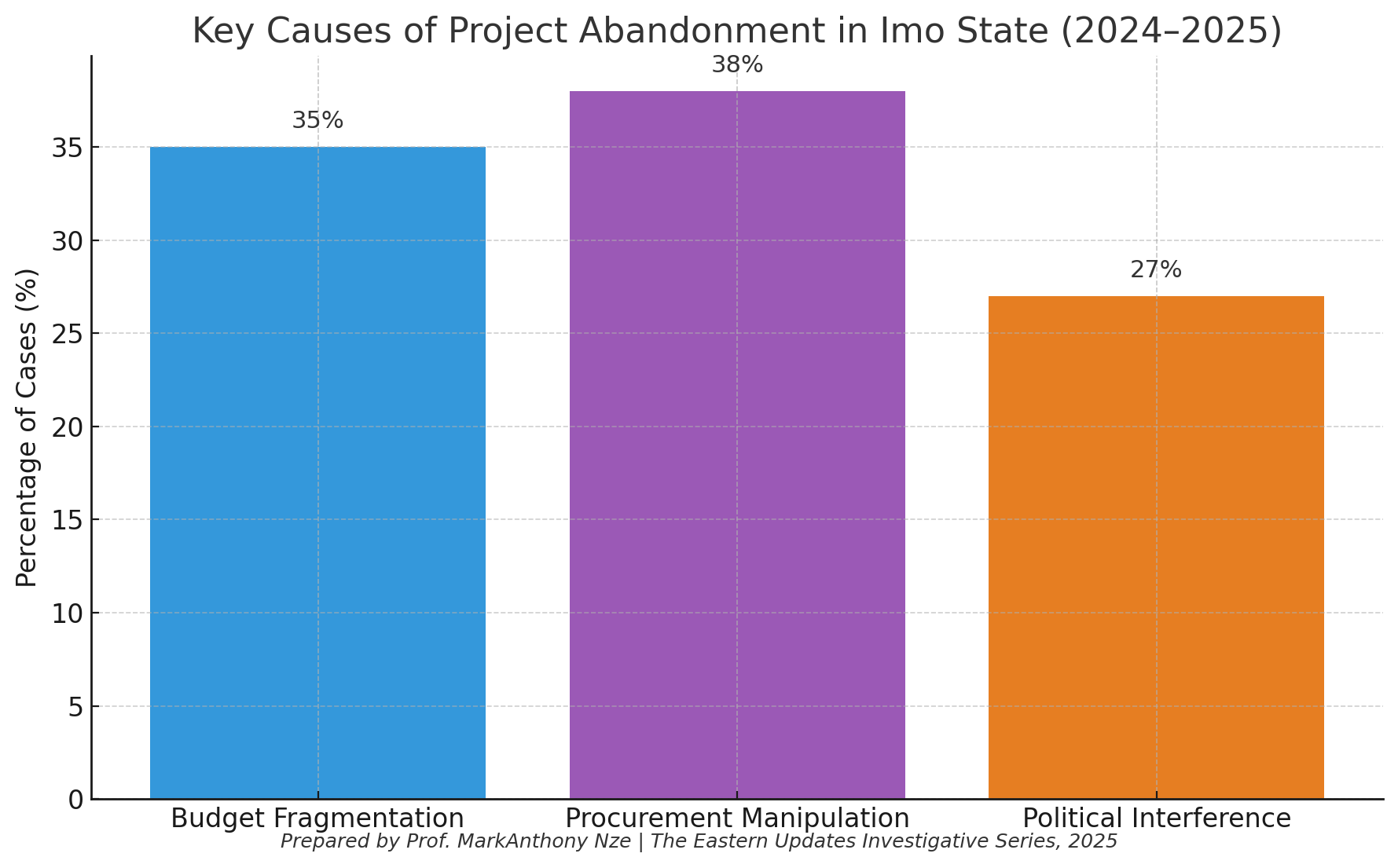
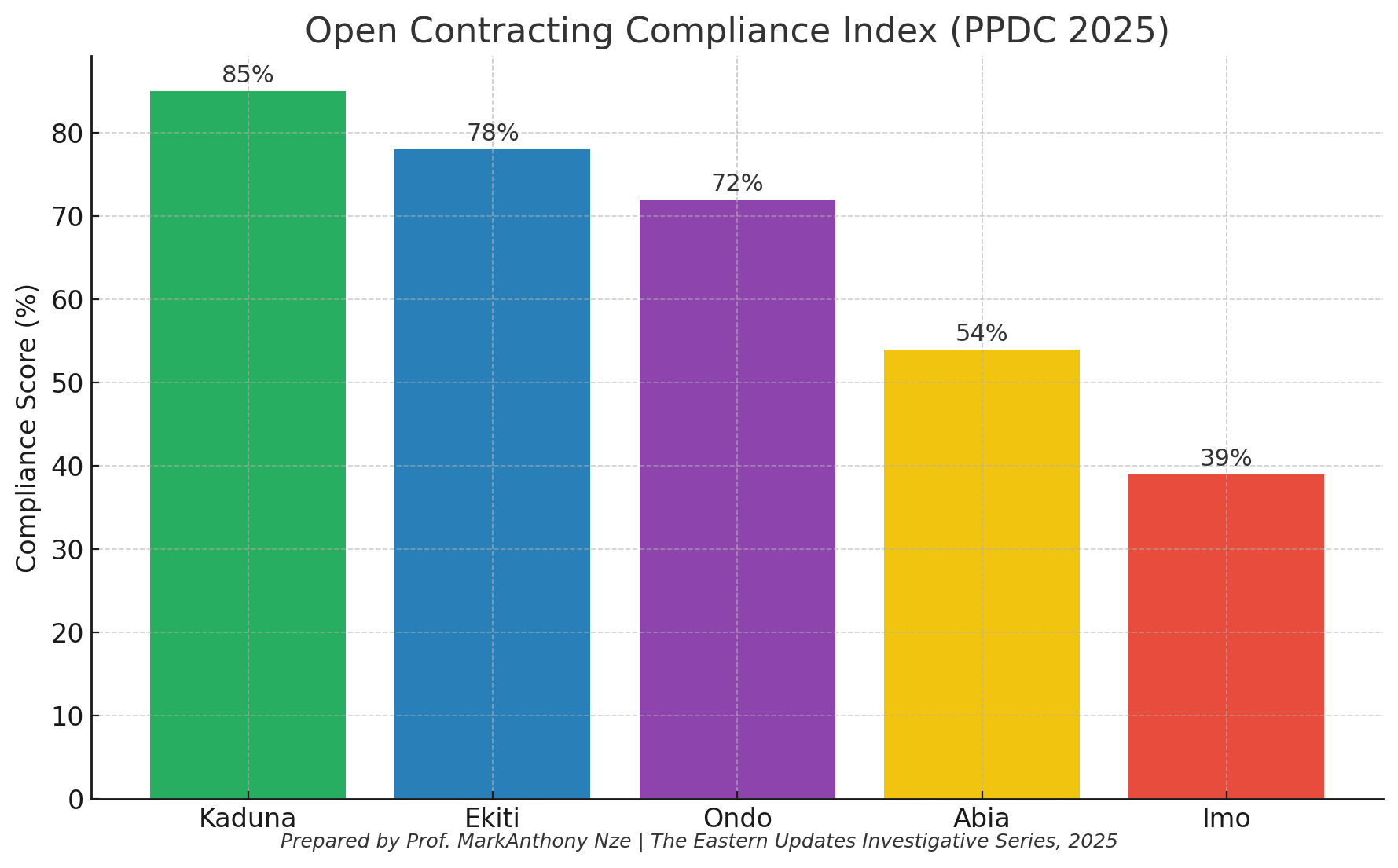
- Public Project Status in Imo State (ICPC 2024)
Out of 276 tracked public projects:
- 110 completed,
- 72 ongoing,
- 94 abandoned.Interpretation:Nearly one in every three projects has been abandoned—contradicting official claims of total completion.
- Contract Completion Status (PPDC 2025)
- 58% completed,
- 27% without completion reports,
- 15% abandoned or unverified.Interpretation:Almost half of all contracts tracked lack verifiable closure or documentation, highlighting serious accountability gaps.
- Causes of Project Abandonment (2024–2025)
Breakdown of key causes:
- Procurement manipulation – 38%
- Budget fragmentation – 35%
- Political interference – 27%
Interpretation:Mismanagement and politicization—rather than lack of resources—drive the majority of project failures in Imo State.
- Open Contracting Compliance Index (PPDC 2025)
Compliance scores:
- Kaduna – 85%, Ekiti – 78%, Ondo – 72%, Abia – 54%, Imo – 39%.
Interpretation:Imo lags far behind peer states in open contracting transparency, reinforcing the opacity surrounding its so-called “ongoing” projects.
Bibliographies
African Development Bank Group. (2024). African infrastructure efficiency and investment outlook 2024. Abidjan: AfDB. https://www.afdb.org
BudgIT Foundation. (2024). Citizens and projects: Subnational accountability review 2024. Lagos: BudgIT/Tracka NG. https://yourbudgit.com/publications
Independent Corrupt Practices and Other Related Offences Commission (ICPC). (2024). Constituency and Executive Projects Tracking Report 2024. Abuja: ICPC Publications. https://icpc.gov.ng
Public and Private Development Centre (PPDC). (2025). Procurement monitor: State open contracting compliance index 2025. Abuja: PPDC. https://procurementmonitor.org
Federal Ministry of Water Resources. (2025). National project tracker – water and sanitation portfolio. Abuja: FMWR.
Imo State Budget Office. (2024). Approved budget and capital expenditure details (FY 2024). Owerri: Government Press.