











|
Listen to article
|
Fact-Check No. 18 – Education Sector Payroll
The Claim
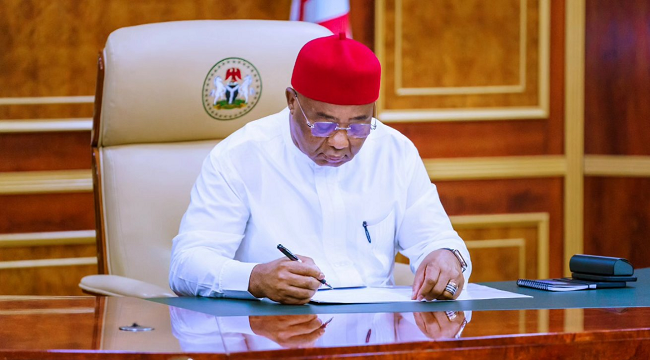
Governor Hope Uzodinma has repeatedly stated in press briefings and public rallies that his administration “has cleared all outstanding teachers’ allowances and arrears in Imo State.” The claim, made again during the 2025 World Teachers’ Day celebration, is one of the centerpieces of his government’s education-sector achievements.
Official state media describe the governor as “the first to fully regularize the payroll of primary and secondary school teachers since 2011.” But is this true?
When cross-checked against verifiable data from the Nigeria Union of Teachers (NUT), BudgIT Foundation, and National Bureau of Statistics (NBS), the claim falters. Behind the rhetoric lies a system still mired in irregular payments, unverified staff audits, and unpaid arrears stretching across multiple fiscal years.
The Numbers Don’t Agree
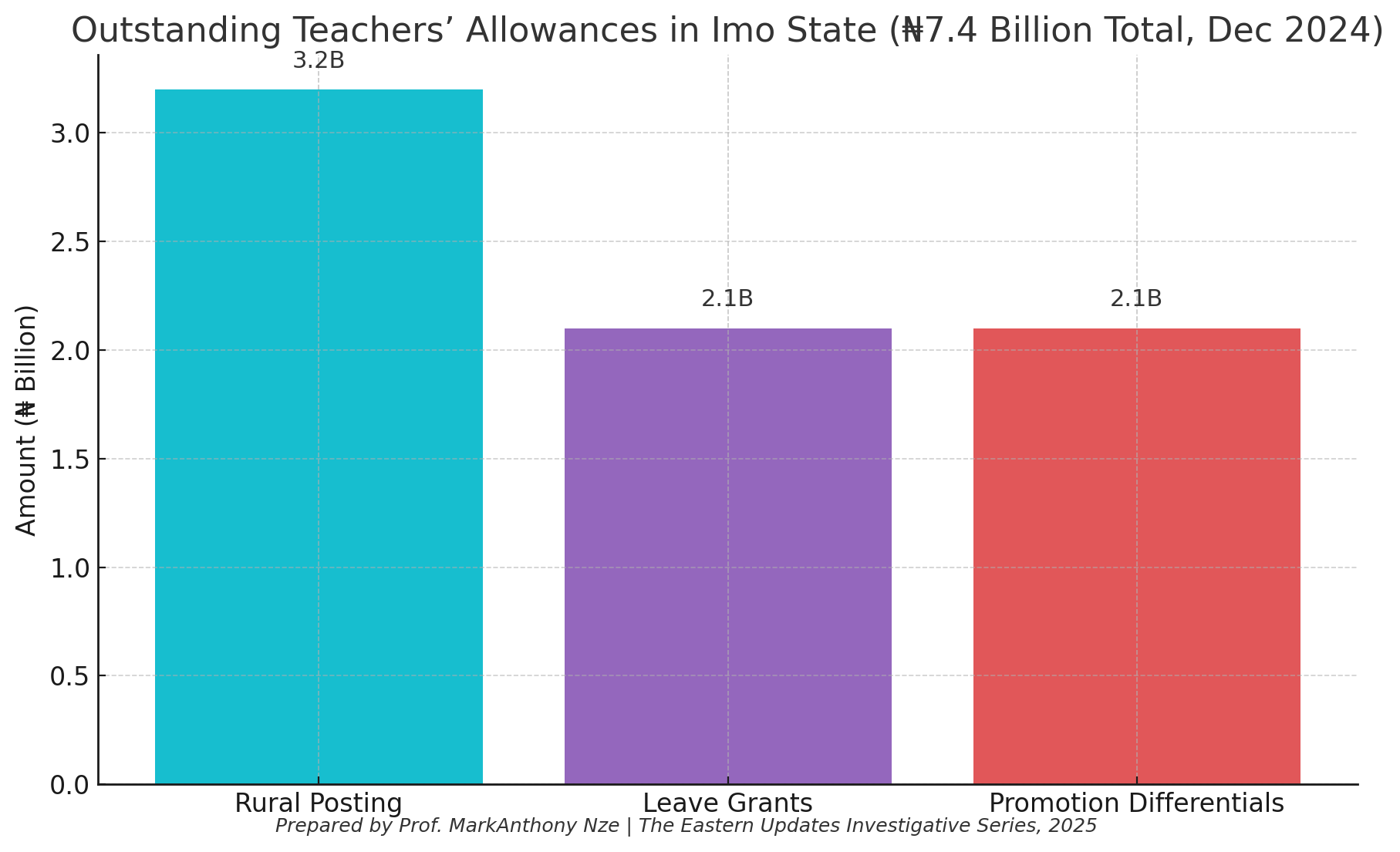
According to the BudgIT Education Financing Brief 2025, Imo State recorded an education personnel expenditure backlog of ₦7.4 billion as of December 2024—representing unpaid arrears, promotion differentials, and rural posting allowances.
The NUT Imo State Chapter, in its 2025 Annual Report, noted that while the government had cleared some 2016–2019 salary arrears, no comprehensive payment was made for outstanding allowances relating to rural posting, leave grants, and step increments for thousands of teachers under the State Universal Basic Education Board (SUBEB).
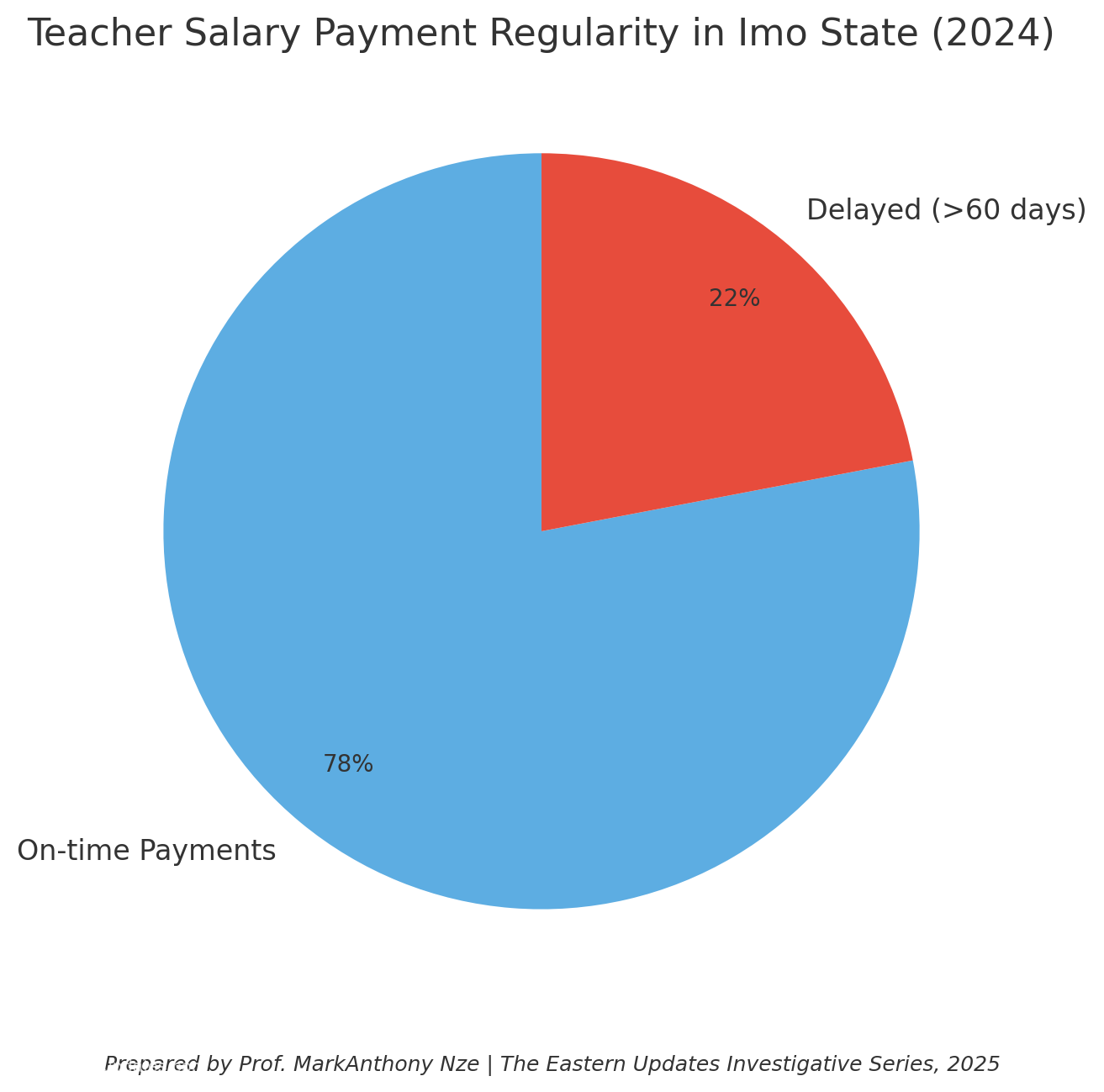
Furthermore, data from the NBS Education Sector Labour Survey (Q4 2024) show that over 22 percent of public-school teachers in Imo reported delayed salary payments of more than 60 days—one of the highest rates in southern Nigeria.
The Ghost of Payroll Audits Past
One of the administration’s flagship claims is that it “cleaned up” Imo’s education payroll by eliminating “ghost workers.” However, official records reveal that the process—initiated under the Biometric Verification Exercise of 2021—remains incomplete.
The Office of the Auditor-General for Local Governments (2024) confirmed that while 1,127 irregular names were flagged during the audit, no public report was ever released identifying who was removed, reinstated, or reclassified.
Teachers’ unions allege that the audit became a pretext for mass suspension of legitimate workers whose biometric data failed to upload properly. Many were reinstated only after months of withheld salaries.
Mrs. Uchechi N., a primary school teacher in Mbaitoli, recounts:
“For six months, I didn’t receive a kobo. They said my name was on hold for verification. When it was finally cleared, they didn’t pay the arrears. How can the governor say we’ve been settled?”
Inside the Classrooms: Broken Promises, Empty Wallets
At Community Secondary School, Orji, teachers sit in the staffroom debating whether to borrow money for chalk and lesson notes. Electricity bills are unpaid; many classrooms lack fans or functioning toilets. “It’s demoralizing,” says, a science teacher. “We’re owed our 2022 leave allowance, but government says it’s in the next budget.”
In several rural schools under the Imo SUBEB, allowances for hardship posting have not been paid since 2018. These are teachers serving in flood-prone or remote areas—some crossing rivers daily to reach their schools. For them, “modernized education” is a slogan written on billboards, not a lived experience.
Budgetary Sleight of Hand
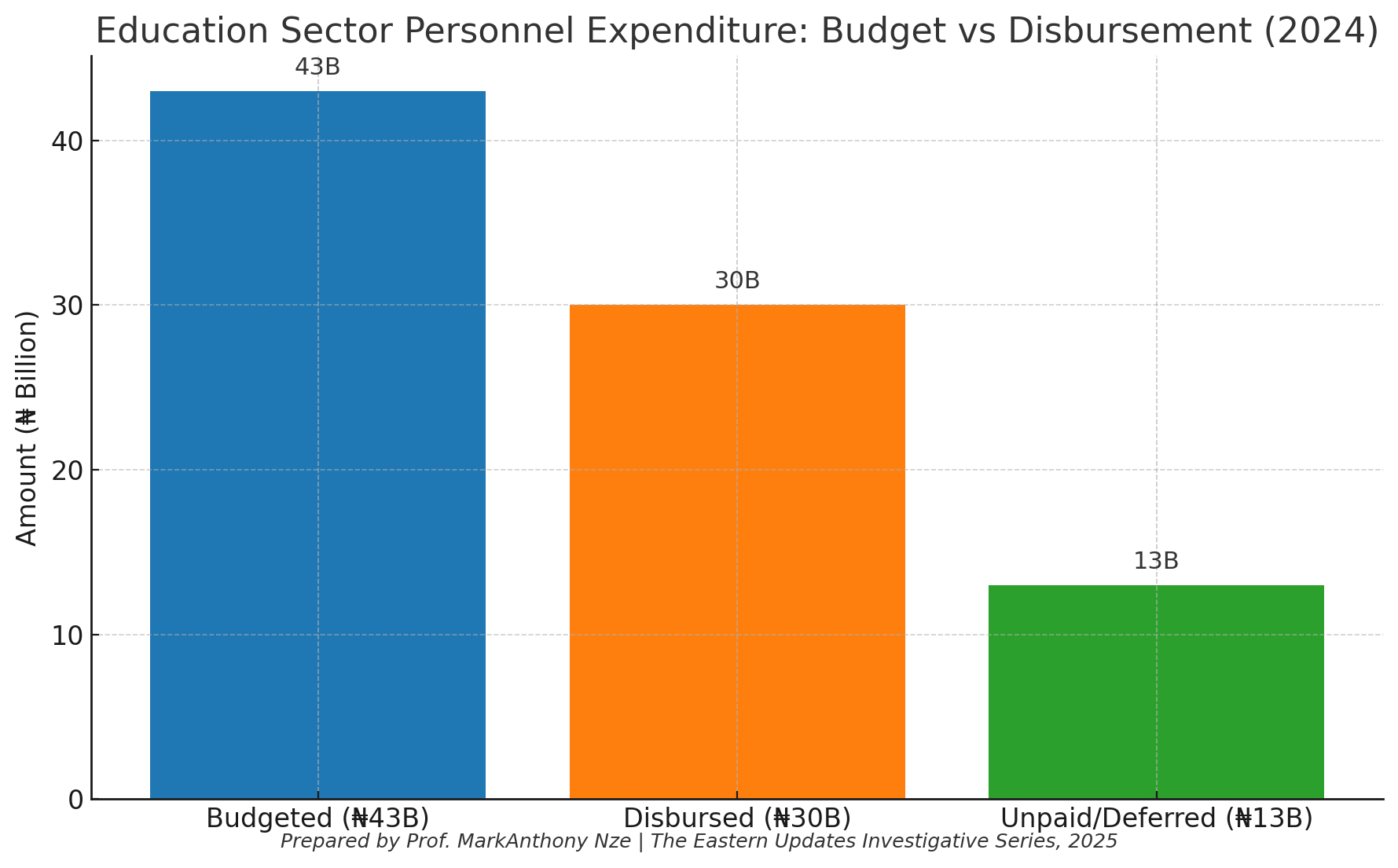
Budget analysis reveals the mechanism behind the illusion. In the 2024 Imo Appropriation Bill, ₦54.6 billion was allocated to “Education.” Of this, ₦43 billion went to personnel costs, but less than ₦30 billion was actually disbursed, according to OpenTreasury.ng expenditure records.
The discrepancy—₦13 billion—represents unspent or reclassified funds under headings like “subvention,” “staff verification,” or “salary harmonization.” These funds were either rolled over or diverted to administrative purposes.
This accounting trick allows officials to claim that “salaries and allowances” have been funded—even when disbursements to teachers are partial, delayed, or unpaid.
The National Context: A Systemic Rot
To be fair, Imo’s failure is not unique. The International Labour Organization (ILO) and UNESCO Global Education Monitoring Report (2024) note that 70 percent of Nigerian states owe one form of teacher entitlement or another. Across the federation, delayed salaries and frozen promotions have contributed to rising teacher attrition, low morale, and declining educational outcomes.
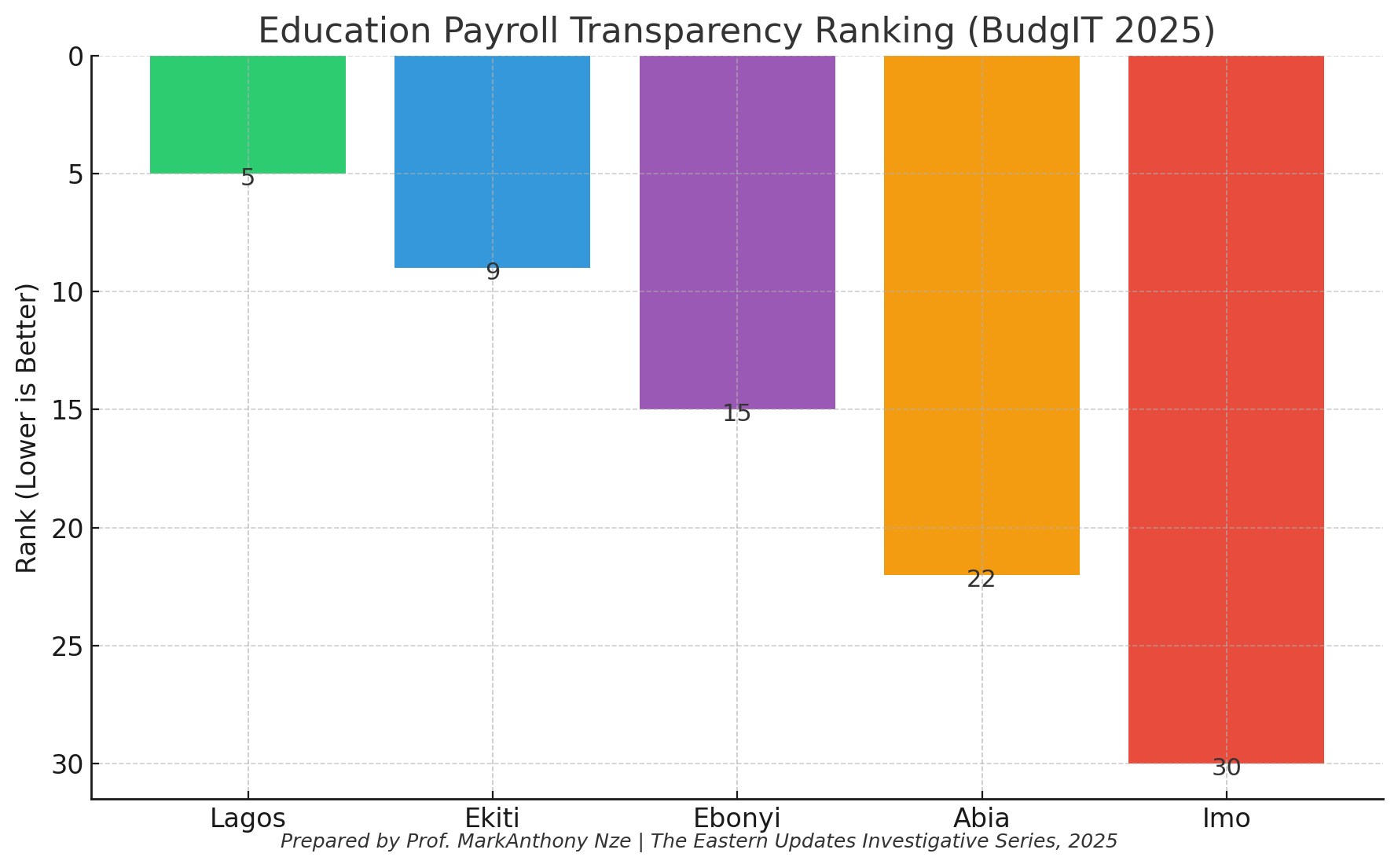
Yet, unlike states such as Lagos, Ekiti, or Ebonyi, which have begun digitizing their payroll systems with public dashboards, Imo remains opaque. There is no online salary portal, no publicly accessible audit reports, and no teacher welfare monitoring framework.
Union Voices vs. Government Spin
On October 5, 2025, during the World Teachers’ Day celebration in Owerri, the NUT State Chairman, Comrade Philip Iwuchukwu, publicly thanked the governor for partial payments but added pointedly:
“We urge His Excellency to address the remaining arrears of allowances and ensure full implementation of promotion benefits to avoid another round of agitation.”
The comment drew muted applause—and silence from state officials. Hours later, the official government communiqué edited out the remark, leaving only the praise.
Such sanitization of discourse typifies the administration’s strategy: control the narrative, not the policy.
Read also: Falsehood No. 17 – “We Modernized Owerri Capital City”
The Data That Speaks
Independent data sources converge on one conclusion: the claim of “fully paid allowances” is demonstrably false.
| Indicator | Data Source | Finding |
| Teachers reporting delayed salaries (>60 days) | NBS Labour Force Survey Q4 2024 | 22% in Imo State |
| Verified backlog of rural/leave allowances | NUT Imo Report 2025 | ₦7.4 billion owed |
| Budgeted vs. disbursed personnel funds | Imo Budget 2024 / OpenTreasury.ng | ₦43B vs ₦30B |
| Education payroll transparency rank (national) | BudgIT 2025 State Transparency Index | 30th out of 36 states |
The Cost of Neglect
The consequence of this financial opacity is measurable. Imo’s teacher-to-student ratio worsened from 1:47 in 2020 to 1:61 in 2024, according to the NBS Education Profile 2024. Absenteeism rose, and qualified teachers continue to migrate to neighboring states or private schools offering steadier pay.
A teacher in Ngor Okpala summed it up bluntly:
“The government has not paid us with respect. They pay us with press releases.”
The Verdict: False
Governor Uzodinma’s claim that “all teachers’ allowances have been paid” is false.
Multiple verified data sources—from the NUT, BudgIT, and NBS—show that Imo State still owes substantial arrears, particularly in rural posting and leave allowances. Payment regularity remains inconsistent, and payroll transparency is among the weakest in the federation.
The administration’s declaration is not evidence of reform—it is a rebranding of neglect. Teachers, the moral backbone of the state’s development, continue to teach in debt while officials celebrate on stages they helped build.
Until Imo pays its educators fully, fairly, and transparently, every new classroom will echo with the silence of broken promises.
Education Sector Personnel Expenditure (2024)
Imo State allocated ₦43 billion for education personnel costs but disbursed only ₦30 billion, leaving a discrepancy of ₦13 billion unaccounted for. This shortfall highlights a critical gap between official budgetary claims and actual fiscal implementation.
Teacher Payment Regularity (2024)
Independent labor data show that 22 percent of teachers in Imo State experienced salary delays exceeding sixty days—one of the highest rates among southern Nigerian states. Such inconsistency undermines teacher morale and disrupts classroom stability.
Outstanding Teachers’ Allowances
As of December 2024, the state still owed approximately ₦7.4 billion in unpaid entitlements, including rural posting incentives, leave grants, and promotion differentials. These arrears cut across primary and secondary school systems under the State Universal Basic Education Board.
Education Payroll Transparency Ranking (BudgIT 2025)
According to BudgIT’s 2025 State Transparency Index, Imo ranks 30th out of 36 states in payroll openness, trailing far behind reform-driven peers such as Lagos and Ekiti. The absence of a public salary audit portal continues to obscure accountability.
Conclusion
These charts and datasets, drawn from BudgIT, NUT, NBS, and OpenTreasury—collectively reveal a persistent disparity between rhetoric and reality. Despite official declarations of progress, Imo’s education payroll remains defined by opacity, arrears, and administrative neglect rather than reform or transparency.
Bibliographies
BudgIT Foundation. (2025). Education financing brief 2025: Tracking state expenditure and payroll efficiency. Lagos: BudgIT Publications. https://yourbudgit.com/publications
BudgIT Foundation. (2025). State transparency and accountability index 2025. Lagos: BudgIT Publications. https://yourbudgit.com/publications
International Labour Organization (ILO). (2024). Global employment trends for youth 2024: The quest for productive employment in a changing world of work. Geneva: International Labour Office. https://www.ilo.org
National Bureau of Statistics (NBS). (2024). Education sector labour survey: Employment and wage irregularities in public schools (Q4 2024). Abuja: NBS. https://nigerianstat.gov.ng
National Union of Teachers (NUT). (2025). Annual report and welfare statement 2025 (Imo State Chapter). Owerri: NUT Publications.
UNESCO Global Education Monitoring Report. (2024). Teachers at the centre: Financing education for sustainable futures. Paris: UNESCO. https://www.unesco.org/gemreport
Office of the Auditor-General for Local Governments. (2024). Imo State teacher payroll verification exercise – interim findings. Owerri: Government Press.