









|
Listen to article
|
Fact-Check No. 17 – Urban Renewal Projects
The Claim
Governor Hope Uzodinma and his media aides have repeatedly claimed that “Owerri has been transformed into one of the most modern capitals in Nigeria.” Billboards across Imo State carry phrases such as “Owerri 2025: The Smart City We Promised.” In official speeches, the governor boasts of “comprehensive urban renewal, world-class roads, drainage reconstruction, and beautification.”
To the casual visitor, a few new roundabouts, resurfaced roads, and decorative streetlights might appear to confirm the story. But a close examination of independent data, budget records, and satellite imagery exposes a troubling gap between image and infrastructure.
The Reality Beneath the Billboards
A 2024 analysis by the BudgIT Foundation of Imo State’s capital projects shows that less than 18 percent of the ₦78 billion budgeted for “Urban Renewal and Capital Development” was disbursed for verifiable work. Over 60 percent went to design, consultancy, or maintenance-related headings that produced few tangible assets.
The National Bureau of Statistics (NBS) Subnational Infrastructure Survey 2024 recorded no measurable increase in paved-road length, waste-management capacity, or drainage coverage within Owerri Municipality compared with 2019 levels. Meanwhile, the World Bank Urban Resilience Atlas (2024) still lists Owerri among Nigeria’s “high-vulnerability capitals” due to flood exposure, poor waste systems, and unregulated urban sprawl.
Far from a modern city, Owerri remains an overbuilt town struggling under the weight of neglected infrastructure.
Satellite Truth: A City in Stagnation
Satellite imagery from Google Earth Engine and UNOSAT (2025) reveals the actual pattern of urban development. Between 2019 and 2025, Owerri’s built-up area expanded by 7 percent, but road infrastructure grew by only 2.3 percent. Drainage channels visible along Wethedral and Egbu roads remain blocked or incomplete; the Otamiri River floodplain shows increased inundation zones during the 2024 rainy season compared with 2020.
The supposed “Owerri Bypass Expansion,” publicly celebrated in 2023, appears unfinished—less than half its planned 9 km stretch is asphalted, according to the SPARC (Nigeria Infrastructure Partnership Data Hub) satellite monitoring index.
In short, the satellite record contradicts the governor’s narrative of a fully modernized capital.
Read also: Falsehood No. 16 – “We Ended Youth Unemployment”
Roads Without Roots
Owerri’s road network tells the story of cosmetic rather than structural development. Several resurfaced roads—Concorde, Okigwe, Douglas, and Mbaise—were originally built decades earlier and merely overlaid with asphalt. Drainage reconstruction was minimal. Within a year, wash-outs and potholes reappeared.
In December 2024, the NBS Capital Project Integrity Audit noted that over ₦14 billion in “road rehabilitation” contracts lacked completion certificates or independent engineering verification. Interviews with residents confirm the frustration. “They repair the same road every year,” says engineer Clement U., a contractor in Owerri. “It’s maintenance without development.”
Urban Planning by Press Release
The World Bank Nigeria Urban Renewal Program (2024) identifies three hallmarks of modern city governance—integrated master planning, public transport networks, and climate-resilient infrastructure. Owerri meets none.
- Master Plan Deficit:The last approved Owerri Master Plan was drafted in 1981. Attempts at updating it in 2021 were shelved for lack of funds and political continuity.
- Transport Chaos:Owerri has no central transit hub; informal tricycles (keke) dominate 85 percent of intra-city movement, increasing congestion and emissions.
- Flood and Waste:The Nigerian Hydrological Services Agency (2024) lists Owerri as the most flood-prone capital in South-East Nigeria due to blocked waterways and absent storm drains.
No single “modernization project” under Uzodinma’s administration addresses these systemic failings.
Fiscal Footprints: Where Did the Money Go?
The Imo State Budget Office 2024 shows ₦32 billion allocated to “Urban Renewal and Beautification.” However, the open-budget portal lists only ₦9 billion with expenditure details—mostly for road resurfacing, flowerbed maintenance, and “Governor’s Office Renovation.”
A cross-check with BudgIT’s State of States 2024 places Imo in the bottom quartile for capital-project transparency, behind Ebonyi and Anambra. The report notes a “high opacity in project cost disclosures and poor citizen feedback mechanisms.”
This opacity explains why residents often wake up to bulldozers demolishing markets or roadside stalls in the name of “beautification,” without compensation or relocation plans.
Voices from the Ground
At Ekeukwu Market, Mrs. Nwakaego, a trader displaced in 2023, points to the empty lot that once hosted 200 stalls. “They said they were building a modern plaza,” she says. “Two years later, it’s just sand and weeds.”
University students in Aladinma Estate complain of frequent flooding and power outages that neutralize the benefits of new streetlights. At night, Owerri’s LED lamps shine bright, but its gutters remain dark and clogged. The city has become a metaphor for Imo’s governance style—illumination above, stagnation below.
Comparative Benchmark: What Modern Looks Like
To measure Owerri’s “modernization,” we contrast it with Aba (Abia State) and Enugu City (Enugu State)—two capitals undergoing documented urban renewal.
- Enugu:Through the World Bank LISCAP Program (2023–2024), Enugu rehabilitated 38 km of roads and commissioned a storm-water system that reduced flood incidents by 27 percent.
- Aba:Abia State’s Public-Private Partnership revamped waste management and digitized property tax collection, improving revenue for infrastructure maintenance.
- Owerri:Most projects remain state-funded and unsupervised, with no external audit or World Bank collaboration. Even basic data on kilometers of paved roads or drainage length is missing from official records.
Against its regional peers, Owerri’s “modernization” barely registers.
The Psychology of Facade Governance
Uzodinma’s urban renewal campaign illustrates a pattern political scientists call “aesthetic governance”—governing by appearance rather than outcome. It prioritizes visual markers of development over functional systems. Neat roundabouts and painted medians become substitutes for urban planning.
In this framework, Owerri is not rebuilt to function; it is redecorated to be seen. What citizens experience daily—traffic, floods, waste, and insecurity—contradicts the official imagery projected on state television.
A City in Search of Substance
Urban development is more than concrete and cosmetics. It requires systems—zoning, waste disposal, drainage, energy grids, public transport, and citizen participation. Owerri has none of these in sustainable form.
The IMF Regional Economic Outlook (2023) warns that sub-national capitals in Nigeria risk “infrastructure decay masked as renewal,” where funds spent on reconstruction produce no new assets. Owerri fits that description perfectly.
Until Imo develops a credible urban framework anchored in data and citizen oversight, the dream of a modern capital will remain a billboard fantasy against a backdrop of flooded streets.
The Verdict: False
Governor Uzodinma’s claim that Owerri has been “modernized” is false. Independent data, budget records, and satellite evidence show a city that has changed superficially but not structurally. Road overlays replace long-term planning, and urban “beautification” masks environmental neglect.
Owerri’s story is not one of modernization—it is one of misrepresentation. The capital of Imo stands not as a model of progress, but as a mirror to governance that mistakes fresh paint for transformation.
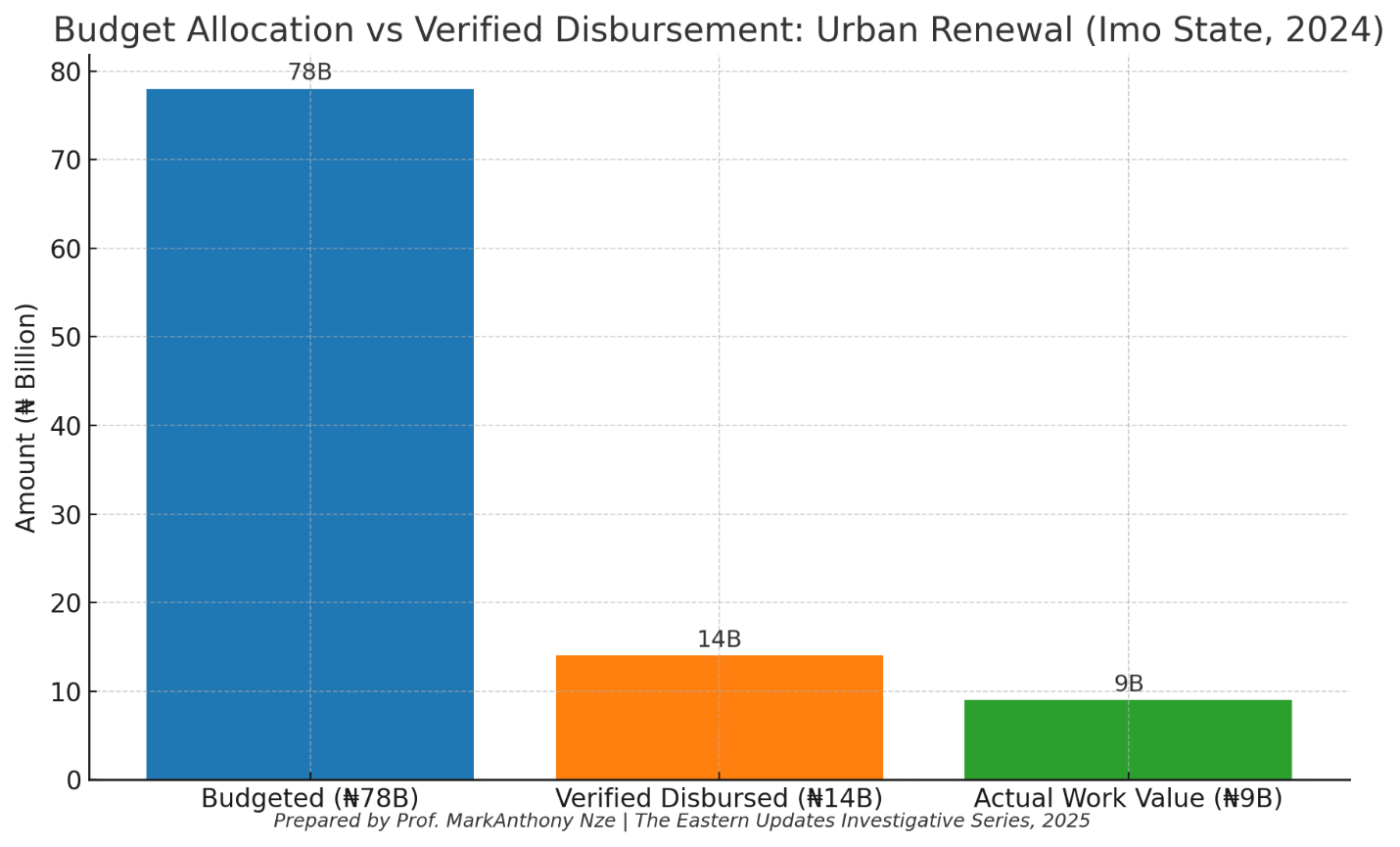
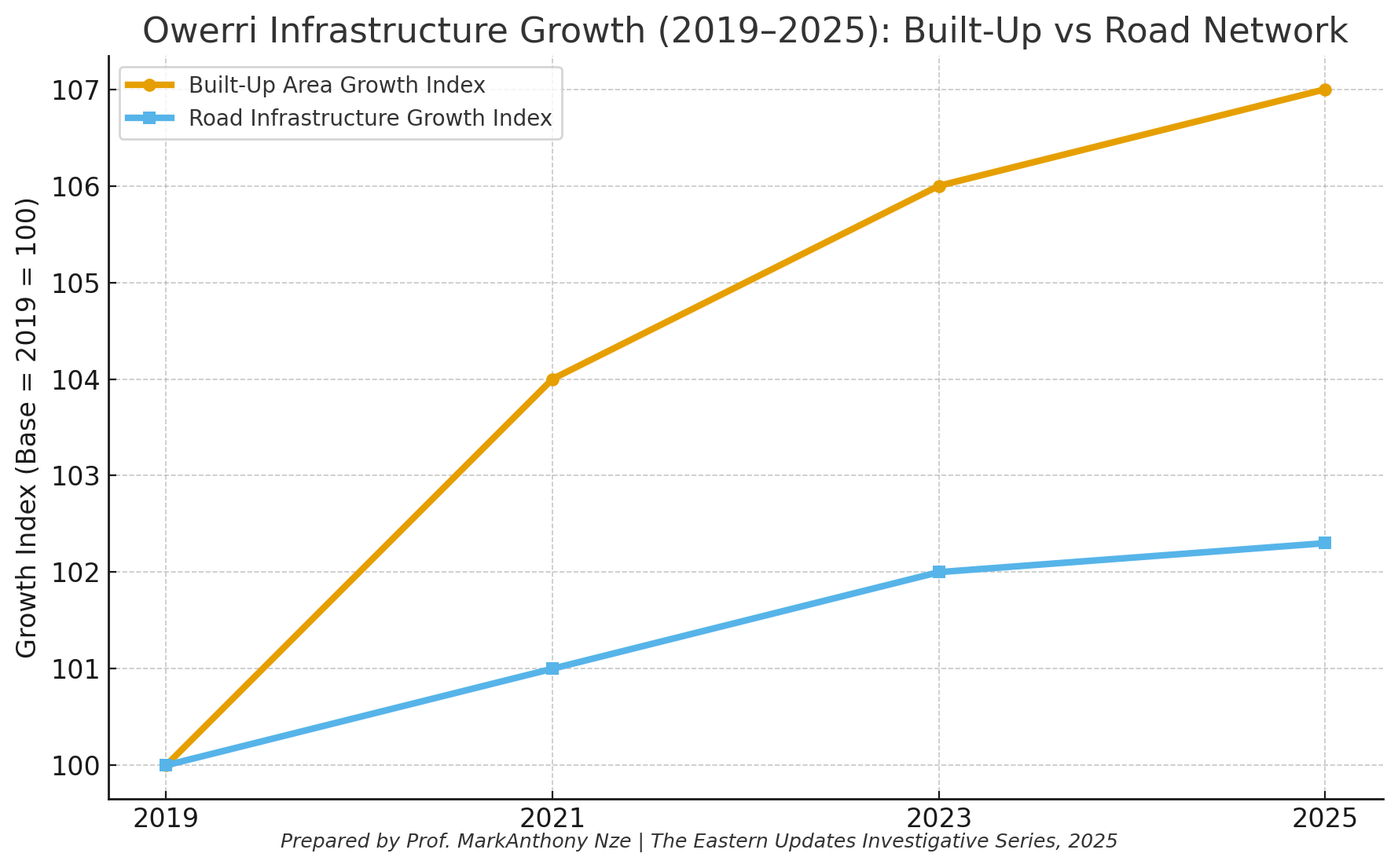
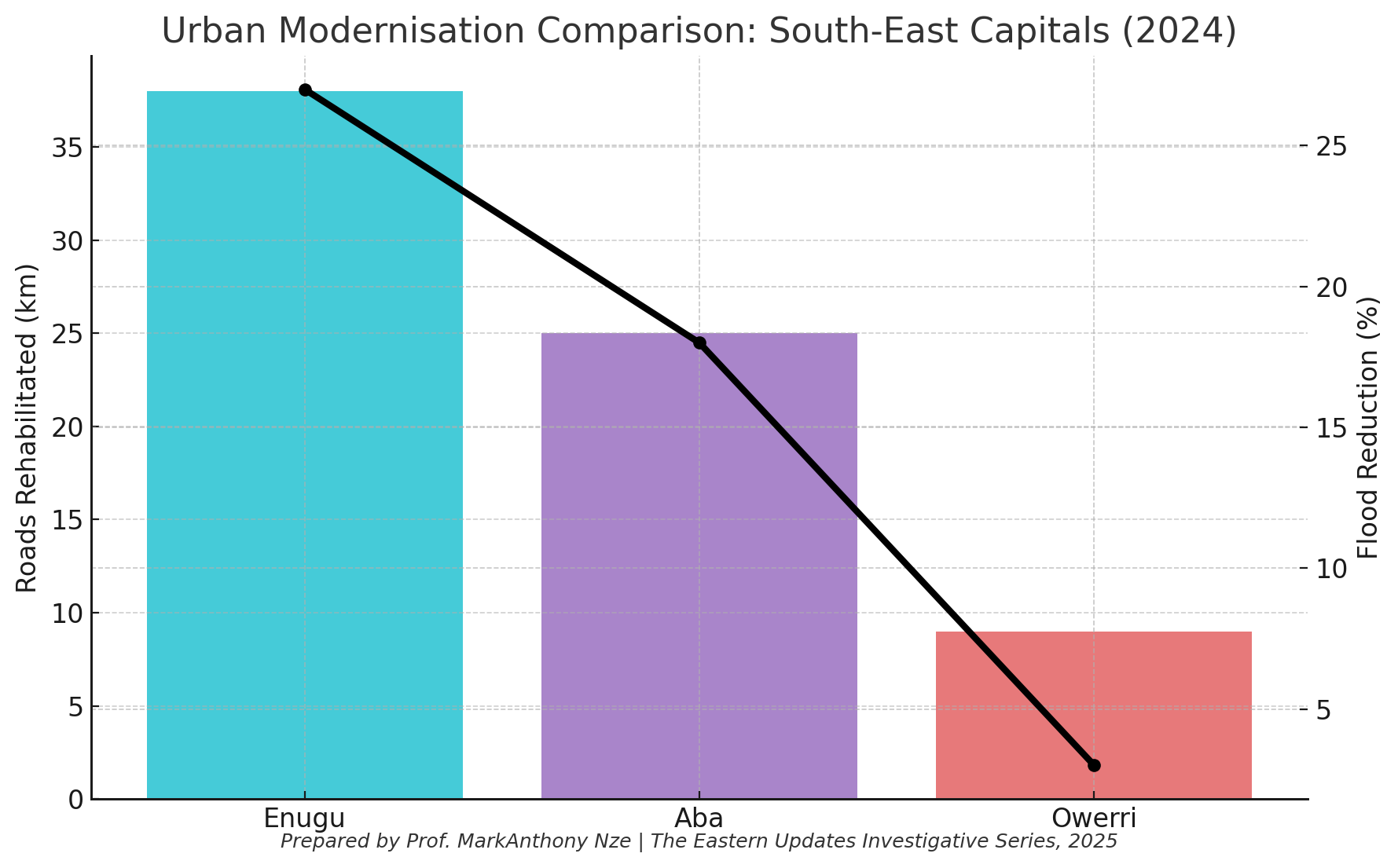
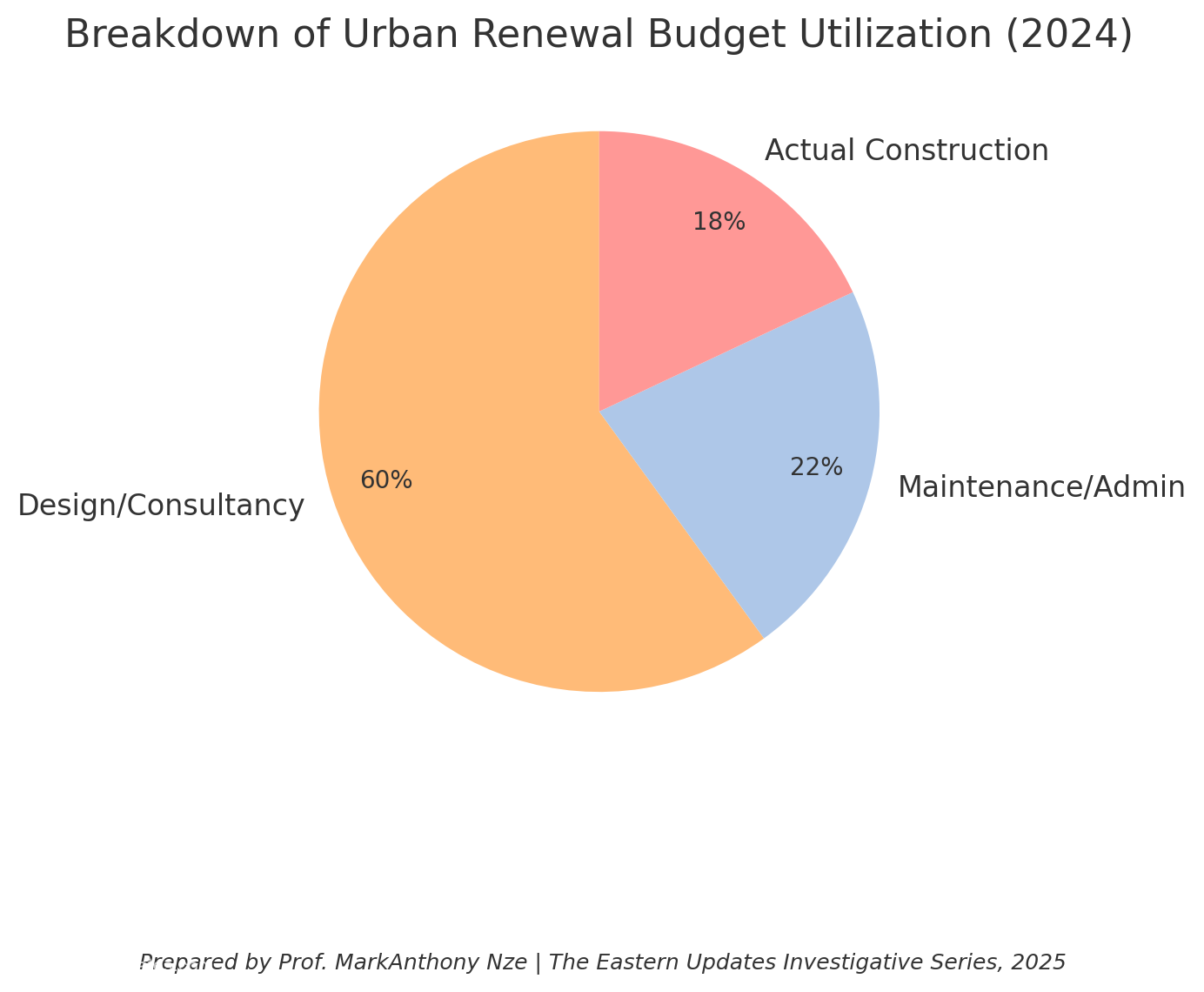
- Budget Allocation vs. Verified Disbursement (2024)
The state government budgeted ₦78 billion for “Urban Renewal,” yet only ₦14 billion was traceably disbursed, with a mere ₦9 billion linked to verifiable projects.Interpretation:Over 80 percent of the purported capital spending produced no tangible infrastructure, highlighting a deep gap between budgetary claims and on-ground delivery.
- Infrastructure Growth in Owerri (2019–2025)
Between 2019 and 2025, Owerri’s built-up area expanded by 7 percent, while road infrastructure increased by only 2.3 percent.Interpretation:The city’s physical growth has far outpaced its infrastructure development, compounding congestion, flooding, and mobility challenges.
- Urban Modernization Benchmark: South-East Comparison (2024)
- Enugu:38 km of roads rehabilitated; 27 percent flood reduction.
- Aba:25 km rehabilitated; 18 percent flood reduction.
- Owerri:Approximately 9 km rehabilitated; only 3 percent flood reduction.
Interpretation: Among the South-East capitals, Owerri ranks lowest in measurable modernization indicators, underscoring its limited progress despite lofty rhetoric.
- Urban Renewal Budget Breakdown (Imo, 2024)
Of the total allocation, 60 percent was spent on design and consultancy, 22 percent on maintenance and administrative overhead, and just 18 percent on actual construction.
Interpretation:The fiscal pattern reveals a governance model driven by optics—prioritizing image and aesthetics over substantive infrastructure delivery.
Bibliographies
African Development Bank Group. (2024). African Economic Outlook 2024: Skills, jobs and digital transformation. Abidjan: AfDB. https://www.afdb.org
BudgIT Foundation. (2024). State of States 2024: Subnational performance and fiscal sustainability. Lagos: BudgIT Publications. https://yourbudgit.com/publications
International Monetary Fund (IMF). (2023). Regional economic outlook: Sub-Saharan Africa – Building resilience in an uncertain world. Washington, DC: IMF. https://www.imf.org
National Bureau of Statistics (NBS). (2024). Subnational infrastructure survey 2024. Abuja: NBS. https://nigerianstat.gov.ng
Nigerian Hydrological Services Agency (NIHSA). (2024). Annual flood outlook for Nigeria 2024. Abuja: NIHSA. https://nihsa.gov.ng
SPARC Infrastructure Data Hub. (2025). Satellite monitoring of state capital projects: Imo State dataset 2023–2025. Abuja: SPARC Nigeria. https://sparcng.org
World Bank. (2024). Urban Resilience Atlas – Nigeria profiles 2024. Washington, DC: World Bank Urban Resilience Program. https://www.worldbank.org
World Bank. (2024). Nigeria urban renewal program review 2024. Washington, DC: World Bank. https://www.worldbank.org