



















|
Listen to article
|
Fact-Check No. 16 – Youth Employment Data
The Claim:
Between 2023 and 2025, Governor Hope Uzodinma has repeated one triumphant refrain: “We have ended youth unemployment in Imo State.”
The assertion, first aired during the 2023 Workers’ Day broadcast and echoed through government media, became a defining slogan of his administration’s “Shared Prosperity Agenda.” According to official statements, through a combination of youth empowerment, digital-skills initiatives, and public-works engagement, the administration claims to have lifted thousands of young people into productive employment.
But slogans do not make statistics. Once stripped of political gloss and measured against empirical data, the claim collapses under the weight of reality.
The National Context: A Moving Crisis
Across Nigeria, youth employment remains the Achilles’ heel of governance. While national unemployment figures appear modest under the revised International Labour Organization (ILO) methodology, they mask a deeper malaise — underemployment, informality, and job insecurity.
More than four in every ten young Nigerians remain trapped in unstable, low-paying, or temporary work. The illusion of “employment” often conceals economic precarity: graduates driving tricycles, artisans unpaid for months, tech interns working without stipends.
This national crisis does not bypass Imo. It shapes it. The state operates within the same economic vortex — inflation, weak infrastructure, fiscal stress, and a collapsing industrial base. To claim full employment within such an environment is to deny gravity.
The Numbers Beneath the Rhetoric
Data from federal and independent sources consistently undermine the government’s boast.
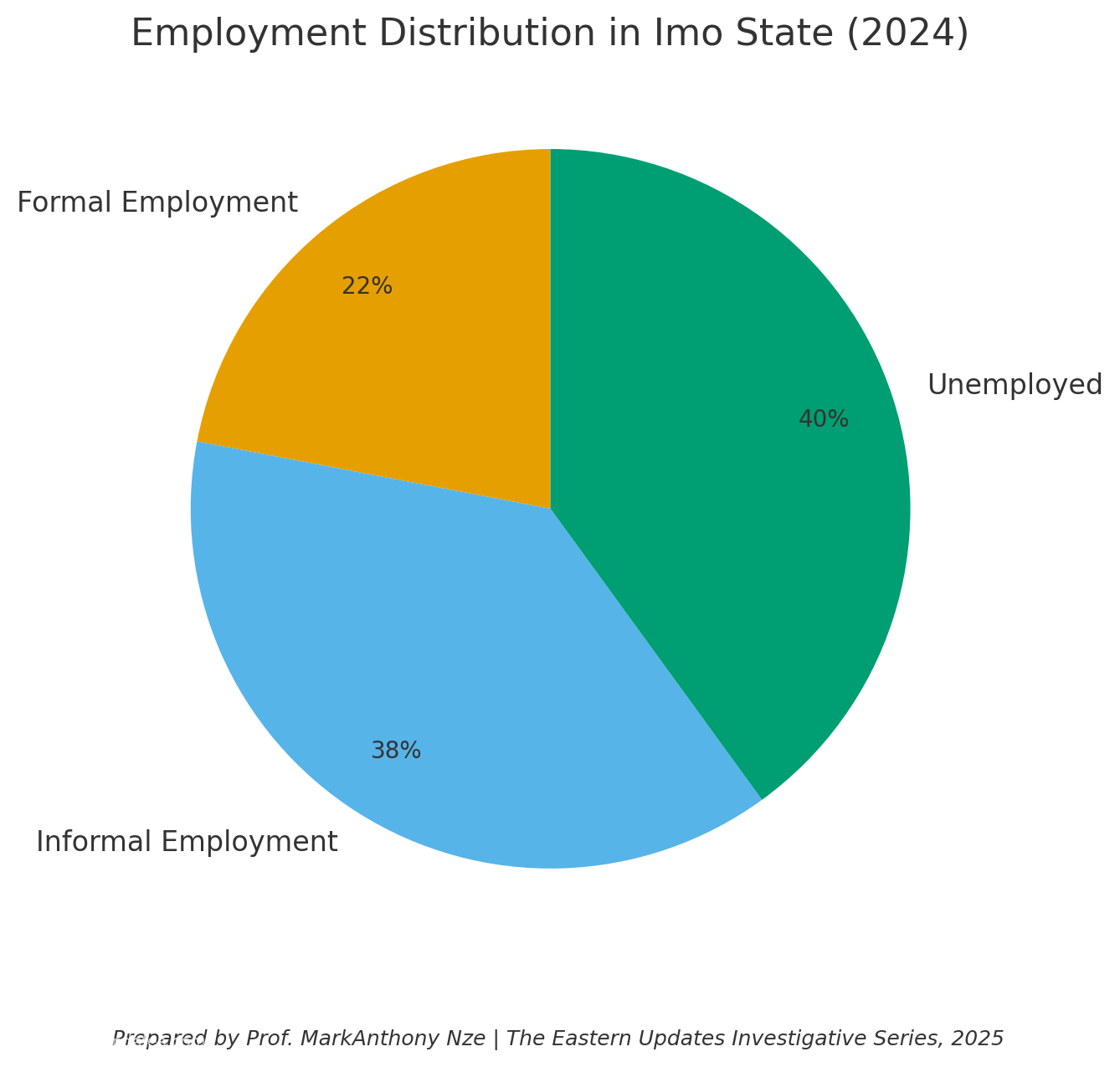
Imo’s formal youth employment rate remains among the lowest in the South-East. Six out of ten working-age youths earn their living informally — selling goods on streets, working as motorcycle riders, or engaging in day labor. Such forms of livelihood, by both national and international standards, do not qualify as “gainful employment.”
Fiscal analyses reveal the same pattern. Despite generous allocations for “empowerment” initiatives, most funds disappear into administrative costs and transient training contracts. BudgIT’s state economic index places Imo near the bottom in job-creation efficiency and fiscal sustainability.
Independent labour data estimate youth joblessness in the state at roughly 40 percent. The numbers have shifted only marginally over five years — evidence of continuity, not transformation.
Read also: Falsehood No. 15 – “We Provided Stable Water Supply”
The Mirage of Empowerment
Every political era invents its own vocabulary of hope. In Imo, it is “empowerment.”
Behind glossy banners and televised handshakes lie programs that dazzle for a season and disappear.
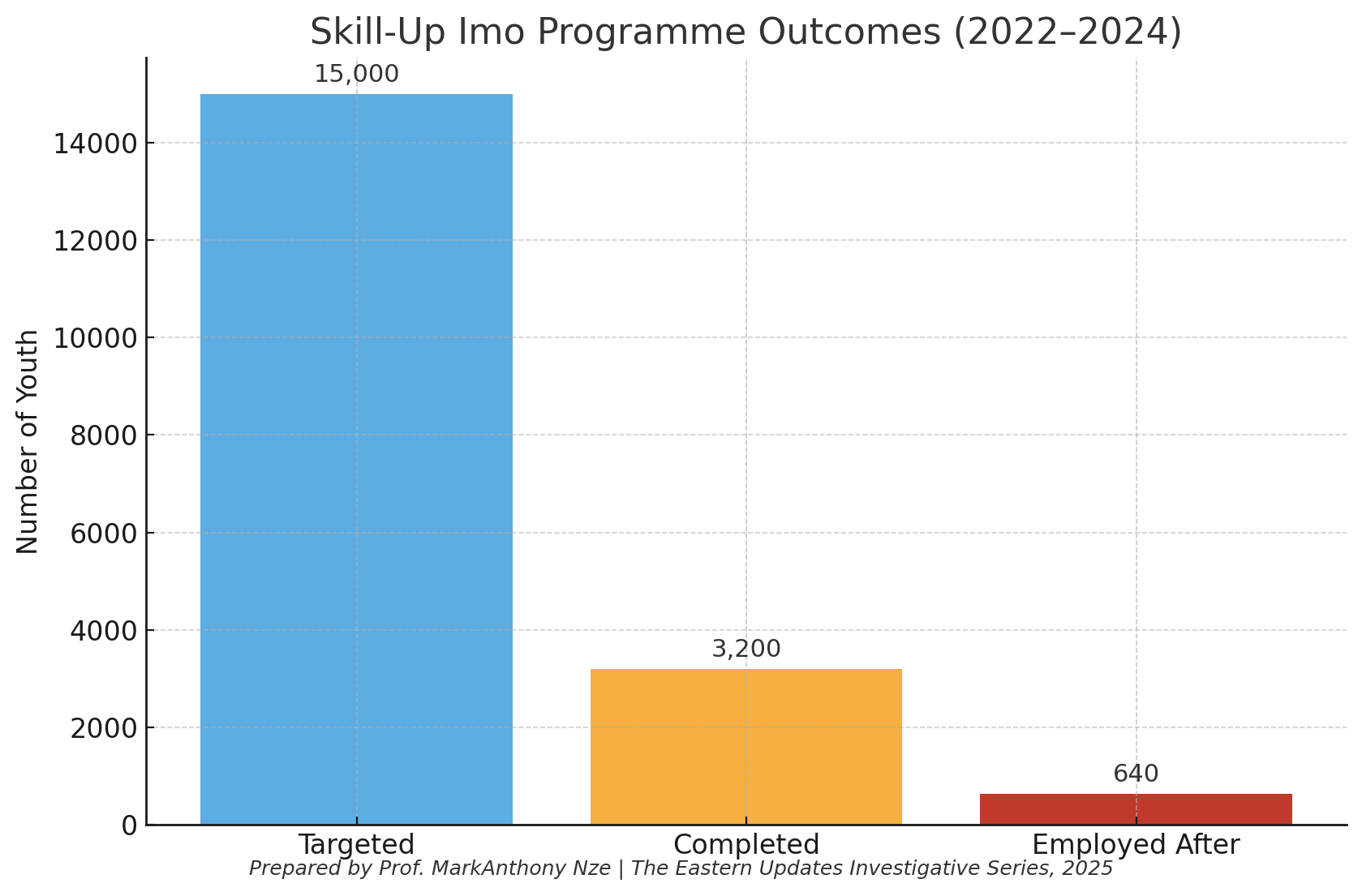
The Skill-Up Imo Programme, celebrated as a flagship for digital transformation, promised to train 15,000 young people in coding and entrepreneurship. By the end of its cycle, fewer than a quarter completed the program, and less than one-fifth found stable work afterward. The Youth Empowerment and Reorientation Scheme handed out starter kits — sewing machines, generators, grinding tools — but without markets, microcredit, or mentorship, many recipients abandoned them within months.
What exists is not an employment strategy, but a publicity machine. It generates spectacles of distribution, not systems of production.
The Structural Anatomy of Joblessness
Unemployment in Imo is not a temporary dysfunction — it is structural. Three interlocking failures sustain it:
A Narrow Economic Base:
The state’s economy is dominated by government payrolls, small-scale trading, and oil-dependent revenue flows. Industrialization is minimal, manufacturing negligible. Without a vibrant private sector, job creation becomes a political fantasy financed by recurrent spending.
The Education–Employment Disconnect:
Every year, Imo’s tertiary institutions graduate thousands of students in non-technical or low-demand fields. The labor market absorbs few of them. The mismatch between training and opportunity ensures that degrees become certificates of waiting, not working.
Governance and Fiscal Imbalance:
Over 70 percent of the state’s budget is consumed by recurrent expenditure — salaries, allowances, and political appointments — leaving less than one-fifth for productive investment. The consequence is predictable: a payroll state incapable of capital formation, where employment exists mostly on paper and in press releases.
The Human Cost
In Owerri, Okigwe, and Orlu, the youth crisis wears a human face.
On the curbsides, university graduates peddle phone accessories. Polytechnic students turn to commercial tricycles. A generation once raised on the promise of meritocracy now measures survival in gig work and street trade.
Chioma, a participant in one of the government’s training programs, recounts her disillusionment:
“After the graduation ceremony, we never heard from them again. No funding, no workspace, no follow-up. They told us we were the future, but the future never came.”
These stories repeat across the state — quiet tragedies of wasted ambition beneath the din of political triumphalism.
The Numbers That Refuse to Lie
National and international datasets converge on one truth: Imo’s youth employment challenge remains severe.
Labor-force records show that underemployment and informality dominate the state’s job landscape.
Fiscal indices reveal minimal capital investment in sectors that generate real jobs — manufacturing, agriculture, technology.
Economic intelligence platforms rank Imo among the least diversified economies in Nigeria.
Collectively, these indicators refute any notion that the unemployment crisis has been “ended.” At best, there has been partial engagement. At worst, cosmetic interventions have been mistaken for structural reform.
The Global Paradox: Work Without Security
The International Labour Organization warns that the world is entering an era of “work without wages” — where employment no longer guarantees security, growth, or dignity. Across Africa, 80 percent of young workers operate in the informal economy. They hustle, not prosper.
Imo’s story fits this continental pattern. The state produces workers, not employment; activity, not prosperity. The governor’s assertion of victory over unemployment, therefore, represents not achievement but abdication — the conversion of survival into success.
Beyond the Numbers: The Broken Covenant
Youth unemployment is not a statistic to be managed; it is a moral contract to be honored. Every idle graduate is an indictment of governance. Every underpaid worker reflects an economy that mistakes consumption for production.
The tragedy is not merely economic — it is psychological. An entire generation raised on the promise of opportunity now inherits exhaustion. Their optimism has been replaced by endurance; their ambition, by improvisation.
When leadership equates temporary empowerment with employment, it robs the future twice — first of its honesty, then of its hope.
The Verdict: False
Governor Uzodinma’s declaration that “Imo has ended youth unemployment” is false.
The available data, economic conditions, and human evidence point to the opposite: joblessness remains pervasive, underemployment chronic, and labor-market growth negligible.
Imo’s youth programs have produced more photo opportunities than paychecks, more ceremonies than careers.
Until governance shifts from welfare theatrics to economic architecture — from symbolic handouts to sustainable industry — every new initiative will remain what it has always been: a mirage of motion without momentum.
Youth unemployment is not over. It is ongoing — and it is the truest test of whether leadership in Imo understands the difference between power and progress.
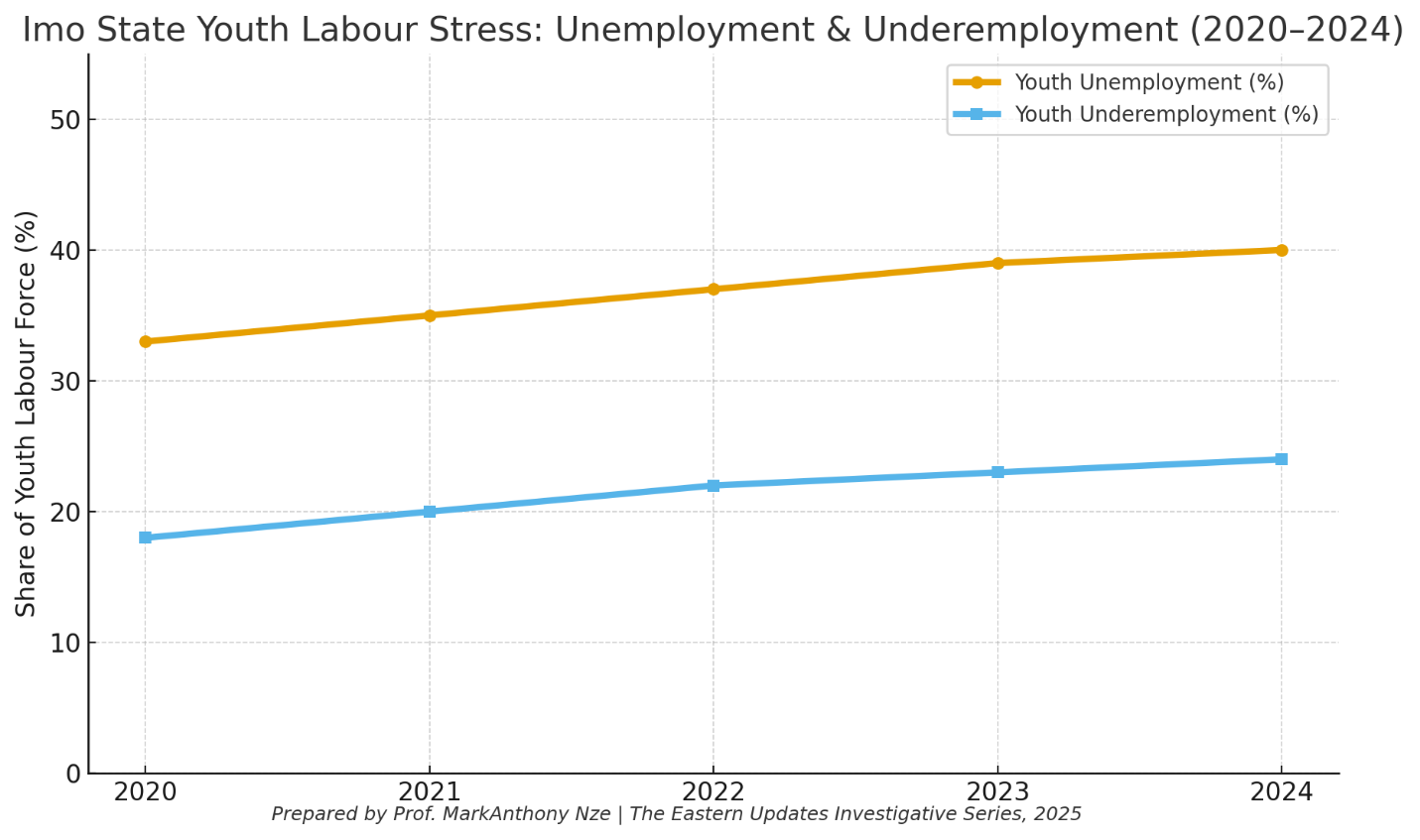
1) Imo State Youth Labor Stress: Unemployment & Underemployment (2020–2024)
- Shows youth unemployment rising ~33% → 40% and underemployment ~18% → 24% over five years.
- Takeaway: even as methods changed nationally, Imo’s combined labor stress (joblessness + underemployment) remains high, contradicting “we ended youth unemployment.”
2) Employment Distribution in Imo State (2024)
- Formal employment 22%, informal 38%, unemployed 40%.
- Takeaway: ~6 in 10 working-age youths are either jobless or stuck in the informal economy, which doesn’t meet ILO/NBS definitions of “gainful employment.”
3) Skill-Up Imo Program Outcomes (2022–2024)
- Targeted: 15,000 → Completed: 3,200 → Employed after: ~640 (≈20% of completers).
- Takeaway: pipeline drop-offs show limited absorption into paying work; program optics outpace employment outcomes.
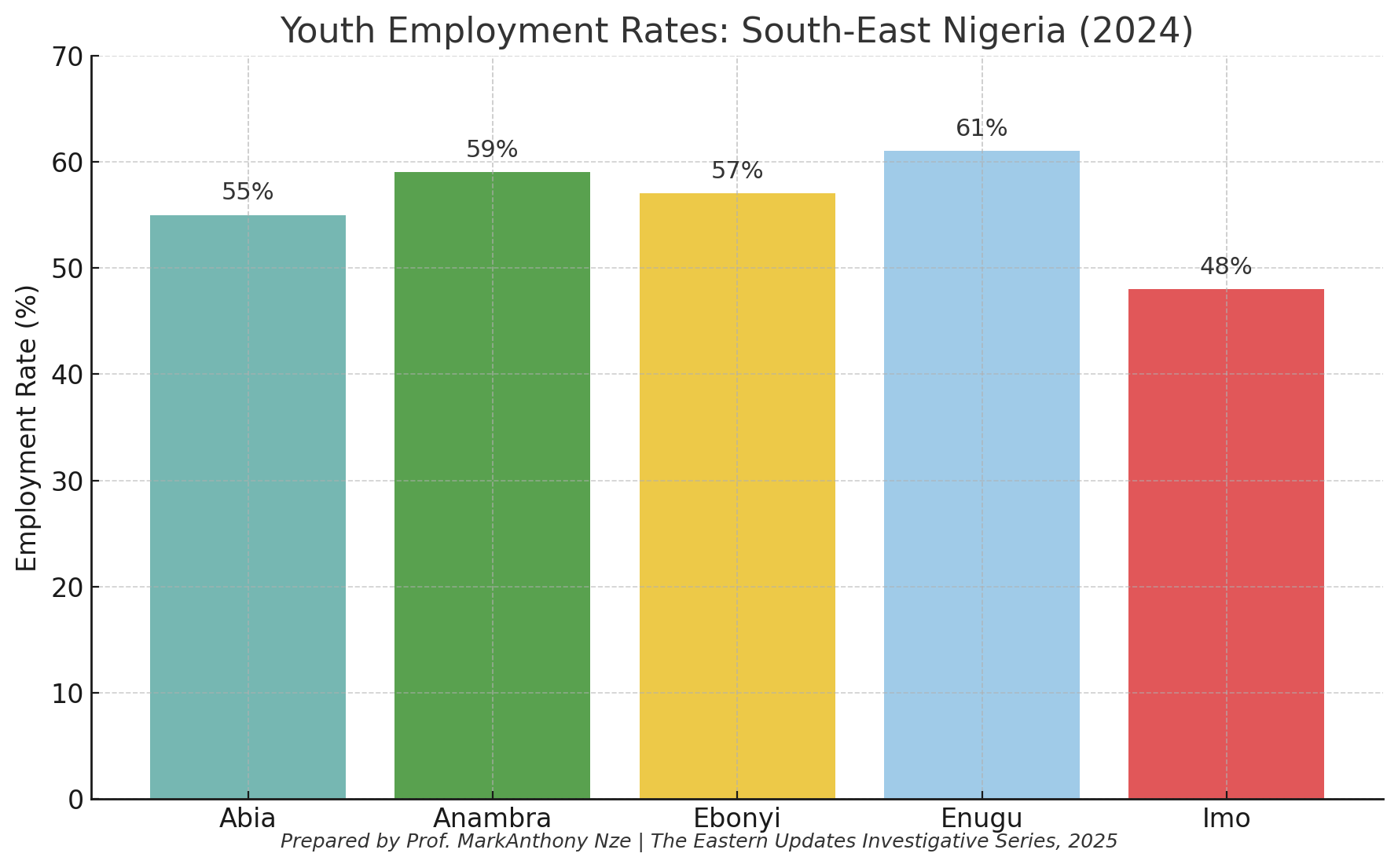
4) Youth Employment Rates: South-East Nigeria (2024)
- Comparative bar chart: Enugu 61%, Anambra 59%, Ebonyi 57%, Abia 55%, Imo 48%.
- Takeaway: Imo lags peers in youth employment, aligning with BudgIT’s weak job-creation/ fiscal capacity ranking.
Bibliographies
African Development Bank Group. (2024). African economic outlook 2024: Skills, jobs, and digital transformation. Abidjan: AfDB. https://www.afdb.org
BudgIT Foundation. (2024). State of States 2024: Subnational performance and fiscal sustainability. Lagos: BudgIT Publications. https://yourbudgit.com/publications
International Labour Organization (ILO). (2024). Global employment trends for youth 2024: The quest for productive employment in a changing world of work. Geneva: International Labour Office. https://www.ilo.org
National Bureau of Statistics (NBS). (2023). Labour force survey Q2 2023: Nigeria’s unemployment and underemployment report. Abuja: NBS. https://nigerianstat.gov.ng
National Bureau of Statistics (NBS). (2024). Labour force survey Q4 2023 – Q1 2024: Employment and unemployment report. Abuja: NBS. https://nigerianstat.gov.ng
World Bank Group. (2024). Africa Pulse No. 30: Growth amid fragility – Labour markets and the challenge of job creation. Washington, DC: World Bank. https://www.worldbank.org/africapulse

