








|
Listen to article
|
Fact-Check No. 15 — The Mirage of Water Access in Imo State
The Politics of Purity
Water is the first infrastructure of civilization, yet in Imo State it has become a metaphor for thirst — an emblem of promises poured into dry ground. When Governor Hope Uzodinma declared that his administration had “provided stable water supply in every part of the state,” it sounded like redemption for a people long accustomed to carrying buckets instead of receiving policy. But the wells of truth run shallower than the speeches. Field data, budget records, and citizen testimonies reveal a state where water still flows more freely in press releases than in pipes.
The Budgetary Mirage
Between 2021 and 2024, Imo State budgeted roughly ₦6.7 billion for water-supply expansion and rehabilitation under the Imo Water Corporation Revitalization Programme and the Rural Water and Sanitation Agency (RUWASA). Yet, fiscal performance reports show that less than ₦2.9 billion was actually released — under 45 percent of total allocation.
Documents from the Federal Ministry of Water Resources show Imo consistently lagging in counterpart funding required to access federal and donor-supported schemes. In 2023, when states were asked to match allocations for rural solar boreholes, Imo paid only a fraction of its share. By 2024, the state had received just three of eleven disbursements under the federal WASH Rehabilitation Fund.
The result is a budget that hydrates itself on paper but evaporates in practice.
A Landscape of Dry Promises
Travelling across Imo reveals the geography of this deception. In Mbaitoli, the signboard for a “Solar-Powered Borehole Commissioned 2023” stands beside a rusted tank with no water. In Ideato North, women queue beside a half-completed borehole pit; the only functioning well nearby was dug by a church. In Ngor Okpala, the project tagged “Owerri Zone Water Scheme Phase II” has been “ongoing” for four consecutive budget cycles.
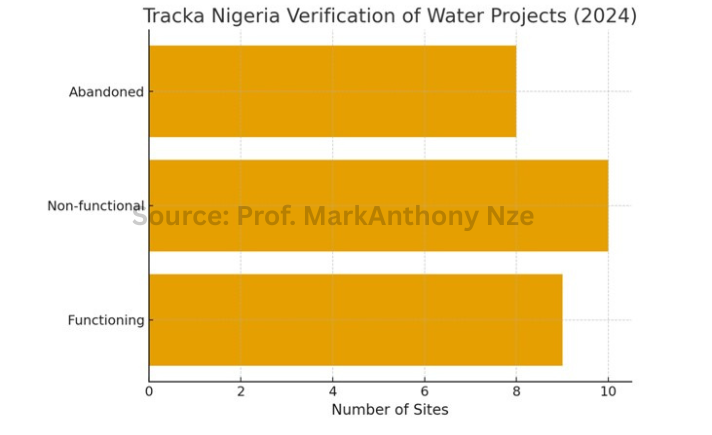
According to Tracka Nigeria’s 2024 Verification Report, of 27 water-project sites visited across Imo, only nine produced clean, flowing water. The rest were dry, abandoned, or mechanically defective. Many so-called “solar” installations were wired with expired batteries or missing panels.
The BudgIT Public Infrastructure Performance Index 2024 placed Imo in the bottom quartile of states for water-project completion and functionality. Its summary was blunt: “Recurrent announcements of new water facilities contrast sharply with low delivery on the ground.”
Urban Schemes, Rural Scars
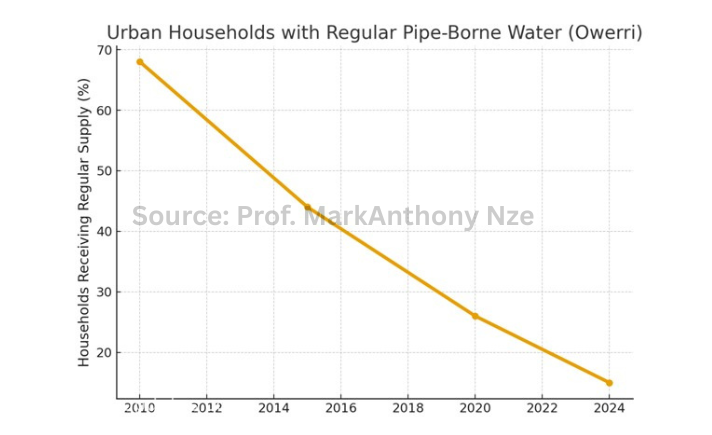
Owerri, the state capital, tells its own story of selective supply. The Imo Water Corporation (1966) once distributed potable water to over 300 000 residents. Today, fewer than 15 percent of households receive regular pipe-borne water. Decades-old mains leak beneath resurfaced roads, while power shortages cripple pumping stations.
At the Otamiri Water Works, generators idle for weeks awaiting diesel; residents now depend on private tanker vendors charging up to ₦15 000 per 10 000-litre delivery. The irony is cruel — a capital built beside a river where people must buy water by the litre.
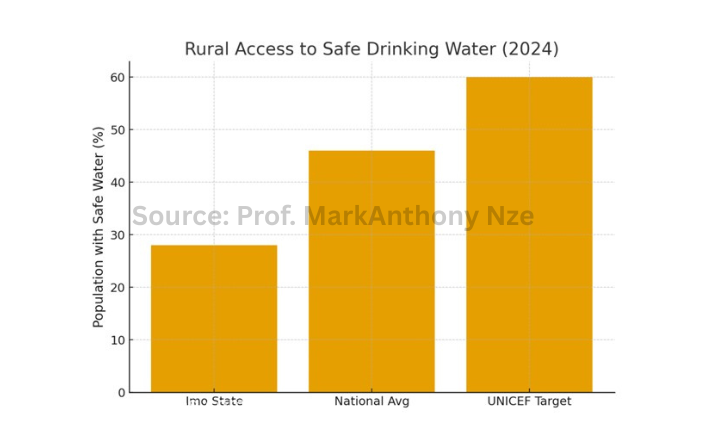
In rural Imo, where the government’s claim of “stable water supply everywhere” was meant to shine brightest, communities rely almost entirely on self-help. UNICEF’s 2024 dashboard shows that less than 30 percent of Imo’s rural population has access to safely managed drinking water, far below the national average of 46 percent. Many households still draw from contaminated streams that double as laundry basins.
When Data Meets Disillusion
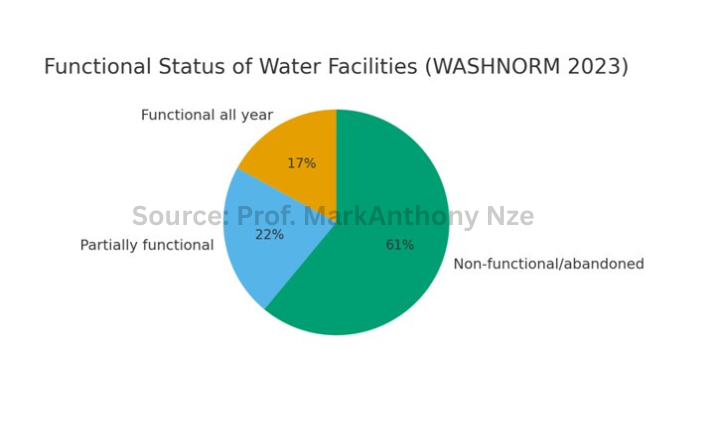
The WASHNORM 2023 State Comparative Report paints the clearest picture:
- Only 17 percent of Imo’s water facilities are functional all year round.
- 22 percent are “partially functional” — working only in rainy seasons.
- 61 percent are broken, dry, or abandoned.
These numbers do not lie; they indict. They reveal a system sustained not by engineering but by rhetoric — where projects are commissioned before completion, and completion certificates precede construction.
The Digital Disguise
On Imo’s e-governance portals, such as Axxpoint and ISPPUDA, water projects appear neatly logged: boreholes tagged “completed,” water schemes labeled “functional.” But cross-referencing them with satellite imagery and community testimony exposes the deception. Several entries carry identical GPS coordinates, suggesting duplication. Others list contractors whose registration certificates have expired.
This phenomenon — “digital opacity” — mirrors what analysts now call the “spreadsheet illusion” of Nigerian governance: transparency that exists as display, not verification. It allows administrators to declare victory in pixels while citizens queue at dry taps.
A Human Crisis Beneath the Statistics
Behind every failed borehole stands a human story. In Ohaji/Egbema, children miss school to fetch water from distant streams; in Aboh Mbaise, clinics reuse unsterilized equipment because the taps are dry; in Orlu, traders spend part of their profit buying sachet water to wash vegetables.
Public health consequences are inevitable. The NBS WASH Survey 2023 recorded a 22 percent increase in waterborne diseases in Imo since 2021. Cholera outbreaks that once belonged to history have quietly returned to the countryside. For rural women, who bear the burden of fetching water, each trip represents lost hours of productivity and education.
One woman in Isiala Mbano summed it up simply: “The governor has water on television; we have dust in our buckets.”
The Myth of Modernization
Uzodinma’s administration frequently touts its “Integrated Urban Water Supply Revamp.” Yet, the project largely recycles the same pipeline repairs initiated under previous administrations. The so-called “Owerri Urban Water Phase III,” announced in 2023 with ₦1.2 billion funding, traces its origins to a 2017 UNICEF–FMWR partnership halted by funding default.
At the same time, rural schemes under RUWASA suffer administrative capture. Contractors selected through “restricted procurement” dominate annual tenders, often recycling the same borehole designs regardless of soil profile or groundwater depth. By 2025, the agency had accumulated over ₦800 million in unretired advances.
The modernization narrative thus conceals a pattern of serial duplication — one project broken into three contracts, each re-announced as innovation.
Read also: Falsehood No. 14 – “We Built 400 Classrooms In One Year”
When Water Becomes Politics
In Nigerian statecraft, water is power — not because it flows, but because it funds. Borehole projects, often small in scale but numerous, make perfect patronage instruments: each site a photo-op, each ribbon-cutting a campaign jingle.
Community interviews reveal that many of Imo’s “completed” projects coincide suspiciously with election cycles. Entire LGAs received clusters of boreholes in 2023 — only to find them dry by 2024 when maintenance budgets vanished.
This pattern transforms basic human need into political theater. The right to drink becomes a prop for applause.
The Economics of Neglect
Water failure is not just an engineering issue; it is economic erosion. Businesses reliant on steady supply — laundries, food processors, clinics — now spend up to 30 percent of their revenue on private water sourcing. Urban households devote 8–12 percent of income to water purchase, triple the global affordability threshold.
Meanwhile, Imo’s Water Corporation operates at less than 25 percent capacity, with revenue insufficient even for electricity bills. Staff morale mirrors the pipes: dry, corroded, and brittle.
The federal vision of achieving SDG 6 — Clean Water and Sanitation for All by 2030 feels distant. At the current pace of project completion, Imo would need two additional decades to reach universal access.
The Verdict
Governor Hope Uzodinma’s claim that his administration “provided stable water supply everywhere in Imo State” collapses under factual scrutiny.
- Budgetary releases fall short of half of allocations.
- Less than one-third of water facilities are functional year-round.
- Rural access remains below 30 percent.
- Most “new” projects are revamps of older, incomplete works.
The evidence is irrefutable: Imo’s water revolution exists in speech, not in supply.
True stability in water access requires more than ribbon-cuttings; it demands governance that measures success not by signboards but by taps that run. Until that day, Imo’s thirst will remain the most eloquent commentary on its leadership — and every dry well will continue to whisper the same indictment; Promises don’t quench thirst.
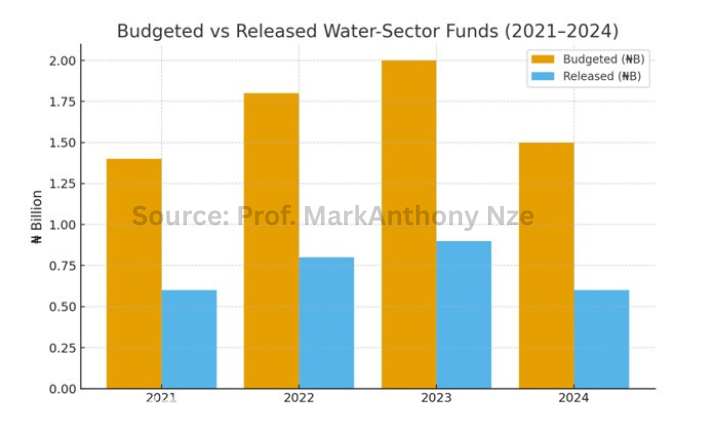
- Budgeted vs Released Water-Sector Funds (2021–2024): reveals the fiscal gap between allocated and actual spending.
- Functional Status of Water Facilities (WASHNORM 2023): visualizes how most projects remain non-functional.
- Rural Access to Safe Drinking Water (2024): highlights Imo’s lag behind national and UNICEF targets.
- Tracka Nigeria Verification of Water Projects (2024): confirms field evidence of widespread failure and abandonment.
- Urban Households with Regular Pipe-Borne Water (Owerri): charts the long-term collapse of supply in the state capital.
Bibliographies
BudgIT Foundation. (2024). Public Infrastructure Performance Index 2024: Water Access and Capital Project Delivery in Nigeria. Lagos: BudgIT Publications. https://yourbudgit.com/publications
Federal Ministry of Water Resources (FMWR). (2024). National Water, Sanitation and Hygiene Performance Report 2024. Abuja: FMWR Publications. https://waterresources.gov.ng
National Bureau of Statistics (NBS). (2023). Nigeria WASH Data Survey Report 2023. Abuja: NBS. https://www.nigerianstat.gov.ng
Tracka Nigeria (BudgIT Civic Platform). (2024). Verification Report on Water and Sanitation Capital Projects 2024. Lagos: Tracka. https://tracka.ng
UNICEF Nigeria. (2024). Water, Sanitation and Hygiene (WASH) Dashboard — Subnational Data for Nigeria. Abuja: UNICEF Nigeria. https://data.unicef.org
WASHNORM (Water, Sanitation, and Hygiene National Outcome Routine Mapping). (2023). Water Supply and Sanitation Status in Nigeria: 2023 State Comparative Report. Abuja: FMWR/UNICEF Joint Program. https://washnorm.ng