|
Listen to article
|
From Phantom Highways to Phantom Finance
What began as an exposé on non-existent roads in Imo State has deepened into something far more insidious. Our previous investigation revealed that the Ministry of Works had devolved into a phantom-road factory—producing invoices, not infrastructure, and bleeding the state of ₦57 billion through fictitious contracts between 2020 and 2024.
But behind every fake road lies an invisible financier. The Ministry of Finance, often perceived as clinical and bureaucratically sterile, is in fact the vault and vanguard of an industrial-scale fraud architecture. Inside its air-conditioned walls in Owerri, the books always balance. The roads, however, do not. In places like Ubowalla and Oguta, villagers still wade through floodwaters, while the Treasury silently processes another round of “capital expenditure.”
In Imo, ghost roads are conceived in the Ministry of Works, but they are baptized—and blessed—in the Treasury.
The Choreography of Vanishing Funds
Public budgets from 2022 to 2025 detail more than ₦1.6 trillion in total expenditure, with nearly half earmarked for capital projects. Yet field investigations across multiple LGAs reveal that less than 30 percent of those projects have been realized in any physical form. The rest exists only in budget documents, approval memos, and carefully scripted performance reviews.
The fraud follows a predictable sequence: a ministry raises a mobilization request for a project that doesn’t exist; the Finance Ministry authorizes the disbursement—no inspections, no questions. Funds are wired to shell contractors, and within 72 hours, the money evaporates through cash withdrawals and internal transfers. No graders, no pavers, no bulldozers—just a paper trail that reads like fiction.
An Engineered Ecosystem of Deceit
This is not negligence. It is design.
The Finance Ministry is not a bystander; it is the oxygen tank of a larger ecosystem. The Budget Department inflates project estimates. The Ministry of Works certifies imaginary progress. The Treasury releases funds. The Procurement office drafts legal justifications for it all. It is a tightly wound syndicate where development is not about construction but about circulation—of signatures, of approvals, of loot.
Project codes are inflated. Progress reports are falsified. Funds are released. No roads appear.
Read also: The Procurement Scam In Imo: When Ghosts Devour Public Trust
Where the Ledger Becomes a Lie
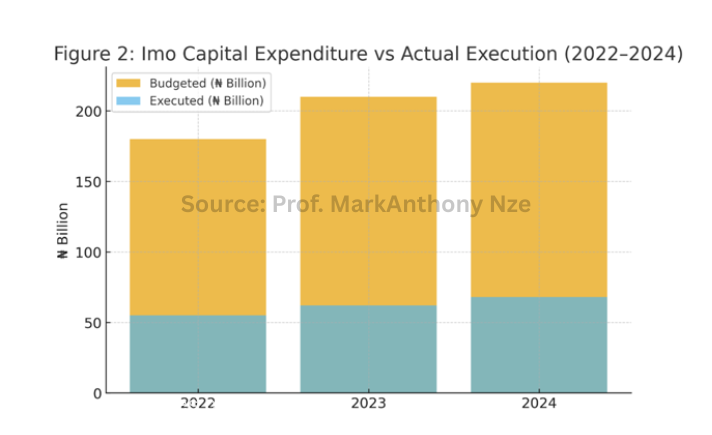
In 2024 alone, ₦220 billion was marked for capital spending. By the second quarter, ₦118 billion had reportedly been disbursed. But boots-on-ground surveys found fewer than ₦60 billion in actual infrastructure across 14 LGAs. The remaining billions have no physical trace—just perfect spreadsheets and glowing press releases.
The Ministry of Finance now operates like a laundering machine with four levels: the Commissioner authorizes disbursements, the Permanent Secretary stamps “urgent priority,” the Accountant-General executes bank transfers, and the Internal Audit unit certifies “compliance.”
Banking on Silence: Financial Institutions as Enablers
The banks—ostensibly neutral custodians of state funds—are anything but. Whistleblower evidence reveals that upon receiving large payments from the Treasury, contractors typically empty their accounts within 24 hours through a series of strategic withdrawals. A standard log might read: Treasury → Contractor A: ₦210 million → three withdrawals in a day → remaining balance: ₦12,000.
No Suspicious Transaction Reports are filed. No EFCC red flags are raised. These banks—managers of political accounts—have become silent partners in laundering public wealth.
The Budget as Propaganda
Each year, Imo’s budget presentation is framed as a grand vision—₦592 billion in 2024, draped in themes like “Rebuilding Confidence” and “Roads for Renewal.” But by the end of the first quarter, half the capital budget is “released” on paper while actual construction sites remain untouched.
The budget is no longer a tool of governance—it is a narrative weapon. A theatrical performance crafted to simulate progress while institutional theft unfolds beneath the stage.
The Mansions of Misconduct
The most visible evidence of systemic theft isn’t in the ledgers, but in New Owerri’s skyline.
Since 2022, the city has seen a quiet explosion of opulent estates—many registered to mid-level finance staff and contractors with no discernible revenue streams. One Treasury Director earning less than ₦10 million a year is now associated with properties valued at over ₦700 million. Procurement officers parade in ₦100 million SUVs bought with proceeds dubbed “legitimate allowances.”
Corruption in Imo has gone from covert to casual. It does not hide—it flaunts itself behind ten-foot gates and palm-lined driveways.
Administrative Silence as Political Strategy
Silence is not incompetence; it is infrastructure.
The Ministry of Finance rarely speaks publicly. Its Commissioner avoids journalists. Payment ledgers are “under audit.” Even memos are marked “confidential.” Each layer of bureaucracy is deliberately non-transparent. This opacity is not accidental—it is political architecture.
The State Assembly hasn’t published a single audit report since 2021. The Office of the Auditor-General remains weak, underfunded, and politically compromised. Civil society requests are met with evasions. Transparency has become performance art; oversight, a ghost in the script.
The Human Toll of Financial Mirage
Every phantom project exacts a real cost. Each diverted billion could have rebuilt schools, stocked hospitals, repaired roads. Over ₦330 billion in federal allocations flowed to Imo between 2020 and 2024. That sum could have transformed rural communities. Instead, it evaporated in spreadsheet fantasies.
Ubowalla remains waterlogged. Clinics in Ohaji remain unstaffed. Children still learn under trees. When Finance chooses fraud over futures, the damage isn’t just economic—it is generational.
Fictional Debt Reduction and Creative Accounting
Governor Uzodinma’s claims of cutting state debt from ₦259 billion to ₦99 billion collapse under scrutiny. The 2024 Debt Management Strategy reveals not a reduction, but a repackaging. Debt has been reclassified and relabeled—not paid down. The fiscal illusion is maintained by burying liabilities in new categories, while the burden on citizens remains unchanged.
Imo’s debt didn’t vanish. It just learned to wear a different face.
Redemption Requires Radical Transparency
Institutional rot cannot be reformed through platitudes. The following reforms are essential:
- An independent forensic audit of all capital expenditures between 2022 and 2025.
- Immediate publication of all Treasury payment records.
- Mandatory use of e-procurement platforms with real-time public tracking.
- Annual compliance audits from banks managing state accounts, filed with ICPC and EFCC.
These are not recommendations—they are preconditions for governance.
Closing Reflection: When the Treasury Funds Treachery
When a Finance Ministry stops guarding the vault and starts authoring the heist, the state collapses—not with a bang, but with a balance sheet.
In Imo today, budgets are ghost stories told in decimal points. Each figure is a gravestone for a road never built, a promise never kept, a future quietly stolen.
When the stewards of the Treasury become its saboteurs, every naira becomes an obituary for public trust.
Unless Imo breaks this code of silence, its future will remain haunted—not by the ghosts of failure, but by the ghosts of theft written in ledgers of betrayal.
Visual Forensics: Interpreting the Architecture of Misappropriation
The following figures are consolidated here to facilitate a cohesive, multidimensional interpretation of Imo State’s fiscal fraud ecosystem. Taken together, they serve not merely as illustrations but as forensic diagrams of systemic decay.
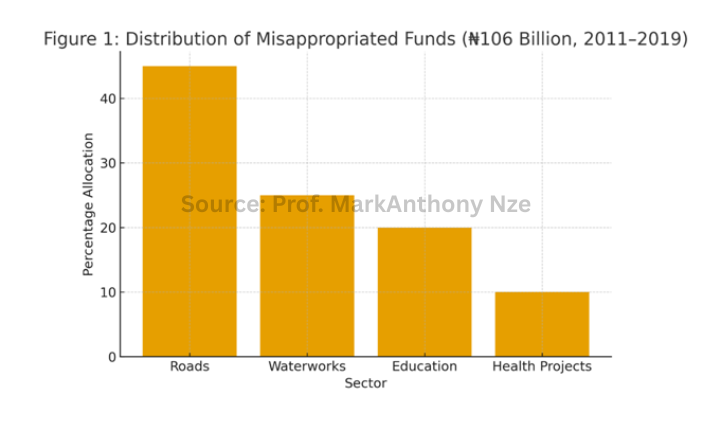
Figure 1: Sectoral Distribution of Misappropriated Public Funds in Nigeria (₦106 Billion, 2011–2019)
This figure reveals that road infrastructure commands the lion’s share—over 45 percent—of all documented public fund misappropriations in Nigeria. The disproportionate siphoning through road projects is no accident: asphalt remains the perfect laundromat—easily budgeted, barely verifiable. This statistic underscores why Imo’s road sector has become the preferred corridor for corruption: paperwork is plentiful; pavement is rare.
Figure 2: Imo State Capital Expenditure vs On-Ground Execution (2022–2024)
Here, the divergence between ambition and execution is laid bare. While capital budget allocations surged annually, physical project delivery plummeted. By 2024, measurable implementation had collapsed to under 30 percent of total allocations. This growing disparity reveals not just administrative inefficiency, but a systemic pivot from fiscal planning to performative governance—where spreadsheets simulate development while the ground remains untouched.
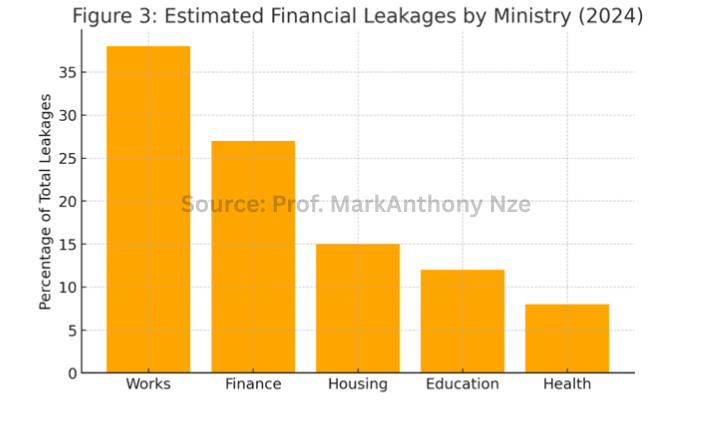
Figure 3: Estimated Financial Leakages by Sector and Ministry (2024)
This visualization exposes the twin engines of fraud: the Ministry of Works and the Ministry of Finance, together responsible for nearly two-thirds of all leakages in 2024. Sectors like Housing, Education, and Health follow distantly. The data unambiguously suggests institutional symbiosis—where engineering and treasury officials do not merely fail to prevent fraud, but actively co-produce it. The budgetary pipeline is not compromised; it is co-authored.
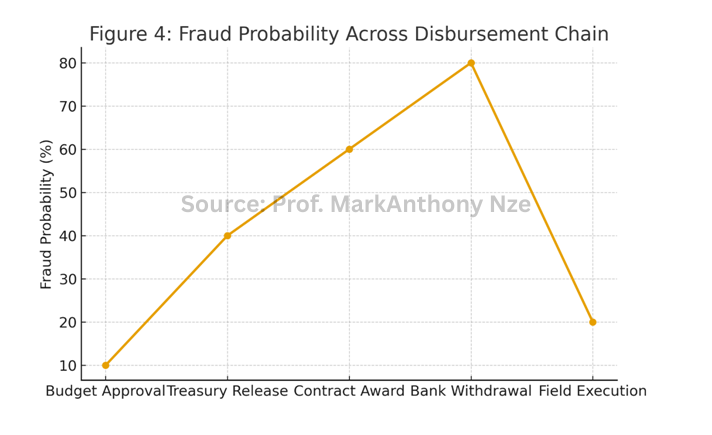
Figure 4: Probability Trajectory of Fraud Across the Disbursement Lifecycle
This analytical model maps the evolving risk of financial fraud along each procedural milestone of public expenditure. At budget approval, fraud probability begins modestly at 10 percent. Risk intensifies during fund authorization and peaks at 80 percent upon bank disbursement—when cash meets private accounts—before tapering to 20 percent at the so-called project execution stage. This curve affirms that Imo’s fiscal theft matures through internal systems—not field sabotage but paper-stage laundering, orchestrated from within.
Bibliographies
Authority Newspaper Nigeria. (n.d.). Imo group accuses Governor Uzodinma of mismanaging ₦330 billion in FAAC funds.https://authorityngr.com
AxxPoint Imo State. (2024). Imo State government approved budget 2024 (PDF).
Imo State Government. (2024). Debt sustainability analysis (DSA) & debt management strategy (DMS) report 2024 (PDF). Invest in Imo.
Imo State Government. (2024). Imo State budget performance report (Q2, 2024) (PDF). Open States Nigeria.
Imo State Government. (n.d.). Imo State budget transparency portal.https://imostate.gov.ng/budget
Leadership Nigeria. (n.d.). Group asks EFCC, ICPC to probe Imo government’s spending.https://leadership.ng
MetroDaily News Nigeria. (2024). Imo State: Appropriation bill of ₦592 billion 2024 passed by Assembly.https://metrodailyng.com
Punch Nigeria. (2024). Imo debt slashed by 60%: Uzodinma’s financial report.https://punchng.com
The Eastern Updates. (2025a). Ministry of Works: The factory of phantom roads.https://theeasternupdates.com
The Eastern Updates. (2025b). Uzodinma’s fraud factory: Ghost roads, ghost funds.https://theeasternupdates.com
Vanguard Nigeria. (2024). TMO calls for accountability, good governance in Imo.https://vanguardngr.com