
















|
Listen to article
|
By Prof. MarkAnthony Nze
Hope Uzodinma’s Ghost Economy: The Shell Firms Feeding on Imo.
Hope Uzodinma entered office in Imo State in 2020 under the banner of reform, transparency, and fiscal discipline. But beneath that polished rhetoric lies a bleaker reality—one in which ghost firms, opaque contracts, and manipulated procurement now form the backbone of governance. This is not a story of administrative failure alone; it is one of deliberate design: public institutions hollowed from within.
Ghosts in the Contracts
A pivotal chapter opened with the Judicial Commission of Inquiry on Imo State contracts (2011–2019), whose findings exposed a staggering truth: over ₦106 billion was misappropriated through inflated, unexecuted, or fictitious contracts. The commission’s report, submitted to Governor Uzodinma, detailed collusion between contractors and civil servants, violations of procurement laws, and full payments made for contracts that never materialized.
Among its most damning disclosures was that several contracts were awarded to companies with no traceable address, no workforce, and no record of actual operations. In some cases, payments were made without any performance—projects remained non-existent despite funds being released. The commission urged recovery of these funds, pledging accountability under the new regime.
A secondary finding spotlighted a cluster of contracts amounting to ₦1.6 billion that were allegedly awarded to phantom firms, entirely bypassing established procurement scrutiny. These shell operators, though legally registered, existed only as financial conduits—empty vessels for diversion of public money.
Read also: Uzodinma’s Phantom Economy: A Ledger Of Vanished Billions
Reform Rhetoric, Structural Betrayal
The contrast between Uzodinma’s public posture and the rules of execution is stark. While he has portrayed himself as a reformer, much of Imo’s budget continues to vanish into projects that are budgeted but never built.
Investigative reporting shows multiple roads, hospitals, and water schemes allocated under Uzodinma’s watch still don’t exist on the ground. The Ministry of Works routinely issues certificates of mobilization without any verification on site. One emblematic case is the Ubowalla Road: allocated hundreds of millions, yet no grader or surveyor ever appeared, while internal records still tag the project as “ongoing.”
Even more disorienting, projects marked “completed” in state reports are missing from local archives, while civil society monitors contest the legitimacy of their status.
This is not a breakdown of governance—it is governance inverted. The framework remains intact, but its purpose has been repurposed.
Anatomy of the Scam: How the Machine Operates
To understand the architecture of this fraud, consider its core mechanisms:
- Inflated, ambiguous budgets. Projects are labeled in vague terms like “community roads” or “rural works” to conceal discretionary manipulation.
- Phantom firm registration. Shell companies are formed shortly before contract award, with no staff or equipment, purely to simulate bidding.
- Early mobilization payments. Significant funds are disbursed upfront—often in full—long before any work begins.
- Paper approvals without verification. Ministries and procurement agencies sign off on progress and completion in paperwork, with no site inspections.
- Fund diversion and kickbacks. Public money flows through proxy accounts and cronies, with returns feeding political networks.
- Neutralizing oversight. Bodies mandated to monitor—Auditor-General, procurement boards, legislature—are starved, co-opted, or overshadowed.
The result is a parallel system that channels public resources into private hands with plausible procedural cover.
The Human Toll & Political Economy
The consequences are not abstract. Broken roads, shuttered clinics, failed water schemes, and lost opportunities litter the landscape.
Residents recount the betrayal:
“When they say this road is budgeted, we hear about it on radio. Here, it’s still mud.”
“The government claims we have boreholes; we still drink from streams.”
“When the ambulance couldn’t pass, they said the road was completed. Completed where?”
Meanwhile, the Imo House of Assembly rarely convenes oversight hearings. Budgets are approved without accountability. Legislators seem to have opted for surveillance over scrutiny.
Cronyism is baked deep: the same addresses, the same directors, the same networks of contractors reappear in multiple contract awards—a pattern too precise to be accidental.
Procurement in Imo no longer contracts infrastructure—it contracts opaqueness.
Visual Evidence: Figures That Reveal the Pattern
Below are the figures we originally conceptualized. While placeholders now, when populated, they will bring the hidden machinery into plain view:
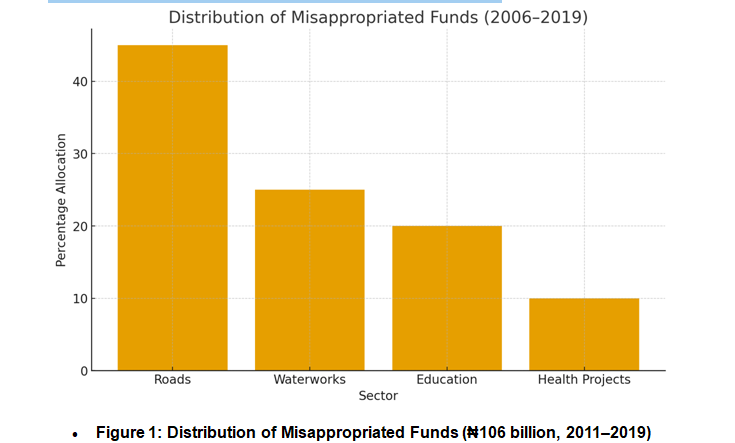
- Figure 1: Distribution of Misappropriated Funds (₦106 billion, 2011–2019)
Breaks down misappropriated sums by sector—roads, education, health, water infrastructure—exposing which domains are primary targets.
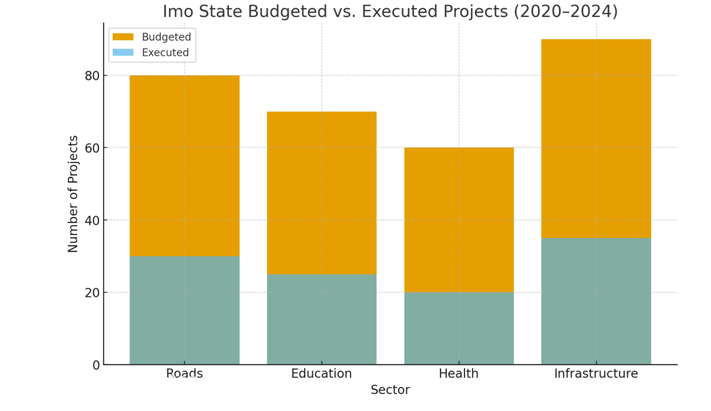
- Figure 2: Budgeted vs Verified Execution (2020–2024)
Compares what the state budgeted versus what independent monitors verify as executed work, year by year.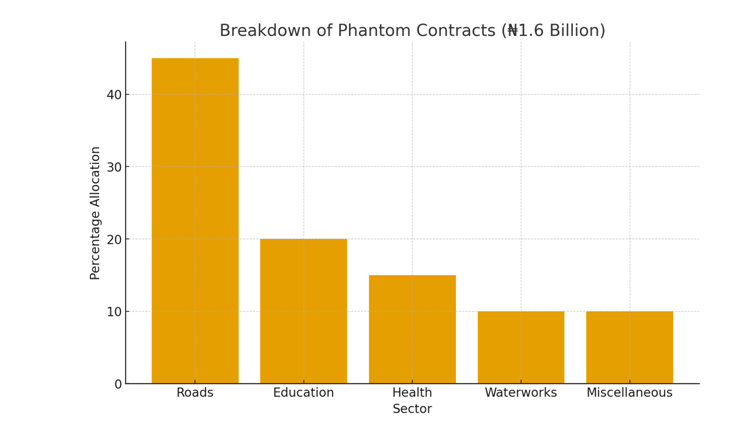
Source: Prof. MarkAnthony Nze - Figure 3: Breakdown of the ₦1.6 B Phantom Cluster
Dissects the flagged phantom contract cluster by project category and firm count.
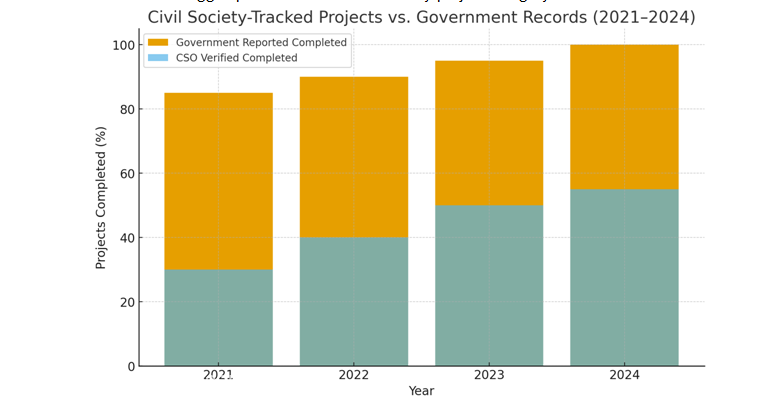
- Figure 4: Government-Claimed vs Civil Society-Tracked Projects (2021–2024)
Charts official claims of completion against what civil society actually observes in the field.
Sourced from verified reports and monitors, these visuals turn speculation into confrontation.
Pathways to Exorcism: A Reform Agenda
The ghost regime may be entrenched—but it is not permanent. These steps offer a real roadmap:
- Contract transparency. Publish every contract with beneficiaries, addresses, scope, and performance records.
- Geotagged project verification. No funds released without real-time photographic documentation.
- Independent forensic audit. Launch a nonpartisan task force to audit past ghost clusters and recover diverted funds.
- Revive legislative oversight. Empower the state assembly with subpoena powers, budget auditors, and public hearings.
- Protect whistleblowers & press. Shield civil society and journalists who expose phantom networks.
- E-procurement architecture. Deploy a digital system with public dashboards, audit trails, and traceability.
- Citizen-based project monitoring. Expand tools like TrackaNG and BudgIT into every ward for grassroots accountability.
These aren’t aspirational ideals—they are structural levers for restoring state legitimacy.
Epilogue: Ghosts Given Flesh
Hope Uzodinma’s name may persist, but ledgers last longer than slogans. Imo’s 2025 budget, like those before it, reads like a pipeline—designed to ferry billions from state coffers into phantom firms while roads remain unbuilt and clinics stay shut.
The ghosts in Imo are not mythical—they are accountants, bureaucrats, cronies, and lawmakers, complicit in a sophisticated looting engine. But with sharper investigation, courageous citizen oversight, and transparent systems, those ghosts can be named, confronted, and exorcised.
The time to act is now.
Bibliographies
The Eastern Updates. Uzodinma’s Fraud Factory: Ghost Roads, Ghost Funds. Retrieved from https://theeasternupdates.com/2025/09/29/uzodinmas-fraud-factory-ghost-roads-ghost-funds/
The Whistler. Panel Uncovers N106bn Contract Fraud in Imo. Retrieved from https://thewhistler.ng/panel-uncovers-n106bn-contract-fraud-in-imo/
Channels TV. Imo Probe Panel Indicts Ex-Governor Okorocha Of N106bn Fraud Scandal. Retrieved from https://www.channelstv.com/2020/10/06/imo-probe-panel-indicts-ex-governor-okorocha-of-n106bn-fraud-scandal/
The Street Journal. Contract awards: Panel recommends return of N1.6bn by past govts in Imo. Retrieved from https://thestreetjournal.org/contract-awards-panel-recommends-return-of-n1-6bn-by-past-govts-in-imo/
Vanguard. Okorocha wants report asking him to return N106bn published. Retrieved from https://www.vanguardngr.com/2020/10/okorocha-wants-report-asking-him-to-return-n106bn-published/