










|
Listen to article
|
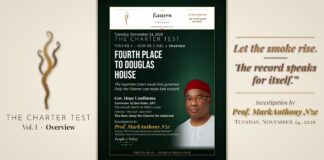
Fourth in a Field of Seventy: The Count Imo Declared on March 11, 2019, and the Divided Party That Produced It
Part 1 sets out the count INEC declared after the 2019 governorship election, candidate by candidate and local government by local government, and traces how the APC arrived at that election divided against itself, with its outgoing governor working for another party’s candidate.

Independent editorial judgment governs this series, and it is published free of charge. Right of Reply remains open to Governor Hope Uzodimma, the Imo State Government, the All Progressives Congress in Imo State and every person named.
The Line
Before the courts spoke, the voters did. They put him fourth.
In Plain English
On March 9, 2019, Imo voted for a new governor from a field of about 70 candidates. Two days later INEC declared Emeka Ihedioha of the PDP the winner with 273,404 votes. The Action Alliance’s Uche Nwosu came second, Ifeanyi Ararume of APGA third, and Hope Uzodimma of the APC fourth, with 96,458 votes and two of the 27 local government areas. Uzodimma’s own party was split: the outgoing APC governor, Rochas Okorocha, backed his son-in-law Nwosu on another party’s ticket. This part sets out that count, because every later argument about the governorship starts from it.
The Law Says
“A candidate for an election to the office of Governor of a State shall be deemed to have been duly elected where, there being two or more candidates – (a) he has the highest number of votes cast at the election; and (b) he has not less than one-quarter of all the votes cast in each of at least two-thirds of all the local government areas in the State.”
Constitution of the Federal Republic of Nigeria 1999 (as amended), s. 179(2). Exhibit A1.
Section 179(2) sets two tests: the most votes, and a quarter of the votes in at least 18 of Imo’s 27 local government areas. INEC’s returning officer declared that Emeka Ihedioha had met both. The candidate this series follows led the count in two local government areas.
Evidence Positions
- Documentedshown by constitutional text, court records or the governor’s own recorded words.
- Reportedcarried in contemporaneous Nigerian press reporting and not yet confirmed from a primary record.
- Inferencethe author’s reasoning from documented facts, marked where it begins.
- Forecastthe author’s judgment of what the record makes likely, labeled so readers can hold it to account when the primary comes.
- Counter-evidencematerial that cuts against this file’s reading, reported where found and flagged.
The Record at a Glance
Our Colors, in Our Style as Usual
Court OxbloodSolidMarks what judges decided. Read it as settled law that no appeal can disturb.
Ballot GreenSolidMarks the figures INEC declared. Set them beside the court’s order and measure the gap.
Charter GoldHatchedMarks the governor’s own pledges on the Charter. Hold him to each one by its date.
Owerri BlueDottedMarks Owerri zone’s claim and its two candidates. Weigh it against the counterclaims reported beside it.
Redaction BlackBarredMarks records sought and not obtained. Draw no inference from a gap.
Oxblood and gold are the colors of this house. Green belongs to the count, and blue answers to Imo East, the zone whose turn this series is about.
01
The Declaration Before Midnight
Shortly before midnight on Monday, March 11, 2019, Prof. Francis Otunta, the returning officer INEC appointed for the Imo governorship election, declared Emeka Ihedioha of the Peoples Democratic Party elected with 273,404 votes (Channels Television, 2019; Exhibit B1). Uche Nwosu of the Action Alliance followed with 190,364, Ifeanyi Ararume of the All Progressives Grand Alliance with 114,676 and Hope Uzodimma of the All Progressives Congress with 96,458 (The Guardian, 2019; Exhibit B2). The Guardian put the field at about 70 candidates and the count at 739,474 votes cast, of which 714,344 were valid and 25,130 were rejected. Former Governor Ikedi Ohakim, running on the Accord ticket, drew 6,846. Reported
Spread told the same story as the total. Ihedioha carried 11 of the 27 local government areas, Nwosu 10, Ararume four and Uzodimma two (The Guardian, 2019). On those figures, the man who would govern Imo ten months later finished 176,946 votes behind the winner, 93,906 behind the runner-up and 18,218 behind the candidate in third place. Plate 3 sets the five leading totals side by side. Reported; arithmetic by this file

02
A Party at War With Itself
The APC reached that election in two pieces. Governor Rochas Okorocha wanted his son-in-law, Uche Nwosu, to succeed him, and the contest split the state party into rival camps (TheCable, 2020; Exhibit B3). Ahmed Gulak, who chaired the party’s governorship primary in Imo, left his hotel room at midnight amid reported claims that Uzodimma’s opponents meant to abduct him, and declared Uzodimma the candidate that morning; the National Working Committee recognized the result. Among the aspirants Uzodimma defeated in that primary was Sir Jude Ejiogu, who polled 12,369 votes (Nze, 2026; Exhibit B5). Reported
Okorocha would not accept the outcome. In November 2018, after an Imo High Court validated Uzodimma’s candidacy, the governor advised Nwosu to take the Action Alliance ticket. He said publicly that Uzodimma could never win a free and fair election in Imo and that party members still regarded him as “a staunch member of PDP” (TheCable, 2020). That same month, the Special Presidential Investigation Panel for the Recovery of Public Property announced that it had arrested Uzodimma over a $12 million Nigerian Ports Authority contract to dredge the Calabar channel; its chairman, Okoi Obono-Obla, said the arrest had no connection with the Imo party crisis. This file reports the announcement only as part of the climate of that campaign and makes no finding on it. Reported
On paper, the two halves of the 2018 APC drew more votes than the man who won. Nwosu’s 190,364 and Uzodimma’s 96,458 come to 286,822, which is 13,418 more than Ihedioha’s total. Votes do not move whole from one candidate to another, and nobody can say how Nwosu’s supporters would have voted on a united APC ticket. The lesson for 2027 is still plain: a ruling party that splits over succession in Imo hands the office to someone else, and the courts will not always hand it back. Inference; arithmetic by this file; Forecast in final sentence
A count is a photograph, and a judgment is a ruling on what the photograph missed.
03
What the Count Left Out
Uzodimma’s quarrel with the count rested on what it omitted. His petition would claim that results from 388 polling units never reached collation and that those units had given him 213,695 votes against 1,903 for Ihedioha (Vanguard, 2020; Exhibit B4). Set against the 739,474 votes INEC declared statewide, the votes he claimed from those units alone equaled nearly 29 percent of the entire declared count. Reported; arithmetic by this file
INEC’s declaration was final only until a tribunal ruled otherwise. Nwosu, Ararume and Uzodimma each petitioned the tribunal against Ihedioha’s return, and Part 2 follows what became of those petitions. Reported
A count is a photograph, and a judgment is a ruling on what the photograph missed. The photograph of March 2019 still shows a fourth-place finish; the judgment of January 2020 changed who sits in Douglas House without changing the picture. Every argument about the Charter in 2027 will be made in front of that photograph, and a governor who remembers it is there will choose his successor with more care than one who has forgotten it. Forecast
◆
What Stands
The voters of Imo spoke first. On the count INEC declared on March 11, 2019, they placed Hope Uzodimma fourth, with 96,458 votes and two local government areas, while the governor of his own party campaigned for a rival. Everything that followed in the courts, and everything the Charter now asks of him, starts from that arithmetic.
A man who knows where he started is best placed to decide how he leaves. The governor started fourth. He can still leave first in Imo’s memory, and the Charter is how.
The Finding
On INEC’s declared count of March 11, 2019, Hope Uzodimma finished fourth of about 70 candidates, with 96,458 votes and two of 27 local government areas. The dispute that followed concerned what the count left out, not the figures it declared.
The Request
To the Independent National Electoral Commission: publish on its website the declaration of result (Form EC8D) for the 2019 Imo governorship election, together with any revised result reflecting the Supreme Court’s judgment of January 14, 2020, or state that no revised result exists.
Next: Part 2 of 15 follows the petitions: the 388 units, the police officer who carried their results into court, and the two benches that turned them away.
Trace the record. Document the evidence. Build the proof until denial has nowhere left to stand.
Evidence Docket
Class A: Legal Instruments
A1
Class B: Contemporaneous Reporting
B1
B2
B3
B4
B5
Records Not Retrieved
D1
D2
No inference is drawn from any record listed here.
Source Note. The returning officer’s surname appears as Otunta and Otonta in press reports; this series uses Otunta. Vote totals are those INEC declared, as reported by Channels Television and The Guardian. The governor’s surname appears as Uzodimma and Uzodinma; this series uses Uzodimma except in quoted headlines.
Right of Reply. Governor Hope Uzodimma, the Imo State Government, the APC in Imo State and every person named may reply at [email protected]. Replies are published in full.
Disclosure. Africa Today News New York and The Eastern Updates share common ownership under People & Polity Inc. Its reporting on Sir Jude Ejiogu is cited as this publisher’s own record and is not offered as independent corroboration.
Legal Sources and References
Legal Instruments and Cases
Constitution of the Federal Republic of Nigeria 1999 (as amended), s. 179(2).
References
Channels Television. (2019, March 11). Breaking: PDP’s Emeka Ihedioha wins Imo governorship election. https://www.channelstv.com/2019/03/11/breaking-pdps-emeka-ihedioha-wins-imo-governorship-election/
The Guardian. (2019, March 12). INEC declares PDP Emeka Ihedioha, winner of Imo Governorship Election. https://guardian.ng/?p=878218
Nze, M. (2026, October 3). Right of reply: Sir Jude Ejiogu (KSM), Ochoudo Agbaso (MFR). Africa Today News New York. https://africatodaynewsnewyork.com/2026/10/03/right-of-reply-sir-jude-ejiogu-ksm-ochoudo-agbaso-mfr/
TheCable. (2020). From Okorocha’s ‘hammer’ to trouble with SPIP: How Uzodinma fought his way to victory. https://www.thecable.ng/?p=409553
Vanguard. (2020, January 30). Imo guber: How Supreme court erred in computation of results. https://www.vanguardngr.com/2020/01/imo-guber-how-supreme-court-erred-in-computation-of-results/
 © 2026 People & Polity Inc., New York. Published by The Eastern Updates.